

table of contents
Imagine having a marketing assistant on your team who works around the clock, crunches data in seconds, and never hits a creative wall. That’s the reality of AI for small business marketing. This isn’t some futuristic tech for massive corporations anymore; it’s a real, accessible advantage for businesses of all sizes.
Your Newest Team Member: How AI Levels the Playing Field
For years, the best marketing tools and data insights felt locked away, reserved for companies with huge budgets. Small businesses were left trying to compete with little more than manual effort and a bit of guesswork. Artificial intelligence is completely changing that dynamic. It’s the great equalizer.
Think of AI as your newest, most efficient hire. It’s built to handle the tedious, time-consuming tasks that slow you down—like sifting through customer data or scheduling a month’s worth of social media posts. This frees you and your team up to focus on what humans do best: building relationships, thinking strategically, and creating truly memorable customer experiences.
Making Big Business Strategies Accessible
AI puts capabilities that were once out of reach right at your fingertips. It can analyze customer behavior to personalize every email, website visit, and ad you run, making your marketing feel more relevant and hit a lot harder. With these tools, you can finally deliver the kind of one-to-one communication that builds real, lasting loyalty.
“AI is the next step in business automation. AI can be deployed to an organization’s business process for a particular strategic purpose to increase efficiencies, cut costs and improve customer service.”
And this isn’t some distant trend—it’s happening right now. A recent survey found that around 75% of small and medium-sized businesses are already putting money into AI. It’s moving from a curious experiment to a core part of how they operate. You can see the full research on SMB AI adoption from Salesforce to understand how fast businesses are adapting.
Smart Growth Is Achievable Growth
Bringing AI into your business doesn’t have to be some massive, complicated project. You can start small. Pick a single pain point, like writer’s block for your blog or handling common customer questions, and build out from there. The whole point is to make smart, small improvements that add up to real results.
The evolution and impact of artificial intelligence on websites shows just how deeply these changes are taking hold. This guide will walk you through exactly how to get started.
Core AI Marketing Strategies You Can Use Now
Alright, let’s move past the theory. This is where AI really starts to show its muscle for small business marketing. The trick is to stop thinking about AI as one giant, scary overhaul. Instead, see it as a series of smart upgrades to the marketing channels you’re already using. It’s all about making each part of your strategy faster, sharper, and a whole lot more effective.
At its core, AI helps in three key ways: it automates the repetitive stuff, personalizes your customer interactions, and delivers insights you couldn’t see before.
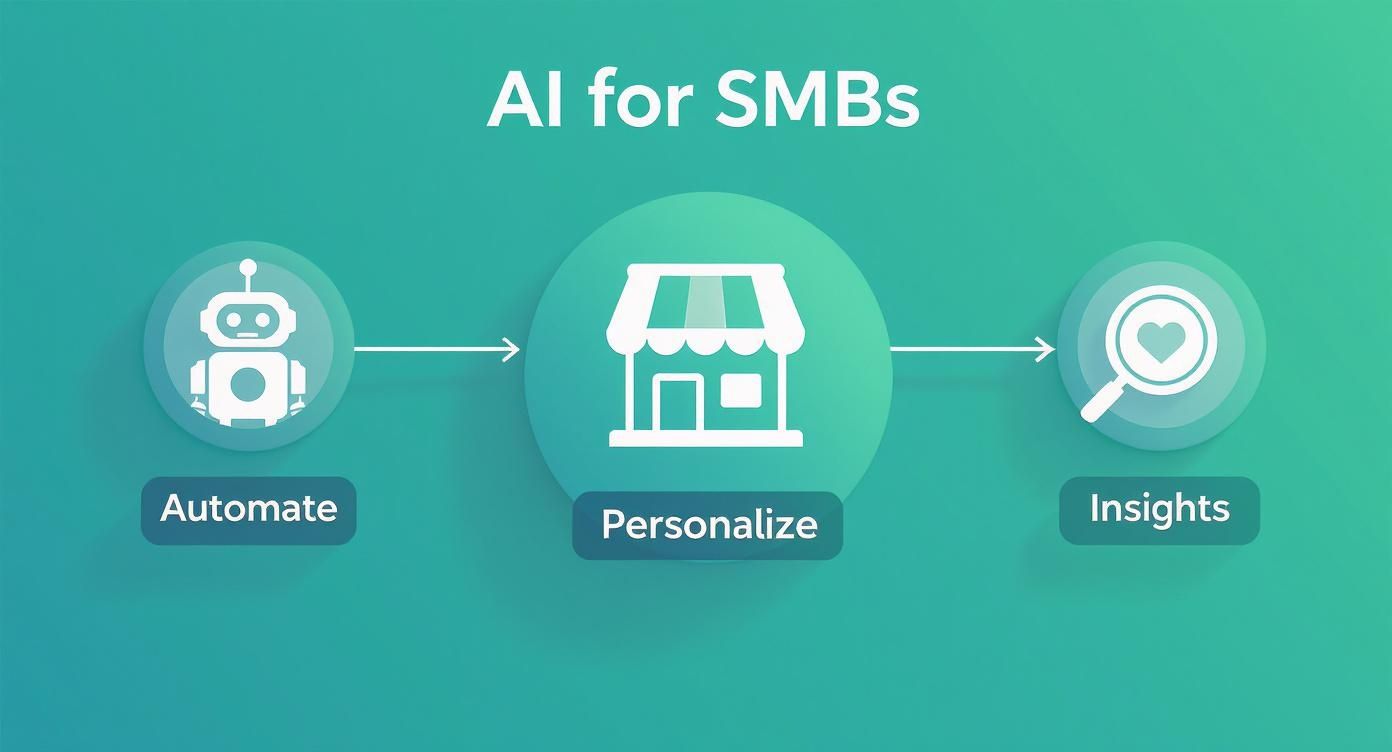
This workflow shows how these three jobs feed into each other, creating a marketing engine that gets smarter over time. Now, let’s get into the specifics of how you can put this to work.
Refine Your Local SEO and PPC Campaigns
If you run a local business, you know that showing up for nearby customers is everything. AI tools can dig into your top local competitors and pinpoint the exact keywords they’re ranking for that you’re missing. It can even whip up optimized Google Business Profile descriptions and posts, keeping your listing fresh and in front of local searchers.
And for paid ads? AI can brainstorm dozens of ad copy variations in minutes. This lets you quickly test different headlines and hooks to see what actually gets clicks, making sure every single dollar you spend on ads is working as hard as possible.
Automate and Personalize Email Marketing
Let’s be honest: generic email blasts don’t cut it anymore. AI can look at your customer data—like what they’ve bought before or what pages they clicked on your site—and automatically group them into smart segments. Think about sending an email about new running shoes only to people who have bought athletic gear in the past. That’s powerful stuff.
AI enables marketing professionals to tailor campaigns by analyzing customer behavior and preferences, delivering highly personalized experiences from product recommendations to targeted advertisements.
This kind of surgical targeting used to be reserved for corporations with massive data science teams. Now, you can do it with simple tools that suggest catchy subject lines, figure out the best time to send an email, and even write entire campaigns for specific customer groups.
Amplify Your Content and Social Media Output
One of the biggest headaches for any small business owner is the constant need for new content. AI can be an incredible creative partner here, helping you turn a single idea into a full-blown content plan.
For example, feed an AI a blog post topic, and it can help you generate:
- A solid outline: Complete with logical headings and key talking points.
- Social media posts: Multiple versions for Facebook, Instagram, and LinkedIn, hashtags included.
- An email newsletter blurb: A quick summary of the blog post to send out to your list.
With this approach, one piece of content can fuel your marketing for an entire week. You save a ton of time while keeping your message consistent across all your channels.
Optimize Your Website for Conversions
Getting people to your website is only half the job. The real win is turning those visitors into customers. This is called Conversion Rate Optimization (CRO), and AI provides some serious advantages here. AI-powered tools can analyze user recordings to show you exactly where people get confused, frustrated, or just give up and leave your site.
What’s more, AI-driven chatbots can engage with visitors 24/7. They can answer basic questions, point people to the right products, and capture leads while you’re busy running your business. It’s definitely worth checking out if chatbots for small businesses are a worthy investment for your particular setup. These tools are like having a tireless customer service agent who improves the user experience and directly impacts your sales.
Supercharge Your Content with AI Tools
Let’s be honest: content creation is a beast. For a small business, the constant need for fresh blog posts, social media updates, and newsletters can feel like a full-time job in itself. This is where AI for small business marketing stops being a buzzword and starts being a game-changer.

Think of an AI content tool as your creative partner. It’s not here to replace you, but to give your ideas a massive head start. You can toss it a simple topic, and in seconds, it can spit back outlines, draft paragraphs, or suggest new angles you hadn’t even considered.
Using AI as a Creative Partner
The real magic happens when you learn how to talk to the AI. A well-crafted prompt is everything. A vague request like “write a blog post about coffee” will get you a generic, forgettable article.
But what if you asked it to, “Write a 500-word blog post for busy professionals about the benefits of single-origin coffee, using an informative and friendly tone”? Now you’re getting somewhere. That specificity gives the AI the guardrails it needs to create something genuinely useful.
Think of it this way: AI provides the clay, but you are still the sculptor. The initial output is a starting point, not the final product. Your job is to shape it, refine it, and inject your brand’s unique personality.
This isn’t just theory; it’s happening right now. A recent report found that 67% of small businesses are already using at least one AI tool for their marketing. The numbers show 58% are using it for blog posts and 55% for social media—clear proof that it’s solving the content bottleneck problem.
Refining and Enhancing AI Content
Once the AI gives you a draft, your human expertise is what makes it shine. The goal is to elevate the content from generic to exceptional, making sure it truly connects with your audience and sounds like your brand.
Here are a few practical steps for turning that AI draft into gold:
- Fact-Check Everything: AI can sometimes get things wrong or just make them up. Always double-check any stats, names, or key claims before you hit publish.
- Inject Your Brand Voice: This is crucial. Rewrite sentences so they sound like you. Weave in personal stories, industry-specific examples, and the unique phrases your customers know and love.
- Add Human Insight: What does the AI not know? Your personal opinions, strategic advice, or firsthand experiences are what provide value no machine can replicate.
- Optimize for SEO: An AI can drop in keywords, but a human touch is still needed for smart placement, internal linking, and making sure the content actually satisfies what the searcher was looking for.
Following this collaborative process ensures the final piece is original, valuable, and authentic. Building a content strategy that works for AI search is all about blending machine efficiency with human creativity. This balanced approach lets you produce high-quality content at a scale that was once impossible for a small business.
Choosing the Right AI Tools for Your Budget
Figuring out the world of AI tools doesn’t have to be a headache, and it definitely doesn’t have to be expensive. The real trick to using AI for small business marketing is finding software that fixes a specific problem without blowing up your budget. A classic mistake is paying for some huge, all-in-one platform when a simple, free tool could have done the job just fine.
The best way forward? Start small. Pinpoint your single biggest marketing bottleneck. Is it writing blog posts? Creating social media graphics? Managing ad campaigns? Whatever it is, find a free or low-cost tool that hits that one pain point. This lets you see the benefits firsthand and build a case for it before you even think about a bigger investment.
Plenty of top-tier AI platforms offer freemium models, giving you access to the good stuff without asking for a credit card. These are perfect for just messing around and seeing what works.
Categorizing Tools by Function and Cost
To make your search easier, think about tools in two ways: what they do and what they cost. This helps you compare apples to apples and find something that fits both your immediate needs and where you want to go long-term. Breaking it down like this keeps you from wasting money on features you might not touch for months, if ever.
Here’s a practical breakdown that works for a small business budget:
- Free and Freemium: Perfect for getting your feet wet. These tools are fantastic for brainstorming content (the free version of ChatGPT), whipping up basic graphics (Canva), and catching typos (Grammarly). They’re a no-risk way to see how AI can slide into your workflow.
- Low-Cost (Under $50/month): This is where you unlock more serious features. You’ll find advanced content writers like Jasper AI, SEO tools that help you rank better like Surfer SEO, and social media schedulers that use AI to predict the best times to post.
- Premium (Investment Tier): These are the heavy hitters for specialized tasks. Think advanced competitor analysis, programmatic advertising, or comprehensive PPC management for small business. Tools in this bracket often provide deep analytics and automation that can deliver a serious return on investment.
A Simple Checklist for Evaluating AI Tools
Before you sign up for anything—even a free tool—run it through a quick gut check. Asking a few smart questions upfront ensures the software actually aligns with your goals and won’t just create more work. Your time is your most valuable asset, and the wrong tool can be a massive drain.
The right tool should feel like a natural extension of your team, automating tasks and providing insights that empower you to make smarter decisions, not complicate your processes.
Use this checklist to guide your decision:
- Problem-Solving: Does this tool solve a specific, nagging problem I have right now?
- Ease of Use: Can I figure out the basics in 15-30 minutes without pulling my hair out?
- Integration: Does it play nicely with the other software I already use, like my website or email platform?
- Scalability: If my business grows, does this tool have a clear upgrade path? Or will I be stuck?
- Support: Is there a human I can talk to, or at least good tutorials and a community forum if I get stuck?
By focusing on your immediate needs and using this simple framework, you can confidently pick AI marketing tools that deliver real value without breaking the bank.
How AI Empowers Your Team and Sparks Growth
The idea that AI is coming for your team’s jobs is one of the biggest myths floating around. The reality is pretty much the opposite—AI doesn’t replace talented people; it empowers them. Think of it as a tireless assistant, handling the repetitive, data-heavy stuff that often bogs down creativity and strategic thinking.

This simple shift lets your team focus on high-value activities that actually move the needle. When they aren’t manually scheduling social media posts or segmenting email lists, they have more time for what really matters: building genuine customer relationships, dreaming up innovative campaigns, and exploring new ways to grow. This is the human side of AI for small business marketing.
From Overwhelmed to Overachieving
Let’s look at a local bakery trying to keep up with online orders and social media chatter. The owner, Sarah, felt her small team was constantly buried in busywork instead of perfecting new recipes or chatting with customers in the shop. They were burning hours every day just answering the same questions online and manually updating their website.
By bringing in a simple AI chatbot and a content scheduling tool, Sarah’s team was instantly freed up.
- The chatbot handled 90% of routine customer questions, like store hours and allergy info.
- The AI scheduler helped them plan and automate a full month of social media content in just a couple of hours.
The result? A team that felt less stressed and more fulfilled. They could finally focus on creating a better customer experience, which directly led to a 20% increase in repeat business within three months.
This is the real power of AI. It doesn’t take over; it augments human talent, leading to better efficiency, stronger results, and sustainable growth. It’s a catalyst that expands what your team is capable of.
AI as a Catalyst for Job Growth
It might sound backward, but adopting AI often leads to hiring, not firing. Recent data shows that U.S. small businesses are quickly adopting generative AI, and the effect on their workforce has been positive. A staggering 82% of small businesses using AI actually increased their staff over the past year, proving this technology supports growth rather than replacing jobs.
You can learn more about how AI is empowering small businesses from the U.S. Chamber of Commerce in their latest report.
Common Questions About AI in Small Business Marketing
Jumping into AI can feel a bit like learning a new language, and it’s totally normal to have questions. Most small business owners I talk to are curious about the practical stuff—how much does it cost, is it hard to learn, and what kind of difference will it actually make?
Let’s clear up some of the most common concerns. Getting started with AI is more about smart strategy than big spending. Once you have these answers, you’ll be in a much better position to make AI work for you.
How Much Does AI Marketing Cost to Start?
The cost to get started with AI is surprisingly flexible. You can begin for free or with a very small monthly expense. Many of the best tools have “freemium” plans that let you test the waters without pulling out your credit card. This is the perfect way to start.
For instance, you could use a free AI writing assistant to help you get over writer’s block for blog posts or social media captions. As you get more comfortable and see the value, you might decide to upgrade to a paid plan, which often runs about $20-$50 per month for more powerful features. The trick is to pick one problem, find a low-cost tool that solves it, and see what happens before you go all in.
Will Using AI for Content Hurt My SEO?
No, using AI to help create content won’t automatically sink your SEO—as long as you’re focused on creating something genuinely useful. Search engines like Google really only care about one thing: giving people helpful, high-quality answers. How you create that content is far less important than its quality.
The real risk isn’t using AI; it’s in publishing raw, unedited AI output that sounds generic. To make AI an SEO asset, you have to treat it like a creative partner, not a replacement for your own knowledge.
Always think of AI-generated text as a first draft. Your job is to step in to edit, fact-check, and inject your brand’s unique voice and industry expertise. This human-AI partnership is the key. To go deeper on this, check out our guide on AI content versus human content and what it means for your brand. When you use it this way, AI can actually give your SEO a boost by helping you produce better content, more often.
Do I Need Technical Skills to Use AI Tools?
Absolutely not. The vast majority of AI marketing tools built for small businesses are designed to be incredibly simple and intuitive. Think clean dashboards and straightforward interfaces that require zero coding. If you can use a word processor or send an email, you’ve got this.
Most of these platforms also offer a ton of support to get you going:
- Step-by-step tutorials walk you through all the important features.
- Pre-built templates are available for common tasks like writing ad copy or email campaigns.
- Responsive customer support is usually just a click away to help with any questions.
These tools were created to make marketing easier, not to add another technical headache to your list.
What Is the Best Way to Start with AI Marketing?
The single best way to begin is to find your biggest marketing bottleneck—that one task that eats up all your time or that you just can’t stand doing—and find an AI tool that solves that specific problem. Don’t try to change everything at once. Focus on scoring one quick win to see the benefits for yourself.
Struggling to keep your blog updated? Start with an AI writing assistant. Is social media management draining your energy? Look into an AI-powered scheduler that can also help you brainstorm post ideas. By zeroing in on one high-impact area, you’ll learn the ropes in a practical way and see a real return on your time. That first win will build your confidence and give you a clear reason to explore what else AI can do for your business.
At Netco Design LLC, we specialize in integrating smart, practical marketing solutions that drive real growth for small businesses. If you’re ready to see how a tailored strategy can elevate your digital presence, we’re here to help. Visit us at https://netcodesign.com to learn more.

