

table of contents
When we talk about content marketing ROI, we’re really asking one simple question: is the money you spend on content actually making you more money in return? It’s the ultimate proof that your blog posts, videos, and social media updates are fueling real business growth, not just making noise online. Get this right, and marketing shifts from being a cost center to a profit driver.
What Exactly Is Content Marketing ROI and Why It Matters
Most business owners get the ROI on a paid ad. You put a dollar in, you get two dollars back. Simple.
But trying to pin a dollar value on a blog post? That can feel like trying to catch smoke. How do you track the journey of a reader who finds your article, signs up for your newsletter, and then, six months down the road, finally becomes a paying customer?
This gray area leads a lot of businesses to throw their hands up and either stop tracking content marketing ROI altogether or just write it off as a “soft” marketing tactic. That’s a huge mistake. Content isn’t just a short-term expense; it’s a long-term asset that quietly builds value over time.

The Fruit Tree Versus The Grocery Store
Think of paid advertising like buying apples at the grocery store. You need fruit, you pay for it, and you get it right away. But the moment you stop paying, the apples stop coming. It’s a purely transactional relationship that requires constant cash flow.
Content marketing, on the other hand, is like planting an apple tree. It takes some upfront work—tilling the soil (research), planting the seed (creation), and watering it (promotion). For a little while, you might not see any fruit at all. But if you keep caring for it, that tree grows strong and starts producing apples year after year, with very little ongoing effort.
Every new article you publish is another tree in your orchard, creating a sustainable source of leads and sales.
Content marketing is the closest thing to compound interest in marketing. An article you publish today can continue to attract qualified leads and customers for months, or even years, after you’ve paid for it.
Why Tracking ROI Is Non-Negotiable
For small and mid-sized businesses especially, tracking your content ROI is absolutely critical. It gives you the clarity to make smart decisions and prove the value of your marketing efforts—whether it’s to your boss, your investors, or just yourself. Figuring out what works is the foundation of any good content marketing strategy for small business.
Here’s why it’s so important:
- Smarter Budget Allocation: When you know which blog posts or videos are bringing in the most customers, you can confidently double down on what’s working and stop wasting money on what isn’t.
- Proving Marketing’s Value: Hard ROI numbers transform marketing from a department that “spends money” into one that “makes money.” This makes it much easier to justify your budget and ask for more resources.
- Strategic Decision-Making: Data-backed insights help you refine everything from your topics and formats to your promotion channels, ensuring you’re creating content that truly serves your audience and hits your business goals.
Ultimately, measuring your content’s return is how you build a predictable growth engine for your business. For a closer look at tying your efforts to tangible results, check out this guide on how to actually prove ROI on social media.
The Essential Formulas for Calculating Content Marketing ROI
So, how do you really know if your content is pulling its weight? To truly grasp your content marketing ROI, you have to turn fuzzy ideas like “brand awareness” and “engagement” into cold, hard numbers. While it might sound intimidating, the math behind it is surprisingly straightforward. It all boils down to a classic formula that pits what you gained against what you spent.
The most universal formula for calculating return on investment is a simple percentage:
ROI = [ (Return – Investment) / Investment ] x 100
This little equation gives you a clear percentage that shows your profit (or loss) in relation to your costs. A positive number? You’re in the black. A negative number? Time to reassess, because your spending is outpacing your earnings. The real trick isn’t the formula itself—it’s figuring out exactly what to toss into the “Return” and “Investment” buckets.
Breaking Down Your Total Investment
Before you can even think about a return, you need an honest accounting of every single dollar you’ve put in. A common mistake is only counting the obvious stuff, like the invoice from a freelance writer. To get a true picture of your content marketing ROI, you have to be much more thorough.
Think about all these cost categories:
- Content Creation Costs: This is everything from payments to writers, graphic designers, and videographers to editors. If your team is in-house, you need to calculate the slice of their salaries that goes toward creating content.
- Tools and Software: Don’t let those monthly or annual subscriptions slip through the cracks. This includes your SEO software (like Ahrefs or Semrush), analytics platforms, email marketing services, and social media schedulers.
- Promotional Expenses: Any money you spend getting eyes on your content belongs here. Think paid social media ads, search engine marketing (PPC) campaigns, or fees for sponsored posts.
- Employee Time: Remember, time is money. Figure out the hourly rate for team members involved in content strategy, management, and promotion, then multiply it by the hours they dedicate to these tasks each month.
Add all that up, and you’ve got the “Investment” side of your ROI equation nailed down.
How to Calculate Your Return
Figuring out the “Return” is where most people get stuck, but it doesn’t have to be a roadblock. You can start simple and add more layers of detail as your tracking gets better. The main goal is to assign a dollar value to the results your content drives.
For a straightforward approach—perfect if you’re just starting to track this—focus on direct revenue. If a customer clicks a “Buy Now” link in a blog post and completes a purchase, that’s a clean, direct return. You can track this with UTM parameters and analytics tools that draw a straight line from a piece of content to a conversion.
But let’s be real, not all returns are that direct. A more complete approach means assigning value to conversions that aren’t cash in hand just yet, like leads.
Example: Valuing a Lead
Let’s imagine your sales team closes 10% of all leads from your website into paying customers, and your average customer lifetime value (CLV) is $2,000.
- Lead Value Calculation: 10% of $2,000 = $200
- This means every new lead your content generates is worth an estimated $200 to your business.
By giving leads a dollar value, you can measure the return from content that fills your pipeline with high-value prospects, even if it doesn’t lead to an immediate sale. For a more detailed breakdown, you might find our guide on how to calculate marketing ROI helpful.
This data-driven mindset is what separates successful campaigns from expensive hobbies. And the numbers back it up: content marketing is one of the most cost-effective strategies out there, generating an average of $3 for every $1 invested. That’s a 200% return, which blows most paid advertising out of the water. To dig even deeper, check out this comprehensive guide on how to calculate content marketing ROI and maximize your return.
Key Performance Indicators You Must Track
Figuring out your final content marketing ROI is the destination, but Key Performance Indicators (KPIs) are the road signs that tell you if you’re actually on the right path. Tracking these metrics helps you see how your content is performing long before the final revenue numbers roll in.
Think of it like baking a cake. Your ROI is the finished product, but the KPIs are the individual ingredients. You have to measure each one correctly—the flour, the sugar, the eggs—to get the final recipe just right.
Without keeping an eye on these indicators, you’re flying blind. You won’t know if your audience is growing, if they care about what you’re saying, or if they’re taking the steps that lead to a sale. Let’s break down the essential KPIs into four categories that perfectly map to the customer journey.
Traffic Metrics: Are People Showing Up?
Before your content can convert anyone, people have to see it. Traffic metrics tell you how many people are finding your content and where they’re coming from. These are your top-of-funnel indicators, measuring brand visibility and audience growth.
- Organic Traffic: This is the number of visitors who land on your website from a search engine like Google. It’s a huge indicator of your SEO success and the bedrock of long-term content ROI. Why? Because this traffic is essentially free.
- Unique Visitors: This KPI tracks the number of distinct individuals who visit your site over a certain period. A steadily rising number of unique visitors is a clear signal that you’re expanding your reach and pulling new potential customers into your orbit.
- Time on Page: This metric shows the average amount of time someone spends on a specific piece of content. A high time on page suggests your content is genuinely engaging and relevant. You’ve captured their attention, which is the crucial first step toward building trust.
Engagement Metrics: Does Your Audience Actually Care?
Okay, so you have traffic. The next big question is: do they care? Engagement metrics reveal how your audience is interacting with what you’ve created. High engagement is a powerful sign that you’re building a loyal community, not just attracting one-off visitors.
These metrics are the bridge between awareness and conversion.
Strong engagement is the difference between an audience and a community. An audience listens, but a community talks back, shares your message, and becomes a powerful extension of your marketing team.
Key engagement KPIs to watch:
- Social Shares: When a reader shares your content on platforms like LinkedIn, Facebook, or X, they’re giving it a personal stamp of approval. This doesn’t just expand your reach to their network; it adds a valuable layer of social proof.
- Comments: Comments on blog posts or social media mean your content has sparked a real conversation. This qualitative feedback is gold for understanding your audience’s pain points and interests.
- Backlinks: A backlink is when another reputable website links to your content. Search engines see backlinks as votes of confidence, which significantly boosts your SEO authority and drives high-quality referral traffic. Every new backlink makes your content a more valuable asset over time.
Conversion Metrics: Are People Taking Action?
This is where your content starts to generate real business value. Conversion metrics track how well your content persuades people to take a specific, desired action, moving them from passive readers to active leads.
Knowing what drives these actions is critical, and you can dig deeper into what conversion rate is in marketing to really sharpen your strategy.
- Lead Generation: This measures how many new contacts you get through your content, whether from newsletter sign-ups, ebook downloads, or webinar registrations. Every single lead represents a potential future customer.
- Conversion Rate: This is the percentage of visitors who complete a desired action, like filling out a form. A high conversion rate means your content and calls-to-action are hitting the mark and are perfectly aligned with what your user wants.
- Customer Acquisition Cost (CAC): While often seen as a sales metric, tracking CAC by content channel helps you understand how efficiently your investment is turning into customers. A low CAC from content marketing is a massive indicator of high ROI.
Revenue Metrics: Is Your Content Making Money?
Finally, we get to the bottom line. Revenue metrics draw the clearest possible line between your content efforts and your bank account. These are the ultimate proof of your content marketing ROI, showing exactly how your content contributes to sales.
- Sales: The most direct metric of them all. This tracks the revenue generated from customers who converted through a specific piece of content. Using tracking tools like UTM parameters is a great way to attribute sales directly.
- Customer Lifetime Value (CLV): This KPI measures the total revenue a business can expect from a single customer over their entire relationship with you. Content often attracts higher-quality leads who become more loyal customers, leading to a much higher CLV.
To help you keep track, here is a quick summary of the most important KPIs and what they tell you at each stage of the marketing funnel.
Essential KPIs for Measuring Content Marketing Success
Traffic Metrics:
- Organic Traffic: Measures visitors from search engines, showing SEO effectiveness and “free” traffic growth.
- Unique Visitors: Measures the number of distinct individuals visiting, indicating audience reach.
- Time on Page: Measures the average time a user stays on a page, signaling content quality.
Engagement Metrics:
- Social Shares: Measures how often content is shared, indicating virality and social proof.
- Comments: Measures user feedback, providing valuable qualitative insights.
- Backlinks: Measures links from other sites, which boosts SEO authority and referral traffic.
Conversion Metrics:
- Lead Generation: Measures new contacts acquired, which fills the sales pipeline.
- Conversion Rate: Measures the percentage of visitors taking a desired action, showing content’s persuasive power.
Revenue Metrics:
- Sales: Measures direct revenue from content, the ultimate proof of financial impact.
- Customer Lifetime Value (CLV): Measures total revenue from a customer, showing content’s role in attracting high-value customers.
By tracking these KPIs, you move from guessing to knowing. You can see exactly what’s working, what isn’t, and where to invest your resources for the biggest impact.
A Step-By-Step Workflow for Measuring Your ROI
Knowing the formulas is one thing, but actually putting them to work is how you get results. Let’s walk through a repeatable process for measuring your content marketing ROI from start to finish. This workflow will help you turn abstract data into a clear story about what’s working and what’s not.
To make it real, we’ll follow a hypothetical home services company in St. Petersburg, Florida. Let’s call them “Sunshine Home Services.”
Step 1: Set Clear Content Goals
You can’t measure success if you haven’t defined it. Vague goals like “get more traffic” just won’t cut it. You need goals that are specific, measurable, achievable, relevant, and time-bound (SMART).
For Sunshine Home Services, a solid goal would be: “Generate 50 qualified leads for kitchen remodels through our blog content in the next quarter.”
This goal is brilliant because it’s tied directly to a high-value service, gives them a specific number to hit, and sets a clear deadline. That kind of clarity makes tracking ROI a whole lot easier down the line.
Step 2: Track Your Content Investment Costs
Next, you need to get a handle on exactly what you’re spending. This goes way beyond just the cost of writing an article. You have to account for every single resource that went into creating and promoting your content.
For their kitchen remodel campaign, Sunshine Home Services needs to add up:
- Creation Costs: $800 for four in-depth blog posts from a freelance expert who knows the industry.
- Design Costs: $200 for some custom graphics and a handy downloadable kitchen planning checklist.
- Promotion Costs: $300 for a targeted social media ad campaign to get the right eyeballs on their new posts.
- Employee Time: $200 for their marketing manager’s time spent on planning and managing the project.
That brings their total investment for this quarterly push to $1,500. Having this concrete number is non-negotiable for the final calculation.
This is the classic flow we’re trying to measure—from getting people’s attention to turning that attention into revenue.
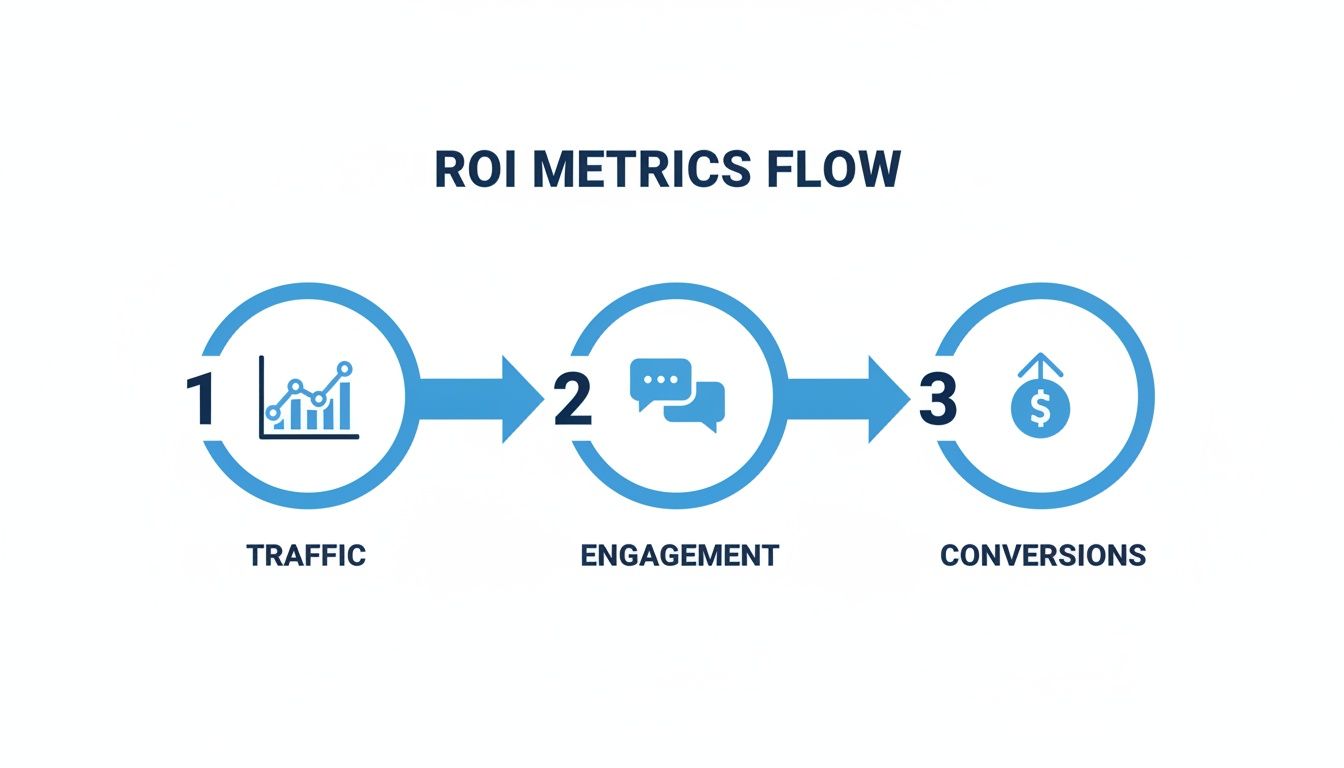
As you can see, each stage—traffic, engagement, and conversions—builds on the last one to create a measurable financial return.
Step 3: Implement Analytics and Tracking Tools
If you don’t track it, you can’t measure it. Period. Setting up the right tools is the only way to connect your content to actual business results. The good news is you don’t need a complicated or expensive tech stack to get started.
Most businesses can get everything they need from a few key platforms:
- Google Analytics: Your go-to for tracking website traffic, seeing how people behave on your site, and monitoring goal completions (like when someone fills out a form).
- CRM (Customer Relationship Management): This is where you’ll manage your leads and watch their journey from their very first click to the final sale.
- UTM Parameters: These are just simple tags you add to your URLs. They act like little breadcrumbs, telling your analytics tools exactly where your traffic is coming from.
Sunshine Home Services makes sure every link in their social media ads and every call-to-action in their blog posts has specific UTM tags. That way, when a new lead comes in, they know with certainty that it started with their kitchen remodel content. For a deeper dive into organizing these efforts, check out our guide on how to create a content calendar.
Step 4: Attribute Leads and Sales to Specific Content
This is where all that tracking pays off. Attribution is how you connect a conversion—whether it’s a lead or a sale—back to the specific blog post or ad that brought them in. It’s how you prove your content is actually making you money.
Attribution bridges the gap between your content creation and your revenue generation. It turns your analytics data into a story about what marketing actions are truly driving business growth.
At the end of the quarter, Sunshine Home Services dives into their CRM. Thanks to their careful tracking, they see that 60 people downloaded the kitchen planning checklist. Better yet, they can confirm that 45 of those leads came directly from their new blog content.
Step 5: Calculate and Report on ROI Periodically
Alright, it’s crunch time. This is where you do the math and see how you did. This shouldn’t be a one-off task; make it a regular part of your marketing rhythm, whether that’s monthly or quarterly.
Sunshine’s sales team is good—they convert 10% of the leads from content into paying customers. Each kitchen remodel project brings in an average profit of $5,000.
- Leads Generated: 45
- New Customers: 45 leads x 10% conversion rate = 4.5 customers (we’ll round down to 4 for this example)
- Total Return: 4 customers x $5,000 profit = $20,000
- Total Investment: $1,500
Now, they just plug these numbers into the ROI formula:
ROI = [ ($20,000 – $1,500) / $1,500 ] x 100 = 1,233%
Reporting a jaw-dropping 1,233% ROI gives Sunshine Home Services undeniable proof that their content is a powerful revenue engine. It justifies future marketing spend and gives them the confidence to double down on what’s working.
Strategies to Improve Your Content Marketing ROI
Measuring your content marketing ROI is a great start, but the real magic happens when you start improving it. Once you’ve got a baseline, you can make strategic tweaks that squeeze more value out of every dollar you spend. Boosting your return isn’t just about churning out more content; it’s about making your content work smarter and harder for you.
The good news? Small, focused changes can lead to huge gains. By refining your approach, you can attract better traffic, generate more qualified leads, and drive more sales—often without touching your marketing budget.
Optimize and Refresh Existing Content
One of the most efficient ways to boost ROI is to look at what you’ve already created. So many businesses have a goldmine of older blog posts that are just sitting there, underperforming but full of potential. Instead of letting them collect digital dust, a content refresh can breathe new life into them.
A refresh is all about updating old content with new information, stats, and examples to make it relevant again. This process usually includes beefing up the on-page SEO, adding new graphics, and double-checking that all the information is still accurate and competitive. This strategy almost always delivers results much faster than creating a brand-new piece from scratch.
Your best-performing content from two years ago is a goldmine. Updating it with fresh insights not only makes it valuable to new readers but also signals to search engines that it deserves to maintain its high ranking.
Here are a few quick wins for your next content refresh:
- Update statistics and data: Swap out old numbers with the most current figures you can find.
- Add new internal links: Connect your refreshed article to newer, relevant content on your site. This helps with both user navigation and SEO.
- Improve the intro and conclusion: Rewrite the opening to immediately hook new readers and update the conclusion with a much stronger call-to-action.
Focus on High-Conversion Topics
Let’s be honest—not all content is created equal. Some topics naturally attract people who are much closer to making a purchase. To really move the needle on your content marketing ROI, you have to identify and prioritize these high-conversion topics by getting inside your user’s head and understanding their intent.
Instead of only chasing broad, top-of-funnel keywords, dig deeper to find terms that signal someone is ready to buy. These often include words like “best,” “review,” “vs,” or specific questions about your product. Creating content that directly answers these queries pulls in pre-qualified customers who are actively looking for a solution just like yours. This is a core part of our SEO services at Netco Design, where we help clients capture traffic that’s ready to convert.
Strengthen Your Calls-to-Action
Even the most amazing piece of content will fall flat if it doesn’t guide the reader on what to do next. A weak or nonexistent call-to-action (CTA) is a massive missed opportunity. Every single piece of content should have a clear purpose and a CTA that perfectly aligns with that goal.
Your CTAs need to be specific, compelling, and super relevant to what the user just read. Instead of a generic “Contact Us,” try something more targeted, like “Download Your Free Kitchen Planning Checklist” on a blog post about kitchen remodels. It’s a simple change that can dramatically lift your conversion rates.
The financial upside here is undeniable. In fact, content marketing costs about 62% less than traditional outbound marketing while generating roughly 3 times as many leads. By optimizing your content to capture those leads effectively, you amplify an already powerful advantage. You can find more insights about effective lead generation strategies at Martal.ca.
Essential Tools and Templates for ROI Tracking
Putting a system in place to measure your content marketing ROI shouldn’t be complicated or expensive. You don’t need a massive software budget to get started. In fact, a handful of powerful—and often free—tools can give you all the data you need to connect your content efforts to real business outcomes.

The key is to build a simple, reliable tech stack. What you want is a clear view of the customer journey, from their first click all the way to their final purchase. With the right setup, you can stop guessing and start making data-driven decisions that actually improve your return.
Your Foundational Toolkit
For most small and mid-sized businesses, just a few core tools are all it takes to build a robust tracking workflow. These platforms work together, giving you a complete picture of your content’s performance and its direct impact on your bottom line.
Here’s your essential starter pack:
- Google Analytics: This is your command center for understanding website traffic. It tells you who’s visiting your site, which blog posts they’re reading, and how they’re converting on key goals like form submissions or newsletter sign-ups.
- Google Search Console: Think of this as your direct line to Google’s search engine. It reveals which keywords are driving organic traffic to your content, helping you see what topics are truly resonating with your audience.
- A Basic CRM: A Customer Relationship Management (CRM) system, like the free version of HubSpot, is where you connect the dots between content and sales. It lets you track individual leads and see exactly which articles or guides they interacted with before becoming a customer.
This simple combination gives you the power to follow a lead from the moment they discover your blog post all the way through to the final sale, making attribution refreshingly straightforward.
A Practical ROI Tracking Template
To tie all this data together, nothing beats a well-organized spreadsheet. A dedicated template ensures you track the same metrics consistently every month, making it easy to spot trends and calculate your return over time. It transforms all that raw data into a clear performance dashboard.
A simple spreadsheet is often the most powerful tool for an SMB. It forces you to focus on the essential metrics, turning complex data into a clear, actionable summary of your content’s financial performance.
Your template should act as your single source of truth for content marketing ROI. It’s where your investment costs meet your performance metrics to reveal the final calculation. An effective template, built in something as simple as Google Sheets, should have distinct sections to track all the critical parts of your ROI formula. For those looking to present this data effectively, our guide on creating a professional SEO audit report format offers valuable insights on structuring your findings.
Key Fields for Your Template
Your spreadsheet should be easy to update and understand at a glance. Here are the must-have fields to include for a comprehensive monthly snapshot:
1. Investment Costs:
- Content Creation: Total spent on writers, designers, etc.
- Tools & Software: Monthly cost of your marketing software stack.
- Promotional Spend: Any budget used for ads or content promotion.
- Team Time: The calculated cost of employee hours.
- Total Monthly Investment: A sum of all the above costs.
2. Performance & Return:
- Organic Traffic: Total visitors from search engines.
- Leads Generated: Number of new contacts from content (e.g., form fills).
- Customers Acquired: Total new customers attributed to content.
- Total Revenue: The total sales value from those new customers.
3. The Final Calculation:
- ROI (%): The result of your
((Return - Investment) / Investment) x 100formula.
By updating this simple document each month, you create a powerful historical record of your content’s value. It empowers you to make smarter investments and, most importantly, prove the worth of your marketing strategy.
Still Have Questions About Content Marketing ROI?
Even with a solid plan, measuring content marketing ROI can feel a bit murky. Let’s clear up some of the most common questions and hurdles so you can track your return with confidence.
How Long Does It Take to See Content Marketing ROI?
This is the big one, and the honest answer is: it takes patience. Content marketing isn’t like flipping a switch on a paid ad campaign where you see results almost instantly. It’s a long-term play.
You’ll likely spot early wins—like a bump in traffic or more social media engagement—within 3 to 6 months. But a significant, measurable financial return? That usually takes 6 to 12 months, sometimes even longer. Think of it like planting a tree; it needs time to grow roots, build authority with search engines, and nurture visitors into loyal customers.
What If My Content Doesn’t Generate Direct Sales?
That’s perfectly normal. In fact, most content isn’t designed to land a sale on the first click. Its real power is in building brand awareness, earning trust, and guiding potential customers along their journey.
If your content doesn’t lead directly to a sale, its value lies in the journey it creates. Measure its success by tracking lead generation, newsletter sign-ups, or demo requests. Each of these actions has a tangible value that contributes to your overall ROI.
A blog post that brings in a new email subscriber might not be a sale today, but it’s a valuable lead for tomorrow.
Can I Measure ROI Without Expensive Tools?
Absolutely. While fancy analytics platforms are great, you can build a surprisingly powerful tracking system using free tools you probably already have access to.
Google Analytics and Google Search Console are your best friends here. They give you all the essential data on your website traffic, user behavior, and keyword performance. Pair that with a simple spreadsheet to log your costs and track conversions, and you’ve got everything you need to calculate an accurate content marketing ROI. The most important thing isn’t the cost of your software—it’s being consistent with your tracking.
Ready to stop guessing and start building a content strategy that delivers measurable results? Netco Design LLC specializes in creating and optimizing content that attracts pre-qualified customers and drives real growth. Find out how we can elevate your digital presence.

