

table of contents
You usually start with one obvious competitor.
A client names the company they keep losing bids to, or points to the site that always outranks them for a core service. That’s a useful starting point, but it’s rarely the full market. The sites that steal search visibility, pull referral traffic, attract industry links, and shape customer expectations often extend well beyond the two or three brands everyone already knows.
That’s why I treat the effort to find similar websites as a market-mapping exercise, not a quick lookup. The goal isn’t just to build a longer competitor list. It’s to identify the websites that influence your pipeline, your rankings, your content strategy, and your conversion benchmarks. Once you do that well, decisions get easier. You stop guessing which topics matter, which offers are standard, and which rivals are worth tracking.
Why Finding Similar Websites Matters for Your Business
A small business owner usually notices the problem before they know how to name it. Their site looks fine. Their services are clear. Leads still feel inconsistent, and organic traffic doesn’t line up with the quality of the business. When I dig in, the issue is often simple. They’re comparing themselves to the wrong websites.
The websites that matter aren’t always the ones with the same logo style, the same city, or the same service menu. Some are direct competitors. Others are indirect players that own informational search intent, dominate referral channels, or shape how buyers evaluate options before they ever request a quote.
Similar sites reveal the real market
When you find similar websites the right way, you get a clearer view of who is competing for attention. That affects more than SEO.
A strong list helps you:
- Sharpen SEO priorities by showing which domains repeatedly appear for the same topics and search intent
- Improve website strategy by exposing common page structures, offers, and user flows in your category
- Spot partnership angles through publisher relationships, directory placements, and referral patterns
- Benchmark realistically instead of measuring your site against businesses that serve a different segment
For businesses doing structured competitor review, a resource on benchmarking with competitors can help frame what to compare after the discovery stage.
The first useful output isn’t a spreadsheet full of domains. It’s a cleaner definition of your market.
The business value goes beyond rankings
I’ve seen service businesses assume they were losing to local firms, when most of the search demand was being intercepted by national content sites and lead-gen publishers. I’ve also seen e-commerce brands focus on large retailers while smaller niche stores effectively owned the long-tail queries that drove conversions.
That’s why similar-site research matters. It changes who you watch, what you publish, where you seek links, and how you position your offer. Done well, it becomes the foundation for lead generation, content planning, and smarter design decisions.
Start with Simple Search Engine Techniques
You don’t need a paid tool to get started. A search bar can uncover a surprisingly useful first draft of your competitive environment, especially when you’re validating a niche or starting work with a new client.
Use the obvious operator, but don’t stop there
Google’s related: operator is often the first thing tried. It can still be useful for quick exploration.
Try searches like:
related:example.comfor a fast look at domains Google considers similarsite:example.com "service name"to see how a competitor structures topic coverage"primary keyword" "city"to identify direct local competitors"best [service or product type]"to find review sites, affiliate publishers, and comparison pagesintitle:[keyword]orinurl:[keyword]to surface niche players with focused relevance
The operator is helpful, but it has limits. It won’t give you a clean market map by itself, and it can miss important adjacent competitors. That’s why I use it as a prompt, not a conclusion.
If your team needs a refresher on query syntax, this guide to search operators is a practical reference.
Search for the keyword set, not just the brand
The better method is manual. Search the core terms your buyers would use, then document which domains appear repeatedly across:
- Commercial queries such as service and category terms
- Informational queries tied to problem awareness
- Comparison queries where buyers evaluate providers or platforms
- Local queries if geography matters to conversion
What you’re looking for is repetition. If the same domain keeps showing up across different intent types, it belongs on your watch list.
Practical rule: A true competitor usually overlaps with you in topic, audience intent, and conversion path. If only one of those lines up, keep it on a secondary list.
Check the SERP features and page types
Don’t just note the domain. Note the page model. Is Google surfacing service pages, blog articles, category pages, local listings, or review content? That tells you what kind of asset is winning visibility.
I usually keep a quick worksheet with:
- Domain type such as direct business, publisher, marketplace, or directory
- Primary intent served like transactional or informational
- Page format including landing page, guide, location page, or product grid
- Observed offer such as consultation, demo, quote, trial, or direct purchase
This is also the stage where people over-trust traffic screenshots from browser extensions. Be careful. Similarity and competitor tools rely on estimated data built from sources such as browser panels, third-party providers, and public data, and they commonly surface metrics like total visits, unique visitors, pages per visit, average visit duration, bounce rate, traffic sources, and top keywords rather than publisher-reported counts, as explained in this overview of Similarweb-style traffic tools.
That doesn’t make the data useless. It means you should use it for direction, not blind certainty.
Use Dedicated Tools for Deeper Traffic Analysis
Once the manual search phase gives you a seed list, dedicated platforms help you separate obvious competitors from meaningful ones. At this point, website similarity becomes useful as an operational workflow rather than a loose idea.
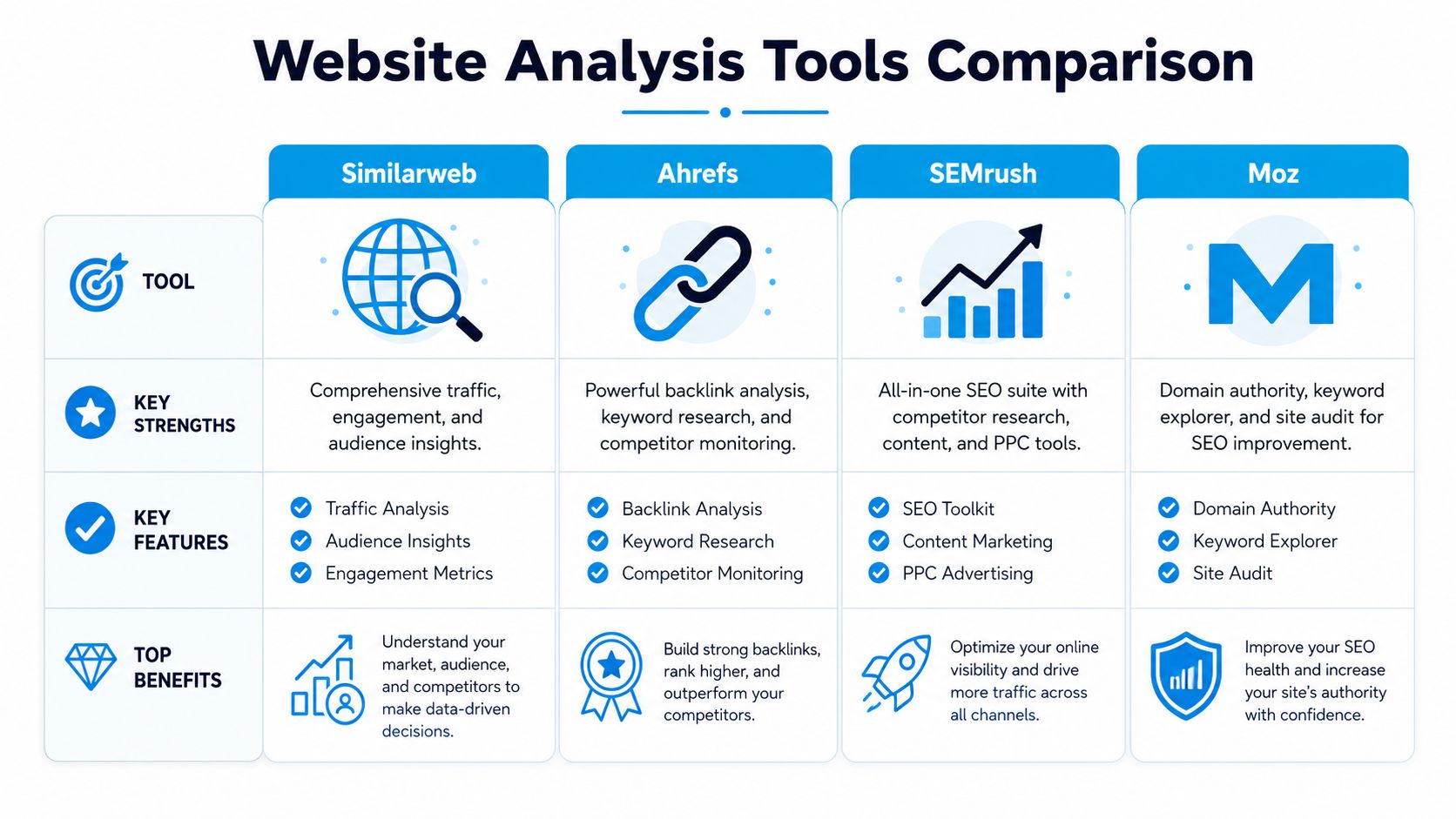
What to pull from each platform
Different tools answer different questions.
Similarweb is useful when you want a broader view of audience and traffic behavior. Its documented Similar Sites feature can uncover up to 40 domains related to a site and lets users compare up to 5 domains at once in the website analysis workflow, which makes it practical for market mapping rather than one-to-one comparison, according to Similarweb’s Similar Sites documentation.
Ahrefs is stronger when the job is keyword overlap, backlink discovery, and identifying content competitors that don’t look obvious on the surface.
SEMrush is useful for pulling together competing domains, keyword gaps, and paid-search context in one place.
Moz can help with domain-level SEO review and topic targeting, especially when you want a lighter research stack.
For companies that also need a quick business-level snapshot alongside website data, I sometimes use tools that can analyze target companies to add context around the organization behind the domain. That matters when you’re deciding whether a site is a direct rival, a publisher, or a potential partner.
What actually indicates a real competitor
The dashboard is full of numbers and charts. Most of them are only helpful if you connect them to a business question.
Focus on these signals:
- Traffic source mix because two domains may rank for similar terms but rely on very different acquisition channels
- Top keywords and top pages because they show what demand the site captures
- Referral patterns because they reveal partnerships, directories, affiliates, and media relationships
- Engagement indicators because they can hint at whether the audience is aligned or accidental
A lot of teams stop at “these sites look similar.” That’s the wrong threshold. What matters is whether they compete for the same audience and intent.
Build tiers instead of one giant competitor list
I recommend splitting discovered domains into three groups.
- Tier one direct competitors are businesses selling a similar offer to a similar audience.
- Tier two search competitors are sites competing for search visibility but not necessarily for the final sale.
- Tier three adjacent opportunities are publishers, associations, directories, and partner candidates.
This keeps your analysis usable. Otherwise, teams mix direct rivals with content publishers and then wonder why benchmarks feel inconsistent.
If you’re comparing platforms and trying to choose a practical stack, this list of SEO tools for small businesses is a useful starting point. Netco Design LLC also offers SEO-focused website and visibility work for businesses that need implementation support after the research phase.
Uncover Competitors via Backlink and Content Gaps
The best discoveries usually come from association. If trusted sites, directories, publishers, and resource pages keep linking to the same cluster of domains, that cluster tells you something about the market.
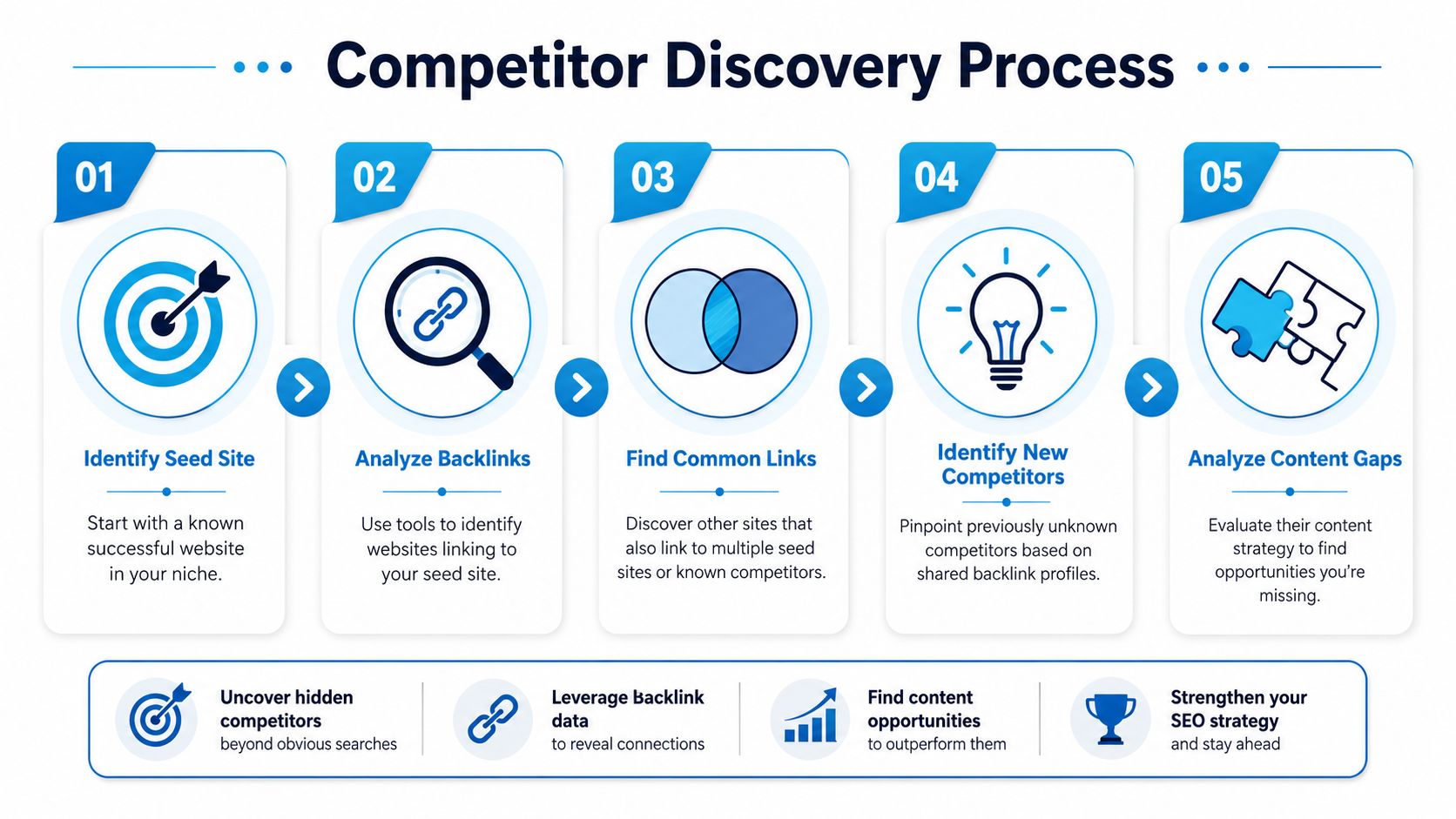
Find competitors through shared link patterns
Start with one known site in your niche. Pull its referring domains in Ahrefs, Semrush, or another backlink tool. Then repeat the process for two or three other known players.
What you’re looking for isn’t every link. It’s overlap.
Domains become interesting when they appear in patterns like these:
- Shared editorial coverage where the same publications cite multiple competitors
- Industry directories that list several comparable companies in the same category
- Resource pages linking to a cluster of solution providers
- Niche blogs and associations that repeatedly reference the same set of brands
When a domain shows up across several competitor backlink profiles, review it. Sometimes it’s just a directory. Sometimes it’s a publisher. Sometimes it’s a competitor you hadn’t considered because they target a slightly different angle.
Use content gaps to surface hidden rivals
Content gap analysis does more than generate topic ideas. It also reveals who owns the keyword territory around your offer.
Run a gap analysis between your site and a few known competitors. Then ask:
- Which domains rank for the same cluster of terms?
- Which sites repeatedly appear around your missing topics?
- Which page types win those terms?
- Are those domains businesses, publishers, or aggregators?
That process often uncovers “competitors” that sales teams never mention. For example, an informational publisher might dominate early-stage searches, shaping who enters the pipeline. That site may not sell your service, but it competes for attention and trust.
Validate discovery with competitor-path analysis. Check visitor patterns, search activity, and top pages before deciding a site belongs in your active benchmark set.
That matters because single-source traffic estimates can mislead you. In one comparison referenced in this guide to similar websites and competitor validation, Similarweb’s estimates averaged 19.4% lower for total visits and 38.7% lower for unique visitors than Google Analytics, while its bounce-rate estimates were 25.2% higher. The lesson isn’t that one tool is unusable. It’s that you need cross-validation before making hard strategic calls.
A working review process
I keep this phase simple:
- Start with a seed set of known competitors and category leaders
- Pull backlink overlap to identify common referrers and repeated domain clusters
- Run content gap reports to find missing topics and recurring ranking domains
- Validate the shortlist by checking whether the site serves the same audience and intent
- Classify the site as direct competitor, search competitor, publisher, directory, or partner target
If your team is formalizing this process, a practical guide on how to do competitor analysis in SEO can help turn raw findings into a repeatable workflow.
Turn Your Research into Actionable Business Strategy
A competitor list by itself doesn’t move revenue. What matters is what you do with it after the discovery work is done.
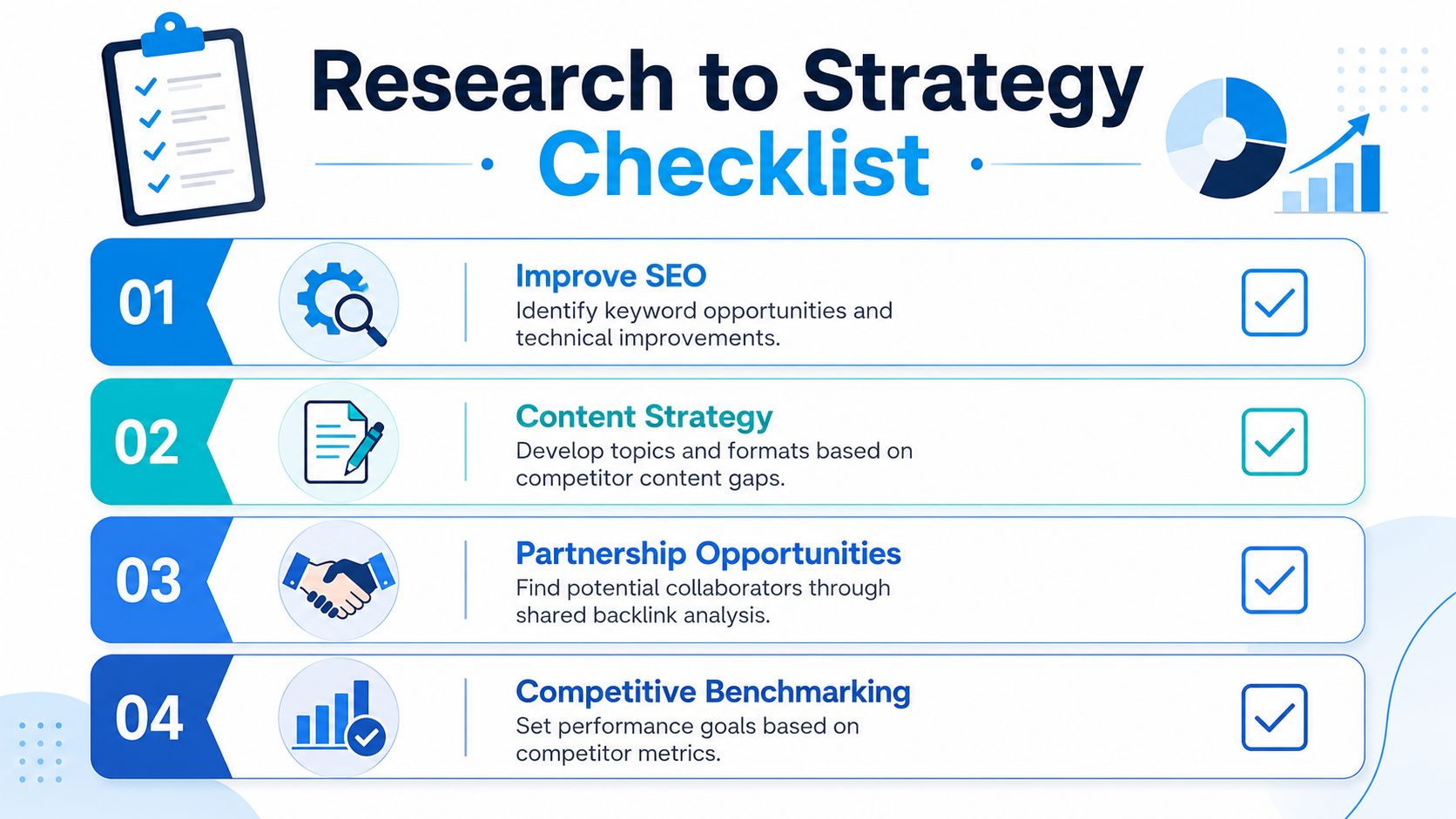
Use the list to make better decisions
The first use is benchmarking. Not in the shallow sense of copying homepages, but in the practical sense of understanding what a normal market position looks like in your category. The U.S. Small Business Administration framing, discussed in this competitive analysis guide, centers on market share, strengths, weaknesses, and indirect competitors. That’s the right lens because a site can look similar and still target a different segment entirely.
At this stage, I sort findings into business decisions.
- SEO planning means identifying which domains own service intent, which own education intent, and where your current pages don’t match the market standard.
- Content strategy means mapping the topics, formats, and page depth that repeatedly appear in winning content.
- Design and CRO review means studying how comparable sites handle calls to action, proof points, pricing signals, and user flow.
- Partnership outreach means using publisher and referral discoveries to build a list of potential placements, collaborators, and industry relationships.
Turn the research into a scoring model
A simple scoring model helps teams avoid opinion battles. I usually score domains on relevance, threat, and usefulness.
Consider questions like:
- Relevance. Does this site target the same buyer and solve the same problem?
- Threat. Does it compete with your visibility, your leads, or both?
- Usefulness. Should you monitor it, learn from it, pitch it, or ignore it?
Decision filter: Don’t ask whether a website is “similar.” Ask whether acting on its data will change your marketing decisions.
Match the insight to a department
One research pass provides SMBs with the most value, since it can support several teams at once.
Marketing can use the list to prioritize keyword clusters and traffic sources. Sales can use it to understand how competitors position offers and authority. Designers can build a swipe file of layout patterns and trust elements. Leadership can use it for a more grounded view of the market instead of reacting to whoever appears loudest online.
For companies reviewing demand, competition, and positioning together, a broader framework for market assessment helps connect website research to business planning.
Final Tips and the Future of Website Discovery
Website discovery is getting messier, not simpler. Search behavior is shifting, AI-generated answers are changing referral paths, and some of the websites that shape visibility won’t look like traditional competitors at all.
One of the most useful current perspectives is that the market is moving away from static website-to-website matching and toward entity, topic, and audience mapping as AI search changes how people discover information, as discussed in this piece on finding similar websites for research. That’s the right direction. If you only track sites that resemble yours visually, you’ll miss the publishers, answer-focused resources, and multi-channel brands shaping demand upstream.
Keep your process tight:
- Start manually so you understand the SERP before a tool abstracts it
- Validate with multiple signals instead of trusting one estimated data source
- Separate direct rivals from search rivals so benchmarks stay useful
- Revisit the list regularly because discovery patterns are changing fast
The businesses that consistently find similar websites well aren’t just doing competitor research. They’re building a clearer map of where attention, trust, and demand live online.
If you want help turning competitor research into a practical SEO, website, or lead generation plan, Netco Design LLC works with businesses that need clearer market positioning, stronger search visibility, and websites built to convert the right traffic.

