

table of contents
Home services SEO lead generation is the practice of optimizing your digital presence so that local homeowners find your business first when they search for the services you offer. It is not about chasing rankings for their own sake. The goal is a steady, predictable flow of qualified calls and contact form submissions from people who are already ready to hire.
The mechanism works like this: a homeowner in your area searches “emergency AC repair near me” or “roof replacement [city name].” Your Google Business Profile, service pages, and local content either show up or they do not. When they do, and when your reviews and website build enough trust, that homeowner calls you instead of a competitor. SEO captures that intent at the exact moment it exists.
What separates SEO from paid advertising is ownership. Paid ads rent you visibility. The moment you stop paying, the phone stops ringing. SEO builds an asset. A well-optimized page or Google Business Profile keeps generating leads long after the initial work is done, and the cost per lead drops as the asset matures.
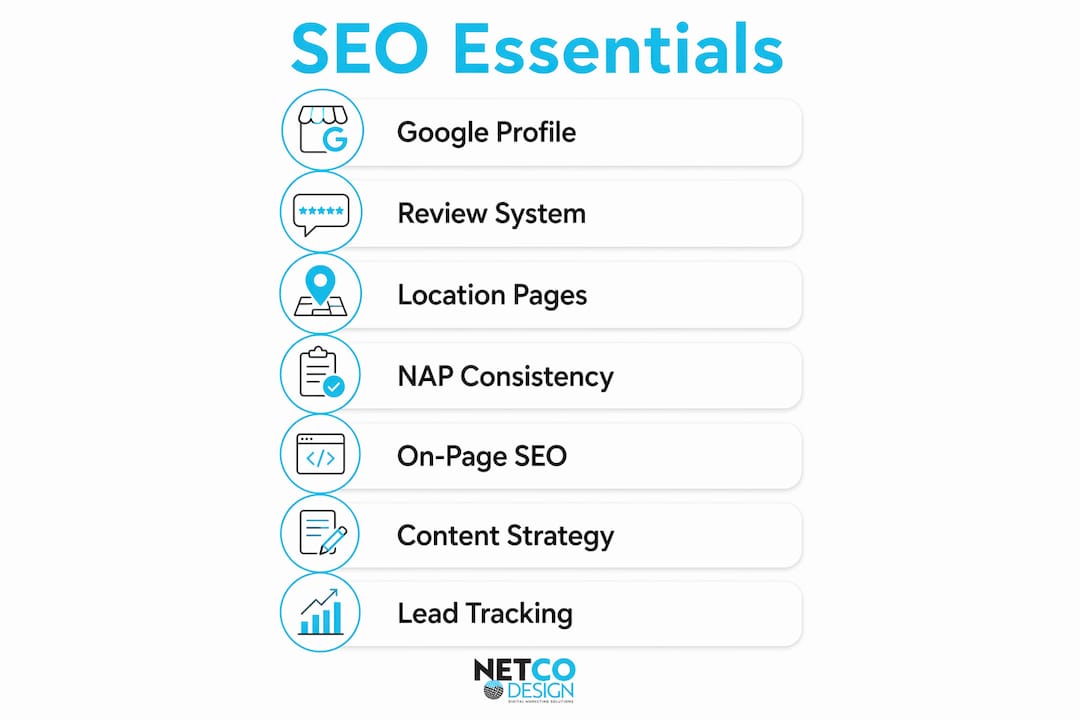
The core tactics that drive home services lead generation through SEO:
- Google Business Profile optimization with complete service listings, photos, and weekly posts
- Unique location pages targeting specific cities and neighborhoods you serve
- Review generation immediately after job completion to build recency and volume
- Consistent NAP (Name, Address, Phone) across your website and all directories
- Schema markup for LocalBusiness, Service, and FAQ to help both Google and AI assistants read your site
- Answer-first content on service pages that addresses what homeowners actually search
- Tracking and analytics to measure which pages and channels produce real leads
What makes a home services SEO strategy actually work?
Most home service businesses get about 60% of their Google Business Profile optimization right, leaving significant free ranking opportunities on the table. The businesses that dominate local search treat GBP as a living asset, not a one-time setup.

The non-negotiable components
1. Google Business Profile done completely
Fill every field: service categories, individual services (not just “plumbing” but “water heater installation,” “drain cleaning,” “emergency pipe repair”), operating hours, service area, and a keyword-rich business description. Upload photos of your team, vehicles, and completed jobs. Post weekly updates. Answer every question in the Q&A section before a stranger does it for you.
2. Review generation with a system
Reviews affect both your map pack ranking and whether a homeowner picks up the phone. The most effective moment to ask is within 24 hours of completing a job, when the customer is satisfied and the work is fresh. Respond to every review, including the negative ones. A thoughtful response to a complaint often builds more trust than ten five-star ratings.
3. Location and service pages with real content
Generic templated pages do not rank, and Google may penalize them. Each page needs to address the specific service in a specific area, reference local context, and answer the questions homeowners actually ask. The 80/20 rule for home service SEO applies here: focus 80% of your content effort on the 20% of service and location pages that capture the highest-intent queries, like emergency repairs and replacement services.
4. NAP consistency everywhere
Your business name, address, and phone number must be identical across your website footer, Google Business Profile, Yelp, Angi, HomeAdvisor, and every other directory where you appear. Minor inconsistencies, a suite number in one place and not another, can harm local rankings measurably.
5. On-page SEO and schema markup
Title tags should include your primary service and city. Schema markup for LocalBusiness and Service types helps Google and AI search tools understand exactly what you do and where. Page speed and mobile responsiveness are table stakes.
6. Content strategy aligned to buyer intent
Not all content is equal. A page targeting “cost to replace HVAC in [city]” will generate more leads than a page about “how HVAC systems work.” Prioritize transactional and comparison queries over purely informational ones.
7. Tracking that connects to real business outcomes
Rank tracking alone tells you almost nothing. Track phone calls from GBP, form submissions from service pages, and which cities or services drive the most conversions. Google Analytics and GBP Insights together give you the full picture.
Pro Tip: Set up call tracking numbers on your key service pages so you can see exactly which pages generate phone calls, not just traffic. This one change makes budget decisions far easier.
Here is a practical execution sequence for a new or underperforming campaign:
- Audit and complete your Google Business Profile
- Fix NAP inconsistencies across all directories
- Build or rewrite your top five service pages with answer-first content
- Create location pages for each city or neighborhood you serve
- Implement LocalBusiness and Service schema markup
- Launch a review request system tied to job completion
- Build local citations on Angi, HomeAdvisor, Manta, and trade-specific directories
- Publish monthly content targeting high-intent local queries
- Monitor GBP Insights and Google Analytics weekly
- Adjust content and pages based on what is actually generating calls
Local SEO tactics that move the needle for home service businesses
Local SEO for home services is not a single action. It is a layered system where each component reinforces the others. Here is where to focus your effort.
- Optimize GBP consistently. Fresh posts, updated photos, and answered Q&A questions signal to Google that your business is active. Dormant profiles lose ground to competitors who treat GBP as an ongoing channel.
- Build genuinely unique location pages. Reference local landmarks, neighborhood names, and weather patterns relevant to your service. A roofing page for a Tampa suburb that mentions hurricane season and specific building codes outperforms a generic “roofing services in [city]” page every time. Authentic, community-specific content combined with real customer reviews drives both rankings and trust.
- Audit your citations regularly. Use tools like BrightLocal or Whitespark to find and fix NAP inconsistencies. A single mismatched phone number across dozens of directories can suppress your map pack ranking.
- Ask for reviews at the right moment. Right after a completed job is the highest-conversion window. A simple text message with a direct link to your Google review page removes all friction.
- Build local links. Sponsoring a local Little League team, joining your city’s Chamber of Commerce, or getting listed on a regional trade association site all generate the kind of locally relevant backlinks that move map pack rankings.
- Optimize for voice and mobile search. Queries like “who fixes furnaces near me” and “best plumber open now” are conversational and location-specific. Pages that answer these questions directly, in plain language, tend to capture voice search results.
Pro Tip: Review velocity matters as much as total count. Ten reviews in one week followed by nothing for six months looks suspicious to Google. Aim for a steady cadence of two to four new reviews per month rather than bursts.
Website optimization essentials for lead generation in home services
Your website is the conversion engine behind your SEO. Traffic without a site that converts is wasted effort.
- Build a clear site architecture. Every service you offer and every city you serve should have its own dedicated page. A plumber serving five cities with six services needs 30 pages, not one homepage that mentions all of them.
- Use answer-first content architecture. Open every service page with the direct answer to what the homeowner is searching for. “We provide same-day water heater replacement in [city], with upfront pricing and a one-year labor warranty” is more effective than three paragraphs about the history of water heaters.
- Meet Google’s speed and mobile standards. Use Google PageSpeed Insights to identify and fix issues. A page that loads in under three seconds on mobile retains far more visitors than one that takes five or six. Since Netco Design builds mobile-first by default, this is baked into the foundation rather than retrofitted.
- Implement schema markup. LocalBusiness, Service, and FAQ schema help Google and AI assistants understand your business accurately. This is especially important as AI-generated search results become a primary lead channel.
- Place click-to-call buttons prominently. Your phone number should appear in the header, in the body of every service page, and in a sticky footer on mobile. A homeowner with a burst pipe is not going to hunt for your contact information.
- Remove thin or templated pages. If you have location pages that are identical except for the city name, Google may treat them as doorway pages and suppress them. Rewrite each one with unique, locally relevant content or consolidate them.
- Align your website with your GBP. Google cross-references what your site says with what your profile claims. Inconsistencies between the two suppress rankings. Your NAP in the site footer must match your GBP exactly.
How AI-driven search is changing home services visibility
AI-powered search tools, including Google AI Overviews, ChatGPT, and Perplexity, are now answering home service queries directly. When a homeowner asks an AI assistant “who are the best HVAC companies in [city],” the answer comes from pages that are structured for machine readability, not just traditional ranking signals.

Schema markup like LocalBusiness, Service, and FAQ has become the bridge between your website and AI-generated answers. Without it, AI tools cannot reliably extract and cite your business information. With it, your business becomes a candidate for AI recommendations even when your traditional organic ranking is not in the top three.
Answer-first content matters here too. AI systems favor pages that state a clear, factual claim at the top rather than burying the answer in the middle of a long article. A service page that opens with “We offer licensed electrical panel upgrades in [city], typically completed in one day, starting at [price range]” gives an AI assistant exactly what it needs to cite your business.
Stat to know: 28.3% of pages cited by ChatGPT rank poorly or not at all in traditional Google search. That means AI visibility and organic ranking are separate opportunities, and you can win one without dominating the other.
Generative Engine Optimization (GEO) is the emerging discipline that addresses this directly. It combines traditional on-page SEO with structured data, factual specificity, and content architecture designed for AI citation. For home service businesses, the practical steps are:
- Add FAQ schema to every service page with questions homeowners actually ask
- State your service area, licensing, and pricing context explicitly on each page
- Use structured data to mark up your reviews, services, and business details
- Monitor whether your business appears in AI-generated local recommendations and adjust content based on what is and is not being cited
Budget and timeline expectations for SEO lead generation
SEO is not a fast channel, but it is the most cost-efficient one once it matures. Setting the right expectations upfront prevents the most common mistake: abandoning the investment before it compounds.
Most home service contractors see measurable local pack improvements within 90 days of disciplined execution. Full local pack dominance typically takes 9 to 15 months. That timeline is not a flaw in the strategy. It is the barrier that keeps competitors from easily displacing you once you get there.
On cost, a real local SEO monthly retainer for a single-location contractor often runs in the mid-thousand-dollar range. By month 12, organic SEO leads typically cost significantly less than most paid channels after ramp-up. Well-run programs can return multiple times the investment by one year or later.
The smartest sequencing strategy: use paid ads to generate immediate cash flow while building the SEO foundation in parallel. Google Local Service Ads (LSA) can produce calls within two to five weeks of launch. Meanwhile, the SEO work compounds in the background. Contractors running both channels generate more total leads at a lower blended cost than those relying on a single channel.
Key budget considerations:
- Foundation work first. GBP optimization, NAP cleanup, and core service page rewrites should happen before any monthly retainer begins. This work makes everything else perform better.
- LSA for immediate cash flow. At $900 to $1,000 per month in LSA spend, most contractors in a normal market see real leads within the first month.
- SEO retainer for long-term asset building. Start the retainer as soon as cash flow allows. The earlier the foundation starts, the sooner compounding kicks in.
- Response time affects LSA performance. Fast responders qualify leads 21 times more effectively than slower ones, so your lead handling process matters as much as your ad spend.
- Cost per lead drops over time. Mature SEO campaigns reach roughly $25 per qualified lead, a number paid channels rarely match.
How to analyze competitors in your local home services market
Understanding what your competitors are doing in search is not optional. It is how you find the gaps they have left open and the opportunities they have already validated.
Start with a simple search for your primary service in your city. Note which businesses appear in the map pack and which appear in the organic results below it. These are your real competitors, not the national brands, but the local operators ranking for the same queries you want.
What to look for in competitor analysis
Review volume and recency. A competitor with 200 reviews and a 4.8 rating is harder to displace than one with 40 reviews and a 4.2. Look at how recently their reviews were posted. A business that earned most of its reviews two years ago is vulnerable to a competitor with a consistent, current review cadence.
Content gaps on their service pages. Visit the top-ranking competitor pages for your target keywords. Are they thin? Do they answer the specific questions homeowners ask? If their “roof replacement” page is three paragraphs of generic copy, a well-written, answer-first page from you has a real chance to outrank it.
Their backlink profile. Tools like Ahrefs or Moz show you which sites link to your competitors. Local news mentions, Chamber of Commerce listings, and trade association pages are all link sources you can pursue. If a competitor has a link from the local homebuilders association and you do not, that is a specific gap to close.
Their GBP activity. Check how often competitors post, whether they respond to reviews, and how complete their service listings are. An inactive GBP from a competitor is an opening.
Pages they rank for that you do not. Use Google Search Console to find queries where competitors appear and you do not. These are content opportunities with proven demand.
The goal of competitor analysis is not to copy what they are doing. It is to find where they are weak and build something better in that exact spot.
Conversion rate optimization: turning SEO traffic into actual leads
Getting traffic to your site is only half the job. If visitors land on your pages and leave without calling or submitting a form, the SEO investment produces rankings but not revenue.
The most common conversion problems on home service websites are fixable without a full redesign.
Make the next step obvious. Every service page should have one clear primary action: call now or request a quote. A page with five different calls to action, a newsletter signup, a social media follow button, and a contact form, dilutes the decision and reduces conversions. Pick one and make it prominent.
Use trust signals near the conversion point. A five-star rating badge, a “licensed and insured” statement, and a photo of your team placed near the phone number or form dramatically increase the likelihood that a visitor converts. Homeowners are letting a stranger into their house. They need reassurance before they call.
Reduce form friction. A contact form asking for name, phone, email, service type, preferred date, and a message will convert at a fraction of the rate of a form asking only for name, phone, and service. Ask for the minimum you need to follow up. You can gather the rest on the call.
Speed is a conversion factor, not just an SEO factor. A page that loads slowly on mobile loses visitors before they ever see your offer. Google PageSpeed Insights gives you a specific score and a prioritized list of fixes.
Test your click-to-call setup on mobile. Your phone number should be a tappable link on every mobile page. A surprising number of home service sites display the number as plain text, which means a mobile visitor has to manually dial it. That extra step costs you calls.
Follow up fast. Fast response to inbound leads dramatically increases close rates. A lead that waits more than a few hours for a callback often calls the next contractor on the list.
Seasonal and event-based SEO tactics for home service businesses
Home service demand is not flat year-round, and your SEO strategy should reflect that. Search volume for HVAC services spikes before summer and before winter. Roofing queries surge after major storms. Plumbing searches peak around the holidays when families gather and older systems get stressed.
The businesses that capture this seasonal demand are the ones that prepare their content before the season arrives, not during it.
Publish seasonal content six to eight weeks early. A blog post or service page targeting “AC tune-up before summer in [city]” needs to be indexed and building authority before homeowners start searching. Publishing it in June, when the heat is already here, means you miss the peak window.
Create storm-response pages. If your service area is prone to hurricanes, tornadoes, or heavy snow, build dedicated pages for post-storm services. These pages can rank quickly after a weather event because demand spikes and competition for fresh content is low.
Update existing pages for seasonal relevance. A general HVAC service page can include a seasonal callout: “Scheduling spring tune-ups now through May” with a current date reference. This signals freshness to Google and gives homeowners a reason to act.
Use Google Business Profile posts for seasonal promotions. A GBP post about a spring gutter cleaning special or a winter furnace inspection discount drives both clicks and calls. These posts expire after seven days, so a weekly posting habit keeps your profile active and your offers current.
Tie content to local events. A home services company in a market with a major annual home show can publish content around that event: “What to ask contractors at the [City] Home Expo” or “How to evaluate quotes you get at a home show.” This captures event-driven search traffic and positions your business as a local authority.
Build a content calendar around your service demand curve. Map out which services peak in which months, then work backward six to eight weeks to set your publishing schedule. This turns seasonal SEO from reactive to planned.
Netco Design builds home service SEO that compounds over time
Home service businesses that want to stop renting leads and start owning their pipeline need more than a checklist. They need a strategy built around their specific market, services, and growth goals.
Netco Design is a full-service digital marketing agency based in St. Petersburg, Florida, built specifically for businesses that want measurable, compounding results from their SEO investment. The team handles the full stack: Google Business Profile optimization, location page creation, schema markup, content strategy, local link building, reputation management, and conversion rate optimization. Every strategy is tied to real KPIs, and clients receive transparent reporting on rankings, leads, and cost per acquisition.
For home service businesses that are currently dependent on paid lead platforms or third-party directories, Netco Design builds the owned visibility that reduces that dependence over time. The work is grounded in the same principles covered in this guide, executed with the technical depth and local market knowledge that produces results in competitive markets. Stay ahead of where search is heading by reviewing the SEO digital marketing trends shaping lead generation in 2026.
Ready to build a lead generation asset that keeps working after you stop paying for it? Contact Netco Design to get a custom SEO plan for your home service business.
Key Takeaways
Home services SEO lead generation builds a compounding owned asset that drives qualified local leads at a decreasing cost per lead over time, unlike paid channels that stop the moment spending stops.
| Point | Details |
|---|---|
| GBP is your highest-leverage asset | Most contractors leave significant ranking opportunity untapped by not completing and actively maintaining their Google Business Profile. |
| NAP consistency is non-negotiable | Minor inconsistencies in your business name, address, or phone number across directories can suppress your map pack rankings. |
| SEO timeline is 9–15 months to dominance | Measurable improvements appear within 90 days, but full local pack dominance takes 9 to 15 months of disciplined execution. |
| AI visibility is a separate opportunity | 28.3% of pages cited by ChatGPT rank poorly or not at all in traditional Google search, making schema markup and answer-first content critical. |
| Netco Design for home service SEO | Netco Design builds the full SEO stack for home service businesses, from GBP optimization to schema markup and local content, tied to measurable lead outcomes. |
FAQ
What is home services local SEO?
Home services local SEO is the process of optimizing your Google Business Profile, website, and online citations so your business appears when nearby homeowners search for the services you offer. It targets location-specific queries and map pack results rather than broad national rankings.
What is the 80/20 rule for SEO?
In home services SEO, the 80/20 rule means focusing 80% of your content and optimization effort on the 20% of service and location pages that capture the highest-intent queries, such as emergency repairs and replacement services, since those pages drive the most qualified leads.
How much should I pay for lead generation?
A local SEO monthly retainer for a single-location home service contractor typically runs several thousand dollars. After the ramp-up period, organic SEO leads generally cost between $10 and $50 per lead, which is substantially less than most paid lead channels.
How do I get more home service leads through SEO?
Start by completing your Google Business Profile, fixing NAP inconsistencies across directories, and building dedicated service and location pages with answer-first content. Add schema markup, generate reviews consistently after each job, and track which pages produce actual calls rather than just traffic.
How long does SEO take to generate leads for contractors?
Most contractors see measurable local pack improvements within 90 days of consistent execution. Full local pack dominance typically takes 9 to 15 months, which is why running paid ads in parallel during the build phase helps maintain cash flow while the SEO asset matures.

