

table of contents
Let’s be blunt: building an email list is the single most powerful thing you can do to create a predictable, reliable engine for your business. It’s not about just collecting addresses. It’s about attracting the right people, getting their explicit permission to talk to them, and then building a genuine relationship that drives sales.
Why Owned Audiences Are Your Most Valuable Asset
In marketing, you’re always dealing with two kinds of audiences: the ones you rent and the ones you own.
Think about it. Your social media followers, the traffic you get from Google, the people who see your ads—you’re renting that attention. You’re at the mercy of a third party. Their algorithms, their policies, and their ad costs can change in a heartbeat, and poof—your connection to your customers is gone.
An email list is different. It’s an asset you own, outright. You control the platform. You control the message. It’s a direct, unfiltered line of communication to your audience. This isn’t just a nice-to-have; it’s a fundamental strategy for building a stable, resilient business that can weather any storm. When you have a direct line to your customers, you can generate revenue on demand, completely independent of soaring ad costs or a fickle algorithm.
The True Value of Direct Communication
The real magic of an email list lies in the relationship it allows you to build. Social media is great for fleeting interactions, but email is where you can have deeper, more personal conversations. That direct connection is how you build the kind of trust and loyalty that turns casual buyers into lifelong fans.
Here’s why this is so critical:
- Financial Stability: Your email list doesn’t care about market volatility. It’s a consistent, reliable source of leads and sales you can count on, month in and month out.
- Higher ROI: I’ve seen it time and time again—email marketing consistently delivers a massive return on investment, blowing most other channels out of the water. You’re talking to people who want to hear from you, so of course, they’re more likely to convert.
- Customer Loyalty: Showing up in someone’s inbox with valuable, relevant content keeps you top-of-mind. This consistency builds a powerful bond, turning one-time customers into repeat buyers who champion your brand.
This simple flow shows you exactly how it works—turning rented attention from social media into a revenue-generating asset you completely control.
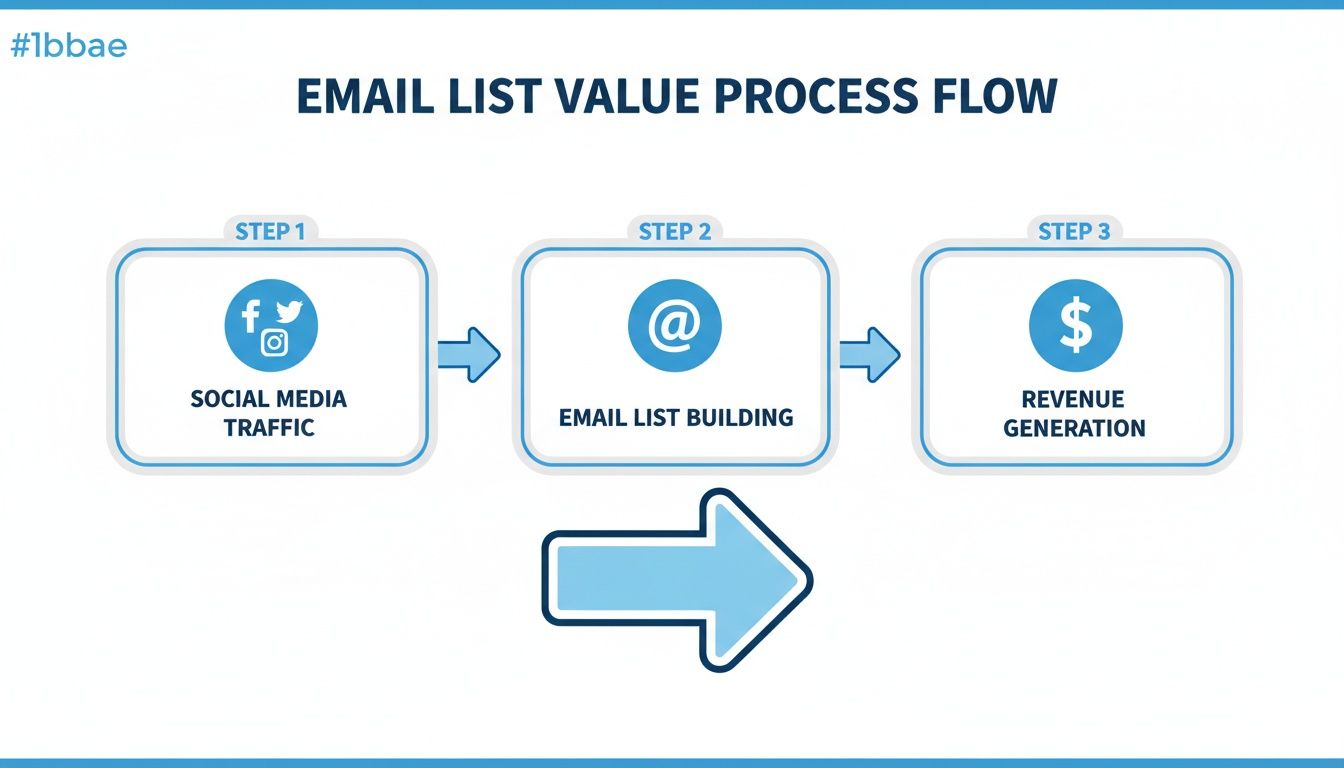
You’re essentially converting borrowed attention into a tangible business asset. Nothing is more powerful than that.
The sheer scale of email proves its staying power. The number of global email users is set to hit 4.6 billion in 2025 and is on a trajectory to pass 4.8 billion by 2027. This isn’t some dying channel; it’s the most widespread digital communication tool on the planet.
An email list is the only marketing channel where your audience has explicitly raised their hand and asked you to sell to them. It’s the ultimate form of permission-based marketing, and that’s why it converts so well.
To build an audience that delivers real value, you have to start with a solid foundation. That means understanding and implementing comprehensive lead generation best practices. By focusing on proven methods for attracting high-quality leads from day one, you set yourself up for a healthy, profitable list that will pay dividends for years to come.
Creating Lead Magnets People Genuinely Want

Let’s be honest. Your future subscribers have a problem, and it isn’t the one you’re trying to solve. Their real problem is an overflowing inbox and a healthy dose of skepticism. They are tired of giving away their email for another generic, forgettable PDF.
If you want to build a high-quality email list, your offer—your lead magnet—can’t just be good. It has to be an irresistible, specific solution to a challenge they’re facing right now.
The secret to a winning lead magnet is simple: it has to deliver an immediate, tangible win. Forget the sprawling 50-page ebook that feels like homework. Think quick. Think actionable. Deliver real value in five minutes or less. This instant gratification is what builds trust and kicks off the relationship on the right foot.
The goal isn’t just to get an email; it’s to attract the right email from someone who’s a perfect fit for what you sell. That means your lead magnet has to be tightly aligned with your core products or services.
Moving Beyond Generic Checklists
Generic lead magnets attract generic subscribers. These are the folks just hunting for freebies, and they’ll probably unsubscribe the moment you try to sell them something. To grab the attention of high-intent prospects, you have to get specific. The more your offer is tailored to a particular pain point, the more powerful it becomes.
I’ve seen these ideas work wonders time and time again:
- Interactive Quizzes: People love learning about themselves. A quiz like “What’s Your E-commerce Growth Blocker?” is gold. It not only gives them personalized results but also helps you segment new subscribers from day one.
- Resource Toolkits or Swipe Files: Don’t just tell people how to do something; give them the tools to actually get it done. A “Startup Tech Stack Toolkit” with direct links to recommended software is infinitely more valuable than a vague guide on choosing tools.
- Exclusive Video Workshops: A short, pre-recorded video or mini-course has immense perceived value. A 15-minute “5-Day Website Traffic Challenge,” for instance, can teach a specific skill and instantly position you as the expert.
- Calculators or Templates: Practical tools that save time are always a hit. Think a “PPC Ad Spend ROI Calculator” or a “Content Calendar Template” in Google Sheets. They provide immediate, reusable value that keeps you top of mind.
A powerful lead magnet doesn’t just promise a solution; it is the first step of that solution. It should be so valuable that you could almost charge money for it, but you offer it for free in exchange for a subscriber’s trust and attention.
Of course, none of this works if you don’t know who you’re talking to. Before you build a single thing, you need a crystal-clear picture of your ideal customer. To get this right, you have to understand how to create buyer personas that map out their specific goals and challenges.
Real-World Examples of High-Converting Offers
Let’s look at how smart brands put this into practice. Imagine an e-commerce store that sells high-performance running shoes. They could offer a “Personalized Gait Analysis Quiz.” The results recommend the perfect shoe type, instantly connecting the user’s specific need with the brand’s product.
Or what about a digital marketing agency? They could create a “Local SEO Audit Checklist.” This simple tool helps a small business owner quickly spot gaps in their online presence, which perfectly demonstrates the agency’s expertise and opens the door for a conversation about their services.
These examples are effective because they’re laser-focused and directly tied to a commercial outcome. They solve a real problem, make the subscriber feel understood, and set the stage for a profitable long-term relationship.
For a deeper dive, you can learn how to create a lead magnet that actually converts and drives real list growth. The key is to stop thinking about what you want to give away and start thinking about what your ideal customer desperately wants to receive.
Turning Your Website Into a Subscriber Magnet

Your website is easily the most powerful list-building tool you own. It’s your turf, where you make the rules. Yet, so many businesses just drop a generic “Subscribe to our newsletter” form in the footer and call it a day. That’s not a strategy—it’s an afterthought.
If you really want to turn your site into a machine that pulls in subscribers, you have to get smart about where and how you ask for that email. The whole game is about making the right offer at the right time, so the experience feels helpful, not annoying. This means ditching the one-size-fits-all form and using a mix of opt-in types that match what your visitors are doing.
Strategic Placement for Maximum Impact
Think of your website like a physical store. You wouldn’t hide the checkout counter in a dark corner, right? So why bury your most important call to action? Every single page on your site is a chance to capture a lead.
Here’s where I’ve seen the best results:
- Header Bar: A slim, site-wide bar at the very top is a persistent but subtle reminder. It’s perfect for a high-value offer like a webinar spot or a site-wide discount code.
- Embedded Within Content: This one’s a powerhouse. If someone is deep into a 2,000-word article you wrote, they’re clearly hooked. Dropping an opt-in form right there for a related checklist or template is a no-brainer.
- Sidebar Box: People say the sidebar is dead, but a well-designed offer can still pull its weight, especially on a content-heavy blog. The trick is to make it pop visually and keep the offer hyper-relevant to what they’re reading.
- Dedicated Landing Pages: This is non-negotiable. Every major lead magnet you create needs its own distraction-free landing page. When you’re running ads or promoting something on social media, you send traffic here, not your homepage.
Don’t just tack on forms; integrate them. The best opt-in experience feels like the next logical step in your visitor’s journey, not a jarring interruption. It should be a clear invitation to get more value, presented exactly when they’re most interested.
Of course, the design of these forms and pages is just as critical as where you put them. For a deeper dive, our guide on landing page design best practices will show you how to build pages that are engineered to convert.
Smarter Opt-Ins That Actually Convert
Beyond just placing forms on a page, dynamic opt-ins can give your sign-up rates a serious boost by reacting to user behavior. They’re designed to grab attention at those critical moments when a person is most likely to make a decision.
Exit-Intent Popups are a true game-changer. These forms only show up when a visitor’s cursor moves toward the back button or to close the tab. Instead of just letting them walk away, you hit them with one last, compelling offer. For an e-commerce site, this could be a last-ditch 15% discount to a visitor abandoning their cart.
Timed Popups can be set to appear after a user has been on a page for a specific amount of time, say 30 seconds. This is a great signal of engagement, making them much more open to an offer. It’s a smart way to target visitors who are already invested in your content.
These aren’t just gimmicks; they drive real revenue. Automated emails, often triggered by these opt-ins, are responsible for 37% of all email-generated sales, even though they only make up 2% of total sends. Just starting with a well-placed exit-intent popup can snag abandoning visitors at a conversion rate of 10-20%.
The secret is to relentlessly A/B test your offers, your copy, and your timing. What works for one audience might fall flat with another. Start with these proven methods, then measure everything and keep tweaking your approach. That’s how you turn every website visit into a potential subscriber.
Driving Targeted Traffic to Your Offers
You’ve built a brilliant lead magnet and your website is ready to capture subscribers. Fantastic. But even the most amazing offer is worthless if the right people never see it. The next move is all about actively getting targeted traffic to your landing pages and opt-in forms.
This doesn’t mean you need a monster marketing budget. A smart, balanced approach that mixes organic and paid strategies will bring in high-quality prospects who are actually interested in what you have to say. Let’s break down the channels I’ve seen deliver the best results, time and time again.
Harnessing Organic Channels for Sustainable Growth
Organic traffic is the foundation of any healthy list-building strategy. It’s cost-effective, builds your authority, and pulls in an audience that’s already searching for the solutions you provide. This is about playing the long game to create a steady, reliable flow of leads.
The most powerful way to do this is with SEO-optimized content. When you publish blog posts, guides, and articles that answer the exact questions your ideal customers are typing into Google, you’re basically creating a direct highway to your opt-in offers.
For instance, if you sell productivity software, a blog post titled “How to Organize Your Week for Maximum Focus” is the perfect spot to embed a sign-up form for your “Ultimate Weekly Planner” template. The content draws them in, proves you know your stuff, and makes downloading the lead magnet feel like the most natural next step. For a much deeper dive on this, our guide on how to increase website traffic lays out a complete roadmap.
Social media is another organic channel you can’t ignore. Don’t just blast links to your blog; turn your profiles into list-building machines.
- Optimize Your Bio: That link in your bio on Instagram, X (formerly Twitter), and LinkedIn is prime real estate. Stop sending people to your homepage—link directly to a high-converting landing page.
- Create Promotional Content: Design posts and stories that specifically show off your lead magnet. Give them a sneak peek of the checklist or share a glowing testimonial from someone who loved your video workshop.
- Engage in Relevant Communities: Jump into Facebook groups or LinkedIn discussions where your audience hangs out. Offer real value, and when it makes sense, mention your free resource as a helpful solution.
Your organic efforts create a powerful flywheel. Great content starts ranking on Google, which drives traffic. That traffic signs up for your list. You can then share new content with them, which earns more shares and links, which in turn boosts your SEO even more.
Accelerating Growth with Strategic Paid Advertising
While organic methods build momentum over time, paid advertising lets you jump the line and get your offer in front of a hand-picked audience almost instantly. Platforms like Meta (Facebook and Instagram) are absolute goldmines for lead generation, even if you’re working with a smaller budget.
The key to winning here isn’t about spending more; it’s about targeting smarter. With lead generation ads, you can zero in on your audience with incredible precision based on their demographics, interests, and online behavior.
Imagine you run a local meal prep service. Instead of yelling at everyone in your city, you could run a Meta ad for your “5 Healthy Recipes for Busy Professionals” guide, targeting only people who:
- Live within a 10-mile radius of your kitchen.
- Are aged 25-45.
- Have shown interest in “fitness and wellness” and “meal delivery services.”
This kind of precision ensures your ad dollars are spent on people who are highly likely to convert. Your ad itself should be direct and all about the value, with a crystal-clear call to action like “Download the Free Guide.” From there, the ad sends them straight to your dedicated landing page, making the sign-up process totally seamless.
By combining the steady, authority-building growth from organic channels with the fast, targeted results of paid ads, you create a complete traffic strategy. This two-pronged approach ensures you’re not just getting more visitors, but attracting the right visitors—the ones who are genuinely excited to join your list and, down the road, become your best customers.
Nurturing New Subscribers From Day One
Getting someone to give you their email address isn’t the finish line—it’s the starting pistol. The first few days after someone joins your list are, without a doubt, the most critical window you have for building a real relationship. This is your one shot to make a powerful first impression that can turn a casual signup into a loyal fan.
So many businesses drop the ball here. They send the lead magnet and then… crickets. That’s a huge missed opportunity. Your welcome series needs to do more than just deliver the goods. It has to set expectations, introduce who you are, and prove that hitting “subscribe” was a smart move.
The Power of a Personalized Welcome
Right out of the gate, you have to show new subscribers you see them as an individual, not just another address in your database. All that information you gathered when they signed up? Whether it was from a quiz or a form targeting a specific pain point, that’s marketing gold. Use it immediately.
For instance, the person who downloaded a checklist on “Local SEO” should get a completely different welcome sequence than someone who grabbed a guide on “PPC for E-commerce.” This isn’t just a nice-to-have; segmented campaigns see 30% more opens and 50% higher click-through rates.
When you get this right, personalized emails can deliver six times the conversion rates of generic blasts. That’s a massive advantage, especially with 4.6 billion people expected to use email daily by 2025.
The goal of onboarding isn’t just to inform. It’s to make every new subscriber feel seen and valued. A generic “thanks for subscribing” email is forgettable. A tailored message that speaks directly to their interests? That’s how you build a relationship.
A Proven 3-Email Welcome Sequence
You don’t need some complex, month-long sequence to make an impact. A simple, strategic three-part welcome series, sent over three to five days, is incredibly effective for warming up new leads and setting the stage for everything that comes next.
The best part? The whole thing can be automated, saving you a ton of time while making sure every single subscriber gets a consistent, high-quality experience.
Here’s a simple framework that I’ve seen work for just about any business:
- Email 1: The Instant Delivery & Expectation Setter (Send Immediately)
Your goal here is twofold. First, deliver the promised lead magnet right away. No delays. Second, tell them exactly what’s coming next. Thank them for subscribing, give them the link to their resource, and briefly explain what kind of emails you’ll be sending and how often. - Email 2: The Brand Story & Connection Builder (Send Day 2)
Now that you’ve provided value, it’s time to build a human connection. Share your brand’s origin story, your mission, or the “why” behind what you do. This is all about humanizing your brand and showing the person behind the logo. I like to end this one with a simple question to encourage a reply, like, “What’s the biggest challenge you’re facing with [their interest] right now?” - Email 3: The First Call to Action (Send Day 4 or 5)
The final email in this initial series should gently guide them toward their next step. This isn’t a hard sell. Instead, point them to some of your most valuable content—a pillar blog post, a popular case study, or your social media channels. The aim is to get them to take that first key engagement beyond just opening an email.
This simple sequence transforms a transactional sign-up into the beginning of a real conversation, paving the way for a profitable and loyal relationship.
Keeping Your Email List Healthy and Compliant
Getting someone to subscribe is a huge win, but your work isn’t over. Not by a long shot. Think of your email list as a living, breathing asset. If you neglect it, it’s going to lose its value. Over time, subscribers go cold, email addresses bounce, and engagement naturally dips—all of which will tank your deliverability and ROI.
An engaged list is a profitable one. That’s why regularly cleaning out inactive subscribers, a process we call list hygiene, is completely non-negotiable. It’s the single best way to keep your emails out of the spam folder and ensure your messages actually reach the people who want to hear from you. The result? Better open rates and a healthier bottom line.
The Importance of Regular List Pruning
I know it feels backward to delete subscribers you worked so hard to get. But trust me, keeping unengaged contacts on your list is doing more harm than good.
Internet Service Providers (ISPs) like Gmail and Outlook are always watching. They see how people interact with your emails. If a big chunk of your list is ignoring, deleting, or—worst of all—marking your emails as spam, the ISPs take note. Before you know it, they’ll start filtering your messages straight to the spam folder for everyone.
All you need is a simple, repeatable process:
- Define “Inactive”: First, decide what “inactive” means for your business. A good starting point is anyone who hasn’t opened or clicked an email in 90-120 days.
- Launch a Win-Back Campaign: Don’t just delete them cold. Give them one last chance with a targeted re-engagement campaign. Try a compelling discount or a simple feedback request. A subject line like, “Is this goodbye?” can work wonders.
- Cut Them Loose: If they still don’t bite, it’s time to say farewell. Removing them feels tough, but this one action can dramatically improve your sender reputation and make sure your metrics reflect genuine interest.
Think of list hygiene like gardening. You have to prune the dead branches to let the healthy parts of the plant thrive. A smaller, highly-engaged list is infinitely more valuable than a massive, dormant one.
Navigating Email Compliance Laws
Beyond keeping your list engaged, you have to keep it compliant. Laws like the CAN-SPAM Act in the U.S. and the General Data Protection Regulation (GDPR) in Europe aren’t just gentle suggestions—they’re strict rules with hefty fines. Building trust starts with respecting your subscribers’ privacy.
The good news is you don’t need a law degree to get this right. Compliance really just boils down to a few core principles of transparency and consent.
Here’s a straightforward checklist to follow for every email you send:
- Get Explicit Consent: Never, ever add someone to your list without their clear permission. Pre-checked boxes are a big no-no, especially under GDPR.
- Identify Yourself Clearly: Your “From” name must be accurate, and you need to include your valid physical postal address in every email. Yes, every single one.
- Provide an Easy Opt-Out: Every email must have a clear and obvious unsubscribe link. Don’t make people hunt for it. It should take one or two clicks, max.
- Honor Opt-Outs Promptly: When someone unsubscribes, you need to process that request quickly. The legal standard is typically within 10 business days, but you should aim for instant.
- Write Honest Subject Lines: Don’t be cute or deceptive here. Your subject line needs to reflect the content of your email. No tricking people into opening.
By focusing on both hygiene and compliance, you’re protecting your most valuable marketing asset for the long haul. This isn’t just about following the rules—it’s about building a trustworthy brand that earns its place in the inbox.
Got Questions About List Building? We’ve Got Answers.
Even with a solid game plan, a few questions always pop up once you get your hands dirty building an email list. Let’s walk through some of the most common ones I hear from clients to get you moving forward with confidence.
How Often Should I Email My List?
There’s no magic number here, but consistency is king. The real key is to set an expectation right from that first welcome email and then actually stick to it. Whether you land on daily, weekly, or something in between, your audience will learn your rhythm.
For most businesses, shooting for one to two emails a week is a fantastic starting point. It’s enough to stay top-of-mind without becoming background noise. But context matters. An e-commerce brand running a flash sale might fire off several emails in a single day, and that’s perfectly fine. Just keep a close eye on your open rates and, more importantly, your unsubscribe numbers—your audience will tell you exactly what’s working.
The best sending frequency is the one you can consistently maintain with high-quality content. It’s far better to send one amazing email a week than three mediocre ones just to fill a quota.
What’s a Good Open Rate for Emails?
Open rates can swing wildly depending on your industry, but a solid benchmark to aim for is somewhere between 20% and 30%. If you’re consistently hitting that sweet spot, you’re in great shape.
Of course, several things feed into that number:
- Your Subject Line: Is it compelling? Clear? Does it spark a little curiosity?
- Audience Engagement: How healthy is your list? Are these people who actually want to hear from you?
- Sender Reputation: Are you landing in the inbox or getting flagged as spam?
- Brand Recognition: When people see your name, do they trust you enough to click?
Try not to get obsessed with hitting a specific number. The real goal is to improve your own average over time. Test different subject lines, experiment with sending times, and clean your list regularly. Building a quality email list is all about nurturing a relationship, not just chasing vanity metrics.
Ready to turn your website into a lead generation machine? The team at Netco Design LLC specializes in building custom digital marketing strategies that attract the right audience and drive real revenue. Let us help you build an email list that becomes your most valuable asset. Start growing your business today.

