

table of contents
When it comes down to it, learning how to build links is all about one thing: getting other websites to vouch for your content. It’s the process of earning high-quality recommendations in the form of backlinks. These links act as signals to search engines, telling them your site is a credible and authoritative source of information.
Laying the Groundwork for Modern Link Building

Before you even think about chasing a single backlink, you have to understand that the game has completely changed. Gone are the days of stacking up hundreds of low-quality links from spammy directories just to see what sticks.
Today, link building is about earning genuine endorsements from reputable sites in your industry. Think of each backlink as a vote of confidence. A single link from a trusted industry blog is infinitely more valuable than dozens from irrelevant, unknown websites. Search engines like Google are incredibly sophisticated at judging the quality of these “votes,” analyzing everything from the linking site’s authority to the context of the link itself.
Why Quality Trumps Quantity
Focusing on quality over quantity isn’t just a good idea—it’s non-negotiable. A handful of truly authoritative links will move the needle on your search rankings far more than a mountain of mediocre ones. This approach not only works better but also protects your site from potential penalties and builds a sustainable foundation for long-term growth.
But let’s be realistic: earning these endorsements is tough. Research shows that a staggering 94% of online content gets zero external backlinks. That stat alone shows just how hard it is to get noticed. What’s more, only about 2.2% of content ever manages to earn links from more than one website.
A successful link building strategy is built on relationships and value, not transactions. Your goal should be to become a resource that other creators genuinely want to reference.
Core Concepts You Need to Know
To build links that actually work, you first need to grasp the foundational elements that give a link its value. Getting a handle on these concepts will help you target the right opportunities and measure what’s working.
- Domain Authority (DA): This is a predictive score (from 1 to 100) that estimates how well a website will rank. When you earn links from sites with a high DA, they pass more of that “authority” on to your own site.
- Relevance: A link from a local bakery’s blog to your plumbing company’s website just doesn’t make sense. It’s far less valuable than a link from a major home improvement blog. Google prioritizes links from sources that are topically related to your own content.
- Anchor Text: This is the clickable text in a hyperlink. Using descriptive anchor text (like “small business SEO tips” instead of “click here”) gives search engines important clues about what the linked page is about.
Before you ever launch an outreach campaign, you absolutely must understand your current backlink profile. A comprehensive site audit will uncover any existing toxic links that could be dragging your rankings down and help you identify your strongest pages. Getting this baseline is a crucial first step. If you’re new to this, you can learn how to do a site audit to get your website ready for a real link building push.
Finding Your Best Link Opportunities
The smartest way to build links isn’t to just start asking for them. You need a map of the landscape first. That means getting a clear picture of your own backlink situation and then taking a hard look at what your top competitors are doing right.
This initial recon is what separates a focused, effective campaign from a scattershot effort that just wastes time and money.
Your first move? Audit your own backlink profile. Using a tool like Ahrefs or Semrush, you can pull a complete list of every single website that currently links back to you. This isn’t just about counting links; it’s about judging their quality and sniffing out potential problems.
The goal here is to spot and clean up any “toxic” links. These are backlinks from spammy, low-quality, or totally irrelevant sites that could be actively hurting your rankings. A clean profile gives your future link building efforts a solid, healthy foundation to build on.
Uncovering Competitor Strategies
Once your own house is in order, the real fun begins: competitive analysis. This is where you shift from defense to offense. By digging into the backlink profiles of the sites that consistently outrank you, you can reverse-engineer their success and find your best opportunities.
Start by picking out three to five of your direct competitors—the businesses chasing the same keywords and audience as you. Plug their domains into your SEO tool of choice and get ready to see exactly who is linking to them.
This analysis is a goldmine. It tells you:
- Who links to them: You’ll see which blogs, news sites, and industry directories are giving them a vote of confidence.
- What content earns links: Pay close attention to which of their pages attract the most backlinks. Is it a massive guide, a free tool, or some original research?
- How they get those links: Look at the context. Are the links coming from guest posts, resource lists, or media mentions?
This process isn’t about blindly copying what your competitors do. It’s about intelligence gathering. You’re looking for patterns that reveal what’s working in your niche so you can adapt those tactics for your own brand and find a unique angle.
Identifying Your Link Gap Opportunities
After you’ve analyzed a few competitors, you’ll start to see a “link gap.” This is the sweet spot: websites that link to one or more of your competitors, but not to you.
Think of it as a pre-vetted list of prospects. These sites have already shown they’re willing to link to businesses just like yours.
For example, maybe you find that two of your main rivals were both featured on a popular industry blog. That blog is now a prime target for your outreach. Since they’ve already covered similar topics, you have a much higher chance of getting their attention if you can offer a fresh perspective or a more valuable resource.
This deep dive into link profiles is a foundational piece of any serious SEO strategy. For a more detailed walkthrough, our guide on how to do competitor analysis in SEO provides a complete framework for this essential process.
By understanding where your competitors are winning, you can strategically claim your own space and start building a backlink profile that drives real, measurable growth. This initial research is what lets you build links with purpose.
Choosing Your Core Link Building Strategies
Now that you have a good sense of where your best link opportunities are hiding, it’s time to pick the right tools for the job. With so many tactics out there, it’s easy to get overwhelmed. The secret is to focus on a few proven strategies that actually fit your business goals and resources instead of trying to do everything at once.
Learning how to build links that move the needle means choosing the right play for the right situation. Some strategies are a perfect match for local businesses, while others work better for e-commerce brands trying to reach a national audience.
This decision tree gives you a simple way to figure out where to focus your energy based on what you’re trying to achieve.
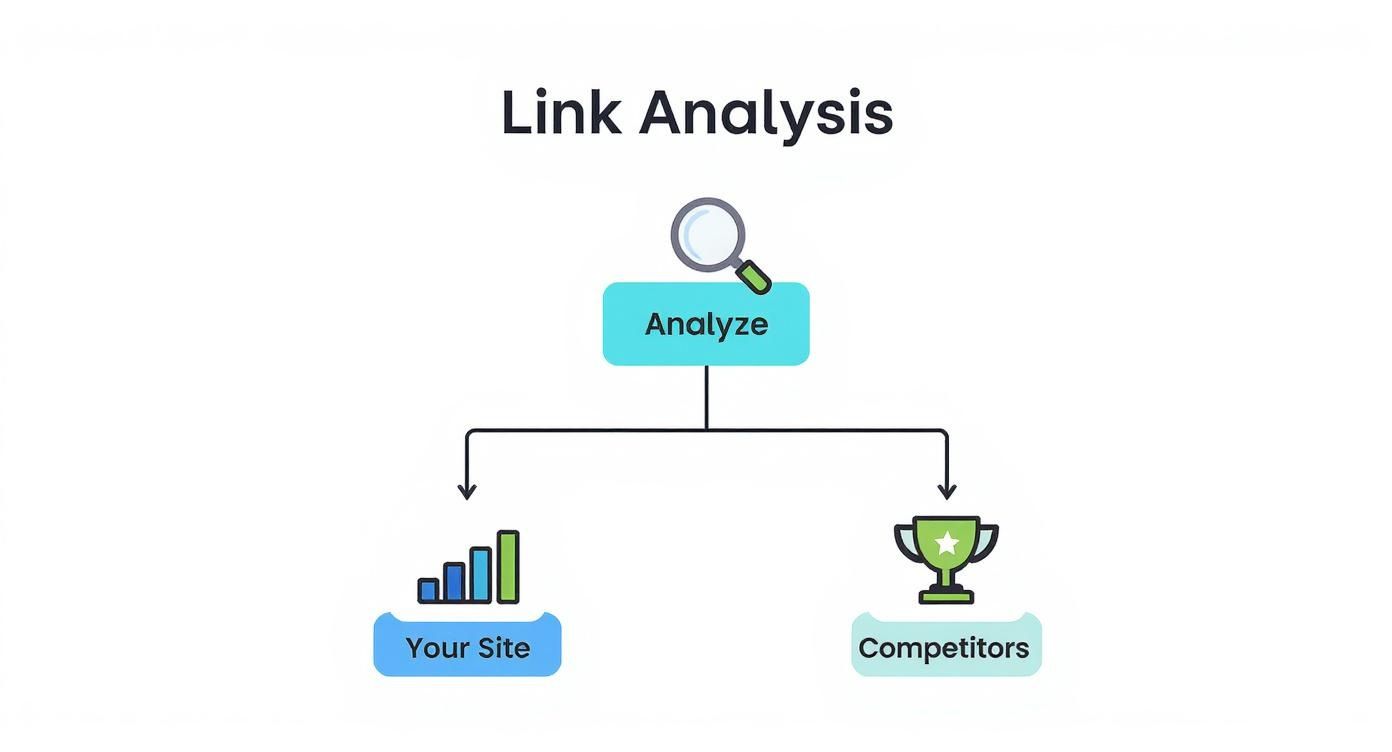
As the visual shows, your starting point—whether it’s looking at your own site or your competitors’—is what really tells you which tactics will pay off the most.
Master the Art of Guest Posting
Guest posting is a classic for a reason: it works. The idea is simple. You write an article for another website in your niche, and in return, you get a backlink to your site. This is usually in your author bio or sometimes within the content itself. This strategy packs a powerful one-two punch of a relevant backlink and direct exposure to a whole new audience.
I’ve found the process breaks down into a few key stages:
- Finding Opportunities: Use Google search operators like
"your keyword" + "write for us"or"your keyword" + "guest post"to find blogs that accept contributions. You can also use the competitor research you just did to spot sites that have already published posts from your rivals. - Crafting the Perfect Pitch: A generic, copy-pasted email is a fast track to the trash folder. Personalize your pitch by addressing the editor by name, mentioning a recent article of theirs you enjoyed, and proposing three specific, relevant topic ideas that their audience would love.
- Writing High-Value Content: Once you get the green light, your job is to deliver an article that’s so good they can’t possibly say no. Don’t hold back your best stuff; provide genuine value that makes their readers want to click over and learn more about you.
For example, a St. Petersburg-based digital marketing agency could pitch an article titled “5 Local SEO Mistakes Tampa Businesses Are Making” to a local business journal’s blog. This gives the journal’s audience incredible value while naturally positioning the agency as the local expert.
Capitalize on Broken Link Building
Broken link building is one of my favorite ways to earn links because you’re leading with value from the get-go. The strategy involves finding a dead link on another website, creating a resource that could replace it, and then reaching out to the site owner to suggest they swap the broken link for yours. You’re helping them, which makes them want to help you.
Here’s the breakdown: you find a resource page or a popular blog post in your industry. Using a tool like the Check My Links Chrome extension, you can quickly scan the page for any broken links that lead to a 404 error page.
When you find one, see what the original linked content was about. If you have a similar piece of content on your site—or can create one quickly—you’ve got a perfect outreach opportunity.
Your email would go something like this: “Hey, I was reading your excellent article on [topic] and noticed a link to [broken URL] isn’t working anymore. I actually have a similar, up-to-date guide on that exact topic here: [your URL]. It might be a great replacement to keep your article helpful for your readers.”
Secure Valuable Local SEO Citations
For small and mid-sized businesses targeting a specific geographic area, local citations are non-negotiable. A citation is any online mention of your business’s name, address, and phone number (NAP). Consistent NAP information across high-authority directories like Yelp, the Better Business Bureau, and industry-specific sites sends powerful trust signals to Google.
These aren’t just about links; they’re about verifying your business’s physical location and relevance for local searches. Make sure your NAP is 100% identical on every single platform. Any small difference can confuse search engines.
Think of link building not as a one-off task, but as an ongoing conversation. Whether you’re offering a guest post or fixing a broken link, you’re building relationships and demonstrating your value to the wider online community.
At the end of the day, the most effective strategies are the ones built on great content. Recent data shows that content marketing is considered the most productive method for earning backlinks, with 12.5% of SEO professionals naming it their top approach. Guest posting follows at 11.7%, proving the power of sharing your expertise. You can explore the full link building research from BuzzStream for more insights. This reinforces that creating valuable, shareable assets is the heart of modern link building.
While SEO is a long-term game, it works best when it’s in sync with your other marketing channels. To get a better handle on how everything fits together, you might be interested in our comparison of SEO vs. social media and which to prioritize. The right mix will depend on your specific business, but focusing on value and relationships is always the key to success.
Creating Content People Want to Link To

Sure, tactics like guest posting and broken link building get the job done, but they require constant, active effort. The real game-changer? Creating content so genuinely useful that other people want to link to it, often without you even asking.
This is the magic behind what we call a “linkable asset.”
Think of a linkable asset as a definitive resource on your website that naturally attracts backlinks. It’s not just another blog post; it’s a high-value piece of content that solves a real problem for your audience, making it an easy and authoritative source for others to cite.
This approach flips the script entirely. Instead of chasing individual links one by one, you build something that works for you 24/7, passively generating authority and traffic over time.
Brainstorming Your First Linkable Asset
The heart of a great linkable asset is utility and originality. You can’t just recycle what everyone else is saying. You need to offer a unique angle, fresh data, or a genuinely helpful tool that stands out from the noise.
So, where do you start? Listen to your customers. What questions do they ask over and over? What are the nagging problems in your industry that nobody has properly solved? Those pain points are goldmines for brainstorming.
Here are a few powerful formats that work time and time again:
- Original Research Reports: Survey your customers or industry peers and publish the findings. Data-driven content is a magnet for links because journalists and bloggers love citing fresh statistics to back up their claims.
- Ultimate Guides: Go deep. Create a truly comprehensive guide on a core topic, aiming to make it the single best, most thorough resource on the internet for that subject.
- Free Tools or Calculators: This is a huge one. If you’re a mortgage broker, a free mortgage calculator is an incredible link magnet. For a marketing agency, a simple headline analyzer could attract thousands of links from other marketers.
- Compelling Case Studies: Don’t just post a simple testimonial. Dig into the details. Outline the client’s problem, your specific solution, and the hard, data-backed results you delivered.
Let’s make this real. Imagine a home services company in Tampa. They could create a “Hurricane Preparedness Cost Calculator” for Florida residents. This tool is specific, incredibly useful for their target audience, and something local news outlets would be eager to link to during storm season.
From Idea to Published Asset
Once you’ve landed on a strong idea, the execution has to be top-notch. A clunky tool or a poorly designed infographic isn’t going to cut it. Your asset needs to look and feel professional, authoritative, and user-friendly.
Gathering your own data is often the toughest part, but it delivers the biggest payoff. If you’re putting together a research report, tools like SurveyMonkey or even Google Forms are perfect for collecting responses. Your existing email list is a fantastic place to start.
When it’s time to publish, think visually. Nobody wants to read a wall of text. Use custom graphics, charts, and a clean layout to make complex information easy to digest. This is where investing in a professional designer can pay for itself many times over.
The goal of a linkable asset isn’t just to be good; it’s to be the undeniable best resource on that specific topic. When someone searches for an answer, you want your asset to be the definitive solution they find and share.
Promoting Your Asset to Get the First Links
Creating an amazing resource is only half the battle. An asset nobody sees is useless. Your promotion plan needs to be just as thoughtful as your creation process.
Start with targeted outreach. Go back to that competitor analysis you did earlier and identify influential bloggers, journalists, and industry leaders who have already written about or linked to similar topics. These are your prime targets.
When you reach out, don’t just ask for a link. That’s a rookie mistake. Your email should be all about the value your asset provides to their audience. Personalize your message, explain what makes your resource unique, and show them how it could enhance a specific piece of content they’ve already published.
Of course, for any linkable asset to have long-term success, it needs to be found in search. A deep understanding of what people are looking for is critical. Our guide to long-tail keyword research can help you uncover the exact questions your audience is asking, ensuring your content perfectly meets their needs and drives organic traffic for years to come.
Mastering the Art of Outreach That Gets Replies

Creating a fantastic linkable asset is a huge step, but it’s only half the battle. The world’s best resource is useless if no one knows it exists. This is where outreach comes in—the art of making a connection and showing someone why your content is genuinely worth their time.
Your outreach email is often the first and only impression you get to make. It needs to cut through a slammed inbox, feel personal, and immediately show what’s in it for them. A generic, mass-blasted template is a guaranteed trip to the trash folder.
Success in link building outreach really just boils down to one simple principle: treat the person on the other end like a human, not just a target.
Finding the Right Person to Contact
Before you even think about writing an email, you have to find the right person to send it to. Pitching a generic info@company.com address is a complete waste of time. Your mission is to find the specific individual who actually has the power to add or update content on their site.
Start by looking for roles like:
- Content Manager
- Editor or Managing Editor
- Marketing Director
- SEO Specialist
You can often find these folks on a company’s “About Us” or “Team” page. If that’s a dead end, LinkedIn is your best friend. A quick search for the company name plus one of these job titles will almost always point you in the right direction. This little bit of detective work is what separates a successful pitch from a deleted one.
The single biggest mistake I see in outreach is failing to personalize. Addressing someone by name and mentioning a specific piece of their work shows you’ve done your homework and aren’t just firing off another automated request.
Crafting a Pitch That Gets a “Yes”
Once you have your contact, it’s time to write an email that feels personal and provides immediate value. A great outreach email isn’t about what you want; it’s about what you can offer them and their audience.
Over the years, I’ve found this simple structure works wonders for promoting a resource:
- A Genuine Compliment: Start with a specific, authentic compliment about a recent article or project. “I loved your recent post on local SEO strategies” hits way different than “I love your blog.”
- The Connection: Briefly explain why you’re reaching out. For instance, “I noticed in that article you linked to a guide on keyword research…”
- The Value Proposition: This is the core of your email. Clearly and concisely introduce your linkable asset and explain why it would be a valuable addition for their readers. Frame it as a way to enhance their existing content.
- The Clear, No-Pressure Ask: Make it easy for them to say yes. End with a simple suggestion like, “It might be a great resource to include for your audience. You can find it here: [Your URL].”
This approach works because you’re leading with their interests, not yours. You’re showing respect for their work and offering something that helps them improve it.
Following Up Without Being Annoying
People are busy. Inboxes are overflowing. It’s totally normal for a great pitch to get missed the first time around. That’s why a polite, gentle follow-up is a non-negotiable part of the process.
Wait about a week, then send a brief reply to your original email. Keep it short and friendly. Something as simple as, “Just wanted to follow up and see if you had a chance to look at this,” is often all it takes to bring your message back to the top of their inbox.
But don’t overdo it. One or two follow-ups is professional persistence. More than that comes across as spammy and can burn bridges. Know when to move on to the next opportunity.
How to Measure Success and Avoid Pitfalls
Link building is a long game, not an overnight fix. But if you aren’t tracking your progress, you’re essentially flying blind. Knowing how to measure your campaign is just as critical as the strategies you choose, because the data tells you exactly what’s working and where to double down.
Just counting the number of backlinks you get won’t cut it. The real value is in tangible business outcomes. By focusing on the right key performance indicators (KPIs), you can draw a straight line from your link building efforts to meaningful growth.
Key Performance Indicators to Watch
Instead of getting bogged down in dozens of different metrics, zoom in on the handful that actually move the needle. These are the KPIs that give you a clear picture of how your backlink profile is impacting your site’s performance and visibility.
Your main focus should always be on:
- New Referring Domains: This is a big one. Ten links from ten different websites are far more valuable than ten links from the same site. It shows search engines a much broader base of authority and trust.
- Organic Traffic Growth: Jump into Google Analytics or a similar tool and keep an eye on visitors coming from search engines. A steady climb in organic traffic is one of the strongest signals that your efforts are paying off.
- Keyword Ranking Improvements: Ultimately, the goal is to rank higher for the keywords that matter to your business. Tracking your position for these key terms shows the direct impact new links have on your search visibility. For a deeper dive, check out our guide on how to check keyword ranking.
Tracking these core metrics is how you prove the ROI of link building. When you see your organic traffic and keyword rankings climb as your referring domains increase, you know the strategy is working.
This kind of sustained investment is quickly becoming the norm. As of 2025, professionals are dedicating serious money to link building. Data shows that 47% of link builders spend over £600 monthly, and a notable 14% invest more than £1,500 each month. This trend just underscores the recognized value of quality backlinks. You can discover more insights about link building budgets on fatjoe.com.
Common Pitfalls and Black-Hat Tactics to Avoid
Knowing what not to do is just as important as knowing what to do. Getting tangled up in risky tactics can land you a severe Google penalty, wiping out all your hard-earned progress in an instant. Protecting your site’s integrity should always be priority number one.
Make sure you steer clear of these common mistakes:
- Buying Links from Sketchy Sources: Never, ever purchase links from private blog networks (PBNs) or shady link farms. These sites exist for the sole purpose of selling links and are easy for search engines to spot. A link should always be earned, not bought.
- Over-Optimizing Anchor Text: Using the exact same keyword-stuffed anchor text for every single backlink is a massive red flag for Google. A natural link profile has a healthy mix of anchor text, including your brand name, generic phrases like “click here,” and naked URLs.
- Acquiring Irrelevant Links: A backlink from a website in a completely unrelated niche provides almost no value and can look manipulative. Keep your efforts focused on acquiring links from sites within your industry or a closely related one.
By sticking to legitimate, value-driven strategies and carefully monitoring your core KPIs, you can build a powerful backlink profile that stands the test of time. This is the approach that delivers sustainable, long-term growth for your business.
At Netco Design LLC, we build SEO strategies that drive real, measurable results. If you want to elevate your digital presence and turn your website into a lead-generation machine, we’re here to help. Learn more about our revenue-focused approach.

