

table of contents
Before you even think about shortlisting agencies, the real work starts in-house. Jumping into discovery calls without a clear vision is like starting a road trip without a destination—you’ll burn time and money without getting anywhere. A great partnership hinges on knowing exactly what you want to achieve.
Success looks different for everyone. An e-commerce brand might need to boost online sales by 25% in six months. A B2B software company, on the other hand, might be focused on generating 50 more marketing-qualified leads (MQLs) per month for their sales team.
Don’t confuse marketing activities with business goals. “Ranking #1 for a keyword” is an activity. “Increasing demo requests from organic search by 40%” is a business goal. This distinction is everything when you’re evaluating an agency’s proposal.
Translate Business Objectives into Marketing Goals
Your big-picture business objectives need to be translated into specific, measurable marketing goals. This is the language agencies speak and the foundation for any strategy they build for you.
Here’s what that looks like:
- Business Objective: Increase local patient bookings by 20% this year.
- Marketing Goal: Generate 30 new patient form submissions per month through local SEO and Google Ads.
Or maybe:
- Business Objective: Expand into a new geographic market.
- Marketing Goal: Build brand awareness in the target region, achieving a 50% increase in branded search traffic.
For B2B companies, understanding how to generate leads from LinkedIn can help you set sharper goals and better evaluate an agency’s plan for that channel.
Establish a Realistic Marketing Budget
Once your goals are set, you need to put a number on them. So many businesses are shy about discussing budget upfront, but it just wastes everyone’s time. An agency can’t give you a realistic scope of work without knowing what you can invest. It’s pointless for them to pitch a massive $10,000/month strategy when you only have $3,000/month to work with.
Getting your goals, budget, and services ironed out first is a non-negotiable prep phase.
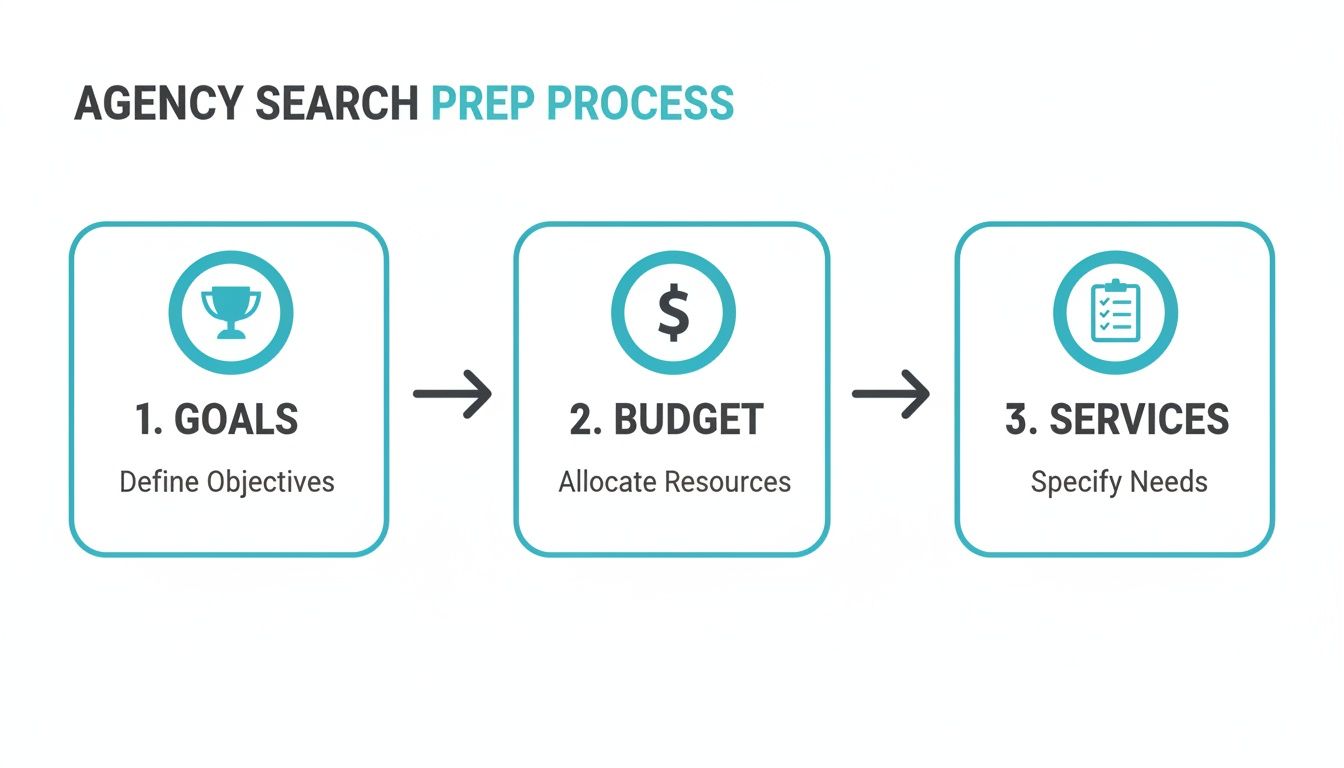
When figuring out your number, think about what you’ll handle yourself versus what you’ll outsource. A quick read on the pros and cons of in-house marketing vs. agency can help you decide where your money is best spent.
Prioritize Your Required Services
You don’t need every digital marketing service under the sun, at least not all at once. Based on your goals, create a simple list of “must-haves” and “nice-to-haves.”
For a local law firm, the must-haves are pretty clear:
- Local SEO to dominate the map pack.
- Reputation management to build trust with positive reviews.
- PPC campaigns targeting people searching for specific legal help.
A national SaaS company, however, would have a totally different list:
- Content marketing to establish authority and pull in organic traffic.
- Paid social media ads for laser-focused lead generation.
- Conversion rate optimization (CRO) to get more visitors to request a demo.
By completing this internal scorecard—goals, budget, and services—you create a powerful filter. You can instantly disqualify agencies that aren’t a fit, saving yourself from countless wasted hours and making sure every conversation you have is a productive one.
How to Evaluate an Agency’s Expertise and Results
Once you have a shortlist, the real investigation begins. It’s time to move beyond polished sales pitches and look for tangible proof that an agency can deliver. A slick website is easy to build, but consistent, measurable results for clients like you are what truly matter.
This is where you need to put on your detective hat, starting with their case studies and client stories. Don’t just skim them; dig into the details. A vague claim like “we increased website traffic” is a red flag. What you’re looking for is specificity that ties directly to real business outcomes.

Look Beyond Vanity Metrics in Case Studies
A great case study tells a story with data, connecting specific marketing actions to actual revenue. As you review their work, ask yourself these questions:
- Is it relevant? Are they showing results for businesses in a similar industry and of a comparable size? Success in e-commerce doesn’t automatically translate to lead generation for a local home service company.
- What was the starting point? Growing traffic from 100 to 1,000 visitors a month is a completely different ballgame than growing it from 100,000 to 200,000. Context is everything.
- Do they highlight business metrics? Look for hard numbers like revenue growth, customer acquisition cost (CAC), and lead-to-customer conversion rates. An increase in social media followers is nice, but it means very little if it didn’t generate any new business.
A top-tier agency will proudly showcase how they reduced a client’s cost per lead by 30% or increased their e-commerce sales by $50,000 in a single quarter. They focus on the numbers that hit your bottom line, not just the ones that look good on a chart.
This focus on measurable outcomes is critical. When you hire a digital marketing agency, you’re investing in an industry that now drives most global ad spending. In fact, digital ads account for about 67% of total ad spend worldwide, and 72% of marketing budgets are now funneled into digital channels.
Despite that, only 36% of marketers feel they can accurately measure ROI. A huge differentiator for any agency is their ability to provide transparent reporting tied to revenue—something 83% of marketing leaders say is a priority. You can dig into more of these trends by checking out key digital marketing statistics on theloopmarketing.com.
Vet Online Reviews and Team Expertise
After analyzing their curated success stories, it’s time to see what clients are saying out in the wild. Platforms like Clutch, Google Business Profile, and even Glassdoor can offer unfiltered insights.
When reading reviews, look for patterns. Do multiple clients praise their communication and proactive strategy? Or do you see repeated complaints about missed deadlines and subpar reporting? Pay close attention to how the agency responds to negative feedback, as it reveals a lot about their culture and commitment to client satisfaction.
Beyond reviews, it’s smart to assess the actual team you’d be working with.
- Certifications: Are their specialists certified in key platforms like Google Ads, HubSpot, or Google Analytics? This shows a commitment to professional standards and staying current.
- Thought Leadership: Does the agency’s own blog and social media presence show genuine expertise? If their content is just recycled, generic advice, it’s a warning sign their strategies might be just as uninspired.
- Team Stability: Hop on LinkedIn and check the profiles of key team members. How long have they been with the agency? High turnover can easily lead to inconsistent service and strategy drift.
Ultimately, you need a partner who can prove they generate a positive return. If they can’t clearly demonstrate how their work impacts revenue, it’s a gamble to assume they’ll be able to do it for you. If you want to get sharper on this yourself, check out our guide on how to calculate marketing ROI to better assess an agency’s proposals.
Asking the Right Questions to Find the Best Fit
Once you’ve checked out an agency’s portfolio and read their reviews, the real test starts in the discovery meetings. This is your chance to get past the sales pitch and see how they really operate. If you ask generic questions, you’ll get generic, rehearsed answers. To find a true partner, you need to dig into their process, communication style, and strategic thinking.
Think of these meetings less like an interview and more like a collaborative diagnostic session. You’re not just hiring another vendor; you’re bringing on a partner who should feel like an extension of your own team. The quality of your questions will directly shape the quality of the partnership you end up with.
Moving Beyond Surface-Level Inquiries
Every agency is going to tell you they do SEO, PPC, and social media. That’s the price of entry, and frankly, it’s useless information on its own. Your job is to uncover the “how” and “why” behind their work. Instead of asking what they do, shift your focus to how they solve problems and prove their value.
Here are a few strategic questions to get a real conversation going:
- “Walk me through your process for onboarding a new client like us.” This question tells you a lot about their organizational skills. A great answer will lay out a structured 30-60-90 day plan, mentioning things like technical audits, kickoff meetings, and goal alignment workshops. A vague answer is a red flag.
- “How will you measure the success of our campaigns and connect it back to our actual business goals?” This is a big one. It separates agencies that chase vanity metrics (likes, impressions) from those focused on your bottom line. Look for answers that talk about KPIs like Customer Acquisition Cost (CAC), lead-to-customer conversion rates, and overall marketing ROI.
- “If a campaign isn’t hitting its targets after the first 90 days, what does your process for course correction look like?” This tests their adaptability and honesty. A strong partner won’t panic. They’ll describe a data-driven process for figuring out what went wrong, forming new hypotheses, and transparently explaining the proposed changes.
These kinds of questions force them off-script and give you a genuine glimpse into their operational maturity.
Understanding the Team and Communication Flow
The people you talk to every day will make or break this relationship. It’s absolutely critical to understand the team structure and how communication works before you sign anything. Surprises here are rarely good ones.
You need total clarity on who you’ll be working with. Ask directly: “Who will be my primary day-to-day contact, and what is their role?” You want a dedicated account manager or strategist, not a generic support@ email address.
One of the most common frustrations I hear from businesses is the classic “bait and switch.” You get wowed by senior leadership during the sales process, only to be handed off to a junior, overworked team member once the contract is signed. Confirming your point of contact and their experience level is non-negotiable.
You also need to nail down their reporting and meeting cadence.
- Reporting: How often will you get performance reports (weekly, bi-weekly, monthly)? Ask to see a sample. A good report is a clear dashboard that visualizes progress against your goals, not a 50-page data dump designed to confuse you.
- Meetings: How often will you meet to discuss strategy and results? Is there a set agenda? Proactive, strategic communication is the hallmark of a great agency partner.
Many of these same principles apply when hiring for specific projects, like a website rebuild. If that’s something you’re considering, our guide on essential questions to ask a web designer will help you cover all your bases.
By asking these detailed questions, you shift from a place of uncertainty to one of confidence, ensuring the agency you choose is not just capable, but the right cultural and operational fit for your business.
Spotting a Truly Modern Agency’s Skills
The digital marketing playbook gets a major revision every few months. An agency that delivered incredible results two years ago might be running on an outdated strategy today. To make sure your investment pays off long-term, you need to find a partner with modern, forward-thinking skills that go beyond the basic menu of services.
This means looking for a team that doesn’t just keep up with change but actively prepares for what’s next. They should be able to walk you through a clear strategy that balances quick wins with sustainable growth, weaving different channels together to create results that build on each other.
A Smart Mix of Performance and Asset Building
A top-tier agency gets that a healthy marketing plan isn’t a one-trick pony. It requires a thoughtful blend of performance-driven channels and long-term asset building.
- Performance Channels: Think Pay-Per-Click (PPC) and paid social ads. These tactics are all about generating immediate traffic, leads, and sales. The results are fast and easy to measure, but the momentum dies the second you turn off the ad spend.
- Asset-Building Channels: This is where Search Engine Optimization (SEO) and content marketing come in. These efforts build your brand’s digital foundation over time, creating a valuable asset that keeps generating organic traffic and authority long after the initial investment.
Lately, the industry has leaned heavily into performance ads. Recent data shows 89% of agency leaders now consider PPC a core service, and 68% believe it will be the most effective channel going forward. But a truly great partner knows how to use PPC for those quick wins while simultaneously building your SEO engine for sustainable, cost-effective growth down the road.
Practical and Purposeful AI Integration
Artificial intelligence has officially moved from a buzzword to a must-have in modern marketing. Your job is to find an agency that uses AI in a practical way, not just as a slide in their sales deck. They need to explain exactly how their AI tools will help you hit your specific business goals.
An agency that just says, “we use AI,” is waving a red flag. A forward-thinking partner will say, “We use AI-powered analytics to identify high-intent audience segments for your ad campaigns, which should lower your cost-per-lead by about 15%.” The difference is specificity and a direct line to your ROI.
This also means they should be able to show you how they use newer strategies and tools, like leveraging AI for User-Generated Content (UGC) ads to create more authentic and compelling campaigns.
Finally, ask them how they’re preparing for a future where users get answers directly from AI assistants instead of a list of blue links. Their answer will tell you everything you need to know about whether they’re building for the future of marketing or just reacting to the present. For more ideas on this, check out our guide on AI for small business marketing.
How to Analyze Proposals and Spot Contract Red Flags
After all the discovery calls and demos, the proposals start hitting your inbox. This is where the promises get put on paper, and honestly, it’s the most critical moment in picking a digital marketing agency.
A good proposal is a roadmap for your success together. A bad one? It can lock you into a partnership that burns through your budget with nothing to show for it.
Think of the proposal as more than a price sheet. It needs to prove the agency gets your business, your customers, and the specific problems you talked about. If it reads like a generic, copy-paste template, that’s probably exactly what it is. A strong proposal is a custom strategy document that ties every single activity back to the business goals you shared.
What a Strong Proposal Must Include
A great proposal doesn’t leave you with questions. It should be a clear, straightforward document that outlines not just what they’ll do, but why they’re doing it and how everyone will know if it’s working.
Before you even glance at the price, scan for these essentials:
- A Real Understanding of Your Business: The intro should feel like it was written just for you. It should recap your goals, who you’re trying to reach, and where you stand in the market.
- A Custom-Fit Strategy: It should detail the specific tactics they recommend—whether that’s local SEO, PPC, or content marketing—and explain how they all work together to hit your targets.
- Specific, Tangible Deliverables: Vague promises like “improve SEO” are a huge red flag. You need concrete deliverables, like “publish four 1,500-word blog posts per month” or “manage a Google Ads budget of $2,000/month with bi-weekly performance reporting.”
- Clearly Defined KPIs: The proposal has to state exactly how success will be measured. This means calling out specific metrics like Cost Per Lead (CPL), Conversion Rate, or Return on Ad Spend (ROAS).
- Transparent Pricing: The cost structure needs to be dead simple. Whether it’s a monthly retainer, a project-based fee, or a mix, you should know precisely what you’re paying for.
A top-notch proposal will often include a quick analysis of your current website or marketing efforts. An agency that takes the initiative to run a basic technical review shows they’re already engaged and thinking about your business.
This is also a great chance to make sure you have a solid baseline of your own site’s health. You can learn more by checking out our guide on how to do a website audit to see what a proper analysis looks like.
Common Contract Red Flags to Watch Out For
Okay, so the proposal looks solid. Now comes the legal document—the contract. This is where you need to put on your detective hat. A good agency will give you a fair and clear agreement, but you have to watch out for a few common traps that can cause major problems later on.
1. Long-Term Lock-Ins Without an Escape Hatch
Be very, very careful with contracts that demand a 12-month commitment with no way out. A standard starting point is usually three to six months, which gives both of you time to see if it’s a good fit. If an agency is pushing hard for a long-term deal, it absolutely must include performance clauses that let you terminate the agreement if they don’t hit the agreed-upon KPIs.
2. Vague Language About What They’ll Actually Do
The contract needs to spell out every service and deliverable in your retainer. Ambiguous phrases like “ongoing optimization” or “social media support” are worthless. If it’s not in writing, it’s not guaranteed. Make sure the scope of work is detailed enough to prevent “scope creep” and surprise bills down the road.
3. Murky Ownership of Your Assets
This one is a total deal-breaker. You must retain 100% ownership of all your digital assets. This includes:
- Your website domain and hosting accounts
- Your Google Analytics and Google Ads accounts
- Your social media profiles
- Any creative content or ad copy they produce for you
Shady agencies might set up these accounts under their own name, basically holding your business hostage if you ever decide to leave. Get it in writing that all accounts will be created with you as the owner and administrator from day one.
A Few Final Questions Before You Hire
As you get close to making a final decision, a few key questions almost always come up. Getting straight answers is the last step to feeling confident you’re making the right move for your business.
Let’s walk through the most common concerns we hear from business owners and marketing leaders at this stage.
How Much Should I Expect to Pay for an Agency?
This is usually the first question on everyone’s mind, and the honest answer is always “it depends.” Agency retainers can run from $1,500 per month for a simple local SEO campaign all the way up to $15,000+ per month for a complex, multi-channel strategy for a larger company. The price tag is tied directly to the scope of work, the services you need, and the agency’s experience level.
Instead of hunting for the “cheapest” option, your focus should be on value. A $5,000/month agency delivering a 4:1 Return on Ad Spend (ROAS) is a much smarter investment than a $2,000/month partner who can’t produce any real results. Always tie the cost back to the business outcomes you’re trying to achieve.
What Is a Reasonable Timeframe to See Results?
Digital marketing requires a bit of patience, but you absolutely need a clear timeline. How long it takes to see traction really depends on the channels you’re using.
Here’s a realistic breakdown:
- PPC (Pay-Per-Click): You can get traffic and leads flowing almost instantly, sometimes within just a few days of launch. But turning that traffic into a profitable, optimized machine usually takes 1-3 months.
- SEO (Search Engine Optimization): Think of this as a long-term investment in your brand’s visibility. You might see small wins early on, but it generally takes 6-12 months to achieve significant, lasting results in organic rankings and traffic, especially if you’re in a competitive space.
Be very skeptical of any agency promising instant #1 rankings on Google. Real SEO is a marathon, not a sprint. Those kinds of guarantees are a massive red flag—it often means they’re using risky tactics that could get your site penalized down the road.
A good agency will give you a detailed roadmap for the first 90 days and beyond. This sets clear expectations and gives you milestones to track progress against.
Should I Choose a Niche Agency or a Generalist?
This decision comes down to your specific needs. There are strong arguments for both.
A niche agency that lives and breathes your industry (like “marketing for SaaS startups”) already gets it. They know your customers, your competitors, and the market’s pain points. This can seriously shorten the learning curve and get you to targeted results faster.
On the other hand, a generalist agency brings a wider perspective to the table. They might pull a successful strategy from an entirely different industry and apply it to your business in a fresh, innovative way. If your goals demand a broad mix of services across different platforms, a generalist can often provide a more seamless, integrated solution.
What Happens If I Want to End the Contract?
Knowing how to get out is just as important as knowing how to get in. Before you sign a single thing, make sure you understand the termination clause. Most reputable agencies work with a 30-day notice period that kicks in after an initial commitment term (usually 3-6 months).
This gives both sides enough time to wrap up active projects and handle a smooth transfer of all assets. The contract must state, without any ambiguity, that you retain 100% ownership of your website, ad accounts, and all creative work. This is a non-negotiable point that protects you from being held hostage if the partnership doesn’t work out.
Feeling ready to find a partner that can deliver real growth? Netco Design LLC builds custom digital marketing strategies focused on measurable results. Let’s talk about how we can help you attract more customers and increase your revenue. Schedule your free consultation today!

