

table of contents
Let’s be honest, a content calendar is more than a to-do list for your blog. It’s the strategic blueprint that turns random acts of content into a predictable engine for growth. Without laying the proper groundwork first, you’re just filling a schedule—not building a business.
Building Your Strategic Foundation

Before you even think about a single topic or deadline, you have to pour the foundation. This is where the real work happens, ensuring every article, video, or social post has a clear purpose. Miss this step, and even the most beautifully organized calendar will fall flat.
The explosive growth in planning tools tells the whole story. The global marketing calendar software market was valued at USD 12.5 billion in 2025 and is projected to hit USD 32.4 billion by 2035. That’s a compound annual growth rate of 10%. Businesses are moving away from reactive, “what should we post today?” thinking and embracing proactive, goal-driven planning.
Define Your Core Business Objectives
First things first: why are you creating content at all? The answer to this question should drive every single decision you make from here on out. Your content isn’t just content; it’s a tool to achieve a specific business outcome.
So, what are you trying to accomplish? Most goals fall into a few key buckets:
- Increasing Brand Awareness: Getting your name out there and establishing your expertise.
- Generating Qualified Leads: Attracting the right kind of potential customers and pulling them into your sales funnel.
- Improving Customer Retention: Keeping the customers you already have happy, engaged, and coming back for more.
- Driving Website Traffic: Boosting your organic search presence and getting more eyeballs on your key pages.
Here’s a pro tip: don’t try to do everything at once. Pick one or two primary goals for the quarter. This sharpens your focus and makes it way easier to measure what’s actually working.
A content calendar without clear goals is like a road trip without a destination. You’ll be busy moving, but you’ll never know if you’ve arrived. The most successful strategies begin by defining what “success” actually looks like.
Get To Know Your Audience Deeply
Okay, so you know why you’re creating content. Now, who are you creating it for? Generic content that tries to speak to everyone ends up speaking to no one. The magic happens when you create something that feels like it was written specifically for one person, addressing their exact problems.
This is where building out detailed audience personas is a game-changer. You need to go way beyond basic demographics like age and location. Dig into the psychographics—what motivates them? What keeps them up at night? If you need a starting point, you can learn how to create buyer personas that actually work.
Start by asking the tough questions:
- What are their biggest professional or personal headaches?
- What exact phrases are they typing into Google when they look for solutions?
- Where do they hang out online? Is it LinkedIn, a niche subreddit, or industry-specific forums?
- What format do they prefer? Are they busy execs who want a quick video or researchers who want a 3,000-word guide?
Answering these questions ensures your calendar is filled with topics your audience is genuinely searching for. This transforms your content from a one-way broadcast into a valuable conversation, setting the stage for a calendar that drives real results.
Defining Your Core Content Pillars And Formats

Now that you know your goals and who you’re talking to, it’s time for the fun part: building the creative framework for your content calendar. This is where you establish your content pillars—the big, overarching themes your brand will be known for. Think of them as the main sections in your library of expertise.
These pillars aren’t just random topics you enjoy. They need to sit right at the intersection of what your business does best and what your audience is dying to know. The sweet spot is usually between three and five key pillars. Any more, and your message gets watered down; any fewer, and you might run out of things to say. A big part of this is understanding what content pillars are so you can build real topical authority over time.
Brainstorming Your Content Pillars
To figure out your pillars, take a hard look at your products, services, and the problems you solve for your customers every single day.
Let’s imagine a local accounting firm. Their pillars could look something like this:
- Small Business Tax Planning: This would cover everything from quarterly estimates to clever year-end deductions.
- Bookkeeping Best Practices: Think software tips, demystifying financial statements, and managing cash flow.
- Business Growth Strategies: This connects the numbers to bigger ideas like scaling, pricing models, and boosting profitability.
- Navigating IRS Compliance: A more technical pillar for topics like audits, notices, and frustrating regulatory changes.
Each of these is broad enough to spark endless ideas but specific enough to scream “expert.” This structure guarantees that every blog post, video, or social update reinforces your authority. To see how this works in the real world, check out this practical content strategy example that shows how pillars tie directly back to business goals.
Diversifying Your Content Formats
Once your pillars are locked in, you have to decide how you’ll bring those ideas to life. Just writing blog posts over and over is a recipe for boredom. A truly effective content calendar looks more like a diverse investment portfolio—different assets designed to meet your audience where they are, in the format they actually prefer.
Varying your formats keeps things fresh and, even better, lets you repurpose ideas across different channels. That one big research report? It can easily be sliced and diced into a dozen smaller pieces of content.
The most engaging brands don’t just say the same thing over and over. They find different ways to tell the same core stories, using a mix of formats to capture attention across various platforms and stages of the customer journey.
Start mapping formats to your pillars. Not every topic works as a 2,000-word article. Some concepts are begging to be a visual infographic, while others need a deep-dive webinar.
Here are a few format ideas to sprinkle into your calendar:
- Blog Posts & Articles: The workhorses for SEO and building deep topical authority.
- Infographics: Perfect for making complex data easy to digest and highly shareable on social media.
- Short-Form Video (Reels/Shorts): Great for quick tips, behind-the-scenes content, and grabbing attention fast.
- Webinars & Live Q&As: Fantastic for generating leads and showcasing your expertise in real-time.
- Case Studies: Powerful social proof for building trust and showing you get real results.
- Email Newsletters: Your direct line to a highly engaged audience, perfect for sharing curated insights.
By planning a healthy mix of these formats under each pillar, you create a much richer and more dynamic experience for your audience. This approach not only prevents content fatigue but also squeezes every last drop of value out of each great idea.
Weaving SEO Into Your Content Planning
A content calendar without SEO is just a to-do list. You’re creating content, sure, but are you creating content people will actually find? Infusing smart SEO from the very beginning is what turns your schedule into a real traffic-driving machine.
It’s all about shifting from guessing what topics might land to planning your content around what your audience is actively searching for. That’s how you create content that serves both your readers and your business goals.
Uncovering Opportunities With Keyword Research
Keyword research is the bedrock of any content plan that’s serious about getting results. It’s how you find the exact words and phrases people type into Google when they need answers or are looking to buy. This isn’t just about chasing high-volume terms; it’s about understanding the intent behind the search.
Let’s say you’re a St. Petersburg-based accounting firm. You might think targeting a broad term like “small business taxes” is the way to go. But a little digging will almost always uncover more specific, high-intent queries that are far more valuable:
- “quarterly tax deadlines for Florida LLC”
- “S-corp vs LLC tax benefits Tampa Bay”
- “how to calculate self-employment tax in Florida”
These are long-tail keywords. They have less competition and signal that the searcher is much closer to needing professional help. To really get good at this, you should check out this in-depth guide on long-tail keyword research to start finding these hidden gems for your own business.
So many people make the mistake of doing keyword research once and then forgetting about it. Search trends evolve constantly. Your calendar needs a built-in process to refresh your keyword targets at least quarterly to stay relevant.
Building Authority With Topic Clusters
Once you’ve got a solid list of keywords, it’s time to organize them into topic clusters. The idea is simple: you create one big, comprehensive “pillar” page on a broad topic. Then, you surround it with several “cluster” articles that dive deep into specific subtopics.
Every cluster piece links back to that main pillar page. This sends a powerful signal to search engines that you’re an authority on the subject, which is a massive factor in how you rank. Instead of just writing random, one-off blog posts, you’re building an entire library of resources that answers every possible question your audience has about a core theme.
Here’s how our accounting firm could do it:
- Pillar Page: The Ultimate Guide to Small Business Tax Planning
- Cluster Content: Blog posts on “Estimated Tax Payments,” “Common Business Deductions,” and “Choosing the Right Accounting Software.”
Each piece is planned out on the calendar to strategically support the main pillar, creating an interconnected web of content that search engines love.
Tailoring Content For Different Channels
Your content calendar should be more than just a schedule for blog posts. A 2,000-word article that crushes it on your website will completely bomb on Instagram if you just copy and paste the link. Every platform has its own rules, audience expectations, and algorithms.
You have to plan for this right from the start. When a new idea goes into your calendar, you should also map out how it will be adapted for your key distribution channels.
- For the Blog: The full, in-depth, SEO-optimized article.
- For LinkedIn: A sharp summary of the article’s main takeaways, maybe framed as a question to get a conversation started with other professionals.
- For Instagram: A clean, visually driven carousel that breaks down the key points into five or six digestible slides with a strong call-to-action in the caption.
This approach squeezes every last drop of value out of each content idea, making sure it connects with people wherever they hang out online. And thinking bigger, you have to consider market dynamics. The global calendar market is projected to hit USD 43,400.2 million by 2025. Europe is seeing an 85.64% surge in adoption and Asia-Pacific an 81.68% growth. Meanwhile, North America is set to lead the marketing calendar software space, which shows how regional tech habits can shape tool choices. Read more on global market dynamics in this detailed report.
Choosing the Right Tools to Build Your Calendar
Once your strategy is locked in, it’s time to give it a home—a functional, living document where your content plan comes to life. The tool you pick can either become the central nervous system of your entire content operation or just another frustrating bottleneck.
There’s no single “best” option here. The right choice really comes down to your team’s size, budget, and how complex your workflow is.
Simple Spreadsheets vs. Dedicated Platforms
For solo creators or small teams just getting their sea legs, a simple spreadsheet can be surprisingly mighty. It’s free, you can customize it endlessly, and it gets the job done without a massive learning curve. But as your team and content volume grow, you’ll probably hit a ceiling where a dedicated platform isn’t just a nice-to-have; it’s essential.
A basic Google Sheets or Excel file is the perfect entry point. It forces you to think through what you actually need to track and helps you build a solid planning habit from the ground up. The cracks start to show when collaboration becomes a priority—version control gets messy fast, and real-time updates can be a nightmare.
This is where dedicated project management and content calendar tools shine. Platforms like Asana, Trello, and CoSchedule are built specifically for this. They offer features that spreadsheets just can’t touch:
- Task Dependencies: You can link tasks together so the designer can’t even start until the writer’s draft is approved.
- Automated Notifications: Team members get an automatic ping when a task is assigned or a deadline is creeping up.
- Seamless Collaboration: All the conversations, files, and feedback for a piece of content live in one tidy spot.
These platforms turn a static schedule into a dynamic workflow engine. Many also plug into other software, which is a huge plus for building effective marketing automation for small business operations, letting you connect your planning directly to your execution.
Essential Fields for Any Content Calendar
No matter what tool you land on, a great content calendar needs to capture the same core information. Think of these fields as the single source of truth for everyone involved, offering a complete, at-a-glance view of your content pipeline.
At a minimum, your calendar should include:
- Topic/Headline: The working title for the content piece.
- Content Pillar: Which of your core themes does this support?
- Primary Keyword: The main SEO target you’re aiming for.
- Format: Is it a blog post, video, infographic, or something else?
- Author/Owner: Who is the point person responsible for getting it done?
- Due Date: When the final draft is due.
- Publish Date: When it’s scheduled to go live.
- Distribution Channels: Where will this be shared after publishing (e.g., LinkedIn, email newsletter)?
- Current Status: A simple dropdown with options like “Idea,” “In Progress,” “In Review,” and “Published.”
The best content calendars aren’t just about plugging in dates. They are comprehensive production dashboards that give everyone total clarity on what’s being created, why it’s being created, who’s creating it, and where it is in the workflow.
This next image shows how a dedicated tool like CoSchedule organizes all these moving parts into a clean, visual interface.
Notice how the calendar view makes it immediately obvious what’s due and when, while all the nitty-gritty project details are neatly tucked away until you click in.
Finding the Right Fit for Your Team
For a small business in St. Petersburg, a powerhouse tool like CoSchedule might be overkill. A simple Trello board with columns for each stage of the content process could be the perfect middle ground—offering more visual organization than a spreadsheet without the complexity of a full-blown marketing suite.
The key is to start simple and scale as you go. Don’t let the hunt for the “perfect” tool paralyze you. Pick something that fits your needs right now, build out your essential fields, and focus on getting into a consistent planning rhythm. You can always migrate to a more powerful platform later as your content engine matures.
After all, the best tool is the one your team will actually use.
Creating A Sustainable Publishing Workflow
An ambitious content calendar is just a pretty document without a realistic workflow to bring it to life. I’ve seen it happen time and again: a perfectly planned schedule crumbles under the weight of its own ambition because the process wasn’t thought through.
The goal here isn’t to work harder; it’s to work smarter. By mapping out each step of your content production cycle, you get rid of that constant “what’s next?” chaos. You create a predictable rhythm that lets your team focus on quality and creativity, not logistical headaches.
Think of it as an evolution. Most of us start with a simple spreadsheet, but as the team and content machine grow, we need to add layers of collaboration and automation to keep things from falling apart.
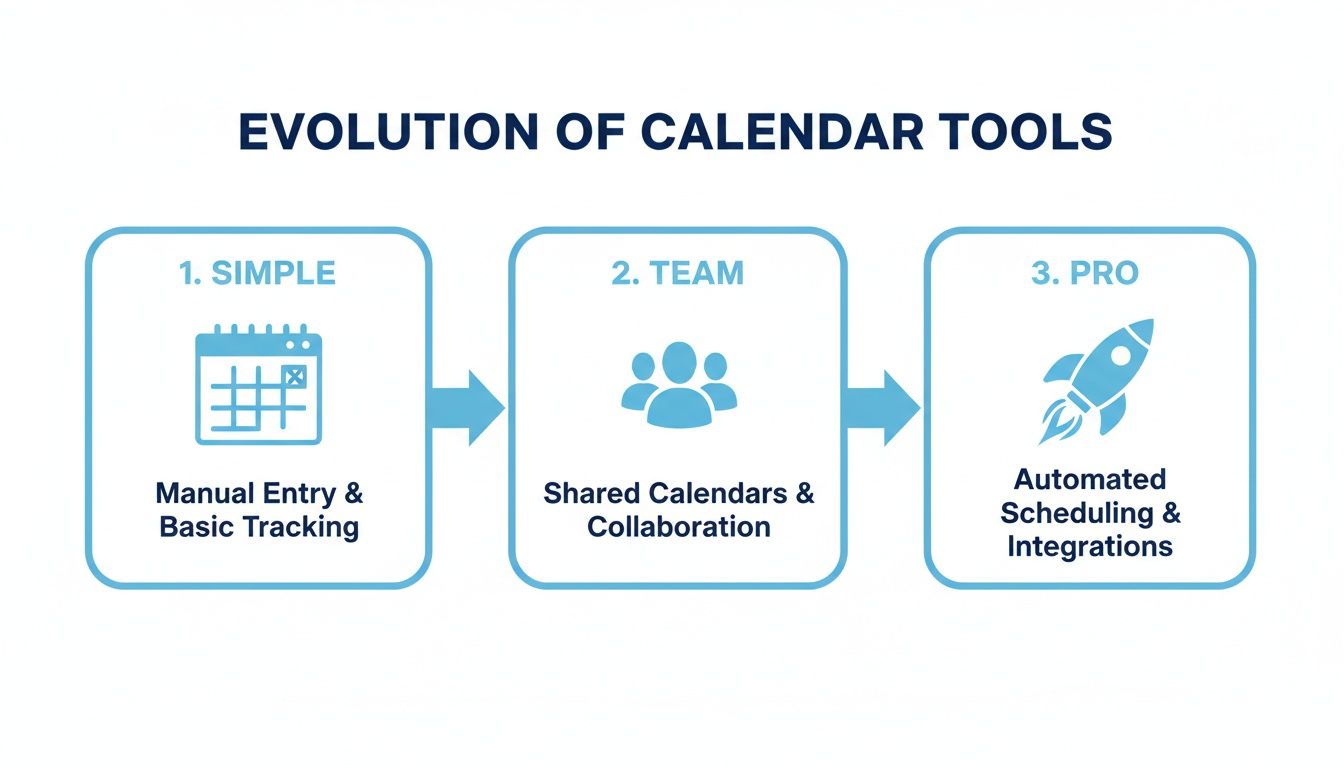
This journey from basic planning to professional execution is all about building a system that can support your growth.
Define Roles and Responsibilities
The very first step is to answer one critical question for every task: “Who owns this?” Ambiguity is the enemy of efficiency. When nobody’s sure who’s supposed to do what, deadlines get missed, and quality takes a nosedive.
Map out the entire journey for a piece of content and assign a clear owner to each stage. For a small business, one person might wear several hats, and that’s perfectly fine. The point is to make sure nothing slips through the cracks.
- Ideation: Who’s digging for new topics and checking them against keyword research?
- Creative Briefing: Who takes that raw idea and builds a structured brief for the writer, complete with the goal, audience, and target keywords?
- Writing & Creation: Who’s actually producing the asset—the blog post, video script, or social media graphics?
- Editing & Review: Who gives feedback, proofreads for typos, and makes sure the content hits the right brand voice?
- Design & Visuals: Who creates the featured images, social media assets, and any other graphics needed?
- Publishing & Promotion: Who’s responsible for the final upload, scheduling, and pushing it out across all your channels?
With these roles clearly defined, everyone knows exactly what they need to do and how their work tees up the next person in the chain.
A documented workflow isn’t about micromanagement; it’s about empowerment. It gives every team member the clarity and autonomy they need to do their best work without constantly asking for direction.
Establish a Predictable Publishing Cadence
One of the biggest mistakes I see businesses make is confusing frequency with consistency. Pumping out five articles one week and then going silent for a month just creates a jarring, unreliable experience for your audience. A sustainable workflow prioritizes a schedule you can actually stick to over the long haul.
Remember, consistency builds trust and authority far more effectively than random bursts of activity. It trains your audience to look forward to your content and tells search engines you’re a reliable source of information.
So, how do you find your rhythm? Be honest about your resources. Is publishing twice a week realistic, or is twice a month more achievable right now? Start there. It’s so much better to consistently hit a smaller target than to constantly miss an overly ambitious one. This approach not only builds a loyal audience but also prevents the team burnout that so often kills content marketing efforts.
Measuring Performance And Refining Your Strategy
A content calendar should never be a static document. Think of it as a living, breathing tool that needs to adapt to what’s actually working out in the wild. Publishing content is only half the battle; the real growth happens when you close that feedback loop, dig into the performance data, and make smart adjustments.
Without this final piece, you’re just throwing content at the wall and hoping something sticks. A systematic review process turns your calendar from a simple schedule into an intelligent system that gets smarter with every piece you publish.
Identifying Your Key Performance Indicators
Before you can measure success, you have to define what it actually looks like. Your key performance indicators (KPIs) should tie directly back to the business goals you set from the very beginning. Different goals mean tracking different metrics—what matters for one business might be a vanity metric for another.
For instance, if your primary goal is brand awareness, you’ll want to keep a close eye on:
- Organic Traffic: How many new visitors are finding you through search engines?
- Keyword Rankings: Are you climbing the search results for your most important terms?
- Social Media Reach: How many unique eyeballs are seeing your content?
On the other hand, if your main objective is lead generation, your dashboard is going to look completely different. You need to measure what actually drives action. If you’re new to this, our guide on what conversion rate is in marketing is a great place to start.
For a lead gen goal, you’ll want to track:
- Conversion Rate: What percentage of visitors are taking that desired action, like filling out a contact form?
- Leads Generated: How many new, qualified leads did a specific blog post or video actually produce?
- Click-Through Rate (CTR): Are people clicking on your calls-to-action, or are they just scrolling past?
Don’t get caught up in tracking vanity metrics. High follower counts or a flurry of “likes” feel great, but they don’t pay the bills. Focus on the numbers that directly reflect progress toward your core business objectives.
Establishing a Regular Review Cadence
Data is useless if you never actually look at it. To make your content calendar truly effective, you have to build a consistent review process right into your workflow. For most small businesses, a monthly or quarterly review hits the sweet spot.
This isn’t just a quick glance at a dashboard, either. It’s a dedicated time to dig into the “why” behind the numbers.
During your review, ask these critical questions:
- Which content pillars drove the most traffic and engagement? This tells you exactly where to double down your efforts.
- Which formats performed best? Did your audience love the in-depth guides, or were the quick-tip videos a surprise hit?
- What topics completely missed the mark? Knowing what not to create again is just as valuable as knowing what worked.
This analytical rigor is what separates thriving content programs from stagnant ones. Integrating analytics is so crucial that the marketing calendar software market was valued at USD 428.2 billion in 2024 and is projected to surge to USD 924.58 billion by 2032, largely driven by automation and data integration. With 74% of marketing teams globally using content to generate leads, the ROI is clear. You can read the full research about marketing calendar software trends to see where the industry is heading.
Common Content Calendar Questions
Even with the best-laid plans, questions always pop up when you’re in the thick of managing a content calendar. Getting a few of the most common ones answered upfront can save you a ton of headaches and keep your content engine humming along.
So, how far out should you actually plan your content? For most small businesses, planning one month ahead hits the sweet spot. It gives your team enough breathing room to research, create, and review everything without feeling rushed, but you’re still nimble enough to pivot if a timely opportunity drops in your lap. For bigger, more complex campaigns, you might need to look a full quarter ahead.
Handling Last-Minute Opportunities
What happens when unexpected news breaks or a new trend just explodes on social media? A rigid calendar can suddenly feel like a cage. The best way to handle this is to build flexibility right into your plan from the start.
I always recommend designating a few “flex spots” in your weekly or monthly schedule. Think of them as empty slots reserved for timely or reactive content. This way, you can jump on a trending topic without completely derailing the schedule you’ve already committed to.
A content calendar should be a guide, not a cage. The whole point is to create a structure that helps you stay consistent while still leaving room for the spontaneous, human moments that make content marketing work. Don’t ever be afraid to shuffle things around for a great opportunity.
What to Include in Your First Calendar
If you’re just starting out, don’t overcomplicate it. Your very first calendar only needs a handful of essential pieces to be effective. Focus on getting these basics right, and you can always add more detail later as your process gets more sophisticated.
Your initial template should cover:
- Publish Date: The day the content is scheduled to go live.
- Topic/Headline: A clear, simple title for the piece.
- Content Format: Is it a blog post, a video, an infographic, or something else?
- Status: A simple tracker (e.g., Idea, In Progress, Published) is all you need.
- Primary Keyword: The main SEO term you’re hoping to rank for.
While this guide walks you through the steps, you might find it helpful to get additional perspectives on the process by reviewing another guide on how to create a content calendar.
Ready to build a content strategy that turns clicks into customers? At Netco Design LLC, we specialize in creating and executing content plans that drive real business results for businesses in St. Petersburg and beyond. Let’s build your content engine together.

