

table of contents
Building a sales funnel really boils down to a handful of core activities: figuring out your audience, creating content that grabs their attention, building a landing page to get their contact info, and then following up to nurture that relationship. The whole point is to create a clear, predictable path that walks a potential customer from "just looking" to "take my money."
Your Blueprint for Predictable Growth
Before we start building, let’s get on the same page about what a sales funnel actually is. It’s not just a marketing buzzword; it’s a strategic roadmap that guides someone from their very first interaction with your brand all the way to their final purchase. A well-designed funnel gives you a reliable, repeatable system for bringing in new customers.
This structured approach is what turns curious visitors into paying clients. For businesses in professional services, e-commerce, or B2B, this kind of system is absolutely essential.
Why a Sales Funnel Matters
A sales funnel helps you truly understand your customer's journey. It shows you where to spend your marketing dollars for the best return and, just as importantly, where people are dropping off. You can finally see the friction points in your sales process that might be silently costing you money.
Think of it as a core business strategy that delivers compounding results over time.
The main benefits are straightforward:
- Saving Time: Automation and clear steps mean your team spends less time chasing leads that go nowhere.
- Lowering Acquisition Costs: By focusing on the right people with the right message, you stop wasting money on marketing that just doesn't connect.
- Building Sustainable Revenue: It creates a predictable process for generating sales you can count on, month after month.
One of the biggest mistakes I see is businesses treating their funnel as a "set it and forget it" tool. The most successful companies view their funnel as a living system, constantly testing and tweaking each stage to improve performance and adapt to what the market wants.
The Foundation of a Strong Funnel
The entire structure is built on one thing: a deep understanding of your market and your ideal customer. Before you can map out stages or write a single word of copy, you have to know exactly who you're talking to.
This is where a proper market assessment becomes critical. To learn more, check out our guide on how to do a market assessment.
Ultimately, learning the fundamentals of how to build sales funnels that actually convert is invaluable. With this blueprint in hand, you can finally move from an inconsistent trickle of leads to a predictable engine for growth.
Mapping Your Customer Journey from First Glance to Final Sale
Turning the idea of a "funnel" into a practical roadmap is where the magic really happens. This map is built around the four classic stages every potential customer goes through: Awareness, Interest, Consideration, and Action. When you know where someone is in their journey, you can meet them with the right message at the right time.
This isn't just marketing theory; it's a concrete framework.
Let’s say you run a local roofing company in St. Petersburg, Florida. A homeowner finds your blog post about preparing for hurricane season (Awareness). Intrigued, they download your "Post-Storm Roof Inspection Checklist," giving you their email in return (Interest).
Over the next week, they get a few automated emails with client success stories and a clear breakdown of your repair process (Consideration). Convinced you're the expert they need, they click the link in the final email to schedule an inspection (Action). That journey wasn't an accident—it was designed, step by step.
The Awareness Stage: Catching Their Eye
At the very top of your funnel, the goal is simple: get noticed by your ideal customer. They have a problem, even if they can't quite put a name on it yet. Your job is to show up as a helpful resource, not just another company trying to sell something.
This stage is all about broad-reach marketing. Think less "buy now" and more "here's something useful."
Here’s what works well for building awareness:
- SEO-Optimized Blog Posts: Answer the exact questions your customers are typing into Google. A financial advisor might write, "5 Common Mistakes to Avoid in Your Retirement Plan."
- Social Media Content: Share engaging videos, infographics, or quick tips where your audience hangs out. A personal trainer could post short at-home workout clips on Instagram.
- Local SEO: Make sure your business pops up on Google Maps and in local search results. This is absolutely critical for service businesses like plumbers or dentists.
- Paid Social Ads: Use targeted ads on Facebook or LinkedIn to put your most helpful content in front of specific demographics.
The Interest Stage: Earning Their Trust
Once you have their attention, the next step is to turn that casual glance into genuine interest. This is where you convert a passive visitor into an active lead by offering them something valuable in exchange for their email address.
This valuable "something" is called a lead magnet. Its only job is to solve a specific problem for your prospect and give them a taste of your expertise. For a lead magnet to work, it has to be super relevant and instantly useful. The more you understand your ideal client, the better your offer will be. (Our guide on how to create buyer personas is a great place to start.)
The key to a great lead magnet is specificity. A generic "free newsletter" is far less appealing than "The Ultimate 10-Point Checklist for First-Time Homebuyers." One is a vague promise; the other is a tangible solution.
The Consideration Stage: Making Your Case
Now that you have a direct line to their inbox, it's time to nurture that relationship. Your lead is now actively looking at their options, and your goal is to build trust and position your business as the obvious choice.
This is usually handled with an automated email sequence or targeted remarketing ads. The content here shifts from general advice to information that highlights why you are the best solution.
Content that shines in the Consideration stage includes:
- Case Studies: Tell detailed stories of how you helped a past client solve the exact problem your lead is facing.
- Webinars or Demos: Offer an in-depth look at your product or service in action.
- Client Testimonials: Let your happy customers do the selling for you. Social proof is incredibly powerful.
- Comparison Guides: Honestly compare your solution to competitors. This helps leads make an informed decision and builds trust.
The Action Stage: Closing the Deal
Finally, we're at the bottom of the funnel. Your prospect is ready to make a choice. The Action stage is where you make a clear offer and ask for the sale. Your call-to-action (CTA) needs to be direct, simple, and frictionless. Anything that causes confusion—like a clunky checkout process or a buggy scheduling tool—can make a qualified lead walk away.
This is where all your hard work pays off. Having a documented path to this point is what separates businesses that thrive from those that just get by. In fact, research shows businesses with a well-documented sales funnel generate 2.3 times more ROI than those winging it.
Unfortunately, only 32% of businesses have a clearly defined funnel. But here's the kicker: companies that optimize theirs quarterly have seen revenue jumps up to 18 times greater than stagnant ones. You can discover more insights about these sales funnel statistics on marketingltb.com.
Building the Core Components of Your Funnel
Okay, you’ve mapped out the customer journey. Now it’s time to roll up your sleeves and actually build the pieces that will guide people from one stage to the next. This is where the theory becomes a tangible system for generating real leads and sales.
Think of it like this: your lead magnet is the hook, the landing page is the handshake, and your email sequence is the first conversation. Each one has a specific job to do, and they all need to work together smoothly to move your business forward.
Crafting a Compelling Lead Magnet
First up is the lead magnet. This is the valuable, problem-solving resource you offer in exchange for an email address. Its entire purpose is to solve a very specific problem for your ideal customer, giving them a quick win and a taste of the value you provide.
Let's be honest, a generic "sign up for our newsletter" offer doesn't cut it anymore. Your lead magnet has to be genuinely irresistible.
Here are a few high-impact ideas I've seen work time and time again:
- Checklists: A simple, one-page PDF that helps someone get a task done. A home services company, for example, could offer a "DIY Spring Maintenance Checklist."
- Ebooks or Guides: A deeper dive into a more complex topic. A financial advisor might create a guide titled "The 5 Pillars of a Secure Retirement."
- Webinars or Video Trainings: A live or pre-recorded session that teaches a specific skill. A marketing agency could host a webinar on "How to Get Your First 100 Local Customers."
- Templates or Swipe Files: A ready-to-use resource that saves your audience a ton of time. A web designer could provide a "High-Converting Homepage Copy Template."
The real power of a great lead magnet is in its specificity. It should feel like it was created for just one person—your ideal customer—to solve one pressing problem they're facing right now. That kind of focus is what drives action.
This is the bridge that turns a casual browser into an engaged lead, moving them from awareness to genuine interest.
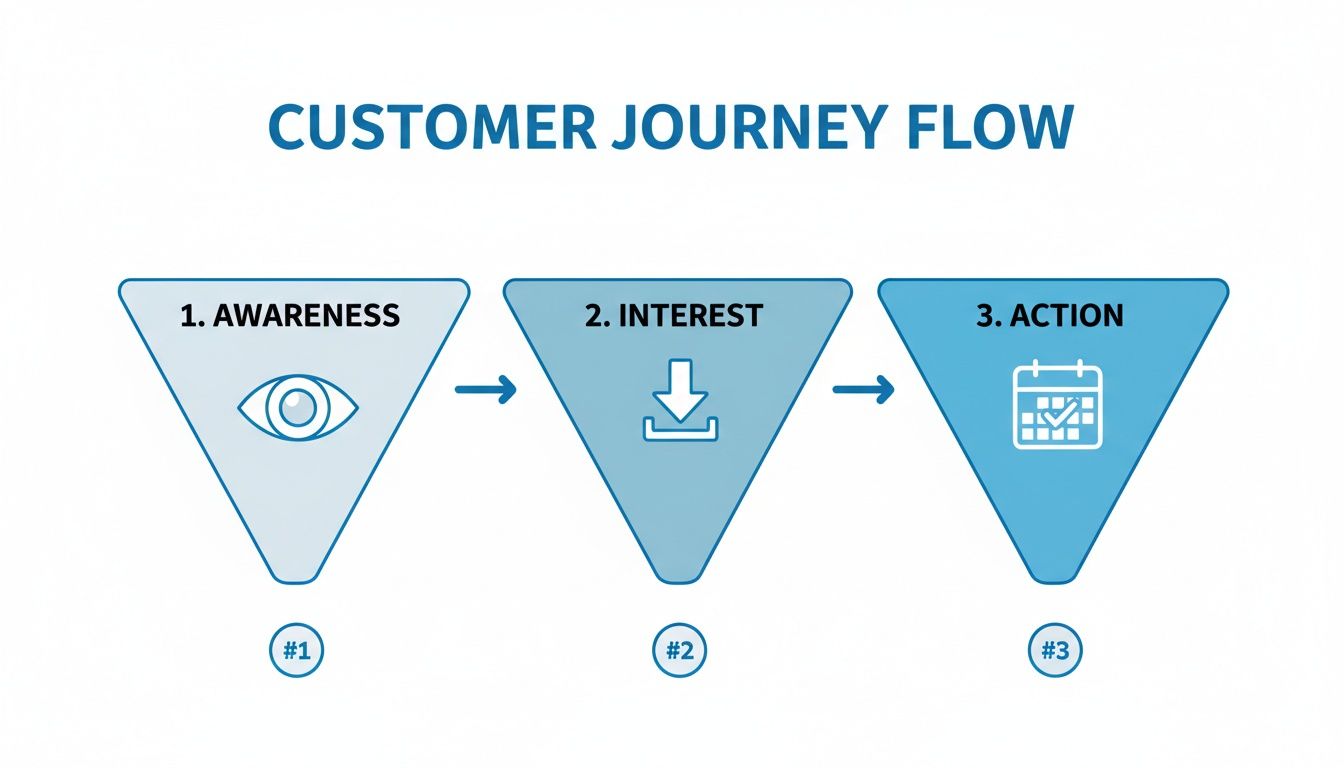
As you can see, the lead magnet is the critical link between the 'Awareness' and 'Interest' stages, capturing attention and starting a real relationship.
To help you organize these assets, here’s a quick breakdown of what you'll need for each stage of your funnel.
Core Funnel Components by Stage
Here's a breakdown of the essential marketing assets and channels for each stage of the sales funnel, helping you align your efforts with the customer journey.
- Top of Funnel (Awareness): The primary goal is to attract new visitors and build brand awareness. Key channels include SEO, social media, content marketing, and paid ads. Example content would be blog posts, infographics, social media updates, and short videos.
- Middle of Funnel (Interest): The main goal is to capture leads and educate prospects. Key tactics include using landing pages, email marketing, and webinars. Example assets are lead magnets (like checklists or ebooks), webinars, and case studies.
- Bottom of Funnel (Action): The goal is to convert leads into customers and drive sales. This is done through email nurture sequences, sales pages, and retargeting ads. Key assets include free consultations, product demos, testimonials, and special offers.
With this structure in mind, you can strategically build out each component to guide your audience smoothly toward becoming a customer.
Designing a High-Converting Landing Page
Once you have an amazing lead magnet, you need a dedicated place to offer it. That's your landing page—a standalone web page designed with a single, focused goal: to get visitors to take one specific action. In this case, it’s downloading your free resource.
Unlike your homepage, which is full of links and distractions, a great landing page is ruthlessly minimalist. Every single element, from the headline to the button, supports its one and only goal. In fact, research shows a page with a single conversion goal can boost conversions by as much as 266%.
Here are the must-have elements for an effective landing page:
- A Powerful Headline: State the benefit of the lead magnet clearly. It should grab attention and speak directly to your visitor's pain point.
- A Clear Value Proposition: Use bullet points to quickly explain what they'll get and how it will help them.
- An Unmissable Call-to-Action (CTA): Your button needs action-oriented text (like "Download My Free Checklist") and should stand out visually.
- Minimal Form Fields: Only ask for what you absolutely need. Usually, a name and email address are plenty to get started.
- Social Proof: Add a testimonial or a client logo to build instant trust and credibility.
And don't forget, page speed is everything. Even a one-second delay in page load time can cause a 7% reduction in conversions. To get this right, you can learn more about our landing page design best practices in our detailed guide.
Writing a Simple Yet Effective Email Nurture Sequence
The moment someone downloads your lead magnet, the conversation has just begun. The next move is to nurture that new lead with a series of automated emails. This email nurture sequence is designed to build trust, deliver more value, and gently guide them toward your main offer.
This is not the time for a hard sell. The goal here is to establish your brand as a helpful, authoritative resource.
A simple three-part sequence can be incredibly effective to start:
- The Welcome Email: This goes out immediately. It delivers the lead magnet and thanks them for signing up. It also sets the stage for what they can expect from you next.
- The Value Email: Send this a day or two later. Provide another useful tip, a link to a relevant blog post, or a short case study. You're reinforcing your expertise without asking for anything in return.
- The Soft Pitch Email: A few days after the value email, this message connects the problem your lead magnet solves to the bigger solution your product or service provides. It ends with a soft call-to-action, like an invitation for a free consultation or a link to your services page.
By building these three core components—your lead magnet, landing page, and email sequence—you create the essential architecture of your sales funnel. With these assets in place, you’ll have a reliable system for turning strangers into genuinely interested prospects.
Driving Targeted Traffic into Your New Funnel
You’ve built the engine—the lead magnet, the landing page, and the email sequence. Now it’s time to add the fuel. An expertly designed sales funnel is only as good as the traffic you send into it, and the key is making sure the right people find their way in.
This isn’t about choosing between organic or paid traffic; it's about making them work together. A smart mix lets you build a sustainable, long-term audience while also getting immediate results and crucial data to fine-tune your entire machine.
Attracting Prospects with Organic Search
Organic traffic is incredibly powerful because it connects you with people who are actively searching for a solution. They have a problem, they know it, and they’re on Google looking for answers. When your content shows up, you aren't interrupting them—you're helping them.
For most small and mid-sized businesses, this boils down to two things: a solid content strategy and smart local SEO.
A targeted content strategy means creating useful blog posts, guides, or videos that answer the exact questions your ideal customers are asking. A home services company in St. Pete, for example, might publish an article on "The Best Hurricane-Proof Windows for Florida Homes." This not only pulls in qualified visitors but also positions the business as a trusted local authority.
Local SEO is just as critical for businesses serving a specific area. This means optimizing your Google Business Profile, encouraging local customer reviews, and making sure your website content is relevant to your service area. Get it right, and you’ll start showing up in the "map pack" for searches like "roofer near me," driving highly motivated leads right to your funnel.
Getting Immediate Results with Paid Advertising
While organic strategies build momentum over time, paid advertising gives you instant visibility. It’s perfect for testing a new offer, driving a burst of traffic to your funnel, and reaching hyper-specific audiences you just can't target organically.
For most SMBs, this means Google Ads and social media ads.
With Google Ads, you can bid on the keywords your prospects are using to find solutions, putting your landing page right at the top of the search results. This is the best way to capture high-intent traffic—people who are ready to make a move now. Our team lives and breathes these campaigns, and you can learn more about our approach to pay-per-click advertising management.
On the other hand, platforms like Facebook and Instagram let you target users based on their demographics, interests, and online behaviors. This is fantastic for building awareness at the top of the funnel, especially for e-commerce brands or services with strong visual appeal.
A common mistake is treating paid ads like a faucet you just turn on and off. Think of it as a laboratory instead. Use it to test your headlines, offers, and audiences. The data you get from a small, controlled campaign can inform your entire marketing strategy for months.
The Power of Remarketing
So, what about all the people who visit your landing page but don’t convert? That’s where remarketing comes in. It lets you show targeted ads specifically to people who have already visited your site.
It's a ridiculously effective way to stay top-of-mind and bring interested prospects back into your funnel.
You could show a visitor who read a blog post an ad for your related lead magnet. Or, maybe you show someone who abandoned their shopping cart a special discount to nudge them back. Since these people are already familiar with your brand, the conversion rates are often much higher than ads targeting a cold audience.
This isn't guesswork—data shows that paid search is a leading traffic source, with an average conversion rate of 2.9% across 14 industries. For e-commerce brands, mobile traffic might bring in 68% of visitors, but desktop is where the sales happen, converting at 3.9% compared to mobile's 2.0%. You can find more of these sales funnel stats over at electroiq.com. It all points to the need for a smart, multi-channel traffic strategy.
By combining the steady, authoritative pull of organic search with the immediate feedback of paid ads and the persistent follow-up of remarketing, you create a complete system for filling your funnel. This balanced approach ensures you're building for the long haul while getting the results you need today.
How to Measure and Optimize Your Funnel for Better Results

Getting your sales funnel live is a huge step, but it’s just the starting line. The real magic—the part that builds a reliable, revenue-generating machine—happens next. A funnel isn't a "set it and forget it" tool; it's a dynamic system that demands constant attention, measurement, and fine-tuning.
Your initial launch is where you get your first batch of real-world data. This information is pure gold. It shows you exactly how people are moving through your funnel, highlighting what’s clicking and, more importantly, where the leaks are. This is where you switch gears from building to optimizing.
Identifying Your Key Performance Indicators
To make meaningful improvements, you have to know what to measure. Tracking fuzzy metrics is a waste of time. Instead, you need to zero in on the Key Performance Indicators (KPIs) that directly map to your results at each stage of the journey. These numbers tell the story of your funnel's health.
At the top of the funnel, where your goal is to capture new leads, your north star is the Landing Page Conversion Rate. This is simply the percentage of visitors who sign up for your lead magnet. If this number is low, it’s a red flag that something is off with your offer, your headline, or even the page design itself.
Once a lead is inside your funnel, your focus shifts to these middle-of-funnel metrics:
- Email Open Rate: Are your subject lines strong enough to cut through a noisy inbox? The average open rate hovers around 21%, so if you're falling far short, your subject lines need a serious rewrite.
- Email Click-Through Rate (CTR): This tells you how many people who opened your email actually clicked the link inside. A weak CTR means your email copy isn't persuasive enough to get them to take the next step.
Finally, at the bottom of the funnel, the ultimate metric is your Overall Funnel Conversion Rate. This is the percentage of total leads who turn into paying customers. This KPI, paired with your Cost Per Acquisition (CPA)—what you spend to land one new customer—reveals whether your funnel is actually profitable.
Plugging Leaks with A/B Testing
Once your KPIs have pointed out a weak spot, it's time to start testing. The best way to do this is with A/B testing (or split testing), where you pit two versions of a single element against each other to see which one performs better.
A/B testing takes the guesswork out of optimization. Instead of just hoping a new headline will work, you can test it against the original and let the data declare a winner. The golden rule is to test only one variable at a time. If you change the headline, the button color, and the main image all at once, you’ll have no idea which change actually made the difference.
Don't underestimate the impact of small changes. I once worked with a client who saw a 25% increase in landing page conversions just by changing their call-to-action button text from "Submit" to "Get My Free Guide." Simple tweaks can produce dramatic outcomes.
Here are a few high-impact elements to start A/B testing:
- Landing Page Headlines: Test a benefit-driven headline versus one that agitates a pain point.
- Call-to-Action (CTA) Buttons: Experiment with different colors, text, and even placement.
- Email Subject Lines: Try a question-based subject line against a direct statement.
- Your Offer: Test different lead magnets or pricing structures to see what resonates most.
Using Analytics to Understand User Behavior
While KPIs tell you what is happening, tools like Google Analytics help you understand why. Analytics platforms give you a window into user behavior, showing you where people come from, what they do on your pages, and where they drop off.
For example, your KPIs might show that your landing page has a high bounce rate. A quick look at Google Analytics could reveal that most of that traffic is coming from mobile devices. That insight might lead you to discover your page isn’t optimized for mobile, giving you a clear, actionable problem to solve.
By combining the hard numbers from your KPIs with the behavioral insights from analytics, you create a powerful feedback loop. You’re no longer making decisions based on hunches; you’re making strategic adjustments backed by real data. For more strategies on this, check out our guide on how to improve website conversion rates.
This continuous cycle of measuring, testing, and analyzing is what turns a good sales funnel into a great one. It’s an ongoing process that ensures your funnel adapts and improves, becoming a more efficient and profitable asset for your business with every iteration.
Got Questions About Building a Sales Funnel?
Jumping into your first sales funnel usually stirs up a few questions. It’s totally normal to wonder if you’re heading in the right direction. Let’s walk through some of the most common hurdles I see business owners run into and get you some clear answers.
"How Long Should My Funnel Be?"
This is probably the number one question I get. The honest answer? It depends entirely on your product's complexity and price tag.
If you're selling a simple, low-cost e-commerce product, a short and sweet funnel is often all you need. Think a social media ad that clicks straight through to a sales page. Done.
But for a high-ticket service, like custom web design, you need to build trust and show your value over time. That kind of funnel requires a much longer nurturing process. It might look something like this:
- A valuable lead magnet to capture their email.
- A multi-part email sequence that tells your story and offers insights.
- A detailed case study to prove your results.
- A final consultation call to close the deal.
The more someone has to think about a purchase, the more steps you’ll need to guide them.
"What If I Don't Have a Lot of Content?"
This is another big one. Many people think they need a huge library of blog posts to even start, but that’s not true. You can get going with just one high-value lead magnet that solves a real, pressing problem for your ideal customer. Once you have that, a simple three-part email sequence is enough to get the ball rolling.
You can also get creative and repurpose what you already have:
- Blog Post to Video: Turn a popular blog post into a quick, engaging video for social media.
- Webinar to Guide: Take a successful webinar, transcribe it, and polish it into a downloadable PDF guide.
- Client Questions to FAQ: Gather the most common questions you get from clients and turn them into an FAQ page or a helpful email.
The goal here is quality over quantity, especially when you're just learning how to create a sales funnel that actually works.
"How Much Should I Spend on Ads?"
Throwing money at ads without a plan can feel like a shot in the dark. Instead of guessing, work backward from your goals. First, you need to know your Customer Lifetime Value (CLV) and decide on an acceptable Cost Per Acquisition (CPA).
Let's say a new client is worth $2,000 to your business over their lifetime. You might decide you're comfortable spending up to $500 to acquire them. Just like that, you have a data-backed budget.
Start with a small, daily budget to test everything—your ads, your landing page, your offer. Once you see positive results and have the data to back it up, you can scale your spending with confidence.
Your initial ad spend isn’t just an expense; it’s an investment in data. You’re paying to learn what messages resonate, which audiences convert, and how your funnel performs in the wild.
The key is to start small, measure everything, and only pour more money in once you have a proven, profitable system. This methodical approach takes the guesswork out of the equation and protects your marketing dollars.
Building and optimizing a sales funnel is a powerful way to generate predictable growth, but it requires expertise and constant refinement. At Netco Design LLC, we specialize in creating revenue-focused digital marketing systems that turn visitors into loyal customers. Let us build the engine that drives your business forward. Explore our custom web design and marketing services today.

