

table of contents
So you want to create buyer personas. At its core, that just means building research-based profiles of your ideal customers. You’ll be digging into data on their goals, challenges, and buying habits, then turning all that information into a detailed character sketch.
This sketch becomes the North Star for your marketing decisions. It’s the difference between shouting into a faceless crowd and having a meaningful, one-on-one conversation.
Why Generic Marketing Fails and Personas Win

Let’s talk about a real-world scenario I see all the time. Imagine a small tech startup launching a slick new project management tool. Their marketing strategy? Blast digital ads at anyone with “manager” in their job title.
The result was predictable: a sky-high ad spend, dismal click-through rates, and a few unqualified leads who didn’t get what the product was for. They were marketing to a ghost, and the message just vanished into thin air.
This is a classic mistake. Generic marketing is a fantastic way to burn through your budget because it’s built on a faulty assumption—that everyone in a broad demographic group thinks and acts the same. It’s like trying to open a specific lock with a key that kinda-sorta fits every door on the street. It’s clunky, inefficient, and almost never works.
The Power of Specificity
This is where knowing how to create buyer personas completely changes the game. Instead of just guessing, you build a detailed, semi-fictional profile of your ideal customer that’s grounded in real data and actual market research. We’re going way beyond basic demographics here. It’s about getting inside their world.
A well-crafted persona helps you answer the questions that really matter:
- What are their biggest headaches at work?
- What does a “win” look like for them at the end of the day?
- Who do they trust for advice and information?
- What’s the trigger that sends them looking for a solution like yours?
Once you have those answers, you can tailor everything—from your ad copy to your blog posts—to connect with a specific person. For that startup we mentioned, it meant they stopped targeting “all managers” and started talking to “Marketing Manager Molly,” a professional who’s struggling to keep her remote team’s campaigns on track. All of a sudden, their messaging became laser-focused and incredibly relevant.
Tangible Business Impact
Moving from a generic shotgun approach to a persona-driven one delivers results you can actually measure. For starters, companies that implement buyer personas can improve their lead targeting by as much as 73%. It doesn’t stop there. Those who use personas in their sales process have seen a 19% increase in revenue growth and a 14% boost in client retention rates.
By defining who you are talking to, you give your marketing a clear voice and direction. It’s the foundation for a strategy that attracts, engages, and converts the right people—not just anyone.
This clarity ripples through your entire strategy, influencing everything from the SEO keywords you target to the tone you use on social media. A detailed persona is the common thread that ties every piece of your marketing together, ensuring it’s always consistent and relevant. In fact, this focused approach is a core part of any successful content strategy example you’ll find.
Now, let’s walk through the practical, step-by-step process of researching and building personas that will quickly become your most valuable marketing asset.
Finding the Truth in Your Customer Data
Great buyer personas are built on truth, not assumptions. Forget brainstorming in a conference room; you need to become a data detective and dig into the real story of who your customers are.
Creating a powerful persona is less about invention and more about discovery. It’s a blend of the “what” you find in your analytics and the “why” that only comes from real human conversations.
The good news? Most businesses are already sitting on a goldmine of this information. You just need to know where to look.
Digging into Your Quantitative Data
Quantitative data gives you the hard numbers—the indisputable facts about customer behavior. This information builds the skeleton of your persona, showing you patterns and trends at scale. It’s the perfect place to start before you dive into individual motivations.
Here’s where I always look first for valuable quantitative insights:
- Website Analytics: Tools like Google Analytics are about more than just traffic. Check which pages your best customers visit, what content they engage with most, and the paths they take before converting. This gives you a map of their interests and priorities.
- CRM and Sales Data: Your Customer Relationship Management system is a treasure trove. Pull reports on the demographics, job titles, and company sizes of your most valuable clients. You’re looking for the common threads that tie your best customers together.
- Social Media Insights: Platforms like LinkedIn, Facebook, and Instagram offer surprisingly detailed audience analytics. You can learn about your followers’ demographics and see which posts get the most engagement, which is a huge signal for what topics truly resonate.
Analyzing this data almost always uncovers a few surprises. Maybe you’ll find that a huge chunk of your traffic comes from an industry you’ve never actively targeted. That’s a massive clue that a new persona is just waiting to be defined. This kind of review is also a crucial first step in any good site audit process.
Uncovering the ‘Why’ with Qualitative Research
While numbers tell you what people do, qualitative research tells you why they do it. This is where your persona gets a personality, a voice, and a real story. The goal here is to get past surface-level answers to understand the genuine motivations and pain points driving your audience.
Honestly, one of the most powerful ways to do this is with a simple customer interview. Talking to just a handful of your best customers can give you more insight than weeks of data analysis ever could.
Don’t just talk to your biggest fans. Some of the most valuable feedback comes from customers who have had challenges or even left your service. Their brutal honesty is gold for understanding friction points and objections.
Your sales and customer service teams are another incredible source. They’re on the front lines every single day, hearing directly from customers about their goals, frustrations, and the exact language they use to describe their problems. Make it a habit to check in with them regularly to gather their observations.
My Go-To Customer Interview Questions
When you finally get a customer on a call, your questions need to be open-ended. You want them to tell you a story, so avoid anything that can be answered with a simple “yes” or “no.” You’re trying to understand their entire journey.
Here are a few of the questions I always lead with:
- “Walk me through the day you realized you needed a solution like ours. What was happening?” This gets right to the core trigger or pain point.
- “What were the most important factors you considered when evaluating your options?” This reveals their actual decision-making criteria, not just what you think it is.
- “What does success look like for you now that you’re using our product/service?” This clarifies their ultimate goals and what they hope to achieve.
- “Where do you typically go for information or advice when facing a professional challenge?” This is how you find out which blogs, forums, or influencers they actually trust.
- “What, if anything, almost stopped you from choosing us?” This exposes their biggest barriers and hesitations head-on.
When you combine the insights from both research methods, your personas become truly effective. This isn’t just theory; a MarketingSherpa study found that companies using personas saw a 100% increase in the number of pages visited on their websites. That’s the power of deep customer understanding in action.
Bringing Your Buyer Persona to Life
You’ve done the hard work. You’ve dug through the analytics, run the surveys, and had some fantastic conversations with real customers. Now you’re probably staring at a mountain of raw data—interview notes, CRM reports, and spreadsheet tabs filled with survey answers.
So, what’s next? It’s time to turn all that information into a living, breathing character that your whole team can actually use.
This isn’t about creating a massive, multi-page dossier that gets filed away and forgotten. The goal is to build a simple, powerful profile that tells a clear story. This is the moment your persona stops being a collection of data points and becomes a real tool for making smarter marketing and sales decisions.
From Data Points to a Human Story
The real magic happens when you start connecting the dots between your quantitative data (the what) and your qualitative findings (the why).
Maybe your website analytics show a specific group of users who keep visiting your pricing page but never convert. On its own, that’s just a number. But then you look at your interview notes and realize three different customers mentioned they couldn’t get budget approval without a clear ROI calculator.
Suddenly, a vague data point becomes a human challenge. You’ve just found a core problem for a persona we might call “Support Manager Sam.” He’s interested, but he’s stuck.
This is the whole point of building a persona. You’re looking for these recurring themes that weave all your research together into a story about someone’s goals, their struggles, and what truly motivates them.
This infographic breaks down how all those different data sources come together.
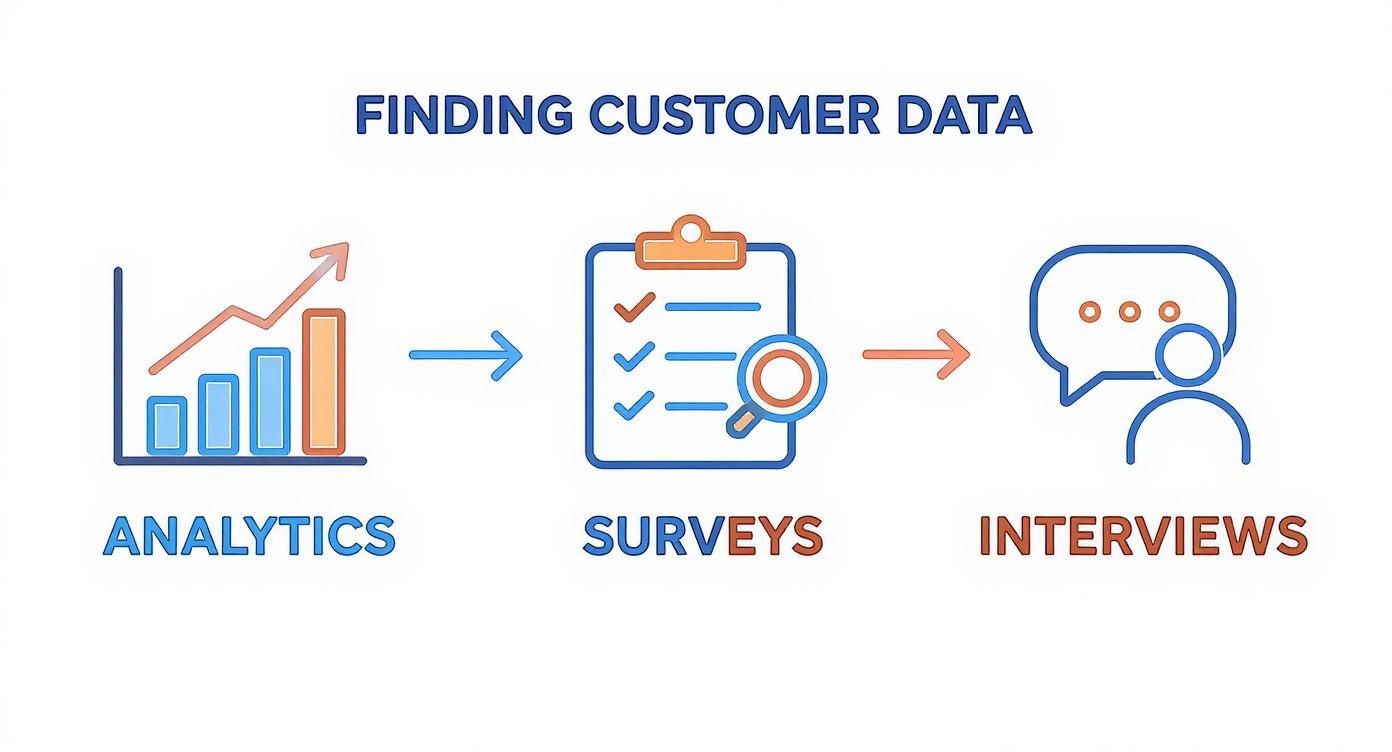
As you can see, it’s the blend of hard data from analytics and the rich, human insights from surveys and interviews that gives your persona both a solid foundation and a real personality.
Building Your Persona Profile
Let’s stick with our “Support Manager Sam” example and build out his profile. We’ll focus on the essential pieces that make a persona actionable, not just a list of facts.
First, give your persona a name and find a stock photo. It sounds simple, but it makes them feel like a real person and helps your team remember who you’re all talking about. From there, you just need to flesh out a few key sections.
1. Demographics and Background
This is just a quick snapshot of who Sam is. Keep it focused on the details that are actually relevant to your business.
- Role: Customer Support Manager
- Company Size: 50-200 employees
- Industry: B2B SaaS
- Age: 35-45
- Location: Mid-sized city, works remotely
- Education: Bachelor’s degree in Communications
2. Goals and Motivations
What is Sam trying to accomplish at work? What does a “win” look like for him? This is where those open-ended interview questions really pay off.
- Primary Goal: Reduce customer response times by 25% this quarter.
- Secondary Goal: Improve the team’s customer satisfaction (CSAT) score.
- Motivation: He wants to be seen as a proactive leader who solves problems before they escalate.
The most powerful personas focus on the why behind a customer’s actions. Understanding that Sam is motivated by a desire for professional recognition helps you craft messaging that speaks to his ambitions, not just his daily tasks.
3. Challenges and Pain Points
This is probably the most important part of the whole profile. What’s standing in Sam’s way? These are the problems your product or service is built to solve.
- Main Challenge: The current helpdesk software is clunky and lacks automation, creating tons of manual work and delays.
- Frustration: Spends too much time compiling reports for his boss instead of actually coaching his team.
- Barrier: Has a limited budget and needs to build a strong ROI case to get approval for any new tools.
These pain points are pure gold. They become the foundation for your content, your ad copy, and even your product features. For instance, knowing Sam struggles to justify ROI tells you to create a blog post titled “How to Calculate the ROI of New Support Software” or to feature a benefits calculator on your ecommerce landing page examples.
4. Communication Preferences and Watering Holes
Finally, where does Sam hang out online, and how does he like to get his information? This tells you exactly where to place your message so it actually reaches him.
- Preferred Channels: Listens to industry podcasts during his commute and is active in a few LinkedIn groups for support professionals.
- Content Formats: Prefers short video tutorials and quick case studies over long, dense whitepapers.
- Trusted Sources: Follows a handful of specific industry influencers and reads a couple of well-known support-focused blogs.
By pulling these elements together, you’ve transformed a pile of disconnected data into a clear, actionable profile. Your team no longer has to guess what “our customer” wants. Instead, they can ask, “What would Support Manager Sam think of this?”
That simple shift is what turns a good marketing strategy into a great one.
Keeping Your Personas Honest and Accurate
Creating your buyer persona is a huge milestone, but it’s not the finish line. A common mistake I see is businesses treating a persona like a one-time project. It gets created with a ton of enthusiasm, then filed away to gather digital dust.
But here’s the thing: the most effective personas are living documents. They have to evolve with your audience and the market. Without a process for validation and upkeep, even the best-researched persona can quickly become a fictional character based on outdated assumptions.
To make sure your hard work keeps paying off, you need to regularly pressure-test your personas against reality.
The Customer Service Reality Check
One of the simplest yet most powerful ways to validate your persona is to run it by your frontline teams. Your customer service and sales staff talk to real customers every single day. They have a gut-level understanding of your audience’s frustrations, questions, and motivations that data alone can’t capture.
Take your completed persona profile—let’s call him “Support Manager Sam”—and show it to them. Ask a simple, direct question:
“Do you recognize this person? Do you talk to Sam every week?”
If their eyes light up with recognition and they start sharing stories that perfectly match Sam’s profile, you know you’re on the right track. If they hesitate or look confused, that’s a major red flag. This kind of feedback is gold for refining the details and making sure your persona truly reflects the people your business serves.
Real-World Testing and Validation
Beyond internal feedback, you need to see if your persona’s assumed motivations hold up when real money is on the line. This is where simple, practical tests can confirm or challenge your hypotheses. You don’t need a massive budget; you just need to be observant.
- A/B Test Your Messaging: Run simple A/B tests on your PPC ads or email subject lines. For instance, if you believe Sam is motivated by efficiency, test one ad that highlights “saving time” against another focusing on “cutting costs.” The winner gives you concrete evidence of what truly drives his decisions.
- Analyze Online Reviews: Your customers are constantly telling you what matters to them in their online feedback. This is a direct line into their priorities and pain points. Understanding why online reviews matter for Florida businesses and what your customers are actually saying is a powerful, ongoing source for persona validation.
- Check Content Engagement: Pay close attention to which blog posts, videos, or social media updates get the most traction. If your persona profile says Sam is worried about team productivity, but your content on that topic consistently falls flat, it might be time to re-evaluate his primary challenges.
A persona isn’t a fact until it’s been proven in the wild. Your assumptions are just the starting point; real-world data is what turns them into a reliable marketing tool.
Schedule a Quarterly Persona Check-in
Markets change, customer needs evolve, and new competitors pop up. A persona created a year ago might not accurately represent your ideal customer today. To prevent this “persona decay,” schedule a recurring check-in every quarter.
This doesn’t have to be some exhaustive, multi-day workshop. A simple, one-hour meeting with key people from marketing, sales, and customer service is all it takes.
The agenda is straightforward: review each persona and ask, “Is this still true?”
Talk about recent customer conversations, look at performance data from recent campaigns, and note any new trends or objections that have surfaced. Making small, incremental updates every quarter is far easier than trying to overhaul an outdated persona a year from now. This simple habit keeps your marketing sharp, relevant, and effective.
Putting Your Personas to Work for Your Business

You’ve put in the work, done the research, and brought your buyer personas to life. Fantastic. But now comes the part that really matters: moving from a well-researched document to a daily strategic tool.
A persona is only as valuable as its application. If it just sits in a folder, it’s a wasted effort. The goal is to weave these insights into the very fabric of your marketing, sales, and even product development. This is where your detailed profile becomes your guide for attracting, engaging, and keeping your ideal customers.
Fueling Your Content and SEO Strategy
Your persona’s challenges are a goldmine for content ideas. Let’s revisit “Support Manager Sam,” who’s struggling to prove the ROI of new software to his boss. That single pain point can spark an entire content series.
Instead of guessing what might resonate, you now have a clear roadmap based on Sam’s real-world needs.
- Blog Posts: Write an article titled, “How to Build an Unbeatable ROI Case for New Support Software.” This hits his biggest roadblock head-on.
- Webinars: Host a live session on “5 Automation Workflows to Reduce Support Response Times by 25%,” speaking directly to his primary goal.
- Case Studies: Showcase a story about another support manager who achieved exactly what Sam is trying to do.
This approach brings incredible focus to your SEO strategy, too. You can move beyond generic keywords and start targeting the long-tail phrases Sam would actually type into a search bar, like “customer support reporting for managers” or “best helpdesk software for small teams.”
A persona-driven content strategy ensures you’re not just creating content, but creating answers to the specific questions your ideal customer is asking. This alignment is what drives qualified organic traffic.
The results speak for themselves. Marketers who ground their strategy in personas are 215% more likely to report that their efforts are effective. What’s more, a staggering 71% of companies that beat their revenue goals have formally documented personas. You can dig into more of the numbers with these key buyer persona statistics.
Crafting PPC Ads That Truly Resonate
Paid advertising is a significant investment. Personas help you make every single dollar count by writing ad copy that feels like you’re reading your customer’s mind.
Knowing what motivates and frustrates “Support Manager Sam” lets you ditch the generic messaging. Instead of an ad that just says, “Great Helpdesk Software,” you can create something far more specific and compelling.
Example Ad Headline: Stop Wasting Time on Manual Reports
Example Ad Description: Our software automates your weekly reporting so you can focus on leading your team. See how much time you can save.
This message connects directly with his frustration over being buried in administrative tasks and his desire to be a more effective leader. This kind of specificity dramatically increases click-through rates and brings in higher-quality leads. For a deeper dive, check out these tips and tricks for optimizing PPC campaigns and see how personas fit into the bigger picture.
Empowering Your Sales and Support Teams
Personas shouldn’t live only within the marketing department. They are a powerful, shared resource for everyone, especially your sales and customer-facing teams. When a salesperson knows they are talking to a “Support Manager Sam,” they can instantly tailor the conversation.
Here’s how that plays out in the real world:
- Tailored Demos: Forget the one-size-fits-all product tour. The sales team can zero in on the features that solve Sam’s biggest problems, like automated reporting and team performance dashboards.
- Overcoming Objections: When Sam brings up his limited budget, the sales rep is already prepared with an ROI calculator and a relevant case study.
- Proactive Support: The customer success team can anticipate needs. Knowing Sam is laser-focused on his team’s CSAT score, they can proactively send him resources on that very topic.
When you weave your persona into every interaction, you create a consistent and deeply relevant customer experience. That alignment is what turns prospects into customers, and customers into your biggest fans.
Got Questions About Building Personas?
Once you dive into creating buyer personas, a few practical questions almost always pop up. It’s totally normal to wonder if you’re getting it right. Let’s clear up some of the most common uncertainties so you can move forward with confidence.
How Many Personas Do I Actually Need?
This is easily the #1 question, and the honest answer is: it depends, but you almost certainly need fewer than you think. There’s a common temptation to create a persona for every single type of customer. That path leads to a dozen half-baked profiles that are too overwhelming to actually use.
For most small and mid-sized businesses, the sweet spot is between three and five core personas.
Start by zeroing in on your most valuable and common customer segments. Who drives the most revenue? Who represents the growth area you’re trying to capture? Focusing on these groups first guarantees your efforts will have the biggest impact right out of the gate.
The goal isn’t to document every possible customer. It’s to deeply understand the distinct groups that need different marketing messages. If two potential personas have the same goals, face the same challenges, and respond to the same value propositions, they can probably be combined into one.
Always choose quality over quantity. One deeply researched, actionable persona is way more valuable than five vague profiles that don’t give you any real direction.
What’s the Difference Between a Persona and a Target Market?
This is another critical point of confusion that can derail the whole process. The terms are related, but they do very different jobs. Confusing them is like knowing what country you’re in but having no idea which city you’re trying to reach.
A target market is broad and data-focused. It’s a high-level description of a group defined by demographics.
- Example Target Market: “Marketing managers at B2B SaaS companies with 50-200 employees in North America.”
It’s a decent starting point, but it’s totally impersonal. It tells you what they are, not who they are.
A buyer persona, on the other hand, puts a human face on that data. It’s a specific, story-driven profile of a semi-fictional individual within that market.
- Example Buyer Persona: “Support Manager Sam, who is struggling to prove the ROI of new software and is motivated by a desire to be seen as a proactive leader.”
See the difference? A target market is a wide net; a buyer persona is a sharp spear. The persona gives you a clear picture of someone’s motivations, goals, and daily headaches—the exact stuff you need to write copy that actually connects.
How Often Should I Update My Personas?
Building your personas is a huge step, but they aren’t meant to be carved in stone. Markets evolve, customer behaviors change, and new challenges pop up. Good personas are living documents, not museum artifacts.
You should plan to review and refresh your personas at least once a year.
That said, some events should trigger an immediate review:
- A major industry shift: Think new regulations or a disruptive technology shaking things up.
- Launching a new product or service: This will likely attract a whole new type of buyer.
- A noticeable change in customer behavior: Are you suddenly fielding different questions or objections from prospects?
A simple annual check-in is usually enough to make small tweaks and keep your personas relevant. This regular maintenance ensures your hard-earned insights don’t go stale and your marketing stays sharp.
Ready to move beyond theory and build a marketing strategy that attracts your ideal customers? The team at Netco Design LLC specializes in creating data-driven marketing plans, from expert SEO to high-converting web design, that deliver measurable results. Learn how we can help your business grow by visiting us at https://netcodesign.com.

