

table of contents
Throwing content at your social media channels without a plan is like setting sail without a map. You’ll make some noise, sure, but you’ll probably end up lost. A real strategy turns social media from a chore into a machine that actually grows your business, whether that means filling an appointment book or selling products online.
Getting this initial plan right is everything. It’s the difference between posting into the void and creating content that gets results.
Before you even think about what to post, you need to be crystal clear on why you’re posting. This means tying every single social media effort back to a real-world business outcome. If you want to go deeper on the big picture, this modern social media and content strategy guide is an excellent resource.
Define Your Business Goals with the SMART Framework
Vague goals like “get more followers” don’t cut it. You need objectives that are specific, measurable, achievable, relevant, and time-bound (SMART). This simple framework forces you to get serious about what you want to achieve and how you’ll track success.
Think about a local dental clinic. Their goals might look like this:
- Generate 15 new patient inquiries through Instagram DMs within the next 3 months.
- Increase website clicks from Facebook by 25% over the next quarter to drive more appointment bookings.
An e-commerce brand would have different goals, of course:
- Achieve a 5% conversion rate from TikTok Shop videos during our two-week product launch.
- Grow our email list by 500 new leads using a lead magnet promoted on LinkedIn within 60 days.
When you tie every action to a specific business outcome, you stop wasting time. Your content creation becomes focused, efficient, and you’re no longer just guessing at what works.
Understand Your Audience with Buyer Personas
You can’t create content that resonates if you don’t know who you’re talking to. This is where a buyer persona comes in. It’s a detailed profile of your ideal customer, built from market research and real data you already have. It goes way beyond basic demographics to uncover what drives them, what they struggle with, and where they hang out online.
A solid buyer persona includes:
- Demographics: Age, location, job title, income.
- Goals & Challenges: What are they trying to accomplish? What’s standing in their way?
- Watering Holes: Which social platforms do they actually use? Who do they follow and trust?
- Content Preferences: Do they binge short-form video, read in-depth articles, or just want quick, scannable tips?
Knowing this stuff lets you create content that feels like it was made just for them. For a closer look at this critical step, check out our guide on building a content marketing strategy for small business.
Establish Your Brand Voice and Content Pillars
Your brand voice is your brand’s personality. Are you witty and informal, or are you more authoritative and professional? Whatever you choose, it needs to be consistent across every platform. Consistency builds recognition and, more importantly, trust.
Once your voice is locked in, you need to define your content pillars. These are the 3-5 core topics your brand will own and talk about all the time. They’re the foundation of your content plan, keeping your message focused and on-point.
For a software company, these pillars might be Productivity Tips, Industry News, and Customer Success Stories. This approach stops your feed from becoming a random mess and cements your expertise in a specific niche.
Generating and Producing Content People Actually Want
Alright, you’ve set your goals and you know who you’re talking to. Now for the fun part: creating content that people actually want to see.
The best social media strategies feel less like a constant creative sprint and more like a well-oiled machine. You don’t need to be a viral genius to fill your content calendar. You just need a solid system for coming up with ideas and turning them into polished posts without burning out your team. This means looking at what your competitors are doing, but more importantly, listening to what your own customers are asking for.
This flowchart lays out the four-part foundation for a killer content strategy.
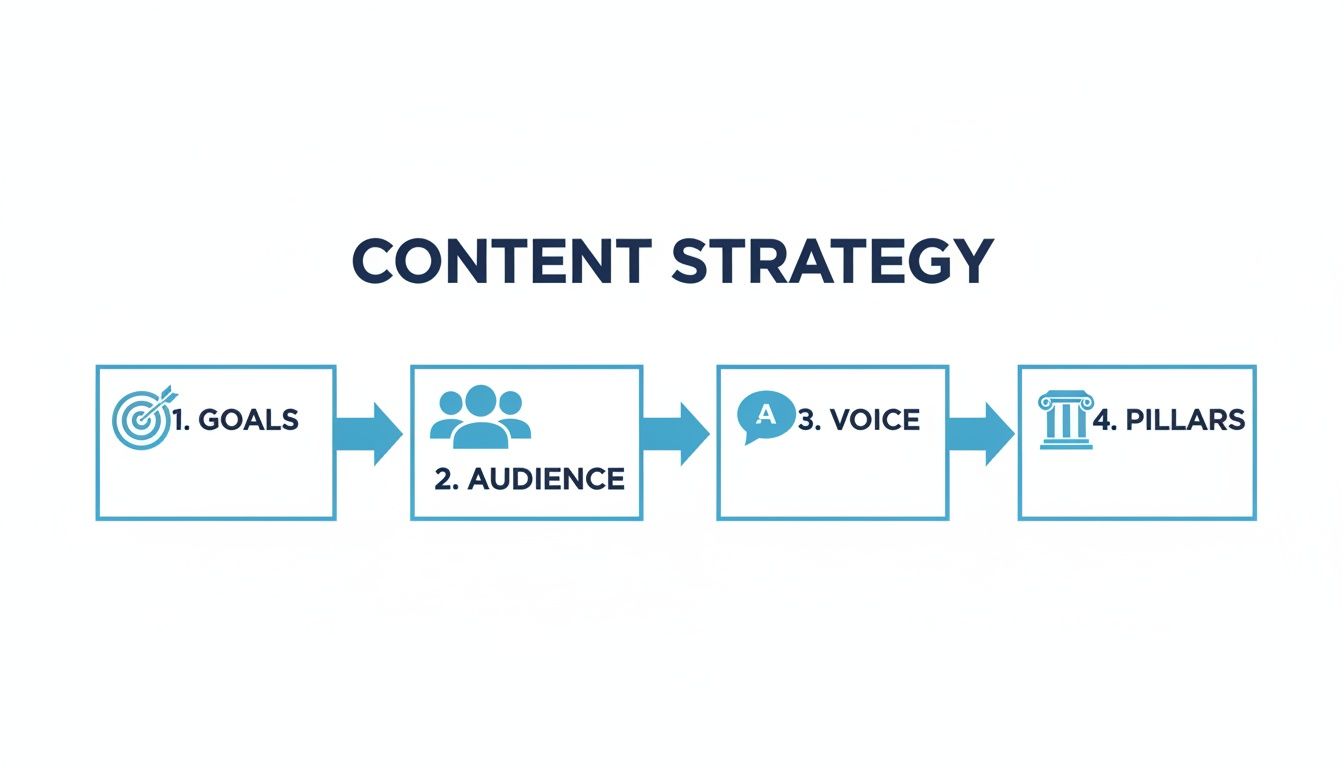
It all starts with clear goals and a deep understanding of your audience. Get those right, and you can build a consistent brand voice and define the core pillars that will guide everything you create.
Uncovering Endless Content Ideas
Great ideas rarely strike like lightning. They come from listening, observing, and understanding what your audience truly needs at every stage of their journey.
A simple way to get started is to map your content ideas to the classic customer journey. Someone just discovering your brand needs something very different from a loyal advocate.
- Awareness Stage: Focus on solving common problems. Think “how-to” guides, simple checklists, or educational carousels that establish your expertise without a hard sell.
- Consideration Stage: Now you can introduce your solution. This is the perfect time for case studies, customer testimonials, or a behind-the-scenes look at your process to build trust.
- Decision Stage: Make it easy for them to say yes. Share limited-time offers, answer common questions about buying, or post user-generated content showing real people loving your stuff.
Speaking of user-generated content (UGC), it’s gold. When a happy customer tags you in a post, that’s not just a nice shout-out—it’s powerful content you can reshare (always ask for permission!). UGC is authentic social proof that resonates far more than any polished ad ever could. To get this part right, you really need to nail your https://netcodesign.com/target-audience-analysis/.
Building Your Content Production Line
Once you have a backlog of ideas, it’s time for production. This is where you turn a concept from a note on a whiteboard into a tangible piece of content, complete with sharp copy, eye-catching visuals, and a clear call to action.
Your workflow doesn’t need to be overly complicated. The goal is to create a repeatable process for each type of content you make, whether it’s a quick Reel or a detailed LinkedIn carousel.
Pro Tip: Stop trying to create brand-new content for every single platform. Start with one core idea—like a customer success story—and adapt it. That one story can become a short video clip for Reels, a professional carousel for LinkedIn, and a series of shareable quote graphics for Instagram Stories.
As AI tools become more common, the human touch in your content is what will set you apart. Trends show that consumers are tired of robotic content and are actively looking for authentic, human-led stories. In fact, 60% of consumers already use Instagram to research products, and 54.5% turn to TikTok. This shows how tailored, platform-specific content is becoming the new norm.
Mapping Content Ideas to Business Goals
To make sure your creative efforts are actually moving the needle, it’s crucial to connect your content ideas directly to your business goals. By aligning specific content formats with your objectives, you ensure every post has a purpose and a measurable outcome.
Here are a few examples of how this works:
- To Increase Brand Awareness: Use an educational carousel on Instagram or LinkedIn to explain a key industry concept. You’ll measure success through Reach, Impressions, and Shares.
- To Generate Leads: Create a “how-to” video for YouTube or TikTok that directs viewers to a free downloadable guide. The key metrics here are Landing Page Clicks and Lead Form Submissions.
- To Boost Engagement: Host an “ask me anything” (AMA) session with a team expert on Instagram Stories or LinkedIn Live. Success is measured in Comments, Questions, and Story Replies.
- To Drive Sales: Showcase user-generated content (UGC) of a customer using your product on Instagram or TikTok. Track the Click-Through Rate to your product page and overall Conversions.
- To Build Community: Share a behind-the-scenes look at your company culture on Instagram Reels or LinkedIn. Look for an increase in Positive Sentiment and Follower Growth.
By using a framework like this, you can be more intentional about the content you create, ensuring every post has a purpose and a way to measure its success.
Crafting Platform-Specific Copy and Visuals
The final, and arguably most important, piece of the puzzle is execution. To truly master how to create engaging social media content, you have to tailor it to the platform. The formal tone that works on LinkedIn will get you ignored on TikTok.
- Write for the Skimmer: Let’s be real, people scroll fast. Use short sentences, plenty of line breaks, and emojis to make your copy easy to digest. Your first sentence needs to be a hook that stops them in their tracks.
- Master Short-Form Video: Platforms like Instagram Reels and TikTok reward short, snappy videos. You don’t need a fancy film crew; your smartphone and good lighting are usually enough. Focus on quick cuts, trending audio, and delivering value in under 60 seconds.
- Design with Simple Tools: You don’t have to be a graphic designer. Tools like Canva offer thousands of templates you can easily customize with your brand’s colors and fonts. It’s never been easier to create professional-looking graphics and videos.
By combining a systematic approach to ideation with a streamlined production process, you can consistently create high-quality social media content that not only stops the scroll but also drives real business results.
Choosing the Right Platforms and Formats for Your Brand
Trying to be everywhere at once on social media is a classic mistake. It’s a surefire way to burn out your team and get lackluster results. The goal isn’t to plant your flag on every platform; it’s to show up where your customers are actually spending their time. A smart, focused approach lets you pour your energy and budget where it will make a real difference.
Each platform has its own vibe, its own language, and its own audience. What gets massive engagement on LinkedIn will likely fall completely flat on TikTok. Getting a feel for these nuances is the first step to building a content plan that doesn’t just show up, but actually connects.
Matching Your Brand to the Right Platforms
Before you even think about platforms, go back to your buyer personas. Where do your ideal customers hang out online? Answering this question honestly will save you from shouting into the void on a channel your audience doesn’t even use.
Think about the primary job of each major network:
- Instagram: A visual-first playground, perfect for B2C brands in e-commerce, wellness, food, and travel. It’s all about showing off products with beautiful images, Reels, and Stories.
- TikTok: This is the home of short-form video and fast-moving trends. The algorithm here can give you incredible organic reach, making it a powerhouse for brands targeting Gen Z and Millennials with content that entertains or teaches.
- LinkedIn: The digital office park. It’s the go-to for B2B companies, consultants, and anyone trying to build authority, share industry insights, and network with other professionals.
- Facebook: With its huge, diverse user base, Facebook is a jack-of-all-trades. It’s fantastic for building community through Groups and still a monster for paid ads, especially for local businesses and brands with a broad demographic.
The point isn’t just to pick a platform—it’s to learn its culture. You have to show up in a way that feels native, whether that means sharing a professional win on LinkedIn or jumping on a trending sound on TikTok.
The Undeniable Power of Short-Form Video
While every format has its place, one is running the show right now: short-form video. The quick, high-energy style of Instagram Reels, TikToks, and YouTube Shorts grabs attention in a way static content just can’t compete with anymore.
The numbers don’t lie. With 5.44 billion people expected to be on social media by 2026, short-form video is the main event. TikTok creators with under 100k followers are seeing average engagement rates of 7.5%, which absolutely crushes Instagram’s overall average of 3.65%.
Even on other platforms, the trend is clear. Carousels on Instagram get a decent 1.92% engagement, and multi-image posts on LinkedIn can hit a respectable 6.6%, but video consistently comes out on top. You can dig into all the data in the full social media trends report from Slate Teams.
This doesn’t mean you should ditch images and carousels entirely. They still serve an important purpose. But ignoring short-form video is like leaving the single biggest opportunity for growth on the table.
Repurposing Content for Maximum Impact
Great content takes a lot of time and effort to create. The smartest social media managers I know don’t start from scratch every single day. They are masters of repurposing.
This means taking one solid piece of content—a blog post, a webinar, a customer story—and slicing and dicing it for different platforms and formats. This strategy doesn’t just save you a ton of time; it hammers your core message home across multiple channels, making it stick.
Here’s a quick look at how one idea can fuel your whole calendar:
- The Core Idea: A deep-dive customer success story.
- The Long-Form Asset: Start by writing a detailed case study for your website.
- Break It Down for Social:
- LinkedIn: Create a sharp, professional carousel post. Each slide walks through the customer’s challenge, your solution, and the amazing results, using key quotes and data.
- Instagram: Edit a 30-second Reel featuring the customer sharing their experience. Add text overlays to highlight the biggest wins.
- Facebook: Design a simple but powerful graphic with a standout quote from the customer. Use the caption to tell a bit more of the story and link back to the full case study.
- TikTok: Film a quick, energetic video that shares the #1 lesson the customer learned. Use a trending sound to give it a boost.
When you start thinking this way, you stop constantly hunting for new ideas and start getting more value out of the work you’ve already done. It’s the secret to creating a social media content engine that’s both effective and sustainable.
Organizing Your Workflow With a Content Calendar
If you want to win at social media, consistency is everything. But being consistent without a plan is a surefire way to burn out. This is where a social media content calendar comes in—it’s your command center, turning a random collection of ideas into an organized, actionable workflow.
A good calendar ensures you post regularly, hit key dates, and maintain a healthy mix of content. It’s the difference between scrambling for a post at the last minute and publishing with purpose. You get a bird’s-eye view of your entire social presence, making it easy to spot gaps, avoid getting repetitive, and make sure every single post is doing its job.

Choosing the Right Content Calendar Tool
Let’s be clear: the “best” tool is the one your team actually uses. You don’t need a fancy, expensive platform to get organized. The goal is to find something that fits your budget, team, and the way you work.
Here are a few popular options, from simple to more powerful:
- Spreadsheets (Google Sheets or Excel): This is the classic starting point for a reason. They’re free, completely customizable, and perfect for solo operators or small teams who just need a simple way to track post dates, copy, visuals, and status.
- Project Management Tools (Trello, Asana, Notion): These tools are more visual and collaborative. You can use Kanban boards to drag content through stages like “Idea,” “In Progress,” and “Scheduled,” while assigning tasks and deadlines to team members along the way.
- Dedicated Social Media Platforms (Sprout Social, Hootsuite, HubSpot): These are the all-in-one solutions. They combine your content calendar with scheduling, deep analytics, and community management tools. They’re a great fit for larger teams managing multiple accounts, as they bring the entire process under one roof.
The most effective content calendar is a living document. It should be flexible enough to accommodate last-minute opportunities and trending topics while providing the structure you need to stay on track with your core content pillars.
Planning Your Content in Advance
As a rule of thumb, try to plan your social media content at least two to four weeks in advance. This buffer gives your team room to breathe—plenty of time for creation, review, and approval without the daily pressure of figuring out what to post. If you want a deeper dive into building your schedule from scratch, you can learn more about how to create a content calendar in our dedicated guide.
To get started, plug in the “big rocks” first. These are the fixed dates and events you already know are coming up. They provide a skeleton that you can flesh out with your regular content.
Make sure your calendar includes these key elements:
- Campaign Launches: Map out all your promotional periods for new products, services, or special offers.
- Holidays and Seasonal Events: Add any relevant holidays (both major ones and fun social media holidays) that make sense for your brand.
- Evergreen Content: Schedule posts based on your content pillars—the educational, inspirational, or entertaining topics you want to be known for.
- Industry Events: Block out time for conferences, webinars, or important dates in your niche.
Finding Your Optimal Posting Times
Posting when your audience is actually online can make a huge difference in your reach and engagement. While there are tons of studies claiming to have found the “best times to post,” the only truth that matters is what your own audience data says.
Most social media platforms have built-in analytics that show you exactly when your followers are most active. Dig into your Instagram Insights, Facebook Page Insights, or TikTok analytics to find your personalized peak times.
Start by testing the recommended hours for your industry, then check your data after a few weeks. Look for the days and times that consistently drive the most impressions and engagement. Once you find those sweet spots, lock them into your content calendar and make them a core part of your scheduling workflow.
How to Measure Your Social Media Performance
Creating social media content without measuring its impact is like flying blind. You can put in all the work, but you’ll have no idea if you’re actually moving in the right direction. To really understand what’s working, you have to dig into the data and turn those numbers into actionable insights.
This isn’t about chasing vanity metrics like likes and follower counts. It’s about focusing on the numbers that directly connect to your business’s bottom line and proving that your social media efforts are paying off.

Key Metrics That Actually Matter
To get a clear picture of what’s going on, you need to track a balanced mix of metrics. Think of them as telling the complete story of your content’s journey, from the first glance to the final sale.
Here are the essential numbers to keep your eye on:
- Reach & Impressions: These tell you how many unique people saw your content (Reach) and the total number of times it was shown (Impressions). Solid reach is the first step—if no one sees it, nothing else matters.
- Engagement Rate: This is arguably the most important metric for judging content quality. It tracks the percentage of your audience that bothered to interact (likes, comments, shares, saves), showing you how well your message resonated.
- Click-Through Rate (CTR): This one is simple: how many people who saw your post actually clicked the link? A strong CTR is a direct signal that your call to action was compelling enough to get someone to act.
- Conversions: This is the ultimate goal. Conversions track how many people took the action you wanted after clicking your link—making a purchase, signing up for a newsletter, or filling out a form.
Tracking these four metrics gives you a complete view of your performance funnel. It takes you from “who saw this?” all the way to “who bought something?”
Using Platform Analytics to Gather Data
The good news is you don’t need to invest in expensive tools right away. Every major social media platform gives you a powerful—and free—analytics dashboard packed with valuable information.
Start by getting comfortable with the native tools you already have:
- Instagram Insights: Offers detailed data on audience demographics, the best times to post, and post-by-post performance for reach, engagement, and website clicks.
- Facebook Business Suite: A comprehensive tool that provides deep insights into your audience, post performance, and page growth.
- TikTok Analytics: Here, you’ll find data on video views, profile views, follower growth, and audience demographics, including their locations and peak activity times.
- LinkedIn Analytics: Perfect for B2B brands, this dashboard breaks down visitor demographics by job title and industry, alongside key engagement metrics.
Don’t just collect data—connect it to your business goals. If your goal is to generate leads, then your Conversion Rate is far more important than your follower count. Tie every metric back to a specific objective to measure what truly matters.
Turning Data into Actionable Insights
The real magic happens when you interpret the data and use it to make smarter decisions. Your metrics should fuel your future content strategy, helping you do more of what works and less of what doesn’t. You can learn more about how this connects to overall business growth by exploring our guide on measuring content marketing ROI.
A great way to do this is with simple A/B testing. This just means creating two slightly different versions of a post to see which one performs better. For example, you could test:
- A video vs. a carousel post
- A short, punchy caption vs. a longer, more detailed one
- Different calls to action, like “Learn More” vs. “Shop Now”
By systematically testing one element at a time and measuring the results, you can continuously fine-tune your approach. This data-driven process helps you optimize your creative for better engagement and higher click-through rates, turning your social media from a content-publishing chore into a predictable growth engine.
Common Questions About Creating Social Media Content
Even with the best strategy in place, creating social media content can feel like a moving target. Questions always pop up, challenges arise, and it’s surprisingly easy to get stuck.
Let’s tackle some of the most common hurdles I see clients face. Getting straight answers here will help you refine your process and keep moving forward with confidence.
How Often Should I Post on Social Media?
Honestly, there’s no magic number. The right answer comes down to your specific platform and what your audience expects. The real key? Consistency is far more important than frequency.
Posting three high-quality, engaging pieces of content per week is always better than posting seven mediocre ones just to fill a quota.
I usually recommend starting with a manageable schedule and then watching your analytics like a hawk.
- Instagram/Facebook: Aim for 3-5 times a week.
- TikTok: This platform rewards a higher tempo, so 5-7 times a week (or even more) can be incredibly effective if you have the content.
- LinkedIn: Usually, 2-3 times a week is plenty to stay visible without overwhelming a professional network.
Let your data be your guide. If engagement drops when you post more, scale it back. If your audience is asking for more, ramp things up.
What Should I Do if My Content Isn’t Getting Engagement?
Low engagement is frustrating, but it’s also valuable feedback. The first thing to do is not panic. Instead, go back to the fundamentals: are you creating content your specific audience actually cares about, or are you just posting what you think they want?
A lack of engagement is often just a sign of a disconnect between your content and your audience’s needs. Use it as a signal to listen more closely, experiment with new formats, and double down on what has worked in the past, even if it was on a small scale.
Take a hard look at the posts that did perform well. What did they have in common? Was it the format (video vs. image)? The topic? The tone of the caption? Try creating more content that mirrors those past successes. And don’t forget to actively engage with your community by responding to comments and asking questions to get a conversation started.
How Can I Create Content Faster?
Feeling like you’re permanently stuck on the content treadmill is a common complaint. The solution is always to work smarter, not harder.
- Batch Creation: This is a non-negotiable for efficient teams. Dedicate one block of time each week to create all your content. Film all your videos on Monday, write all your captions on Tuesday. This level of focus is so much more efficient than trying to come up with something new every single day.
- Repurposing: As we covered earlier, this is an absolute game-changer. One good blog post can easily become a carousel, a Reel, and several quote graphics. You can learn more about related tactics in our guide to using hashtags correctly for SEO optimization.
- AI Assistants: Tools like HubSpot’s Breeze Assistant or other AI generators can help you draft initial captions, brainstorm a list of ideas, or create hashtag sets in seconds. It’s a great way to slash your creation time.
When you build a system, you can produce a steady stream of high-quality content without burning out.
Ready to turn your social media efforts into a real growth engine? The expert team at Netco Design LLC builds revenue-focused digital marketing strategies that get results. We handle everything from content creation to SEO, so you can focus on running your business. https://netcodesign.com

