

table of contents
So, what exactly is a market assessment? Think of it as the foundational research you do before making any big moves. It’s a structured way to gather and analyze information about a market—its size, the key players, and what customers actually want. This process is all about swapping out guesswork for real, hard data.
Ultimately, it’s what allows you to make smarter, more profitable business decisions from day one.
Why Market Assessments Are Your Strategic Compass

Before we jump into the "how-to," let’s get clear on the "why." For small and mid-sized businesses, where every dollar and decision carries a ton of weight, this is way more than just an academic exercise. It’s the strategic compass that guides your every move.
It’s the difference between trying to find your way through a new city with a map versus just winging it. One approach gets you to your destination efficiently. The other? It usually leads to dead ends, frustration, and a whole lot of wasted time and money. A proper assessment is that essential map for your business.
From Gut Feelings to Data-Backed Decisions
I see it all the time—entrepreneurs run on instinct. That passion is powerful, but it can also be dangerously biased. A market assessment forces a shift from those subjective "gut feelings" to objective, verifiable data.
This pivot is absolutely critical for a few big reasons:
- Validating Your Idea: It confirms whether people will actually pay for your product or service before you sink your life savings into it.
- Minimizing Financial Risk: By spotting challenges early, you can avoid costly blunders, like launching into an oversaturated market or building a product for the wrong audience.
- Securing Investment: Let's be real—investors and banks don't fund gut feelings. They want proof of a viable market, and a thorough assessment delivers the hard evidence they need to believe in your vision.
A well-executed market assessment doesn't just tell you if you can enter a market; it tells you if you should. It’s a vital reality check that aligns your ambitions with actual market opportunities.
A Foundation for Sustainable Growth
At the end of the day, doing a market assessment is a proactive move. It gives you the power to see around corners—to anticipate market shifts, understand what your customers truly need, and spot the cracks in your competitors' armor.
For an e-commerce brand, this might mean discovering an underserved niche for a specific type of sustainable home good. For a local service business, it could be as simple as finding a competitor with terrible online reviews, creating a clear opening to win over their unhappy customers.
This is the kind of insight that becomes the bedrock of every successful marketing campaign, product launch, and strategic pivot you’ll ever make. It’s what ensures your business doesn’t just survive, but actually thrives.
Setting Clear Goals for Your Assessment
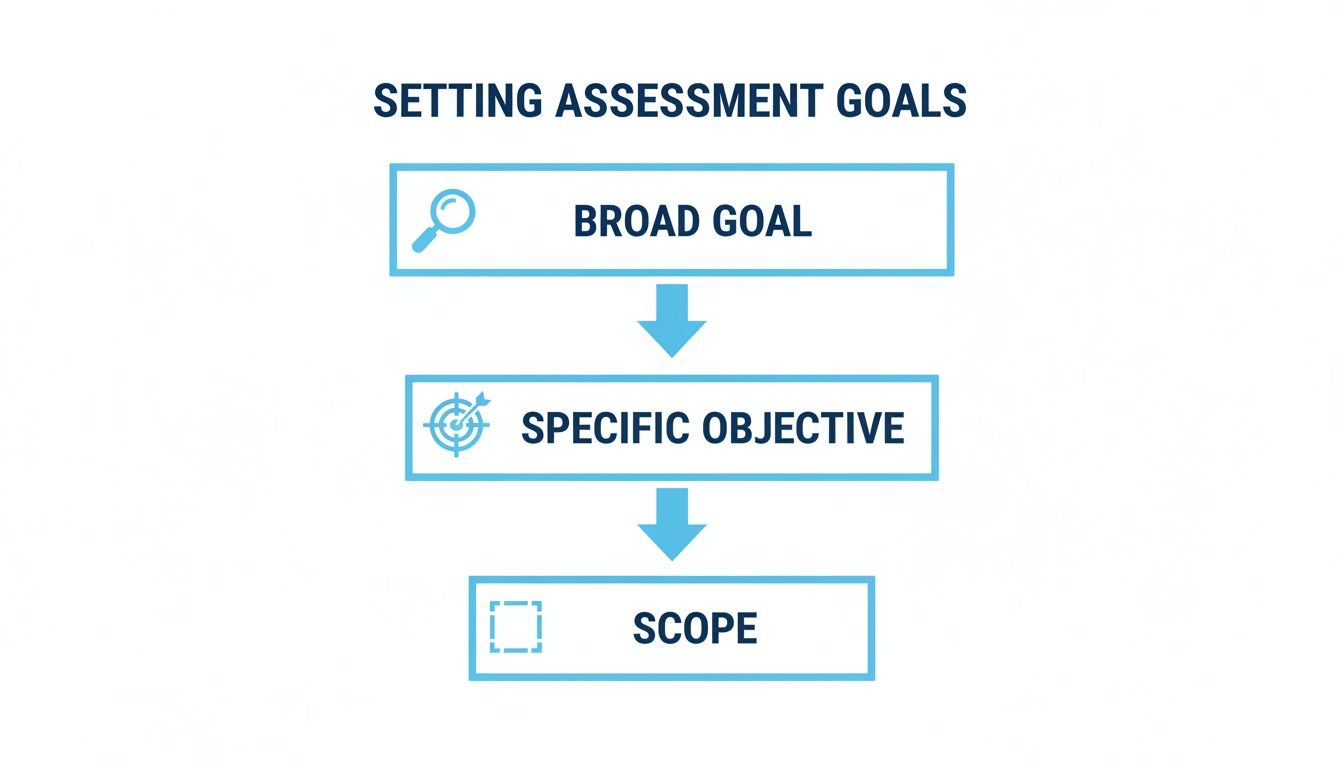
Jumping into a market assessment without a clear goal is like setting off on a road trip with no destination in mind—you’ll burn through resources and end up nowhere useful. A powerful assessment always starts with a sharp, specific question. Vague goals like "understand the market" are way too broad and will leave you buried under mountains of irrelevant data.
Your objective should be tied directly to a real business decision you need to make. Are you trying to figure out why your online sales have stalled in the last quarter? Or are you considering expanding your service area into a neighboring city? Each of these questions demands a completely different research approach.
Before you dive in, it’s a good idea to get a handle on the basics. Brushing up on the foundational principles of research methodology for beginners will give you a solid starting point and ensure the data you gather is both reliable and valid.
Defining Your Scope Realistically
Once your primary objective is clear, the next move is to define a realistic scope. This is where you avoid the classic mistake of trying to "boil the ocean." Your scope sets the boundaries for your research, making sure you only focus on the market segments, competitors, and customer profiles that truly matter.
For example, a local bakery in Tampa exploring a new vegan product line has a much different scope than a national e-commerce brand launching a new software tool.
- The Local Bakery: Their scope would be laser-focused on their immediate geographic area. They'd analyze local competitors with vegan options and survey current customers and nearby residents about their interest and price sensitivity.
- The E-commerce Brand: Their scope is national, maybe even global. They need to analyze major software competitors, identify different user segments across the country, and research various pricing models for subscription services.
Setting a tight scope from the get-go keeps your assessment from becoming an endless, overwhelming project. It ensures every piece of info you collect directly helps answer your core question. To really nail this, you need to know exactly who you're targeting. For a deeper dive, check out our guide on how to create buyer personas to help narrow your focus.
From Vague Ideas to Measurable Objectives
The trick is to transform your broad goals into specific, measurable questions that your research can definitively answer. This process turns abstract ideas into an actionable plan.
Your goal isn't just to gather data; it's to gather the right data that directly informs a specific, high-stakes business decision. A focused objective is the most effective tool for filtering out noise and zeroing in on actionable insights.
Think about these transformations:
-
Vague Idea: "I want to know if I should sell my handmade jewelry online."
-
Measurable Objective: "What is the demand and average price point for minimalist-style silver necklaces among women aged 25-40 on Etsy and Instagram?"
-
Vague Idea: "Should my home services company offer a new maintenance plan?"
-
Measurable Objective: "What percentage of our existing customer base would sign up for a quarterly HVAC maintenance plan priced at $199/year, and which three local competitors offer a similar service?"
This level of specificity makes your research targeted and efficient. It ensures the final report delivers a clear "yes" or "no" and gives you the strategic direction you need.
Sizing Your Market in a Mobile-First World
Before you pour a single dollar into a new venture or marketing campaign, you have to know the size of the prize. Is the market you're targeting a small pond or a vast ocean? Answering that question is the whole point of market sizing, and it all boils down to three core concepts: TAM, SAM, and SOM.
Think of it this way:
- TAM (Total Addressable Market) is the entire ocean.
- SAM (Serviceable Available Market) is the part of the ocean your fishing boat can realistically get to.
- SOM (Serviceable Obtainable Market) is the fish you can actually catch with the gear you have right now.
Getting this right from the start helps you narrow your focus from a broad goal down to a specific, manageable scope for your research.
This process keeps your efforts grounded and prevents you from chasing opportunities that are either too small to be profitable or too massive to compete in effectively.
TAM, SAM, SOM: What They Actually Mean
Let's break these down with a real-world example. It's one thing to know the acronyms; it's another to see how they apply.
- Total Addressable Market (TAM): This is the biggest possible number—the total revenue you could capture if you had 100% market share with no competition. It's your "blue sky" potential.
- Serviceable Available Market (SAM): This is the slice of the TAM that your business model can actually serve. It’s limited by things like your geographic reach or service specializations.
- Serviceable Obtainable Market (SOM): This is the piece of the SAM you can realistically win in the near future (think the next 12-18 months). This number accounts for your direct competitors, current brand recognition, and marketing budget. It's your initial target.
Imagine a web design agency based in Tampa. Their TAM might be all small businesses in the U.S. Their SAM narrows to small businesses in Florida. But their SOM is the share of Tampa Bay businesses they genuinely believe they can land as clients this year.
The Mobile-First Reality Check
Calculating these numbers is a great start, but it's an incomplete picture if you ignore how customers behave today. And today, customer behavior is overwhelmingly mobile.
Mobile devices drive roughly 63.38% of all global web traffic. This isn't just a trend; it's the default way people find, research, and buy things. For an e-commerce brand, that means a massive chunk of your SAM—part of a U.S. mobile retail market worth over $511.8 billion—is shopping from their couch on a smartphone. For a local service business, it means your first impression is almost always made on a tiny screen.
If your website isn't built for mobile, you're effectively invisible to the majority of your potential customers.
How to Size Your Market for Mobile
To get a true sense of your opportunity, you need to weave mobile analysis into every step of your market sizing. It's less about the theoretical market size and more about the actual market behavior.
Here’s how to do it:
- Check Your Own Mobile Traffic: Log into your Google Analytics right now. What percentage of your traffic is from mobile? If that number is way below the 63% benchmark, you've found your first major problem—and a huge opportunity for growth.
- Spy on Your Competitors' Mobile Experience: Grab your phone and pull up the websites of your top three competitors. Is it a clunky, slow-loading mess? Is it hard to find their phone number or buy a product? Their mobile weakness is your competitive advantage.
- Adjust Your SOM Based on Mobile Readiness: Your ability to capture your obtainable market is directly tied to your mobile strategy. For instance, if local customers heavily rely on voice search to find businesses like yours, your SOM shrinks if you're not optimized for it. Get a handle on what this means by checking out our guide on how to optimize for voice search.
By layering this mobile-first lens over your traditional TAM, SAM, and SOM calculations, you move from a theoretical exercise to a practical, actionable plan. You stop guessing and start building a business that meets customers exactly where they are: on their phones.
Uncovering Your Competitors' True Strengths and Weaknesses
Knowing who your competitors are is just the first page of the playbook. The real game is won by understanding exactly how they operate, what makes their customers tick, and—most importantly—where they're dropping the ball.
A proper competitor analysis isn't just a list of rivals. It's about mapping the entire competitive landscape to find your unique path to victory. This deep dive is about reverse-engineering their success and identifying the gaps they’ve left wide open for you.
Looking Beyond the Obvious Rivals
Your first move is to identify who you're really up against. It's easy to spot the direct competitors—the other local bakery or the e-commerce store selling similar products. But a smart analysis goes deeper, looking at indirect and replacement competitors, too.
- Direct Competitors: They offer a nearly identical product or service to the same audience. If you're a specialty coffee shop, this is the cafe across the street.
- Indirect Competitors: They solve the same core problem but with a different solution. For that coffee shop, this could be a high-end tea house or a juice bar.
- Replacement Competitors: They offer something totally different that could eliminate the need for your product. This might be a customer buying a fancy espresso machine for their home instead of visiting your shop at all.
Ignoring these other players is a rookie mistake. Understanding the full spectrum of choices your customers have gives you a much clearer picture of the market you're actually in.
Analyzing the Four Key Pillars of Competition
Once you have your list, it's time to put on your detective hat. A structured approach ensures you gather consistent, comparable data across everyone. I recommend focusing your investigation on four critical areas.
- Products and Services: Go deep on what they sell. What are the core features? What's the quality really like? Do they have any unique selling points or proprietary tech they lean on? Look for what's missing—the feature customers are begging for but no one provides.
- Pricing and Positioning: How are they priced relative to you and the market? Are they the premium option, the budget choice, or somewhere in the middle? Their pricing strategy tells you a ton about their target customer and perceived value.
- Marketing and Sales Channels: Where do they find their customers? Are they masters of social media, or do they own the top spots on Google? Dig into their website, social media presence, ad campaigns, and content. Tools like SEMrush or Ahrefs can show you the keywords they rank for and where their traffic comes from.
- Customer Reviews and Reputation: This is where you find the unvarnished truth. Comb through Google Reviews, Yelp, social media comments, and industry forums. What do people consistently praise? Even better, what are the recurring complaints? A pattern of complaints about slow shipping or poor customer service is a golden opportunity.
For a more detailed breakdown of their digital strategy, our guide explains how to do competitor analysis in SEO.
The most valuable intelligence you can gather isn't what your competitors do well, but where they consistently fall short. Each negative review or identified weakness is a specific, actionable opportunity for you to win over their dissatisfied customers by doing it better.
Practical Tools for Gathering Intelligence
You don't need a massive budget to get powerful competitive insights. A few smart tools can give you all the data you need to make informed decisions.
- Ahrefs/SEMrush: These are the industry standards for digging into a competitor's SEO, backlink profile, and paid ad strategies.
- Google Alerts: Set up alerts for your competitors' brand names. It’s a free and simple way to monitor their press mentions and new content.
- Social Blade: This tool lets you track follower growth and engagement on platforms like Instagram, YouTube, and X (formerly Twitter).
- Owletter: Use this to discreetly subscribe to and analyze your competitors' email newsletters, giving you a peek into their promotion cycles and messaging.
By systematically examining each competitor through this lens, you move from simple awareness to strategic insight. You won't just know what they're doing—you'll understand why, uncovering the weaknesses that will become your greatest strengths.
Turning Your Research into a Strategic SWOT Analysis

So, you've piled up a ton of data on market size, your competitors, and what your customers are thinking. What now? This is where you connect the dots, and a SWOT analysis is the perfect tool for the job. It’s the moment your raw research gets molded into a real strategic direction, moving you from a pile of facts to a clear plan of attack.
The biggest mistake people make is treating a SWOT analysis like four separate to-do lists. The real magic comes from weaving everything together—linking what’s happening inside your business (the stuff you can control) with what’s going on in the market (the stuff you have to react to). This is how you bridge the gap between knowing things and knowing what to do with those things.
Beyond the Four Lists
A truly sharp SWOT analysis isn’t just a brainstorming session; it’s a diagnostic tool backed by all the evidence you just gathered. Every single point you list should tie directly back to the research you've done.
This isn't about guessing. It’s about defining your position with data.
- Strengths (Internal, Positive): What are your built-in advantages? Maybe it's a unique process you've perfected, a killer brand reputation in your neighborhood, or deep-seated expertise in a very specific niche.
- Weaknesses (Internal, Negative): Let's be honest, where are you falling short? This could be a shoestring marketing budget, zero brand recognition, or a website that looks terrible on a phone.
- Opportunities (External, Positive): What’s happening out there that you can jump on? Think about a new trend gaining steam, a group of customers you found that nobody is serving well, or a competitor who keeps dropping the ball on customer service.
- Threats (External, Negative): What external forces could throw a wrench in your plans? This could be anything from new government rules and disruptive tech to a big-name competitor setting up shop down the street.
If you’re swimming in data and trying to pull out these insights, leveraging AI data analysis tools can help you spot patterns you might otherwise miss.
From Analysis to Actionable Strategy
Okay, here’s where the real strategy kicks in. You need to start crisscrossing the quadrants. This is how you come up with moves that are both ambitious and actually achievable. The goal is to draw a straight line from your internal strengths to the external environment.
The most powerful strategies emerge at the intersection of your internal strengths and external opportunities. A SWOT analysis isn't finished until you’ve explicitly connected these dots to define your next move.
Here's a simple way to build those connections:
- Strength-Opportunity (SO) Strategies: How can you use your strengths to grab opportunities? If your strength is a super-skilled team and the opportunity is a rising demand for a specialized service, your path is clear: build out and market that service. Hard.
- Weakness-Opportunity (WO) Strategies: How do you fix your weaknesses by using an opportunity? Let's say your weakness is a tiny marketing budget, but you’ve noticed a new social media platform where your ideal customers are highly engaged. Your strategy could be to go all-in on creating low-cost, high-impact organic content there.
- Strength-Threat (ST) Strategies: How can you use your strengths to shield yourself from threats? If your strength is rock-solid customer loyalty and the threat is a new competitor opening nearby, you might launch a loyalty program to lock in your best customers.
- Weakness-Threat (WT) Strategies: How do you shore up your weaknesses to dodge threats? If you’re totally dependent on one supplier (weakness) and you’re seeing supply chain instability (threat), your strategy is to start finding and vetting backup suppliers now.
This way of thinking turns your SWOT from a static piece of paper into a living, breathing roadmap. It forces you to prioritize what matters, making sure you’re not just working hard, but working on the right things.
To see how these high-level plans slot into a bigger picture, you can learn more about building a cohesive digital marketing strategy for small business in our related guide. When you follow this process, you end up with a prioritized set of actions, not just a bunch of interesting facts.
Turning Your Market Assessment Into an Action Plan
You've done the deep dive. The research is complete, you've analyzed the competition, and your SWOT is staring back at you, full of potential. But what now? A brilliant market assessment is just an intellectual exercise if it doesn't lead to a concrete game plan.
This is where the rubber meets the road. It's time to transform those insights into a realistic roadmap that guides your team's day-to-day decisions and drives real, measurable growth. Let's make sure all that hard work doesn't just collect dust in a forgotten report.
From Opportunities to Actionable Projects
The first move is to translate high-level strategies from your SWOT into specific, manageable projects. This means breaking down broad goals into tangible initiatives with clear owners and non-negotiable timelines. It’s all about creating accountability.
For instance, maybe your SWOT identified a "Strength-Opportunity" like, "Use our expert local reputation (Strength) to capture the underserved commercial client market (Opportunity)." That sounds great, but it's not a plan.
Let’s turn it into one:
- Project Title: Commercial Client Acquisition Campaign
- Key Actions: Develop new B2B service packages, build out targeted landing pages, and launch a localized LinkedIn ad campaign.
- Owner: Marketing Lead
- Deadline: End of Q3
See the difference? We’ve moved from an abstract idea to a clear checklist of what needs to get done, who owns it, and when it's due.
Defining Key Performance Indicators (KPIs)
A plan without metrics is just a wish. To know if your strategy is actually working, you have to define the Key Performance Indicators (KPIs) that will measure success. These metrics must be directly tied to the goals of each project you just outlined.
Good KPIs are brutally specific, measurable, and relevant. Vague goals like "increase brand awareness" are useless without a number attached.
A well-chosen KPI tells a story. It’s not just a number; it’s a direct indicator of whether your strategic choices are paying off. If you can't measure it, you can't manage it.
Let's look at some practical examples:
- For an SEO Campaign: The goal isn't just "rank higher." A real KPI would be a 20% increase in organic traffic to key service pages and a 15% lift in lead form submissions from organic visitors within six months.
- For a New Product Launch: Success isn't just "getting sales." Solid KPIs could be achieving a 2.5% conversion rate on the product page and keeping the Customer Acquisition Cost (CAC) below $50 for the first quarter.
Tracking these numbers tells you in black and white if your plan is on track or if it’s time to pivot. To get a better handle on this, you might find it helpful to learn more about how to calculate marketing ROI and connect your marketing spend directly to revenue.
By building out this action plan and assigning measurable KPIs, you complete the final, crucial step of your market assessment. You ensure your research translates directly into focused, accountable, and growth-oriented actions.
Even with the best roadmap, you're going to have questions once you start digging in. It happens every time. Let's wrap up by tackling some of the most common questions I hear from small business owners and e-commerce brands diving into their first real market assessment.
How Often Should I Actually Do This?
A market assessment isn't a "one-and-done" project you can file away and forget. Think of it more like a living, breathing snapshot of your business landscape.
For most small to mid-sized businesses, doing a full, deep-dive review every 12-18 months is a great rhythm. That’s frequent enough to stay current without bogging you down.
That said, some events should trigger an immediate refresh, no matter where you are in that cycle. These are the big ones:
- A major new competitor suddenly appears on your turf.
- You notice a significant shift in customer behavior or a big economic swing.
- A disruptive new technology lands in your industry.
- You're planning a major business pivot, like launching a whole new product line.
The goal is to stay agile. Keeping your insights fresh is how you do that.
What are the Best Free Tools for a Startup on a Budget?
You absolutely do not need an enterprise-level budget to gather powerful, game-changing data. Startups can get incredibly far with free and low-cost tools that punch way above their weight class.
Your ability to execute a market assessment isn't limited by your budget, but by your resourcefulness. A few well-chosen free tools can often provide 80% of the insights you need to make smart decisions.
Here are a few of my go-to essentials to get you started:
- Google Trends: See exactly how search interest for your key terms is trending over time. Is your niche growing or shrinking?
- Google Alerts: Set this up to monitor mentions of your competitors, key industry terms, and your own brand. It's like having a free listening post.
- AnswerThePublic: This is gold. It shows you the actual questions people are plugging into search engines related to your topic.
- U.S. Census Bureau Data: An absolute treasure trove of free demographic information you can use to build out your customer profiles.
How Do I Analyze a Market for a Completely New Idea?
This is a great question. When you're creating something brand new and have no direct competitors, your focus has to shift. Forget traditional competitor analysis for a moment and zero in on problem validation.
Your job is to prove three things: the problem you're solving is real, it's painful for your target customer, and they are willing to open their wallets for a solution.
Start by researching "replacement" behaviors. What are people doing right now to solve this problem, even if they're using clunky, imperfect tools or weird workarounds? Conduct surveys and interviews that are laser-focused on customer pain points—not on your brilliant solution. This early research is crucial. It confirms you’re building something people actually want before you sink a ton of time and money into it.
Ready to turn your market insights into a high-performance digital strategy? The team at Netco Design LLC specializes in building data-driven web design and SEO campaigns that attract qualified customers and drive measurable growth. Learn how we can help your business thrive at https://netcodesign.com.

