

table of contents
A proper SEO competitor analysis is more than just a quick peek at what your rivals are up to. It’s about systematically breaking down their keyword strategy, their backlink profile, and their on-page and technical performance to find exploitable gaps. Do this right, and you’ll uncover a goldmine of opportunities to outmaneuver them in the search results.
Setting the Stage for an Effective Analysis

Before you fire up any tools or start pulling data, the most successful analyses begin with the right mindset. This isn’t just about making a list of what the other guys are doing; it’s about gathering strategic intelligence that helps you make smarter decisions for your own business. Rushing this foundational step is a classic mistake that leads to a lot of wasted time and unfocused work.
Think of it this way: a solid analysis gives you a clear roadmap. It informs everything from your content calendar to your link-building campaigns. It helps you understand the competitive landscape, see market shifts coming, and find your unique angle to win over the same audience. If you’re new to the game, it’s worth taking a moment to understand what search engine optimization is before diving deep into competitive tactics.
Distinguishing Business Rivals from SEO Competitors
First thing’s first: you need to identify your true digital competitors. This is a critical distinction. The company you see as your biggest business rival—the one you compete with for actual sales—might not be your biggest SEO competitor. An SEO competitor is simply any website that consistently ranks for the keywords you want to own.
Let’s take a local plumbing company in St. Petersburg, Florida. Their main business rival is probably the plumber down the street. But when you look at the Google results, they’re likely competing against a much wider field:
- National directories like Angi or HomeAdvisor.
- Big-box stores like Lowe’s or The Home Depot, with their massive “how-to” content libraries.
- DIY blogs that publish detailed articles on fixing common plumbing problems.
All of these sites are fighting for the same search traffic for valuable terms like “how to fix a leaky faucet” or “emergency plumber St. Pete.” Your job is to figure out who is actually winning the clicks you need.
Setting Clear and Measurable Goals
Without clear goals, your analysis is just a data-collection project. What are you actually trying to accomplish? You need to define specific, measurable objectives to guide your work.
The whole point of a competitor analysis is to generate actionable insights, not just a spreadsheet full of metrics. Your goals should dictate what data you collect and how you interpret it, turning simple observation into a concrete action plan that gets results.
For example, maybe your goal is to increase organic traffic for a specific service line by 20% in the next three months. This is where a deep competitor analysis becomes essential. In fact, research shows that over 70% of websites at the top of the SERPs credit their success to detailed competitor research using advanced tools. These platforms are what allow you to compare keyword rankings, spot content gaps, dissect backlink profiles, and analyze traffic sources to find a clear path forward. This focused approach ensures every bit of data you gather serves a real purpose, moving you closer to your business objectives.
Uncovering Hidden Keyword and Content Opportunities

Once you’ve pinned down who you’re really up against in the search results, the real detective work can start. This is where you go beyond a high-level glance and dig into the nitty-gritty of their keyword and content strategy—the very things driving their traffic.
The goal here isn’t just to make a giant list of keywords. It’s to map out the entire competitive landscape. By running a solid keyword gap analysis, you can spot the high-intent search terms your competitors are ranking for that you’ve completely overlooked. This gives you a clear, data-backed roadmap to challenge their position.
Running a Keyword Gap Analysis
A keyword gap analysis is exactly what it sounds like: you compare your site’s keyword profile to your competitors’ to find valuable terms they rank for, but you don’t. It’s one of the most direct ways to fuel your content strategy with hard data instead of guesswork.
Think of it this way: your competitors have already done a lot of the heavy lifting. They’ve found and successfully ranked for terms that attract the audience you both want. Your job is to reverse-engineer what’s working for them and find the low-hanging fruit.
Modern SEO tools make this pretty straightforward. You just plug in your domain alongside a few of your top competitors, and the tool will spit out several incredibly useful reports:
- Shared Keywords: Terms you both rank for. This is where the head-to-head battles are happening.
- Missing Keywords: Terms one or more competitors rank for, but you have zero visibility for. This is pure opportunity.
- Weak Keywords: Terms where they rank on page one, and you’re languishing back on page five or six. These are ripe for improvement.
This analysis is the core of a data-driven SEO strategy. It stops you from guessing what to create and hands you a blueprint based on proven search demand. Every “missing” keyword is a potential new article, landing page, or service page.
This whole process is about understanding what’s actually working out in the wild. Since around 94% of all clicks go to organic search results, identifying and optimizing for these proven keywords is non-negotiable.
Looking Beyond Keywords to Content Formats
Just finding the keywords is only half the battle. If you really want to outperform the competition, you have to analyze the type of content that’s winning for those terms. Simply writing another blog post for every keyword on your list is a recipe for failure. You have to match—and then exceed—the user intent that Google is already rewarding.
For every high-priority keyword you find, go look at the search results. What kind of content is sitting on page one?
- Are the top spots filled with massive, 5,000-word “ultimate guides”?
- Do you see a lot of comparison pages, like “Product A vs. Product B”?
- Is the SERP dominated by video tutorials or simple listicles?
- Are they landing pages with a strong, direct call-to-action?
By paying attention to the format, depth, and angle of their winning pages, you can create something that doesn’t just fill a keyword gap but is strategically designed to be better. This is how you build a content plan based on evidence, not assumptions.
For example, let’s say you’re a software company and you find a competitor ranking for a valuable long-tail keyword with a basic FAQ page. That’s a massive opportunity. You could create a comprehensive guide with video tutorials, quotes from experts, and a downloadable checklist. To get deeper into this tactic, check out our full guide to long-tail keyword research. You’re not just matching their effort; you’re providing way more value, giving Google a very compelling reason to rank your page higher.
Deconstructing Your Competitor’s Backlink Strategy
Backlinks are still one of the most powerful signals you can send to search engines. Think of them as votes of confidence. When another site links to you, they’re essentially vouching for your content’s authority and trustworthiness. Your competitor’s backlink profile tells you a story—who respects them, what they’re known for, and how they built their authority.
Just counting backlinks is a classic rookie mistake. A single link from a major industry publication can easily be worth more than a hundred low-quality links from random blogs. The real goal here is to figure out the why and how behind their best links. Once you understand that, you can build a smarter, more efficient strategy of your own.
Identifying Their Most Powerful Referring Domains
First things first, let’s look at their referring domains—the unique websites linking to them. Any solid SEO tool will give you a list of every site sending a link their way, usually sortable by metrics like Domain Authority (DA) or Domain Rating (DR).
Don’t get bogged down scrolling through thousands of domains. You want to zero in on the top 10-20% of their most authoritative links. These are the heavy hitters that are actually moving the needle for their SEO.
As you dig through this list, start asking some pointed questions:
- Are these links from well-known industry news sites or influential blogs?
- Have they landed links from educational institutions (.edu) or government sites (.gov)?
- Are they showing up in local business directories or on community websites?
- Is there a pattern of guest posts on other high-authority publications?
This initial scan gives you a 30,000-foot view of their off-page game plan. It shows you where they’re building relationships and what kind of sites find their content valuable.
Analyzing the Content That Attracts Links
Now that you know who is linking to them, it’s time to find out what they’re linking to. Which specific pages on your competitor’s site are the real link magnets? SEO tools make this easy by showing you their “top linked pages,” which is an absolute goldmine of information.
By identifying the specific content formats that consistently earn high-quality links for your competitors, you can reverse-engineer a content plan designed not just for readers, but also for link acquisition. This turns content creation from a guessing game into a targeted, strategic effort.
Are they pulling in links with massive, data-heavy research reports? Maybe it’s their free online tools or incredibly detailed “how-to” guides that do all the work. Perhaps an “experts roundup” post went viral and earned a ton of mentions.
Look for patterns here. If you notice your top three competitors are all earning powerful links to original research studies, that’s not a coincidence. It’s a huge clue telling you that industry publications crave data-backed content. Creating your own could be a fantastic way to build authority. The insights you gather here can directly shape how to increase organic search traffic by focusing on content that naturally earns valuable links.
Uncovering Link Building Patterns and Opportunities
Okay, time to connect the dots. You know which sites link to them and what content they’re linking to. The last piece of the puzzle is understanding the context of those links. This is where you uncover their repeatable, scalable tactics.
For instance, you might find that one competitor constantly gets featured on “best of” lists or resource pages. This strongly suggests they have an active outreach process to get included in these roundups. Your next move? Find similar resource pages in your niche and pitch your own (superior) content.
Here are a few common link-building patterns to keep an eye out for:
- Guest Posting: Do you see author bios linking back to their site across multiple industry blogs? That’s a clear-cut guest posting strategy.
- Podcast Appearances: Are they getting links from podcast show notes where they were featured as a guest? This is a great way to build both links and personal authority.
- Broken Link Building: Are they swooping in to replace dead links on other websites with links to their own relevant content? It’s a classic, and it still works.
By deconstructing their entire approach, you move way beyond just copying them. You can adopt the strategies that fit your brand, improve upon them, and even spot new opportunities they’ve completely missed. This is how competitor analysis shifts from a passive review into an active part of your own growth machine.
Diving Into Your Competitor’s On-Page and Technical SEO
Even with killer content and a mountain of backlinks, a site built on a shaky technical foundation will eventually crumble. I like to think of a competitor’s on-page and technical SEO as the engine running under the hood. If it’s slow, clunky, or poorly structured, it’s a golden opportunity for you to speed right past them.
This part of the analysis is all about looking at how well their website is built for both search engines and the people using it. You’re hunting for their strengths, sure, but the real prize is finding their weaknesses—things like slow load times or a confusing site structure—that you can turn into your competitive advantage.
Analyzing Site Architecture and Internal Linking
The way a competitor organizes their website, what we call site architecture, is a huge tell. It directly impacts how easily search engines can find and understand their pages. A clean, logical structure isn’t an accident; it’s a sign of a well-planned SEO strategy. Just look at their main navigation and URL structures for clues.
Are their URLs clean and descriptive (like competitor.com/services/emergency-plumbing)? Or are they a messy jumble of parameters and random numbers? A logical structure usually means they’ve put real thought into both user experience and SEO.
Internal linking is the other half of this equation. Pay close attention to how they link between their own pages. A smart internal linking strategy does two crucial things:
- It guides users to other relevant content, keeping them on the site longer.
- It funnels “link equity” (or authority) through their site, telling Google which pages are the most important.
See if their key service pages have lots of internal links pointing to them from blog posts and other related content. If they don’t, that’s a glaring weakness. You can make sure your own important pages are well-supported with internal links, giving you an immediate structural edge.
Evaluating On-Page SEO Elements
Now it’s time to get into the nitty-gritty details of their most important pages—the ones you’re directly competing against. The goal here is to see how they optimize individual page elements to match what users are searching for.
Start with their title tags and meta descriptions. Do they include the main keyword? More importantly, do they use compelling language that makes you want to click? Next, check their headings (H1, H2, H3). A clear heading structure makes content a breeze to read for both people and search crawlers.
You’d be surprised how many competitors rank high despite having incredibly sloppy on-page SEO. Finding a top-ranking page with a weak title tag or no clear heading structure is like discovering a hidden shortcut to page one.
Also, look for their use of structured data, also known as schema markup. This is extra code that gives search engines more context about a page’s content, often leading to rich snippets in the search results (think star ratings or FAQ dropdowns). You can use Google’s Rich Results Test to see if a competitor is using it. If they aren’t, implementing it on your site can give you an instant visual advantage in the SERPs.
Assessing Technical Performance and User Experience
Finally, you need to check the technical health of their site because it’s tied directly to user experience. Page speed is one of the biggest factors here. A slow website is frustrating, and it can absolutely tank your rankings. A quick way to check is by running their key pages through Google’s PageSpeed Insights.
If their pages are sluggish, especially on mobile, you’ve found a clear opening. By focusing on your own site’s performance, you can deliver a better user experience that Google will reward. For a deeper dive, our guide on Core Web Vitals performance tips has some great, actionable advice for speeding things up.
And don’t forget to actually check their site on your phone. Is it easy to get around? Are the buttons big enough to tap? With most searches now happening on mobile, a clumsy mobile experience is a major vulnerability. By spotting these technical flaws, you can build a faster, more user-friendly site that leaves the competition in the dust.
Turning Insights Into an Actionable SEO Roadmap
Alright, you’ve done the hard work. You’ve dug through keyword gaps, mapped out backlink profiles, and audited your competitors’ technical SEO. But here’s the thing: all that data is just a pile of interesting facts until you build a plan around it.
This is where the real work begins—turning analysis into action. Without a clear roadmap, you’re just admiring the problem. Let’s build a strategy that actually drives results.
The goal is to move from just knowing what your competitors are doing to actively outmaneuvering them. This means organizing your findings into a prioritized list of tasks that will systematically chip away at their lead and build your authority.
This visual gives a great overview of the flow, from the big picture down to the nitty-gritty details.
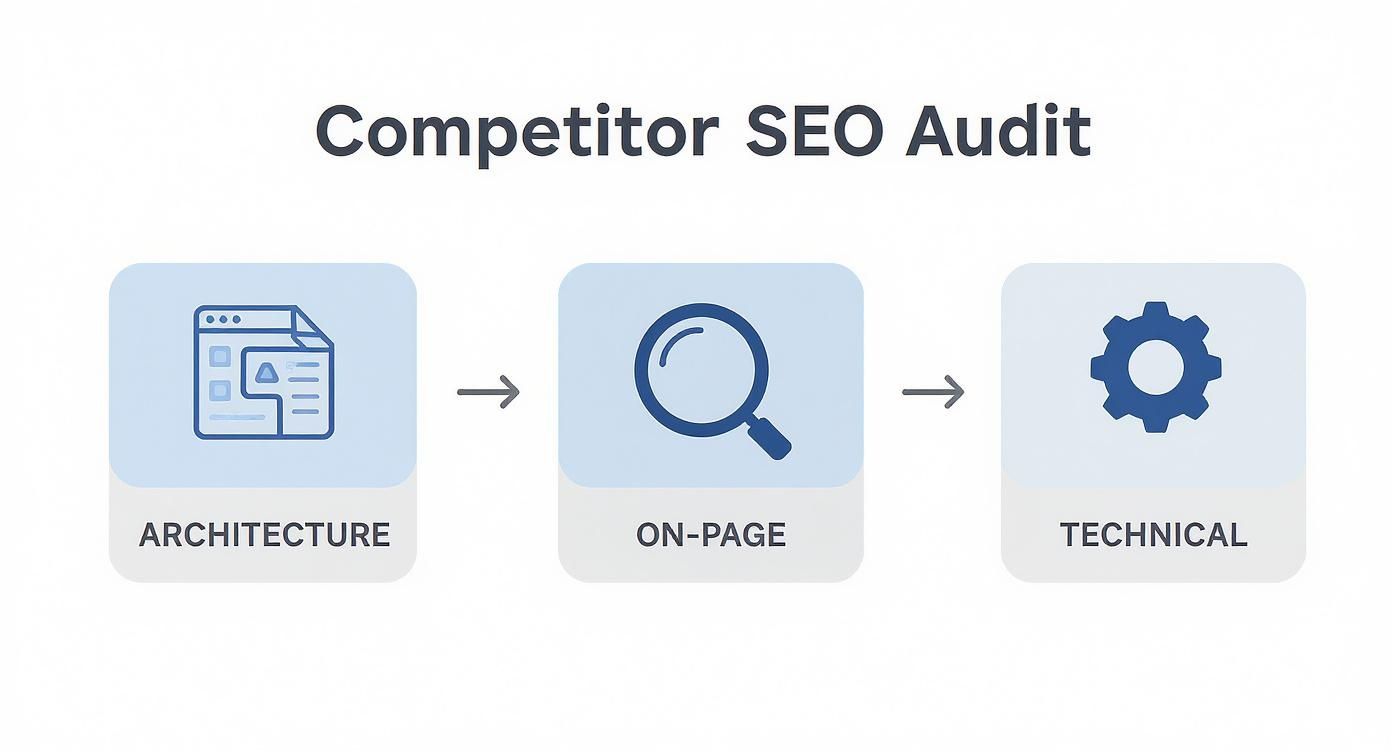
By breaking it down into these three stages—Architecture, On-Page, and Technical—you can be sure you’ve covered all your bases.
Prioritizing Opportunities with an Impact vs Effort Matrix
You probably have a laundry list of ideas by now, from creating new content to fixing a mountain of broken links. If you try to do it all at once, you’ll burn out. Fast.
A simple but incredibly effective way to bring some sanity to the chaos is the impact versus effort matrix. It’s a lifesaver.
This framework helps you sort every potential task by asking two straightforward questions:
- High Impact or Low Impact? How much will this really move the needle on our traffic, rankings, or conversions?
- High Effort or Low Effort? How much time, money, and sanity will this task cost us?
Plotting your tasks on this grid instantly clarifies your most strategic moves. It’s all about building momentum and getting some early wins on the board.
Identifying Quick Wins and Strategic Projects
Once you’ve sorted your tasks, they’ll fall neatly into four buckets, giving you a crystal-clear path forward.
- Quick Wins (High Impact, Low Effort): Jump on these immediately. We’re talking about things like optimizing title tags on pages stuck on page two, fixing critical broken internal links, or writing a blog post for a high-intent keyword where your competitor’s content is surprisingly weak.
- Major Projects (High Impact, High Effort): These are the big, game-changing initiatives that need a real investment. Think a complete website redesign, building out a massive content hub, or launching a serious link-building campaign.
- Fill-ins (Low Impact, Low Effort): These are great for when you have a bit of downtime. Things like updating old blog posts with new stats or cleaning up a batch of meta descriptions fit perfectly here.
- Reconsider (Low Impact, High Effort): These are the time-sinks you should probably avoid. Spending weeks chasing a link from a low-authority site? Classic example. Just don’t.
Your SEO roadmap isn’t just a to-do list; it’s a strategic document that aligns your team around the most important activities. It transforms a complex analysis into a clear, step-by-step plan for outranking the competition.
Building Your Roadmap in a Project Management Tool
You don’t need anything fancy. A simple spreadsheet or a project management tool like Trello or Asana works perfectly for mapping this out. Create columns for each task and add some key details to keep everyone on the same page.
Your roadmap should track:
- Task/Initiative: A clear description of what needs doing (e.g., “Create a guide on ‘how to choose a water heater'”).
- Priority: Label it as a Quick Win, Major Project, or Fill-in.
- Owner: Who is responsible for getting this done? Accountability is key.
- KPIs: How will you measure success? (e.g., “Achieve a top 5 ranking for the target keyword within 6 months”).
- Due Date: Give it a realistic deadline.
This structured approach makes sure every single insight from your competitor analysis becomes a concrete action with clear ownership and a measurable goal. For smaller teams, this kind of process is a non-negotiable part of any small business SEO guide that actually leads to sustainable growth.
Frequently Asked Questions About SEO Competitor Analysis
Even with a solid plan, you’re bound to have questions once you start digging into the data. Let’s clear up a few of the most common ones so you can keep your momentum going and make sure this effort pays off.
How Often Should I Run a Competitor Analysis?
This is one of the first questions people ask, and the honest answer is: it depends on how deep you’re going. A full-blown, comprehensive analysis like the one we’ve outlined here is a serious project. You probably only need to tackle that beast once or twice a year.
But that doesn’t mean you should ignore your rivals for the other 10 months. Watching the competition should be a regular, ongoing habit—think of it less like a massive annual project and more like keeping a constant pulse on the market.
Here’s a practical rhythm that works for a lot of businesses:
- Quarterly Reviews: Do a lighter check-in every three months. This is your chance to spot major shifts, like who’s suddenly pushing a ton of new content or making big moves in the keyword rankings.
- Monthly Monitoring: Take a quick look at your top 3-5 direct competitors. Are they landing valuable new backlinks? Did one of their articles just take off? This keeps you agile enough to respond to threats and opportunities without getting bogged down.
The point isn’t to get obsessed with every tiny move a competitor makes. It’s about staying informed enough to be proactive and strategic, so you’re not always playing defense.
This regular check-in makes your annual deep dive much more effective because you’re not starting from scratch. You’ll already have a feel for the landscape.
What Are the Best Free Tools for This Work?
While the big paid suites offer incredible power, you’d be surprised how much you can uncover without spending a single dollar. If you’re on a tight budget, you can stitch together a really effective analysis with a few free resources.
Here are the essentials you should have in your free toolkit:
- Google Search (Seriously): Never underestimate the power of an incognito search. It shows you exactly what a real user sees for your target keywords. Pay close attention to the “People Also Ask” and “Related Searches” sections—they are pure gold for content ideas.
- Google Search Console: It’s your own data, but it’s invaluable. Look at the queries where you’re ranking on page two. Analyzing who is outranking you for those specific terms is one of the most direct paths to improvement.
- Google’s PageSpeed Insights: This is non-negotiable for any technical audit. Run your competitors’ key pages through it and see how their performance stacks up. It’s a quick, easy way to find a competitive edge.
- Ahrefs Webmaster Tools: The free version gives you a ton of information on your own site’s backlinks and keywords. You can use this as a solid benchmark when you’re manually researching what your competitors are up to.
By combining these tools, you can build a surprisingly detailed picture of the competitive field.
What if My Competitors Are Huge National Brands?
It’s easy to feel defeated when you’re a local shop and your search results are dominated by giants like Home Depot or Forbes. The temptation is to throw your hands up and say you can’t compete. That’s the wrong way to think about it.
You can’t out-spend them, so you have to out-smart them. And that means you have to out-niche them.
These massive brands have to create broad, generalized content to serve a national audience. Your local focus is your superpower.
Instead of chasing a huge term like “kitchen remodeling,” you can win by owning a term like “kitchen remodeling costs in St. Petersburg, FL.” Create hyper-local content that a national brand would never bother with. Feature your local projects, name-drop specific neighborhoods, and answer questions that only matter to people in your community.
This is exactly how to do competitor analysis in SEO when the odds feel stacked against you. You find the angles they are too big to see.
Ready to stop guessing and start winning? The team at Netco Design LLC builds revenue-focused SEO strategies based on deep competitive insights, helping businesses in Tampa Bay and beyond claim their spot on page one. Discover how a professional analysis can transform your traffic at https://netcodesign.com.

