

table of contents
Doing your own SEO is all about having a clear, repeatable process. You start with a foundational website audit to find the high-impact issues, figure out what your customers are actually searching for, and then consistently create helpful content that answers their questions. It’s way less about technical wizardry and much more about strategic, focused effort.
Starting Your DIY SEO Journey Without the Overwhelm
Diving into SEO can feel like trying to learn a new language overnight, but trust me, it’s one of the most valuable skills you can pick up for your business. The good news? You absolutely don’t need to be a coding genius to get real results. Success comes from zeroing in on the foundational elements that make the biggest difference, not getting lost in a sea of confusing jargon.
The first step is to cut through all the noise and create a simple, actionable starting point. This means finding the big-ticket items that might be holding your website back right now. I’m talking about common culprits like a clunky mobile experience, painfully slow page load times, or a confusing site structure that makes it hard for both people and search engines to find anything. If you’re brand new to this, getting a sense of the basics from our guide on what search engine optimization is is a great place to begin.
Pinpointing Your First Action Items
Your goal isn’t to fix everything at once. That’s a recipe for burnout. Instead, you’re going to kick things off with a simple audit using free, accessible tools. This initial check-up gives you a straightforward roadmap for your first few optimization tasks. Think of it as building a solid SEO foundation, one that you can confidently build upon over time.
This initial process—auditing your site, finding the problems, and creating a roadmap—is the absolute core of any effective DIY SEO strategy.
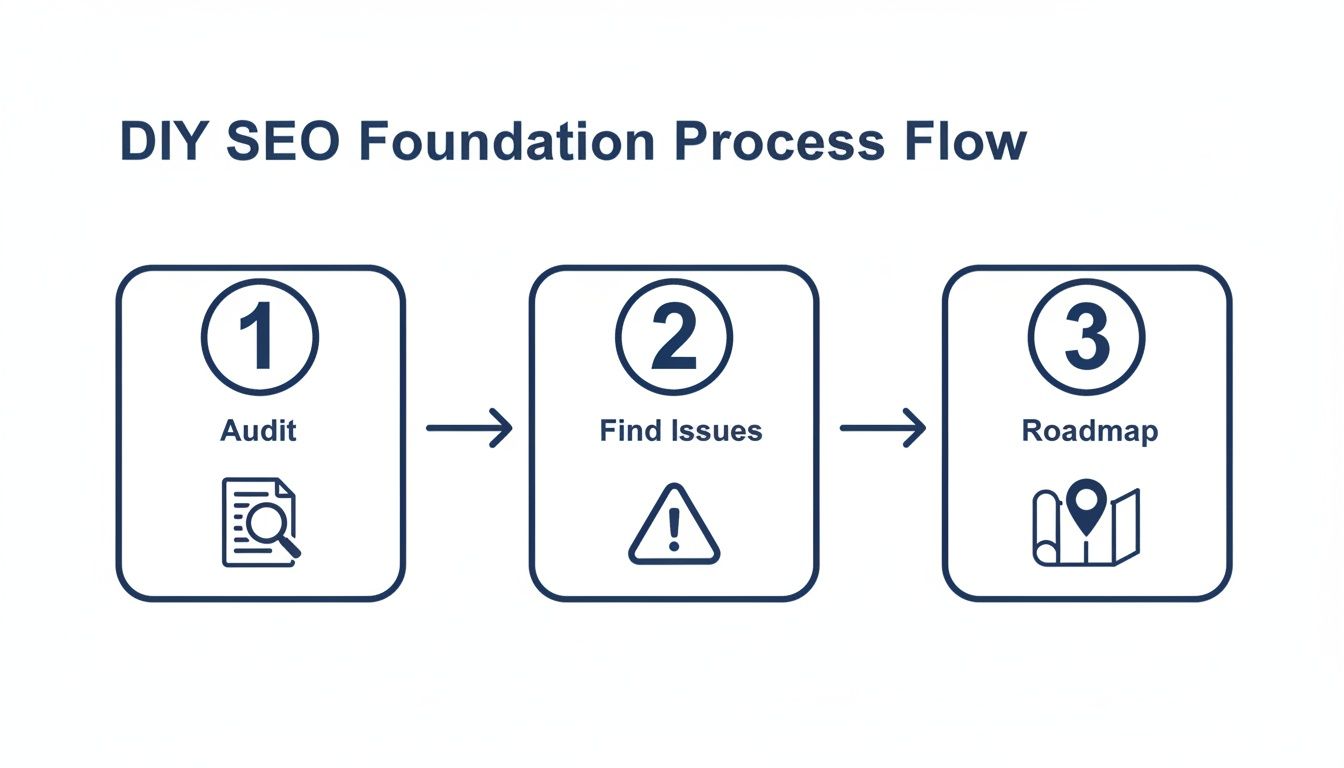
As you can see, every successful optimization effort starts with a thorough audit to understand where you’re at. From there, you identify the specific problems and, finally, build a clear plan of action.
This methodical approach ensures you’re spending your valuable time on tasks that will actually move the needle. You’ll sidestep the common pitfall of randomly tweaking things without a clear purpose. Instead, every action you take will be a deliberate step toward getting more visible online.
Why All This Effort Is Worth It
Investing your time in learning how to do search engine optimization yourself has a direct impact on your bottom line. It’s not just a “nice to have” marketing channel anymore. Organic search now drives over 53% of all website traffic for businesses around the globe. That’s a massive shift in how people find what they need.
And when you consider that 68% of all online experiences begin with a search engine, the importance becomes crystal clear. For a more detailed look, this step-by-step guide to SEO for beginners can provide some great additional structure.
By focusing on SEO, you’re not just chasing rankings; you’re actively placing your business in front of potential customers at the exact moment they are looking for a solution you provide. This is proactive, not reactive, marketing.
Ultimately, this DIY journey is about empowerment. It’s about taking control of your online presence and building a sustainable source of leads and sales without needing a huge marketing budget. By starting with a simple audit, you’re laying the groundwork for compounding results that will grow over time.
Your First DIY SEO Audit Checklist
To get you started, I’ve put together a focused checklist for your initial website audit. This isn’t meant to be exhaustive; it’s designed to help you tackle the high-impact areas that a beginner can manage right away. Use these free tools to get a baseline and identify your first set of to-dos.
- Mobile-Friendliness: Check if your site is easy to use on a phone. Are buttons tappable? Is text readable? Use Google’s Mobile-Friendly Test.
- Page Speed: See how quickly your key pages load (aim for under 3 seconds). Use Google PageSpeed Insights.
- On-Page Basics: Do your important pages have unique title tags and meta descriptions? Use Screaming Frog (free for up to 500 URLs).
- Indexing Status: Is Google able to find and list your site in its search results? Use Google Search Console.
- Broken Links: Are there any links on your site that lead to “404 Not Found” errors? Use Ahrefs’ Free Broken Link Checker.
Completing this quick check-up will give you a handful of clear, actionable tasks. Don’t worry about being perfect. Just focus on making steady progress, and you’ll be well on your way.
Finding Keywords That Attract Your Ideal Customers
Forget chasing random, high-volume keywords for a minute. The real magic in SEO happens when you get inside your customer’s head and figure out the exact language they use when they need what you sell. This is where you shift from guesswork to a repeatable process for attracting the right people.
It all starts with understanding the ‘why’ behind every search query. We call this user intent. You have to become a detective and figure out what someone is really trying to accomplish. Are they just kicking tires and gathering info, or are they ready to pull out their credit card?

Uncovering User Intent
Every search you can think of falls into one of a few key buckets. Nailing these down means you can create the perfect piece of content for the right person at the exact moment they need it. If you’re serious about learning how to do search engine optimization yourself, this is a non-negotiable skill.
Here’s how it usually breaks down:
- Informational Intent: The person is looking for an answer. Think “how to fix a leaky faucet” or “what’s the best grass for Florida lawns?” They want knowledge, and they’re probably not ready to buy just yet.
- Transactional Intent: This person is ready to make a move. Their searches are direct and to the point: “plumber near me,” “buy Nike running shoes,” or “emergency roof repair Tampa.” These are pure gold because the intent to spend money is high.
- Navigational Intent: They already know where they’re going and are just using Google as a shortcut. Searches like “Facebook login” or “Netco Design” fit here.
- Commercial Investigation: This user is in the final research phase before buying. They’re comparing options with searches like “best CRM for small business” or “iPhone 15 vs Samsung S24.”
Once you can spot the intent behind a keyword, you can build a page that gives the searcher exactly what they came for. An informational query gets a detailed how-to guide; a transactional query gets a crystal-clear service page with a “call now” button.
Think of keywords as a direct line into your customer’s thought process. A search for “how to unclog a drain” is a cry for help and information. A search for “24-hour plumber St Petersburg” is a call for immediate service. Your job is to have the right answer for both.
The Small Business Secret Weapon: Long-Tail Keywords
Let’s be real: trying to rank for a massive, one-word keyword like “marketing” or “websites” is a fool’s errand for a small business. You’re going up against giants with million-dollar budgets. It’s not going to happen.
This is where long-tail keywords become your secret weapon.
These are longer, much more specific search phrases. While they don’t get the same massive search volume as broad terms, they are far less competitive and tend to convert like crazy. A solid long-tail keyword research strategy is the bedrock of any smart DIY SEO plan.
Just think about the difference for a local bakery:
- Broad Keyword: “cake” (Insanely competitive, who knows what they want?)
- Long-Tail Keyword: “custom gluten-free birthday cake St Pete” (Super specific, clear intent to buy!)
The person searching that long-tail phrase knows exactly what they want and is probably ready to place an order today. That one visitor is worth more than a hundred people who were just browsing random pictures of cakes.
Simple Methods for Finding Keywords
You don’t need to drop hundreds on fancy software to get started. Some of the most powerful keyword research tools are completely free and built right into Google.
- Use Google’s Autocomplete: Start typing a phrase related to your business into the search bar. Pay close attention to the suggestions that pop up—those are real searches from real people.
- Analyze the “People Also Ask” Section: This little box is a goldmine. It shows you the related questions your audience is asking. Answering these directly in your content is a fantastic and simple SEO tactic.
- Check “Related Searches”: Scroll all the way to the bottom of the search results page. Google literally gives you a list of other, similar searches. This is a fantastic way to uncover more long-tail keyword ideas.
Using just these simple techniques, you can build an impressive list of keywords that reflect how your customers actually talk and search. This is the foundation that ensures every piece of content you create will actually attract the right audience—the people who are actively looking for you.
Creating Content and Pages Search Engines Love
Alright, you’ve done the legwork and figured out what your ideal customers are searching for. Now it’s time to roll up our sleeves and put those keywords into action. This is where we start building pages that actually speak to both people and search engines—and it’s less about fancy code and more about clear, valuable communication.
The main goal here is simple: when someone clicks on your site from a Google search, they should feel an immediate sense of “Ah, I’m in the right place.” Your content needs to directly answer the question they just typed in. A huge part of any DIY SEO effort is mastering how to write SEO articles that consistently rank, because that’s what will ultimately draw customers in.
Crafting Titles and Descriptions That Earn Clicks
Think of your title tag and meta description as your digital storefront window in the search results. They’re the blue link and the little snippet of text underneath, and they have one job: to convince someone to click on your link instead of the nine others on the page.
- Title Tags: You’ve got less than 60 characters to work with, so make them count. Get your main keyword in there early, and tack your brand name on the end. A title like “Emergency Leak Repair St. Petersburg | Netco Plumbing” is worlds better than a generic “Services.”
- Meta Descriptions: This is your 155-character sales pitch. It’s your chance to expand on the title and tell the searcher why they should choose you. Weave in your primary keyword and add a little nudge, like “Get a free quote today.”
These two little elements are incredibly powerful. They don’t just signal relevance to Google; they build trust with a potential customer before they even land on your site.
Structuring Content for Readability and Rankings
Imagine trying to read a book with no chapters or headings—a total nightmare, right? That’s what your website feels like to users and search engines without proper structure. Using heading tags (H1, H2, H3) is non-negotiable.
Your H1 is the big, bold headline for the page. It needs to feature your main keyword, and you should only ever have one H1 tag per page. From there, use H2s to break up the major sections and H3s for the sub-points. This creates a logical flow that helps Google grasp your page’s key topics while letting visitors scan for the exact info they need. Planning this out ahead of time is a game-changer, and it’s much easier when you learn how to create a content calendar.
Your content’s structure is just as important as the words themselves. A well-organized page with clear headings, short paragraphs, and bullet points is easier to read, keeps visitors engaged longer, and sends all the right signals to search engines.
Optimizing Images and Internal Links
Images bring your content to life, but if you don’t optimize them, they’re basically invisible to search engines. Every single image needs descriptive alt text. This is what screen readers use to describe the image to visually impaired users, and it’s also what tells search engines what the picture is about. So instead of an alt text like “image123.jpg,” write something a person would understand, like “plumber fixing a leaky faucet under a kitchen sink.”
Internal links are just links from one page on your site to another. They’re super important. By linking related pages together, you help visitors discover more of your great content and, crucially, you show search engines how your pages are connected. This also spreads authority, or “link equity,” around your site, telling Google which pages are the most important. A simple link from a blog post on “DIY Faucet Repair” over to your main “Professional Plumbing Services” page is a perfect example.
Prioritizing the Mobile Experience
Let’s be crystal clear: if we’re talking about on-page SEO, the mobile experience is not optional. Mobile devices account for roughly 60% of all global internet traffic. Google knows this, which is why it uses a “mobile-first” indexing system. This means it primarily looks at the mobile version of your site to decide how to rank it.
What does that mean for you? If your website is a clunky, hard-to-read mess on a phone, you’re toast. Your other SEO work won’t matter. Pull out your own phone and test your pages. Can you easily tap the buttons? Can you read the text without pinching and zooming? A bad mobile experience will sink your SEO efforts faster than anything else.
For a lot of businesses, the real battle isn’t global—it’s won right in your own backyard. If you’re a plumber, a baker, or a local consultant, dominating your local market is what puts food on the table. This is where you can get a massive edge by learning to do your own SEO.
The first stop on this journey is the single most important tool in your local SEO arsenal: your Google Business Profile (GBP). This is that free listing that pops up in Google Maps and the all-important “local map pack.” When someone searches “pizza near me,” the businesses in that map box are almost always the first to get a call.
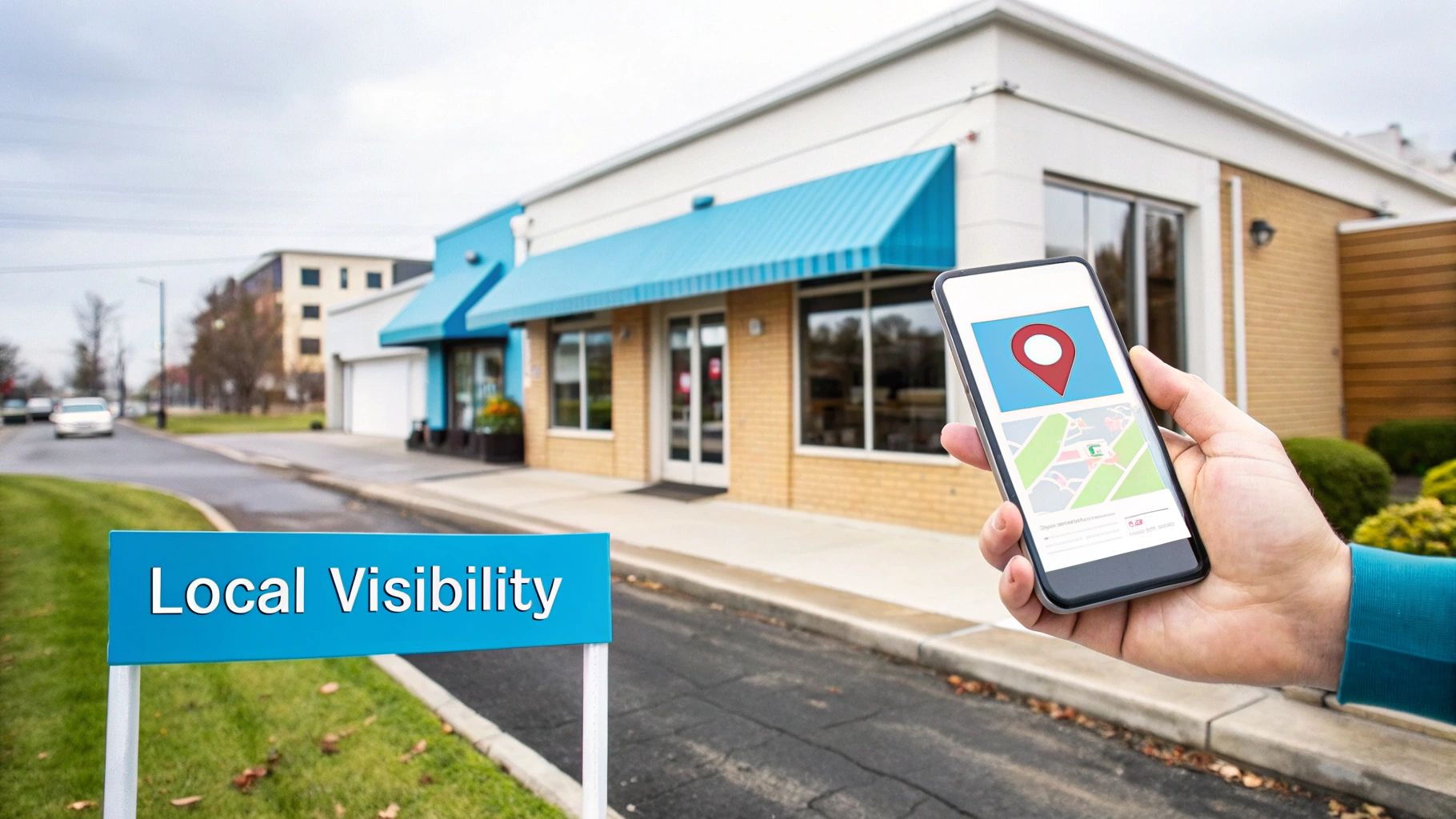
Turn Your Google Business Profile Into a Customer Magnet
Just claiming your GBP isn’t enough. You have to treat it like a mini-website, and that means meticulously filling out every single section. I’m talking about uploading high-quality photos of your work and your team, listing out all your services with solid descriptions, turning on the Q&A feature, and actively asking customers for reviews.
We have a dedicated guide that walks you through exactly how to optimize your Google Business Profile for the best results.
Don’t just take my word for it. The data shows that a whopping 46% of all Google searches are looking for local information. When your profile is packed with useful info and glowing reviews, it sends a huge signal to Google that you’re a trustworthy choice for people in your area.
NAP Consistency: The Foundation of Local Trust
Beyond your GBP, Google is constantly scanning the web for consistent signals about your business. The most critical of these is your NAP: Name, Address, and Phone number. This information has to be absolutely identical everywhere it shows up online.
Think about it from a customer’s perspective. If they find three different phone numbers for you online, which one do they call? That tiny bit of confusion erodes trust, not just for people but for search engines, too.
To keep everything straight, you need to manage your local citations. These are just mentions of your business NAP on other websites, such as:
- Online directories like Yelp, Bing Places, and Apple Business Connect.
- Industry-specific sites, like TripAdvisor for a restaurant or Avvo for a law firm.
- Local community websites, like your local chamber of commerce or event listings.
Your goal is to create a consistent digital footprint. Every accurate citation is another vote of confidence that tells Google, “Yes, this business is legitimate, it’s located where it says it is, and this is how to contact it.”
Demystifying Link Building With a Local Focus
Alright, let’s talk about building real authority through links. For a local business, this has nothing to do with chasing links from massive, global websites. It’s all about earning valuable “backlinks”—links from other websites pointing to yours—from reputable sources within your own community.
Honestly, a single backlink from a well-respected local blog can be more powerful than a dozen links from irrelevant sites. These local links are digital endorsements, telling Google that you’re a recognized and important part of the local scene.
Practical Ways to Earn Valuable Local Links
Forget about complicated outreach campaigns. Start with these practical, relationship-based strategies that any business owner can actually do.
- Sponsor a Local Charity or Event: That 5K race or local little league team you sponsor? It often comes with a link back to your website from their event page. It’s a win for the community and a win for your SEO.
- Partner with Neighboring Businesses: Team up with non-competing businesses in your area. For example, a roofer could get a link from a trusted real estate agent’s “recommended vendors” page.
- Host a Community Workshop: A local accounting firm could host a free “Small Business Tax Tips” workshop. This creates a natural reason for local news outlets, business groups, and even the public library to link to your event page.
- Join Your Local Chamber of Commerce: This is often the easiest win. Most chambers have an online directory where they will list and link to your business website, giving you an instant, high-authority local backlink.
By focusing on these tangible, community-first tactics, you build an online reputation that actually reflects your real-world presence. That’s the core of smart local SEO: becoming so integrated into your community that Google can’t help but notice.
Measuring What Matters and Planning Your Next Move
SEO is a marathon, not a sprint. After you’ve put in all that foundational work, the real journey begins—tracking what’s working, what isn’t, and making smart adjustments along the way. This is where you turn a bunch of data into a clear story about your progress and figure out where to go next.
You don’t need a boatload of expensive software for this, either. Your command center can be two free tools from Google: Google Search Console and Google Analytics 4. Think of it this way: Search Console tells you what happens before someone clicks on your site (like what keywords you’re showing up for), while Analytics tells you what they do after they land on your pages.
Focusing on KPIs That Actually Drive Growth
It’s incredibly easy to get lost in a sea of numbers. The trick is to tune out the “vanity metrics” (like social media likes) and zero in on the Key Performance Indicators (KPIs) that actually mean something for your business. For DIY SEO, this means keeping your eye on a handful of really powerful metrics.
Here are the essentials you should be watching:
- Organic Traffic: This is the lifeblood. It’s the number of people finding your site through a search engine. A steady climb here is the clearest sign that your hard work is paying off.
- Keyword Rankings: Are you moving up the ladder for your target keywords? Tracking your position for the phrases that matter most tells you if your content is truly hitting the mark with Google and your audience.
- Click-Through Rate (CTR): This is the percentage of people who saw your site in the search results and actually clicked it. A low CTR is a huge red flag that your title tags and meta descriptions just aren’t compelling enough to grab attention.
- Conversions: This is the end goal, right? A conversion is any valuable action a visitor takes, whether it’s filling out a contact form, buying a product, or picking up the phone to call you.
Tracking these specific metrics gives you a real, tangible picture of your return on investment. You’re not just guessing anymore; you’re seeing proof that your time is generating actual business.
Don’t just look at the numbers—look for the story they tell. A sudden spike in traffic to a specific blog post means you’ve hit on a topic your audience loves. A drop in rankings for a service page could signal that a competitor just one-upped you with better content.
Using Data to Inform Your Next Steps
Your data is your roadmap. By keeping a close watch on these KPIs, you can shift from making reactive tweaks to building a proactive strategy. The whole point is to create a cycle of continuous improvement: analyze, learn, and act.
For instance, you might log into Google Search Console and notice you’re getting tons of impressions (people seeing you in the results) for a keyword like “how to install a ceiling fan,” but almost no one is clicking. That’s a massive opportunity! It tells you Google thinks you’re relevant, but your headline is putting people to sleep.
The next action is crystal clear: rewrite that page’s title tag to be more interesting. Something like “Step-by-Step Ceiling Fan Installation (With Photos)” is way more likely to get the click. See? You just used data to make a smart, targeted improvement.
This ongoing process of analyzing and refining is what learning to do your own SEO is all about. Once you have a few months of data, you can start putting it together to spot bigger trends. For a deeper look at how to structure all this information, you can check out our guide that explains what an SEO report is and how it helps you visualize your progress.
Your SEO journey doesn’t really have a finish line. It’s an ongoing cycle of creating, measuring, and refining. By focusing on the right metrics, you can confidently steer your website toward steady growth and make sure every action you take is a deliberate step toward attracting more of your ideal customers.
Common Questions About Doing Your Own SEO
When you first dive into doing your own SEO, it’s easy to feel like you’ve opened a can of worms. You fix one thing, and three more questions pop up. It’s totally normal, and honestly, every business owner has been there. Let’s clear up some of the most common roadblocks people hit.
How Long Does It Take to See SEO Results?
This is the million-dollar question, isn’t it? The most honest answer is: it depends. SEO isn’t like flipping a switch; it’s more like planting a garden. You’re building trust and authority with search engines, and that just takes time.
For most small businesses learning how to do search engine optimization themselves, you can expect to see the first glimmers of progress within 4 to 8 weeks. This might look like ranking for your own business name or a super-specific service term that doesn’t have much competition.
But for the bigger wins—ranking for those competitive keywords that actually drive a good chunk of traffic—you’re typically looking at 3 to 6 months of consistent work. The key here is steady, focused effort.
SEO is a long-term investment that builds compounding returns. Unlike paid ads that stop when you stop paying, the authority you build through SEO continues to deliver value over time, creating a sustainable asset for your business.
Is DIY SEO Hard to Learn?
The basics of SEO aren’t rocket science, but they do demand commitment. The toughest part isn’t the technical stuff; it’s sticking with it consistently. The good news is that modern tools and platforms do a lot of the heavy lifting, so you don’t need to be a coding whiz.
You can get really far by just focusing on a few core principles:
- Keyword Research: Figuring out the exact words and phrases your customers use.
- Content Creation: Answering your customers’ questions better than anyone else online.
- On-Page SEO: Making sure your content is structured in a way that’s easy for both people and search engines to understand.
- Local SEO: Claiming and sprucing up your local business listings.
If you can carve out a few hours each week to work on these areas, you can absolutely make a big impact on your own. In fact, around 55% of micro-business owners are already handling their own SEO, which just goes to show it’s completely doable.
When Should I Consider Hiring an Expert?
While doing your own SEO is incredibly powerful, there are definitely times when calling in a professional is the right move. If you feel like you’ve hit a plateau or your business is growing faster than you can keep up, an expert can seriously accelerate your results.
Think about getting help if:
- You’ve been putting in consistent effort for 3-6 months and your progress has completely stalled.
- You simply don’t have the time to create the high-quality content your strategy needs to succeed.
- You’re up against something complex, like a major website migration, a penalty from Google, or trying to break into a super-competitive e-commerce market.
The whole point of DIY SEO is to build a rock-solid foundation. Once you get to a point where your time is better spent actually running your business, you can hand off a well-oiled machine to an agency or consultant, which will save you a ton of time and money in the long run.
Ready to take the guesswork out of your digital marketing and get expert guidance tailored to your business? At Netco Design LLC, we specialize in building revenue-focused SEO and web design strategies that deliver measurable results. Let us help you turn your online presence into your most powerful lead-generation tool. Learn more and get started today!

