

table of contents
To bring in leads, you first need to define your ideal customer and create an irresistible offer that solves a real problem they have. Getting this foundation right ensures every marketing dollar you spend—from SEO to social media ads—is aimed at the right target and doesn’t go to waste.
Build Your Foundation for High-Quality Leads
Jumping straight into tactics without a solid foundation is like building a house on sand. Before you write a single blog post or launch a Google Ad, you need absolute clarity on two things: who you’re trying to reach and what unique value you offer them. Honestly, this is the most critical part of the whole process.
So many businesses create vague “buyer personas” that are too generic to be useful. Instead, I always tell people to focus on building a rock-solid Ideal Customer Profile (ICP). This goes way beyond basic demographics and gets into the real-world challenges, goals, and frustrations of the people you serve best.
The goal isn’t just to describe them; it’s to understand them so well you can anticipate their needs. You can learn more by exploring how to create buyer personas that actually inform your strategy.
Define Your Audience and Their Problem
Your ideal customer has a problem they are actively trying to solve. Your job is to identify that problem with laser precision. Is it a local plumbing company struggling with inconsistent calls? Or maybe an e-commerce store losing sales to abandoned carts?
Once you’ve pinpointed the problem, you can start to map out their journey. Think about the exact questions they type into Google or the frustrations they vent about to colleagues. This deep understanding is what separates generic marketing from messages that truly connect and convert.
A well-defined ICP acts as a compass for all your marketing decisions. It tells you where to find your audience, what to say to them, and how to present your solution as the only logical choice.
This simple visual breaks down the core process: connect with your audience by first identifying their problem, then offering a clear solution.
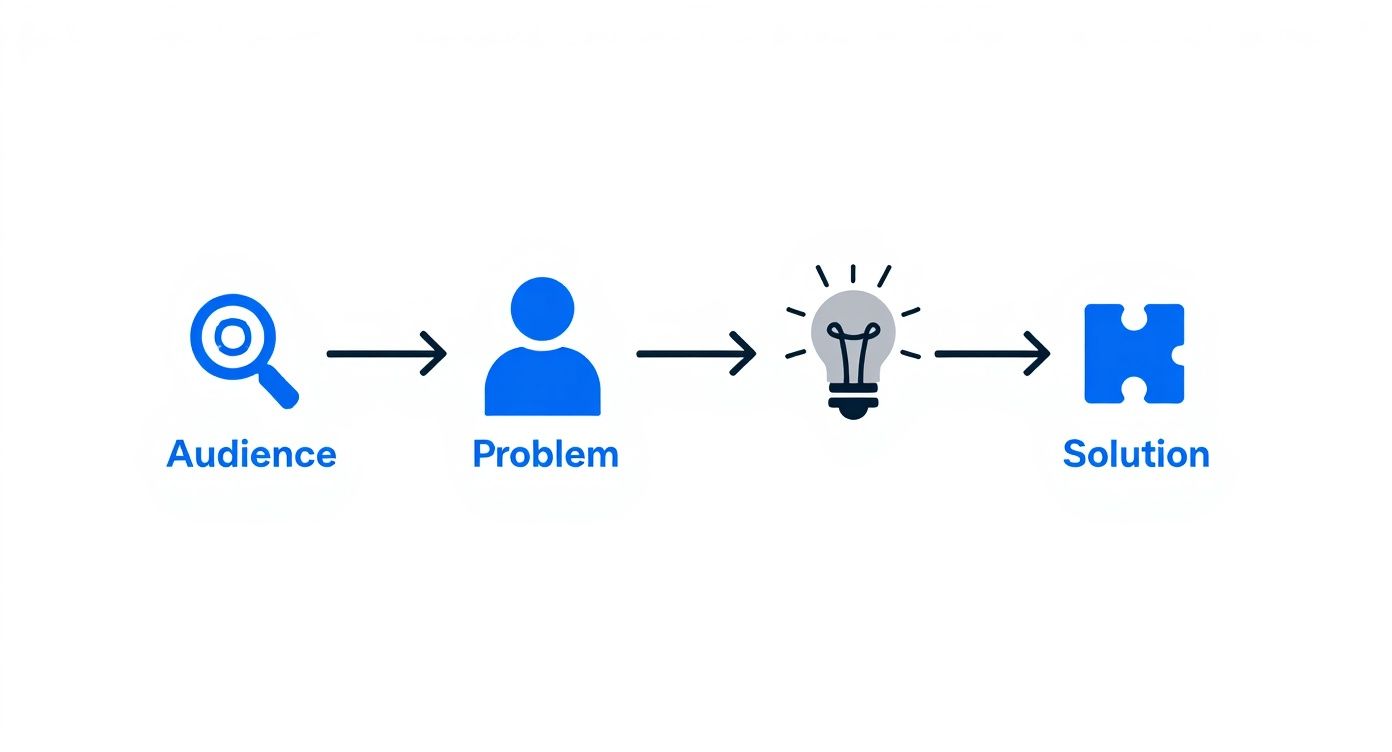
As you can see, a winning lead generation strategy always starts with the customer, not the product. That’s how you stay relevant.
Craft an Unbeatable Unique Value Proposition
With a clear picture of your ideal customer and their problem, you can now craft your Unique Value Proposition (UVP). Think of this as a concise statement that spells out the benefit you provide, how you solve their specific need, and what makes you different from everyone else. It’s the reason someone should choose you over your competitors.
A powerful UVP is specific, pain-focused, and exclusive. For example, instead of saying, “We build websites,” a much better UVP would be: “We build high-converting websites for home service businesses that generate qualified leads within 90 days.” See the difference? One is a service; the other is a solution.
A strong UVP needs these key components:
- Relevance: It has to clearly explain how you solve your customer’s specific problem.
- Quantified Value: It should promise a specific, measurable benefit (e.g., “increase leads by 30%“).
- Unique Differentiation: It must highlight what makes you the obviously better choice.
Nailing this foundation makes everything that follows so much easier and more effective. Your ad copy will be more persuasive, your content will attract the right people, and your landing pages will convert better—all because you’re speaking directly to your ideal customer with an offer that feels like it was made just for them.
Use Content and SEO to Attract Ready-to-Buy Leads

Once you’ve got a crystal-clear picture of who you’re talking to, it’s time to stop chasing them down. The real goal is to get them to come to you. This is how you turn your website from a digital brochure into a lead-generating machine that works for you 24/7. The two big levers we pull to make this happen are content marketing and Search Engine Optimization (SEO).
It’s a pretty straightforward idea. You create genuinely useful articles, guides, or videos that answer the exact questions your ideal customers are typing into Google. When they find your content, they don’t just get a solution—they find your business and start to see you as the go-to expert.
This isn’t about cold calls or spammy emails. You’re not interrupting anyone’s day. You’re just being helpful. And it works. The data shows that content marketing pulls in three times more leads than old-school outbound tactics, all while costing 62% less. In fact, a whopping 74% of marketers say content has directly boosted their lead generation.
Think Like a Problem Solver, Not a Salesperson
If you want your content to actually generate leads, you have to shift your mindset. Your primary job is to educate and help, not to push a sale. Your potential customers are looking for answers, not a sales pitch.
So, forget about posting company news or bragging about awards. None of that matters to your audience. You need to focus on the problems that keep them up at night.
For instance, a home services company in Florida shouldn’t just be posting photos of their recent jobs. A much smarter play would be to create content that answers questions real homeowners are asking:
- “How to Prepare Your Home for a Hurricane in Florida”
- “5 Warning Signs Your AC Unit Needs a Repair”
- “DIY vs. Professional Landscaping: What’s the Better Investment?”
Each of these topics hits on a real pain point. By providing a truly helpful answer, you build instant trust. When they eventually need to hire someone, who do you think they’ll call first? A strong content strategy is your roadmap for creating this kind of value, and this real-world content strategy example shows you how all the pieces come together.
Find the Keywords Your Customers Actually Use
Writing great content is one thing, but people have to be able to find it. This is where keyword research comes in. The mission is to uncover the exact phrases and questions your Ideal Customer Profile (ICP) types into search engines.
You’ve got to think beyond simple, one-word terms. The real gold is in long-tail keywords—longer, more specific phrases of three or more words. These are incredibly powerful for generating leads because they signal someone is much closer to making a decision.
Think about it. A search for “plumber” is casual, maybe just browsing. But a search for “emergency plumber for leaking pipe in St. Petersburg” is a cry for help. That person has a serious problem and needs a solution right now. Creating a page optimized for that phrase will attract a lead who is not just qualified but ready to buy.
Pro Tip: Use the free tools right inside Google. The “People Also Ask” box and the “Related Searches” at the bottom of the page are treasure troves. They show you the exact language your customers are using to find solutions.
A Real-World Example of Niche Content Dominance
I once worked with a small business consulting firm trying to make a name for itself in an absolutely brutal market. They were up against giant, established corporations with bottomless marketing budgets. There was no way they could compete for broad keywords like “business consulting.”
So we changed the rules of the game. Instead of going broad, we went incredibly narrow. We targeted a super-specific niche: “financial forecasting models for SaaS startups.” They poured everything into creating the single most comprehensive guide on that topic. It had downloadable templates, video tutorials, and detailed case studies.
The result? Within six months, that one piece of content was ranking on the first page of Google for dozens of related long-tail keywords. It became their number one source of new business, bringing in a steady stream of SaaS founders who needed exactly what they sold. They didn’t win with a bigger budget; they won by being the absolute best resource for a specific audience with a specific problem. That’s the power of smart content and SEO.
Amplify Your Reach with Paid Ads and Social Media
While content marketing and SEO are building your long-term, lead-generating machine, sometimes you just need to step on the gas. This is exactly where paid advertising and a smart social media strategy come in. They give you a direct line to a very specific audience, and they work fast.
Think of paid channels as your accelerator. They can start bringing in leads almost immediately, but you have to be strategic. The goal isn’t to outspend your competition; it’s to outsmart them and avoid burning through your budget with nothing to show for it.
At the same time, organic social media is where you build a community and nurture the leads you attract. It’s the human side of your brand, where trust is built one conversation at a time.
Launching Strategic Paid Ad Campaigns
When you’re ready to jump into paid ads, the very first rule is to have a crystal-clear goal. Are you after demo sign-ups? Ebook downloads? Or do you just need the phone to ring? That single objective will shape every other decision you make.
Google Ads is fantastic for capturing intent. You’re targeting people who are right now, at this very moment, searching for a solution you provide. It’s like setting up a shop right on the digital highway where your ideal customers are already driving.
LinkedIn Ads, on the other hand, is all about targeting based on identity. This is a goldmine for B2B companies. You can get incredibly specific, reaching people with certain job titles, in specific industries, or at companies of a certain size. A software company, for example, could target “Project Managers at construction firms with 50-200 employees.” That level of precision is just unmatched.
Here’s a simple framework to get you started:
- Define Your Goal: What’s the one action you want someone to take? (e.g., fill out a form, call your business).
- Set Your Budget: Start small. Find out what works before you pour more money into it. You can always scale up a campaign that’s delivering a positive return.
- Write Compelling Copy: Your ad needs to speak directly to the pain points of your ideal customer. Ditch the feature list and focus on the benefit.
- Create a Dedicated Landing Page: This is critical. Never, ever send paid traffic to your homepage. Your ad needs a dedicated, clutter-free landing page with a message that matches the ad and one clear call-to-action.
Running these campaigns well can get complicated, fast, especially when you’re juggling a million other things. For a deeper dive, you might want to look into professional PPC management for small business to make sure your investment pays off.
So many businesses make the mistake of “setting and forgetting” their ad campaigns. The most successful advertisers are constantly in their accounts, testing and tweaking ad copy, targeting, and landing pages to push their cost per lead down and their conversion rates up.
Building a Community with Organic Social Media
If paid ads are the sprint, organic social media is the marathon. This is your long game for nurturing leads and building real relationships. It’s where you stop being just a logo and start becoming a credible, trustworthy voice.
The key is to pick your battles. Don’t try to be everywhere. Instead, show up where your audience already spends their time.
- B2B Companies: You’ll likely find your crowd on LinkedIn and X (formerly Twitter). These are the places to share industry insights and connect with other professionals.
- Visual B2C Brands: Instagram and Pinterest are your best friends. They are visual powerhouses for showcasing products and building a lifestyle around your brand.
- Broad Local Audiences: Facebook is still a giant for building a local community and driving engagement.
The real goal isn’t just to post; it’s to start conversations. Ask questions. Run polls. Respond to every single comment. Each of those little interactions is a chance to turn a follower into a warm lead.
Stop thinking of your social profile as a billboard and start treating it like a digital storefront. You’re there to greet people, answer their questions, and gently guide them toward the solution they need. When you focus on genuine engagement, you build a loyal following that will eventually become paying customers.
Turn Your Website into a Lead Conversion Machine
Getting traffic to your site is just half the battle. If visitors arrive, poke around, and then leave without doing anything, all that effort you put into SEO, content, and ads goes right out the window. The real game-changer is turning that hard-won traffic into actual leads. This is the world of Conversion Rate Optimization (CRO).
CRO is all about making it incredibly easy—and compelling—for a visitor to take the next step. It’s about shifting your website from a passive digital brochure into your most active and effective sales tool. Every single element on your page, from the headline to the button color, should work together to guide the user toward a specific goal.
This isn’t about shady tricks or annoying pop-ups. It’s about understanding how people think and systematically removing any friction that gets in their way. You’d be surprised how even small, incremental improvements can lead to massive gains in leads over time.
The Anatomy of a High-Converting Landing Page
Your landing pages are the front lines of your lead generation. Someone clicks a Google Ad or a link in a social media post, and bam—they land on a page where the conversion either happens or it doesn’t. A page that actually performs has several key pieces that need to work in perfect harmony.
Think of your landing page as a focused, one-on-one sales pitch. It needs to be completely free of distractions. That means no navigation bars, no social media links, no sidebars—nothing that could possibly pull the visitor away from the one thing you want them to do.
A truly effective landing page nails these essentials:
- A Magnetic Headline: Your headline has one job: to instantly confirm the visitor is in the right place and that you can deliver on the promise they just clicked on.
- Compelling Copy: The text shouldn’t just list features. It needs to scream benefits. Focus entirely on what the user gets out of it. Use short sentences and bullet points to make it easy to scan.
- An Irresistible Call-to-Action (CTA): Your CTA button has to stand out visually. More importantly, it needs to use action-oriented language. “Get My Free Quote” is so much more powerful than a bland, generic “Submit.”
The single biggest mistake I see is a landing page with a weak or confusing offer. If a visitor can’t figure out what’s in it for them in about three seconds, they will hit the back button without a second thought. Your value has to be front and center, crystal clear.
Optimizing Your Forms and Building Trust
That little web form is often the final hurdle between you and a new lead. It’s also where a ton of businesses lose potential customers because of simple, avoidable mistakes. The absolute golden rule of form design is this: only ask for what you absolutely need.
Every single field you add to a form increases friction and tanks your completion rate. Study after study has shown that cutting the number of form fields can dramatically boost conversions. For an initial inquiry, a name and an email (or phone number) is usually plenty. You can always gather more info later in the conversation.
Beyond the form itself, you have to build instant trust. This is where social proof isn’t just a “nice-to-have”—it’s a must.
- Testimonials and Reviews: Slap some quotes from happy customers on there, ideally with their photo and company name. It shows real people have trusted you and gotten results.
- Case Studies: Even a short summary of a successful project—or a link to a more detailed one—can build immense credibility.
- Trust Badges: Displaying security seals (like SSL certificates), industry awards, or partner logos can quiet those little voices of concern in a new visitor’s head.
Consistently improving your website’s performance is a marathon, not a sprint. To dig into more practical techniques, check out this guide on how to improve website conversion rates and start making impactful changes today. Small tweaks, guided by actual data, are what turn a good website into a great one.
Nurture Prospects with Smart Email Automation
Getting a new lead is a great start, but it’s just that—a start. The real work begins in the follow-up, and this is where email marketing and automation become your secret weapon for building relationships that last.
This isn’t about spamming your list with generic promotions. It’s about being helpful. It’s about sending the right message to the right person at exactly the right time. With smart, automated email sequences, you can guide people from curious onlookers to committed customers, all while you’re busy running your business.
Don’t just take my word for it. The numbers are staggering. By 2025, 48% of marketers expect email to be their most effective way to generate leads. For every $1 you spend on email, the average return is a whopping $36. On top of that, 50% of marketers say it has the biggest impact on their overall success. You can dig into more of these stats to see just how powerful this channel is.
Start with an Irresistible Lead Magnet
Before you can nurture anyone, you need their permission to show up in their inbox. This all starts with a lead magnet—something valuable you give away for free in exchange for their email address. The trick is to offer something so useful that your ideal customer can’t help but say yes.
A generic “sign up for our newsletter” just doesn’t cut it anymore. People are protective of their inboxes. You need to offer a quick, tangible win that solves a real problem for them, preferably something they can digest in less than 15 minutes.
Here are a few ideas I’ve seen work wonders:
- Checklists: A simple, one-page guide to completing a specific task. A home inspector could offer a “First-Time Homebuyer’s Inspection Checklist.” It’s incredibly practical.
- Templates: A ready-to-use file that saves them a ton of time. Think of a marketing agency providing a “Social Media Content Calendar Template.”
- Case Study Summaries: A quick look at a successful project that shows off your results. This builds instant credibility and trust.
- Discount Codes or Coupons: For any e-commerce or local service business, a special offer is often the fastest path to getting that email address.
The goal here is simple: provide immediate value. Give them a taste of the expertise you’ll continue to share down the road.
Crafting the Perfect Welcome Series
Once someone opts in, your job has just begun. Those first few emails are absolutely critical for setting the right tone and building rapport. An automated welcome series is your chance to make a fantastic first impression.
Your welcome series can turn a casual subscriber into a loyal fan. It needs to do more than just deliver the goods; it should introduce your brand, set expectations, and prove you’re here to help.
A simple but effective three-part welcome sequence is all you need to get started:
- Email 1 (Sent Immediately): Deliver the lead magnet. Keep it short, sweet, and focused on getting them what they came for.
- Email 2 (Sent 1-2 Days Later): Share one of your greatest hits—a popular blog post, a helpful video, or an insightful case study. You’re reinforcing your expertise without asking for a single thing.
- Email 3 (Sent 3-4 Days Later): Tell your story. People connect with people, not faceless brands. Share why you do what you do and end with a soft call-to-action, like an invitation to follow you on social media.
This sequence builds a relationship based on generosity and trust, not a hard sell.
Segment Your List for Maximum Impact
As your email list grows, a one-size-fits-all approach starts to fail. Segmentation is just a fancy word for dividing your subscribers into smaller, more relevant groups. You can group them by their interests, their behavior, or where they are in their journey with you. This allows you to stop shouting at a crowd and start having personal conversations.
Think about an online store that sells both hiking and camping gear. They could segment their list based on what a customer first showed interest in. Someone who downloaded a “Beginner’s Guide to Hiking” gets emails about trail guides and boots. Someone who bought a tent gets tips on campsites and campfire cooking.
You can segment your audience based on almost anything:
- The lead magnet they downloaded
- Their purchase history (first-time buyer, repeat customer, etc.)
- How they behave on your website (pages they visited, links they clicked)
When you tailor your messages, you prove that you’re paying attention. That simple act of understanding your subscribers’ needs is what turns a list of contacts into a thriving community of future customers.
Measure Your Results and Keep Improving
Here’s a hard truth: flying blind is the fastest way to burn through your marketing budget. If you aren’t tracking your lead generation, you’re just guessing. To make real progress, you need a simple, clear way to see what’s actually working.
This isn’t about getting lost in a sea of analytics dashboards. It’s about zeroing in on a few Key Performance Indicators (KPIs) that tell you the real story. Once you know your numbers, you can confidently double down on what’s driving growth and fix (or ditch) what isn’t.
The Metrics That Actually Matter
Forget the vanity metrics. Social media likes and total website visitors feel nice, but they don’t pay the bills. The numbers that truly move the needle are the ones tied directly to leads and revenue.
Here are the essential KPIs every small business should have on their radar:
- Conversion Rate: This is the big one. It’s the percentage of people who take the action you want them to, whether it’s filling out a form or picking up the phone. Your conversion rate tells you exactly how persuasive your website and landing pages are.
- Cost Per Lead (CPL): A beautifully simple metric. Just divide your total spend on a campaign by the number of leads it brought in. This reveals precisely how much you’re paying to get a new prospect in the door.
- Lead-to-Close Ratio: This metric is all about lead quality. It tracks how many of your leads turn into actual, paying customers. If you’re getting tons of leads but few are closing, you’ve likely got a disconnect between your marketing message and what your sales team is delivering.
When you track these core KPIs, the guesswork vanishes. You get a crystal-clear picture of which channels are delivering a real return, letting you put your budget where it will make the biggest impact.
Using Free Tools for Powerful Insights
You don’t need a massive software budget to get started. Free and powerful tools like Google Analytics 4 (GA4) are more than enough to show you where your best leads are coming from.
By setting up some basic conversion goals, you can immediately see which channels—organic search, paid ads, social media—are your heavy hitters.
Maybe you’ll discover your blog posts are a quiet but steady source of high-quality organic leads, while those Facebook ads you’re pouring money into are falling flat. That insight alone is gold. It tells you to invest more in your content strategy and rethink your social ad spend.
You’ll also want to keep a close eye on your search engine performance. Knowing where you stand for your most important keywords is fundamental to understanding your SEO effectiveness. For a good walkthrough on this, our guide explains how to check keyword ranking properly. It’s a key part of generating consistent leads from search.
Make measurement a regular habit. When you do, marketing stops feeling like an expense and starts becoming a predictable engine for growth.
Ready to stop guessing and start growing? Netco Design LLC builds revenue-focused marketing strategies that deliver measurable results, from high-converting websites to targeted SEO campaigns that attract ready-to-buy customers. Let’s create a plan that turns your online presence into a predictable lead generation machine. https://netcodesign.com

