

table of contents
Improving your local SEO is a bit like setting up a shop on the busiest street in town. It takes a few different things working together, but it all starts with your Google Business Profile (GBP), consistent business info across the web, and website content that speaks directly to your local customers. Get this foundation right, and you’ll start showing up in that coveted “Map Pack” right when people nearby are looking for exactly what you offer.
Master Your Google Business Profile for Maximum Visibility
If there’s one tool to obsess over in your local SEO toolkit, it’s your Google Business Profile. Think of it as your digital storefront. For many potential customers, it’s the very first time they’ll interact with your brand. Just claiming your profile is table stakes; the real magic happens when you dive deep into optimization to drive calls, clicks, and actual foot traffic.
This isn’t just about filling in the blanks. It’s about making strategic choices that tell both Google and your customers who you are, what you do, and why you’re the best option around. A polished profile can become your number one conversion tool in local search, making a direct impact on your bottom line.
Selecting Strategic Business Categories
First things first: your categories. Your primary category is the big one—it defines your main line of work. If you’re a plumber, “Plumber” is your clear choice. Simple enough.
But where many businesses drop the ball is with secondary categories. This is your chance to capture all the other specific things you do. That same plumber might also offer “Water Heater Installation & Repair” or “Drain Cleaning Service.” Adding these helps you show up when someone searches for those exact services, not just for a general plumber.
Pro Tip: Don’t just guess. Take a look at the top-ranking competitors in your area. What categories are they using? This gives you a proven roadmap for what Google already understands and rewards in your specific market.
Crafting a Compelling Business Description
You get 750 characters for your business description—make them count. This is your elevator pitch. Use this space to connect with your community, not just to list keywords. What makes you different? Mention your local roots. Talk about the problems you solve.
Instead of stuffing it with phrases like, “We are the best roofer, roofing contractor, and roof repair specialist in Tampa,” try a more human approach. Something like, “As a family-owned Tampa roofer for over 20 years, we specialize in durable roof repairs and installations that protect your home from Florida’s weather.” It’s far more persuasive and still hits the right notes. To truly optimize your Google Business Profile and pull in more customers, this natural tone is key.
This flow shows the core optimization process, starting with nailing your categories, writing a great description, and then adding compelling photos.
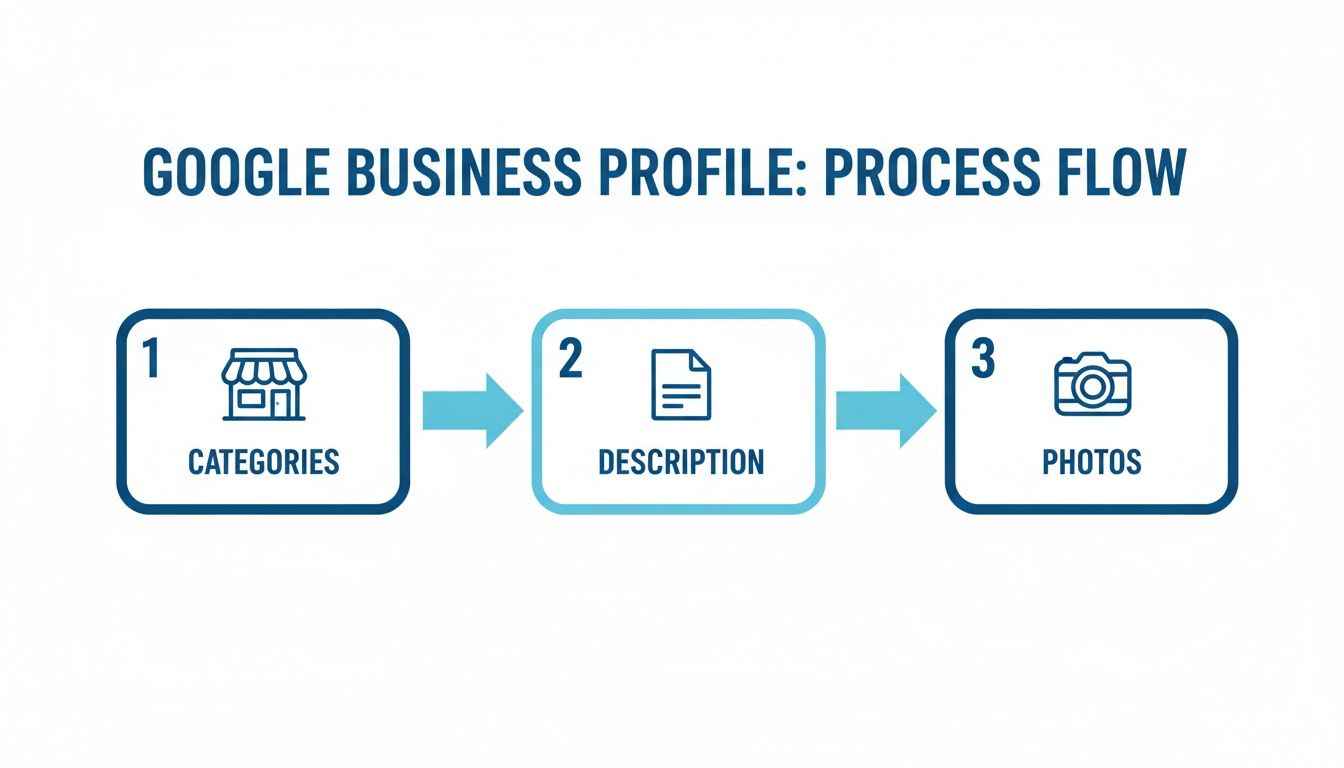
Each step builds on the last to create a profile that genuinely attracts local customers.
To help you stay on track, here’s a quick checklist of the most important GBP features and what to do with them.
Google Business Profile Optimization Checklist
- Business Name: Ensure it’s your exact, real-world business name without extra keywords. This builds trust and avoids penalties from Google for spammy titles.
- Categories: Choose a specific primary category and add all relevant secondary ones. This is the single most important ranking factor for showing up in discovery searches.
- Address & Service Areas: Use a precise address or define a clear service area for SABs. This tells Google exactly where you operate so you can appear in “near me” searches.
- Hours of Operation: Keep hours accurate, including holidays and special events, to prevent customer frustration from showing up to a closed door.
- Phone Number: Use a primary, local phone number that’s answered consistently. This is a direct line for leads and critical for click-to-call conversions from mobile.
- Website: Link to your homepage or, even better, a location-specific landing page to drive qualified traffic from your profile directly to your site.
- Services/Products: Add all your services or products with descriptions and prices. This helps you rank for long-tail service searches (e.g., “emergency pipe repair”).
- Business Description: Write a compelling, 750-character summary of your business. It’s your chance to tell your story, highlight what makes you unique, and connect locally.
- Photos & Videos: Regularly upload high-quality images of your team, work, and location. Visuals build trust, and profiles with more photos get more clicks.
- Reviews: Actively request reviews and respond to every single one (good and bad). Social proof is huge, and high ratings with owner responses are powerful ranking signals.
- GBP Posts: Publish weekly updates with offers, news, or event announcements. This signals to Google that your business is active and keeps your profile fresh.
- Q&A: Proactively ask and answer common questions your customers have to control the narrative and provide helpful info 24/7.
Following this checklist ensures you’ve covered all the high-impact areas that contribute to a fully optimized and effective Google Business Profile.
Engaging with GBP Posts and Q&A
Your profile is not a “set it and forget it” asset. Google built features like Posts and the Q&A section specifically for ongoing engagement.
- GBP Posts: Treat these like social media updates. Share a special offer, highlight a recent project, or announce something new. They do expire, so a steady stream of activity tells Google your business is alive and well.
- Q&A Section: Don’t wait for customers to ask questions—seed this section yourself. Think about the most common things people ask and post them with clear answers. This prevents bad information from cropping up and helps searchers get what they need instantly.
For a deeper dive into these strategies, our complete guide on how to optimize your Google Business Profile has you covered.
Showcasing Your Business with High-Quality Photos
Photos are absolutely essential for building trust. People want to see who they’re hiring and what kind of work you do. Your profile should have a healthy mix of images:
- Exterior and Interior Shots: Helps people find you and know what to expect.
- Team Photos: Puts a human face on the business. It’s amazing how much this helps.
- Photos of Your Work: This is your portfolio. Show off your best results.
- Videos: A quick behind-the-scenes tour or a customer testimonial can work wonders.
Always go for high-resolution, well-lit photos. Just like with GBP Posts, adding new images regularly is another signal to Google that your business is active. And remember, most people will see this on their phone. A staggering 84% of local searches happen on mobile, and those searches are growing 50% faster than general ones. Your profile has to look great on a small screen, especially when you consider that 78% of local mobile searches result in a purchase within 24 hours. A visually appealing profile isn’t just nice to have; it’s a must.
Build Local Trust with Consistent Business Citations
Once your Google Business Profile is dialed in, the next layer of local SEO is all about proving you are who you say you are, where you say you are. In this game, consistency is the currency that buys trust from search engines. This is where local business citations become critical.
So, what’s a citation? It’s simply any online mention of your business’s Name, Address, and Phone number (often called NAP). You’ll find them on online directories, social media sites, and industry-specific portals. Think of every consistent citation as a vote of confidence, telling Google your business info is legit. But inconsistencies? They do the exact opposite—they create doubt and can drag your rankings down.
Why NAP Consistency Is Non-Negotiable
Picture Google as a detective trying to verify your business’s identity. If it finds one address on your GBP, a slightly different one on Yelp, and an old phone number on a local directory, it gets confused. That confusion erodes trust, and a lack of trust directly hurts your ability to show up in local search and the coveted Map Pack.
The goal is to get your NAP 100% identical everywhere. This gets surprisingly granular, and it’s the little details that often trip people up:
- “Street” vs. “St.”: Pick one and stick with it.
- “Suite 100” vs. “#100”: Choose a format and apply it universally.
- “(555) 123-4567” vs. “555.123.4567”: Keep your phone number formatting the same.
Yes, these tiny details really do matter. A clean, consistent NAP profile is a foundational pillar for any serious local SEO effort.
Start with a Citation Audit
Before you even think about building new citations, you have to clean up the mess that’s already out there. This is called a citation audit. You can get started manually by simply searching for your business name, plus common variations of it.
Keep an eye out for the usual suspects:
- An old address from a previous location.
- A call-tracking number that was mistakenly listed as your main line.
- Slight variations in your business name (e.g., “Main St. Cafe” vs. “Main Street Cafe LLC”).
I recommend documenting every inconsistency you find in a simple spreadsheet. Note the website, the incorrect information, and the correct version. This becomes your cleanup checklist—the first real step toward building a trustworthy online footprint. For a deeper look at how this fits into the bigger picture, check out our complete guide to local business SEO.
Build a Powerful Citation Portfolio
With your existing listings clean, it’s time to build out a strong portfolio of new, accurate citations. The strategy here is quality and relevance over sheer quantity. You want to start with the big, authoritative platforms first.
Foundational Directories
These are the heavy hitters that have high authority and often feed data to countless smaller sites. Getting your listing right on these is non-negotiable.
- Apple Maps: Absolutely essential for any iPhone user trying to get directions.
- Yelp: A powerhouse for reviews and a major citation source.
- Facebook: Your business page is both a key citation and a customer touchpoint.
- Bing Places: Basically the GBP equivalent for the Bing search engine.
According to a study from BrightLocal, 98% of customers use the internet to find information about local businesses. Being present and accurate on these foundational platforms puts you right where the vast majority of your customers are looking.
After you’ve locked those down, expand your focus to platforms that are relevant to your specific industry and city. A restaurant needs to be on TripAdvisor and Zomato. A home services contractor should be on Angi and HomeAdvisor. And don’t sleep on hyper-local sources like your local Chamber of Commerce website or community news portals.
Manual vs. Automated: Choosing Your Path
You have two main ways to tackle citation management: do it all yourself by hand, or pay for a service to handle it.
- Manual Management: This approach is free (in terms of money) but costs you time. You’ll create accounts on each site, submit your information, and go through their verification processes. The upside is you have total control, but it requires a lot of ongoing effort to monitor for changes.
- Citation Services: Platforms like BrightLocal or Yext push your business data to dozens or even hundreds of directories at once. They save a tremendous amount of time and are great for maintaining consistency, but they do come with a recurring subscription fee.
For most small businesses I’ve worked with, a hybrid approach hits the sweet spot. Manually claim and meticulously optimize your top 10-15 foundational and niche-specific directories. From there, you can decide if a paid service makes sense to broaden your reach or if you simply don’t have the bandwidth to manage it all yourself.
Develop On-Page Content That Resonates Locally
Your Google Business Profile and consistent citations build the foundation, but your website is where you really close the deal with both customers and search engines. It’s how you prove you’re the local authority. Simply having a website isn’t enough; it needs to scream “local” from every corner.
This is all about transforming a generic site into a powerful resource that speaks directly to specific neighborhoods, highlights your community involvement, and shows you understand the local market better than anyone else. When someone lands on your site, there should be zero doubt that you’re the right choice for their area.
Create Hyper-Specific Location and Service Pages
If you serve multiple towns or distinct neighborhoods, creating individual pages for them is one of the most effective local SEO tactics you can deploy. A generic “services” page just can’t compete with a dedicated page titled “Plumbing Services in St. Petersburg, FL.” Think of these as dedicated digital storefronts for each community you serve.
For each location page, customize the content beyond just swapping out the city name. You need to include details that only a local would know.
- Mention local landmarks: “We’re just a short drive from the Sunken Gardens.”
- Reference local events: “Proudly serving our community during the annual Grand Prix.”
- Include location-specific testimonials: Feature a review from a customer in that specific town.
This level of detail signals to Google that you have a genuine, physical connection to that area. That directly improves your chances of ranking for searches like “plumber near me” when the user is physically there. To really nail down the right terms, it’s worth exploring a guide on how to do local keyword research to find the exact phrases your customers are using.
Weave Local Language into Your Content Naturally
Beyond dedicated pages, your entire website—from your blog posts to your homepage—should reflect your local identity. You have to think like a member of the community, not just a business owner.
For instance, a roofer in Tampa wouldn’t just talk about “roof repair.” They’d talk about “hurricane-ready roofing solutions” or “fixing leaks from summer storms.” This localized language builds an immediate connection with your audience because it shows you understand their specific problems and environment. It’s the difference between being a faceless company and a trusted neighborhood expert.
Key Takeaway: Write for humans first and search engines second. When your content genuinely helps local customers by addressing their unique needs and referencing familiar community touchpoints, the SEO benefits naturally follow. Authenticity is a powerful ranking signal.
Implement Local Business Schema Markup
While great content is for your human visitors, schema markup is a special language just for search engines. It’s a bit of code you add to your website that explicitly tells Google and others the critical details about your business, like your address, phone number, hours, and review ratings.
Structured data helps search engines display rich information directly in the search results, making your listing stand out.
This screenshot from Schema.org shows just how specific you can get, from payment types accepted to your exact geographic coordinates.
I know, implementing code can seem technical, but it’s a crucial step. Many website platforms and SEO plugins offer tools to help you generate and add this markup without needing to write a single line of code. By clearly defining your business information for search engines, you make it easy for them to feature you prominently, giving you a serious competitive edge.
4. Cultivate a Five-Star Reputation with Smart Review Management
Online reviews are the new word-of-mouth. Think of them as a neighbor’s recommendation, but instead of being shared over the fence, it’s broadcast to thousands of potential customers. They’re a massive ranking factor and the ultimate form of social proof. If you’re serious about local SEO, a proactive review strategy isn’t optional.

When Google sees a steady flow of recent, positive reviews, it gets a clear signal: this business is active, valued, and trustworthy. That perception directly boosts your visibility in the local map pack. For customers, those stars are often the final nudge they need before they decide to call you or walk through your door.
Encourage Your Happiest Customers to Leave Reviews
So, how do you get more reviews? The key is simple: ask at the right time and make it incredibly easy. You don’t need to be pushy. The perfect moment to ask is right after you’ve delivered great service and the customer is smiling.
Here are a few low-pressure ways to get the ball rolling:
- Personalized Email or SMS: After a job is done, send a quick, personal note. “Hi [Customer Name], we loved working with you today! If you have a moment, we’d be grateful if you could share your experience on Google: [Direct Link to GBP Review].”
- QR Codes: Put a QR code on your invoices, receipts, or business cards that links straight to your Google review page. It removes all the friction.
- Website Prompts: Add a simple “Review Us” button in the footer of your website. It’s a passive but effective way for motivated customers to find the link later.
The goal is to weave the “ask” right into your customer service workflow. It should feel like a natural part of wrapping things up, not a desperate plea.
The Art of Responding to Every Single Review
Getting reviews is just the first step. Responding to them is where you really build trust. A smart response strategy shows that you’re engaged and that you actually care about what your customers have to say. It’s a public display of great service, and it works wonders for both positive and negative feedback.
Expert Insight: Responding to reviews isn’t just for show. Google has confirmed that business owners who reply to reviews demonstrate that they value their customers, which can positively influence local search rankings.
Handling Positive Feedback
When someone leaves you a great review, don’t just reply with a generic “Thanks!” Make it count. A personalized response feels more genuine and can even add a little SEO juice.
- Use Their Name: Always address the reviewer by name if you can.
- Mention a Specific: Reference something they said in their review. For example, “We’re so glad you enjoyed the [specific product or service]!” It proves you actually read it.
- Subtly Include a Keyword: If it fits naturally, mention your service and location. “We appreciate you choosing us for your roof repair in St. Petersburg.”
Turning Negative Feedback into a Positive
Bad reviews happen to everyone. The key is how you handle them. A calm, professional response can neutralize a bad situation and sometimes even win over the unhappy customer—and everyone else reading.
- Acknowledge and Apologize: Start by validating their frustration with a sincere apology, even if you don’t agree with the complaint.
- Take it Offline: Give them a direct way to resolve the issue out of the public eye. “We’re sorry to hear about your experience. Please call our manager, [Name], at [Phone Number] so we can make this right.”
- Stay Professional: Never, ever get into a public argument. Your response is for every future customer who will see it, not just for the person who wrote the review.
A well-managed reputation is one of your most powerful local SEO assets. For a deeper dive, check out our guide on how to improve your online reputation and build unbreakable customer trust.
Earn Authority Through Genuine Local Link Building
Links from other respected local websites are one of the most powerful authority signals you can send to Google. Forget what you might have heard about complex, large-scale SEO campaigns. For local businesses, link building is really about genuine community engagement.
These digital endorsements tell search engines that your business isn’t just a name in a directory but an integral part of the local fabric. This whole process is less about technical tricks and more about old-fashioned business development. When you build real relationships in your community, you naturally earn the kind of backlinks that boost your local search visibility.
Think Community First, SEO Second
The best local links come from things you’re probably already doing to grow your business offline. The trick is to start recognizing the digital value in these interactions and making a conscious effort to secure a link from them.
Instead of hunting for obscure directories, focus on building real connections. This approach doesn’t just strengthen your backlink profile; it reinforces your brand’s presence in the community. It creates a positive feedback loop that drives both online discovery and offline word-of-mouth.
Here are a few practical, community-focused ideas:
- Sponsor a local youth sports team: Nearly every little league or youth soccer team has a website where they thank their sponsors. This is often one of the easiest and most authentic local links to get. Your sponsorship helps the kids, and their website gives you a relevant, feel-good backlink.
- Host a community event: A free workshop, a charity drive, or a holiday open house can generate plenty of local buzz. Local news outlets, community calendars, and bloggers are often happy to link to your event page to let their readers know what’s happening.
- Partner with neighboring businesses: Team up with a non-competing business for a joint promotion. For instance, a local gym and a health food store could co-host a wellness event, with both businesses linking to each other as partners. Simple, effective, and community-oriented.
Key Takeaway: The most valuable local links are a byproduct of being a good community member. Your offline engagement directly fuels your online authority. Stop chasing links; build relationships that earn them.
Finding Hyper-Local Link Opportunities
Beyond sponsorships and events, there are plenty of other opportunities to earn links from established local institutions. These organizations carry significant trust and authority in the eyes of Google, and a link from them is digital gold.
Start by making a list of the key players in your town or city. Who does the community trust for information?
- Chamber of Commerce: If you’re already a member, make sure your profile in their directory links back to your website. You could also offer to write a guest article for their blog on a topic you’re an expert in.
- Local News and Media: Build relationships with local journalists and bloggers. If you have a genuinely newsworthy story—like a major business anniversary, a significant new hire, or a big community contribution—let them know.
- Charity and Non-Profit Organizations: Donating your time, services, or money to a local charity can often result in a link on their supporters or sponsors page. It’s a win-win.
To dig deeper into the mechanics of these connections, you can explore more about how to build links that create lasting authority for your website.
Creating Link-Worthy Local Resources
Another powerful strategy is to create a resource so helpful that other local websites want to link to it. This approach positions you as an expert and a central hub of information for your community.
For example, a real estate agent could create a comprehensive guide to the best neighborhoods in their city, complete with school ratings, walkability scores, and information on local parks. A local restaurant could publish a “Local Foodie’s Guide to [Your Town],” featuring other non-competing eateries, bakeries, and coffee shops.
These resources provide real, tangible value, making them natural targets for links from local bloggers, travel sites, and community forums. This isn’t just content creation; it’s community service that pays SEO dividends.
Common Questions About Improving Local SEO
Diving into a local SEO strategy always brings up a lot of “what ifs” and “how to’s.” You can have the best playbook in the world, but real-world scenarios add a layer of complexity. Let’s tackle some of the most common questions I hear from business owners to help you prioritize your efforts and set the right expectations.
How Long Does It Take to See Results from Local SEO?
This is always the first question, and the honest answer is: it depends. But you need to be patient.
You might see some quick wins from a well-optimized Google Business Profile in just a few weeks—maybe an uptick in calls or direction requests. That’s a great start. However, meaningful, sustainable results that actually move the needle for your business typically take 3 to 6 months of consistent work.
Think of it like building a reputation in a new town. It doesn’t happen overnight. Factors like how competitive your market is and how consistently you apply your strategy play a huge role. The good news is that the results compound over time; the foundational work you do now pays bigger and bigger dividends down the road.
What Is the Difference Between Local SEO and Organic SEO?
The key difference comes down to geographic intent.
Classic organic SEO aims to rank for broad, non-location-specific questions, like “how to fix a leaky faucet.” Local SEO, on the other hand, is all about getting in front of customers within a specific service area who are searching for things like “plumber near me” or “emergency plumber in Tampa.”
To win at local, you need to focus on signals that are less critical for broader organic SEO:
- Your Google Business Profile is the absolute cornerstone.
- Online reviews provide critical social proof and are a massive ranking factor.
- Local citations (your NAP consistency) build trust and verify your location with search engines.
Ultimately, the goal of local SEO is to get your business into the Google Map Pack—that block of three business listings that appears for most local searches. It’s prime real estate for grabbing the attention of customers who are ready to buy right now.
What Should I Focus On with a Limited Local SEO Budget?
If your budget is tight, don’t worry. The highest-impact activities are often the lowest cost—they just require your time and attention.
Prioritize for Impact: Focus on the free tools first. Mastering your Google Business Profile, cleaning up your citations, and encouraging reviews will give you the best possible return on your time. Nail these basics before you even think about investing in paid strategies.
Here’s your priority list if you’re bootstrapping:
- Fully Optimize Your Google Business Profile. It’s free, and it’s the most powerful local SEO tool you have. Fill out every single section.
- Clean Up Your Core Business Citations. Make sure your Name, Address, and Phone number (NAP) are 100% consistent across major platforms like Apple Maps, Yelp, and Facebook.
- Implement a Simple Review Strategy. Get in the habit of consistently asking your happiest customers to leave you a review on Google. That social proof is invaluable.
Mastering these three areas will get you 80% of the way there without spending a dime on complex tools or campaigns.
Do I Need a Physical Address for Local SEO?
Yes, but you don’t always have to show it. To appear in Google Maps, you must provide a verifiable physical address during setup.
However, if you’re a Service Area Business (SAB)—like a plumber, a roofer, or a mobile detailer who travels to customers—you can hide your physical address on your public-facing Google Business Profile. Instead of showing a pin on the map at your home or office, your profile will display a shaded service area.
You still need to give Google a real address for verification, but it won’t be shown to the public. This protects your privacy while still allowing you to rank for searches in the areas you serve. For a deep dive into this topic, especially for trades, this guide on Local SEO for Contractors: A Guide to Dominating Your Service Area is an excellent resource.
Ready to stop guessing and start growing your local presence? The team at Netco Design LLC specializes in creating custom SEO strategies that drive real results for businesses in Tampa Bay and beyond. We build user-friendly websites and optimize them to get you on page one of Google, so you can attract more qualified customers and turn clicks into sales. Schedule your free consultation today!

