

table of contents
Improving your website’s SEO isn’t about chasing secret formulas. It’s a methodical process that starts with auditing your site’s technical health, creating valuable content that people are actually searching for, and building authority through high-quality backlinks. This groundwork ensures search engines can find, understand, and trust your site—the only real way to start climbing the rankings.
Your Essential Starting Point for Better SEO
Before you even think about keywords or content, you have to get your technical house in order. Think of it like building a house: a beautiful design means nothing if the foundation is cracked. So many businesses wonder how to improve their website’s SEO without ever realizing that technical glitches are quietly sabotaging all their efforts.
Search engines like Google use “crawlers” to discover and index your pages. If these crawlers run into roadblocks—like broken links, a confusing site structure, or pages that take forever to load—they might just give up before they even see your best content. That means your hard work goes completely unnoticed.
The Critical First Step: Your Website Audit
The first real step in any serious SEO plan is a comprehensive audit. This isn’t a quick glance; it’s a deep dive into the guts of your website to find anything that’s stopping search engines from doing their job.
You’re basically hunting for specific problems:
- Crawl Errors: Are there parts of your site that Google’s bots just can’t access?
- Indexing Issues: Are your most important pages being accidentally left out of search results?
- Broken Links (404s): Do your links lead to dead ends? This is frustrating for users and a red flag for Google.
- Slow Page Speed: Does your site load fast enough? A delay of just a few seconds can cause over 50% of mobile users to bounce.
Running this check-up is non-negotiable. For a detailed guide on how to tackle this, our post on how to do a website audit breaks it all down, step by step.
This flowchart shows the simple but powerful workflow for getting your site’s technical health on track.
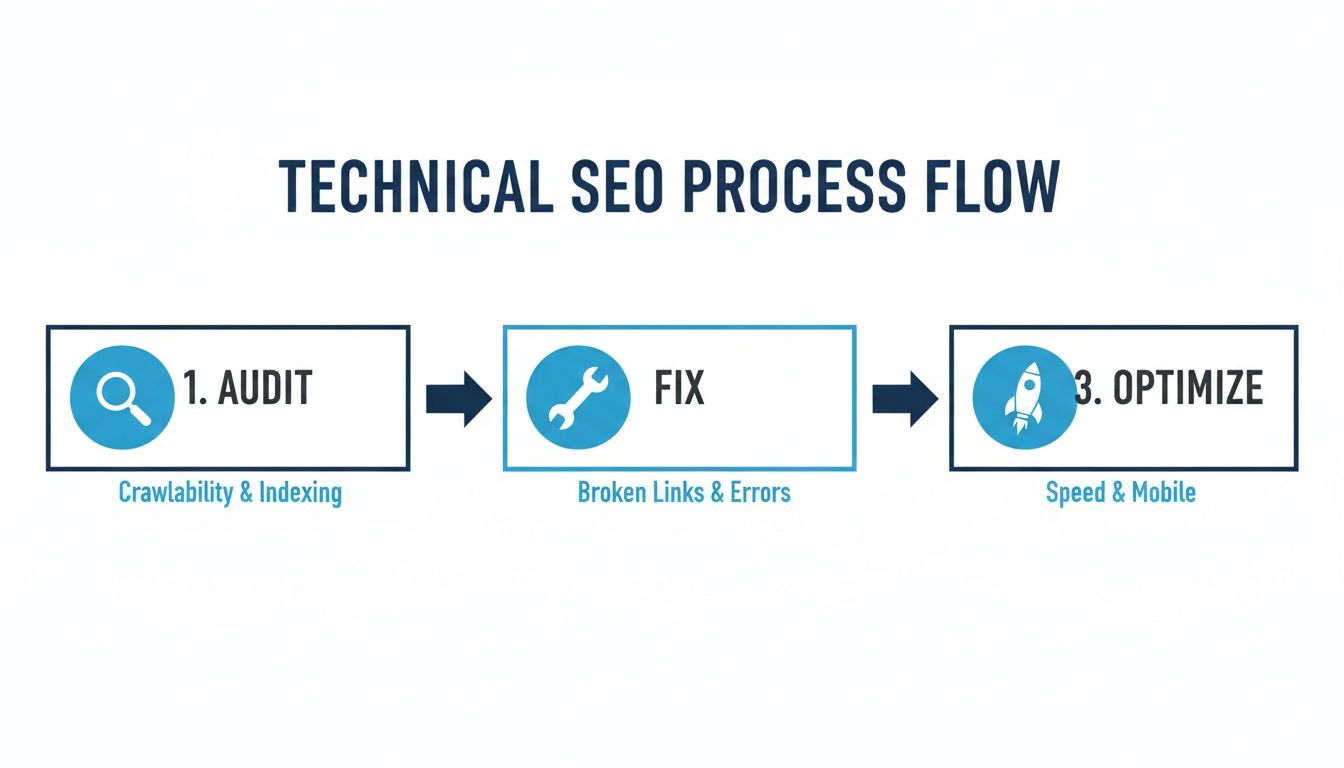
The key takeaway here is that technical SEO isn’t a one-and-done task. It’s a continuous cycle of auditing to find issues, fixing what’s broken, and optimizing for better performance.
Why Mobile Performance Is Non-Negotiable
These days, Google operates on a mobile-first indexing model. In plain English, that means Google primarily looks at the mobile version of your site to decide how to rank it. If your website looks fantastic on a desktop but is slow, clunky, or broken on a smartphone, your SEO is going to suffer. Period.
A poor mobile experience is one of the fastest ways to lose rankings and customers. If someone has to pinch and zoom to read your text or can’t easily tap a button, they’re gone.
This isn’t just about looks; it’s about accessibility and user experience, which are direct ranking factors. Your design must be responsive, meaning it automatically adjusts to fit any screen. Buttons need to be big enough to tap, and text should be easy to read without any effort. Nailing these fundamentals is the only way to make sure every other SEO effort you make actually has a chance to succeed.
Crafting Content That Ranks and Converts

Once your website is technically sound, it’s time to shift gears to the real engine of SEO: your content. This is where you stop fixing things and start actively attracting the customers you want. It isn’t about chasing algorithms with clever tricks. It’s about creating genuinely helpful resources that answer the exact questions your audience is asking.
Think about it. You could pour your heart into a website for your small business in Tampa Bay, only to see it buried on the second page of Google. That’s a huge problem, considering a whopping 75% of users never venture past the first page.
On the flip side, securing that coveted top spot can skyrocket your click-through rate to 27.6%. That’s nearly a third of all organic clicks going straight to you.
Uncovering What Your Customers Actually Search For
Great SEO content starts with practical, real-world keyword research. You have to get inside your customer’s head and figure out the specific words and phrases they use when looking for what you offer. This isn’t just about targeting high-volume terms; it’s about finding the phrases that signal someone is ready to buy.
A plumber in St. Petersburg, for example, might find that while “plumber” gets a lot of searches, terms like “emergency plumber South Pasadena” or “how to fix a leaky faucet” attract customers who need help right now.
Your first job is to build a solid list of these valuable terms. This list will become the blueprint for your entire content plan. To keep it all organized and stay consistent, it helps to learn how to create a content calendar for your business.
Integrating Keywords Naturally and Effectively
With your target keywords in hand, the next step is weaving them into your website’s content. The key here is to do it thoughtfully, not forcefully. You want to place them where they’ll have the most impact for both people and search engines.
Here are the critical spots to focus on for every single page:
- Page Title (Title Tag): This is the single most important place for your main keyword. It’s the blue link people see in Google’s search results.
- Headings (H1, H2, H3): Your main page heading (the H1) should always include the primary keyword. Subheadings are perfect for related terms and questions.
- First 100 Words: Mentioning your keyword early in the first paragraph immediately confirms the page’s topic for search engines.
- Throughout the Body Copy: Sprinkle your keyword and related variations naturally within the text. Readability is the goal, not repetition.
Of course, there’s more to it than just placing keywords. To really nail it, you need to find that perfect balance between user engagement and optimization. A great next step is to learn how to write SEO articles that people and Google both love.
Think of it this way: your content must serve the human reader first. If a sentence sounds clunky because you jammed a keyword in, rewrite it. Google’s algorithms are plenty smart enough to understand context and synonyms.
Building Trust with E-E-A-T
Ultimately, high rankings are built on trust. Google’s entire mission is to show its users the most credible and authoritative information out there. It measures this using a framework it calls E-E-A-T, which stands for Experience, Expertise, Authoritativeness, and Trustworthiness.
Demonstrating E-E-A-T isn’t a one-and-done task; it’s a commitment. It means writing in-depth service pages that showcase your firsthand experience. It means publishing blog posts that answer tough customer questions, proving your expertise.
For a local business, this could look like a detailed case study of a project you completed in a specific Tampa Bay neighborhood. That single piece of content shows your direct experience while also building your local authority. By consistently producing high-quality, helpful, and transparent content, you send strong signals to Google that you’re a trustworthy source. That’s the real secret to sustainable SEO success.
Winning The Local Search Game
Forget about ranking on the other side of the world. For most small and mid-sized businesses, the real money is made right in your own backyard. Winning the local search game means showing up when a customer in your neighborhood needs what you offer, right now. It’s about becoming the most visible, credible, and obvious choice for people nearby who are ready to buy.
For professional services like law firms, plumbers, or contractors, local SEO isn’t just a nice-to-have; it’s the engine of growth, driving 22.6% of all internet traffic for these industries. The numbers don’t lie: a massive 46% of all Google searches are for local information, and nearly 28% of those searches lead to a purchase almost immediately. This is where your best customers are looking.
Your Most Powerful Local SEO Asset
Your Google Business Profile (GBP) is the absolute cornerstone of your local strategy. Think of it as your digital storefront on Google Search and Maps. When someone searches for “plumber near me” or “best coffee shop in downtown St. Petersburg,” that little map box at the top of the results is often their first handshake with your business.
A half-finished profile just won’t cut it anymore. To stand out, you need to treat your GBP like an active marketing channel.
- Fill Out Everything: Don’t skip a single section. Add your services, products, accessibility options, and accurate business hours. The more complete your profile is, the more Google trusts you enough to show you.
- Show, Don’t Just Tell: Keep a steady stream of high-quality photos flowing. Show your storefront, your team in action, and your finished work. It builds instant trust and helps customers visualize working with you.
- Use Google Posts: This feature is gold. Share updates, promotions, and company news regularly. It signals to Google that you’re an active, thriving business.
Turning this listing into a customer-generating machine takes consistent work. To get started on the right foot, check out our in-depth guide on how to optimize a Google Business Profile for maximum visibility.
Building Consistent Local Signals
Beyond Google itself, search engines look for consistency across the web to confirm you are who you say you are. This is where citations come in. A citation is simply any online mention of your business’s name, address, and phone number (NAP).
Every time your NAP appears correctly on a reputable site like Yelp, Angi, or your local chamber of commerce, it’s like a vote of confidence. When Google sees the same, accurate information across dozens of trusted sites, it sends a powerful signal that your business is legitimate and located exactly where you claim to be.
Inconsistent information is a silent killer for local rankings. An old address on one directory or a wrong phone number on another creates confusion for search engines and customers alike. Diligently cleaning up these errors is one of the most critical—and often overlooked—tasks in local SEO.
To help you stay focused on what moves the needle first, here’s a quick checklist of where to start.
Local SEO Priority Checklist
This list breaks down the most impactful local SEO actions. Tackle the high-priority items first to see results faster, then work your way down.
High Priority:
- Action: Fully Optimize Google Business Profile.
- Why It Matters: This is your digital storefront. It’s the #1 factor for ranking in the local map pack and for “near me” searches.
- Action: Actively Request and Respond to Reviews.
- Why It Matters: Social proof is huge. Positive reviews directly influence both customer decisions and Google’s ranking algorithm.
Medium Priority:
- Action: Clean Up NAP Inconsistencies.
- Why It Matters: Incorrect or inconsistent business info on major directories confuses Google and hurts your credibility.
- Action: Build Citations on Top-Tier Directories.
- Why It Matters: Getting listed on relevant, authoritative sites like Yelp, Angi, and industry-specific portals builds trust.
Low Priority:
- Action: Create Location-Specific Website Content.
- Why It Matters: Develop pages or blog posts targeting your service areas (e.g., “Roofing Services in Tampa”). This proves your local relevance.
Once you’ve made progress on these fundamentals, you can move on to more advanced tactics.
The Power of Social Proof and Location-Specific Content
Customer reviews are a massive ranking factor. Google wants to recommend businesses that real people trust, and nothing demonstrates that better than a steady stream of positive, authentic reviews. Make it a habit to ask happy customers to leave feedback on your Google profile.
Finally, your website content needs to speak directly to your local audience. Instead of a generic post about “roofing tips,” write one titled, “Choosing the Right Roof for Florida’s Hurricane Season.” This kind of location-specific content is powerful because it solves a local problem and naturally weaves in geographic keywords, signaling your relevance to search engines loud and clear.
Building Authority Through Strategic Link Building
If your content is the engine, then backlinks are the high-octane fuel that makes it go. In Google’s world, a link from another website to yours is a powerful vote of confidence. Think of it like a trusted referral—each quality backlink validates your expertise and authority, which directly helps you rank higher.
But this isn’t about collecting as many links as you can from anywhere you can find them. That’s an old-school, risky strategy that just doesn’t work anymore. Modern link building is all about earning genuine endorsements from respected and relevant sources in your industry.
The goal is to move away from spammy, low-value tactics and instead focus on creating things that people want to link to. It’s a shift from quantity to quality that pays off for years to come.
Moving Beyond Old-School Tactics
For a long time, the internet was flooded with sketchy link-building methods—things like buying links, joining link farms, or spamming blog comments. Google got wise to these tricks years ago, and using them now can get you a severe penalty, pretty much wiping your site off the search results.
A successful strategy today is all about earning links naturally. This means creating something so valuable—an insightful article, a unique data study, a helpful tool—that other site owners feel compelled to share it with their audience.
The core principle of modern link building is simple: be the source, not the echo. Create content so original and useful that it becomes the go-to reference on a topic. When you pull that off, the links will follow.
This approach takes more effort, no doubt. But the links you earn are far more powerful and sustainable because they represent real editorial trust. They just carry more weight in Google’s algorithm. For a deeper dive into the nuts and bolts, our guide on how to build links the right way breaks down the best modern strategies.
Actionable Strategies for Earning High-Quality Links
So, how do you actually do this? Let’s get practical and look at some real-world methods for earning backlinks that will genuinely move the needle on your SEO.
Guest Blogging on Respected Industry Sites
This one’s a classic for a reason. When you write an article for a well-known blog in your niche, you accomplish two things at once: you put your brand in front of a new, relevant audience, and you usually get a valuable backlink in your author bio or within the content itself. The key is to be selective. Don’t just write for any site; target publications that are genuine authorities in your field.
- Real-World Scenario: A St. Petersburg-based home remodeling company could write a guest post for a popular national home improvement blog. An article on “5 Hurricane-Resistant Remodeling Tips for Florida Homeowners” provides real value to that blog’s audience while earning a powerful, contextually relevant link back to the remodeler’s site.
Creating Link-Worthy Content Assets
Some types of content are just natural link magnets. If you can create a resource that becomes a definitive guide or presents unique information, other sites will link to it when they need a credible source.
- Data-Driven Studies: Run a survey or analyze industry data, then publish your findings. A local digital marketing agency, for instance, could survey 100 Tampa Bay businesses on their marketing challenges and publish a report. Other local business publications and blogs would be very likely to link to that original research.
- Ultimate Guides: Set out to create the single best, most comprehensive resource on a specific topic related to what you do. Think of a guide that answers every possible question a customer might have about one of your core services.
- Free Tools: Develop a simple calculator, template, or checklist that solves a common problem for your audience. These practical assets often attract a steady stream of links over time because they’re so genuinely useful.
By focusing on these value-first strategies, you’re not just building links. You’re building a reputation as a true leader in your industry, and that’s an SEO foundation that lasts.
Future-Proofing Your SEO in an AI-Driven World
The world of search is shifting under our feet. With the rise of AI Overviews and conversational search, just ranking for a keyword isn’t the whole game anymore. To keep your website visible tomorrow, you have to think about how AI understands and presents information today. This means shifting your strategy to a new reality where being a cited source is just as valuable as being a blue link.
This new environment is all about clarity and context. Instead of just chasing short keywords, the focus is now on answering natural language questions—the kinds of things people speak into their phones or type into an AI chat. When you frame your content to directly answer these conversational queries, you position your website as the authority, making it a perfect candidate for a feature.
As AI reshapes search, businesses that adapt are seeing a 70% higher ROI. We’ve watched AI-driven search traffic explode by 527% year-over-year, and AI Overviews now show up in 25.8% of all searches. In critical industries like health, that number jumps to a staggering 51.6%. Getting featured as a source in these AI-generated answers can double your click-through rate from 0.6% to a much healthier 1.08%—a serious lift when you’re fighting for every click.
Speaking the Language of AI with Structured Data
One of the most powerful tools in your arsenal for this new era is structured data, also known as schema markup. Think of it as a secret language you add to your website’s code. It’s invisible to your human visitors, but it explicitly tells search engines and AI models what your content is about, breaking it down into simple, digestible pieces.
For example, you can use schema to label specific things on your page:
- Business Information: Clearly spell out your business name, address, phone number, and hours.
- Products: Tag your product names, prices, and availability so they can pop up in rich results.
- Events: Mark up event dates, times, and locations for easy discovery.
- FAQs: Structure your Q&A sections so they can be pulled directly into search results as quick answers.
By implementing schema, you’re not leaving interpretation up to chance. You’re basically spoon-feeding AI the exact information it needs, which dramatically increases your odds of being featured accurately in AI Overviews. This is a non-negotiable step if you want to understand how to make your website AI-friendly so you still rank in a world beyond the classic ten blue links.
The goal is to remove all ambiguity. The more context you can provide through structured data, the less work an AI has to do to understand your content, making your site a more reliable and preferable source of information.
Leveraging AI Ethically in Your Own Workflow
Future-proofing isn’t just about optimizing for AI; it’s also about using AI tools to make your own work smarter. Used ethically, AI can be an incredible assistant, helping you streamline processes that once took days.
Don’t think of AI as a replacement for human expertise. Instead, view it as a research and brainstorming partner. It can help you analyze massive amounts of data to find content gaps, generate outlines for articles based on user intent, and even suggest the natural language questions your audience is actually asking. It’s about working faster, not cutting corners on quality.
To really get ahead, you need to dig into AI Search Optimization: A Guide to Getting Cited to learn how to maximize your visibility in these new AI-driven results. The landscape is changing, but the core principles haven’t: provide the best, most helpful, and clearest answers. By embracing structured data and using AI to augment your expertise, you ensure your website remains a trusted authority, ready for whatever comes next.
Answering Your Key SEO Questions
Even with a solid game plan, you’re going to have questions. SEO can feel like a maze, and it’s easy to get sidetracked by conflicting advice. Having clear answers to the most common sticking points is the best way to stay focused on what actually moves the needle.
This section tackles the big questions we hear from business owners all the time. Whether you’re going the DIY route or thinking about hiring help, getting these fundamentals straight is your first big win.
How Long Does It Realistically Take to See SEO Results?
This is the million-dollar question, and the honest answer is: it depends, but it’s never overnight. SEO is a long-term investment, not a quick-win tactic. While you might see some small upticks from technical fixes in a few weeks, significant, lasting improvements in rankings usually take six to twelve months of consistent work.
What causes that range? A few things. A brand-new website with zero online history will take much longer to earn Google’s trust than an established site that just needs a tune-up. The competition in your market is also a huge factor. Trying to rank for “Tampa Bay personal injury lawyer” is a much tougher, longer fight than ranking for “artisan dog treats in Gulfport.”
Think of SEO like planting a tree. You won’t get shade overnight. It requires consistent watering, sunlight, and care over many months before it grows strong enough to provide real value. Patience and unwavering execution are the only way to achieve sustainable results.
What Are the Most Important SEO Tools for a Small Business?
You absolutely do not need an expensive suite of tools to get started. In fact, some of the most critical tools are completely free, straight from Google. These should be the bedrock of your SEO efforts.
Your essential, non-negotiable toolkit includes:
- Google Analytics: This is your window into who is visiting your site, where they’re coming from, and what they do once they get there. It’s the source of truth for user behavior.
- Google Search Console: Think of this as your direct line of communication with Google. It tells you which keywords you’re showing up for, flags technical problems, and tracks your search performance over time.
- Google Business Profile: For any business with a physical location or a local service area, this is everything. It’s how you show up in the map pack and dominate local “near me” searches.
Once you’ve mastered these, you can start looking at paid tools like Ahrefs or Semrush for more advanced keyword research and competitor analysis as your budget and needs grow.
When Should I Hire an SEO Agency Instead of Doing It Myself?
The DIY vs. agency decision usually comes down to three things: time, expertise, and tools. You can definitely get results doing SEO yourself if you or a team member can dedicate several focused hours every single week to learning and implementing. It’s a serious commitment.
However, you should seriously consider hiring an agency if you find yourself in one of these spots:
- You’re swamped running the business. If your time is better spent on operations, sales, and serving customers, outsourcing SEO to specialists is a smart investment.
- Your market is a battlefield. Going up against entrenched competitors requires advanced strategies, expensive tools, and a level of expertise that’s hard to build from scratch.
- You’ve hit a wall. If your own efforts have gotten you this far but now you’re stuck, an agency can bring in a fresh perspective and proven systems to break through that plateau.
A good agency accelerates your results and lets you focus on what you do best.
Can I Improve My SEO with Just Content and No Technical Changes?
In a word: no. While amazing content is the heart and soul of any great SEO strategy, it simply can’t perform if it’s sitting on a broken foundation. You could write the most brilliant, helpful article in the world, but if your site has major technical issues, it’s not going to rank.
Imagine your content is a high-performance race car and technical SEO is the racetrack. If that track is full of potholes (slow page speed), dead ends (broken links), and confusing signs (bad site structure), even the fastest car is going to crash and burn.
Technical health is what allows search engines to find, understand, and reward your great content. The two work together. A technically sound website gives your content a stage to shine, and great content gives that website a reason to exist.
At Netco Design LLC, we take the guesswork out of SEO. Our team specializes in building the technical foundation, content strategy, and local authority your business needs to climb the rankings and attract more customers. If you’re ready to see real, measurable growth, let’s talk about how we can help. Learn more about our approach at https://netcodesign.com.

