

table of contents
Before you can start polishing your online reputation, you first have to know what people are actually saying about you. That means you need to do a thorough audit, systematically searching for your brand, products, and even your key people across search engines and review sites.
This baseline is everything. Only after you have it can you build a smart strategy to tackle the negatives and shout about the positives.
Establishing Your Baseline with a Reputation Audit
Look, before you can build a stronger, more resilient online reputation, you need an honest look at where you stand right now. This initial assessment is your starting point, a foundational step that will inform everything you do next. Without a clear picture of your current digital footprint, you’re just flying blind.
The goal here is to move way beyond a quick Google search of your business name. You need to dig deeper to find the conversations happening in places you might not even think to look. This audit isn’t just about putting out fires; it’s about uncovering hidden strengths and identifying real opportunities for growth.
Conducting a Comprehensive Search
Your first move is to think like a potential customer. How would they research your business? Chances are, they’ll look beyond just your company name. A good audit covers multiple search variations to make sure nothing slips through the cracks.
A systematic approach is your best friend here. It prevents you from missing crucial feedback. Start with these search categories:
- Brand Name: The most obvious one, but don’t forget common misspellings or abbreviations.
- Product or Service Names: Search for your specific offerings. Customers often leave reviews tied to a particular product. For example, a restaurant should search for its name plus “best burger” or “weekend brunch.”
- Key Personnel: The names of your CEO, top salesperson, or other public-facing managers can have their own online reputations that directly impact the business.
- Brand Name + “Reviews”: This simple trick often brings up dedicated review platforms and forum discussions you might otherwise miss.
And please, don’t stop at the first page of Google. Negative or outdated information can lurk on pages two, three, and beyond. A complete inventory requires a bit of digital archaeology. For a more streamlined process, check out our guide on how to audit your digital presence in under 20 minutes, which offers a great quick-start framework for small businesses.
Checking Key Review Platforms
While a broad search is essential, you also need to go directly to the sources where customers are most vocal. Different industries have different go-to platforms, but some are nearly universal. Your audit absolutely must include a manual check of the major players.
Start with the giants:
- Google Maps / Google Business Profile: This is often the first impression for local customers and carries immense weight in search rankings. Don’t skip this.
- Yelp: Still a major force, especially for service businesses, restaurants, and local shops.
- Facebook: Reviews and recommendations on your business page are highly visible and shareable.
From there, branch out to industry-specific sites. A home contractor needs to be on Angi and HomeAdvisor. A hotel needs to check TripAdvisor and Booking.com. A B2B software company has to monitor G2 and Capterra. You get the idea.
The objective is to create a complete inventory of your digital footprint. Sort every mention, review, and comment into three buckets: positive, neutral, and negative. This simple categorization is what helps you prioritize your next steps effectively.
This structured audit transforms a vague feeling about your online reputation into a concrete, actionable dataset. It shows you what customers love, where your service is falling short, and which platforms hold the most sway over how your brand is perceived. With this baseline in hand, you can finally move from reacting to problems to proactively shaping the conversation.
Managing Negative Feedback Effectively
Discovering negative feedback about your business can feel like a punch to the gut. But in the world of online reputation, your response matters far more than the initial comment. A thoughtful, calm, and professional reply can turn a detractor into a fan and show countless potential customers that you genuinely care.
How you handle criticism truly defines your brand. The key is to see every piece of negative feedback not as an attack, but as an opportunity—an opportunity to solve a problem, demonstrate your commitment to service, and build trust. Rushing to respond emotionally is the fastest way to make a bad situation worse.
This decision tree visualizes the simple but powerful choice you have with every brand mention you find.
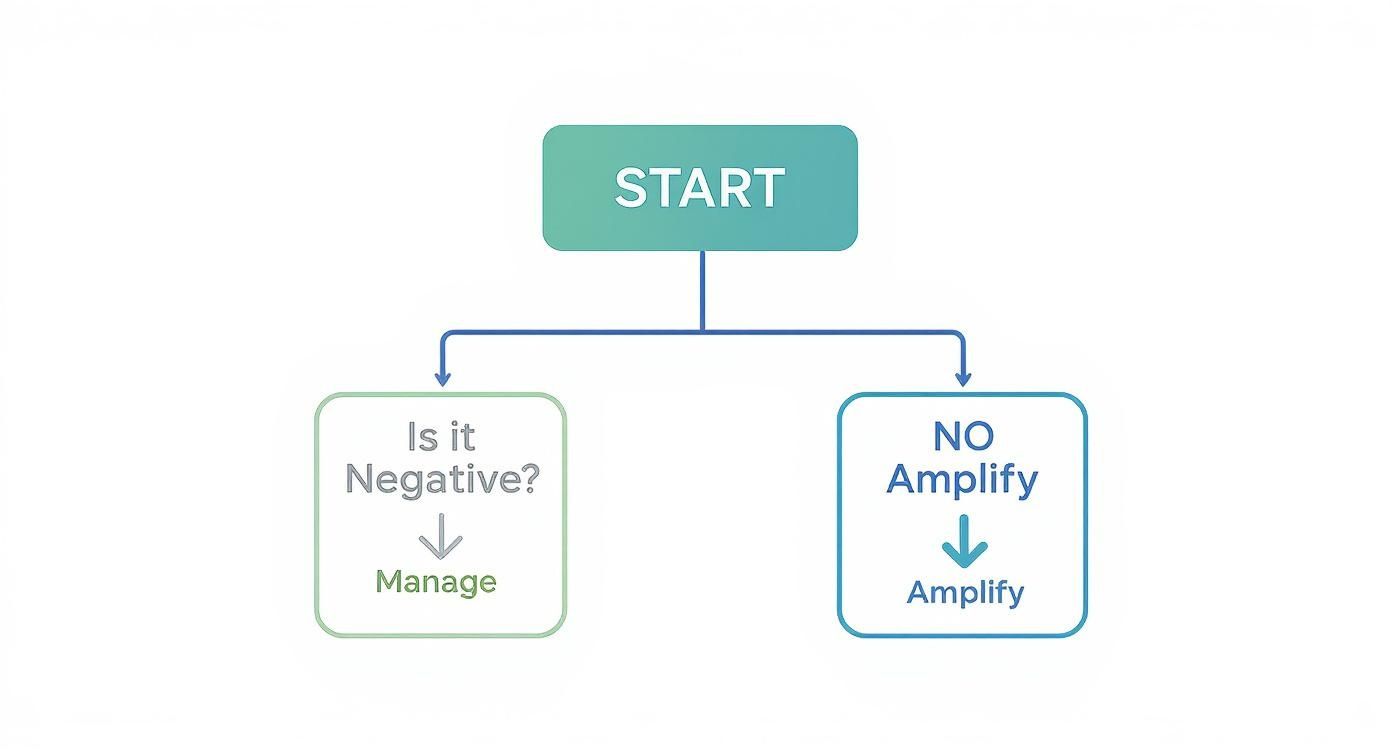
Ultimately, every online comment requires a conscious decision: either amplify its positive message or manage its negative impact.
Responding to Legitimate Customer Criticism
First things first: you have to figure out if you’re dealing with a valid complaint or an unfair attack. Legitimate complaints, even when they’re harsh, come from real customers who had a bad experience. These are your most valuable learning tools. A recent study found that 89% of travelers said a thoughtful response to a negative review improved their impression of a business.
When you get a valid complaint, follow this simple framework:
- Acknowledge and Apologize: Thank them for their feedback and offer a sincere apology for their experience. Don’t make excuses. A simple, “We’re sorry we fell short of your expectations,” goes a long way.
- Show Empathy: Use phrases that validate their feelings, like, “I can understand why you would be frustrated.” It shows you’re actually listening.
- Take it Offline: Provide a direct contact method—a specific manager’s email or phone number—to resolve the issue privately. This shows you’re serious about fixing the problem while moving a heated discussion out of the public eye.
A public response is for the benefit of future customers watching how you handle problems. The private follow-up is for fixing the relationship with the unhappy customer. Both are essential.
This two-pronged approach shows transparency and a genuine desire to make things right, which is a powerful signal to anyone researching your business.
Dealing with Unfair or Fake Reviews
Not all negative feedback is created equal. Sometimes you’ll encounter reviews that are factually incorrect, defamatory, or just plain fake. These require a different strategy, since a defensive public reply can make you look argumentative.
First, check if the review violates the platform’s terms of service. Most platforms have policies against:
- Hate speech or harassment: Content that attacks individuals or groups.
- Conflicts of interest: Reviews from competitors, ex-employees, or anyone with a clear bias.
- Spam or fake content: Reviews that are obviously not from a real customer.
If a review falls into one of these categories, your first move should be to report it. Document everything with screenshots and give the platform a clear, concise reason why the review violates their policies. It can be a slow process, but it’s the right one for removing illegitimate content.
While you wait, you might still choose to respond publicly. Keep it brief, professional, and factual. For example: “We take all feedback seriously, but we have no record of a customer with this name or experience. We encourage the reviewer to contact us directly at [email address] so we can learn more.”
This response sidesteps a direct confrontation but signals to other readers that the review might not be authentic. In situations where a negative review goes viral, it’s critical to have a plan. For deeper insights, you can review our guide on how to handle a negative review or incident going viral, which provides a comprehensive framework for crisis management.
Building a Positive Review Engine
Once you’ve got a handle on managing negative feedback, it’s time to go on the offensive. The best defense against a few bad reviews is a tidal wave of authentic praise from your happy customers. This isn’t about crossing your fingers and hoping for the best; it’s about building a system that consistently encourages your fans to share their great experiences.
When you make it easy for your supporters to speak up, you create powerful social proof that directly influences new buyers and shores up your brand’s credibility. This proactive approach ensures a couple of cranky comments get drowned out by a chorus of five-star praise.
Make Leaving a Review Frictionless
The biggest reason people don’t leave reviews? It’s a pain. If a customer has to hunt for your Google page, remember a password, or navigate a clunky form, they’re going to give up. Your job is to make it so ridiculously easy that it takes them less than 60 seconds.
Think about the peak of their satisfaction—what we call the “moment of delight.” For a restaurant, it’s right after that amazing dessert. For a roofer, it’s when the homeowner steps back and admires their brand-new roof. That’s your golden window to make the ask.
Here are a few dead-simple ways to cut the friction:
- Direct Links: Never, ever just say “review us on Google.” Give them a direct link that opens the review box right on their screen. No searching, no extra clicks.
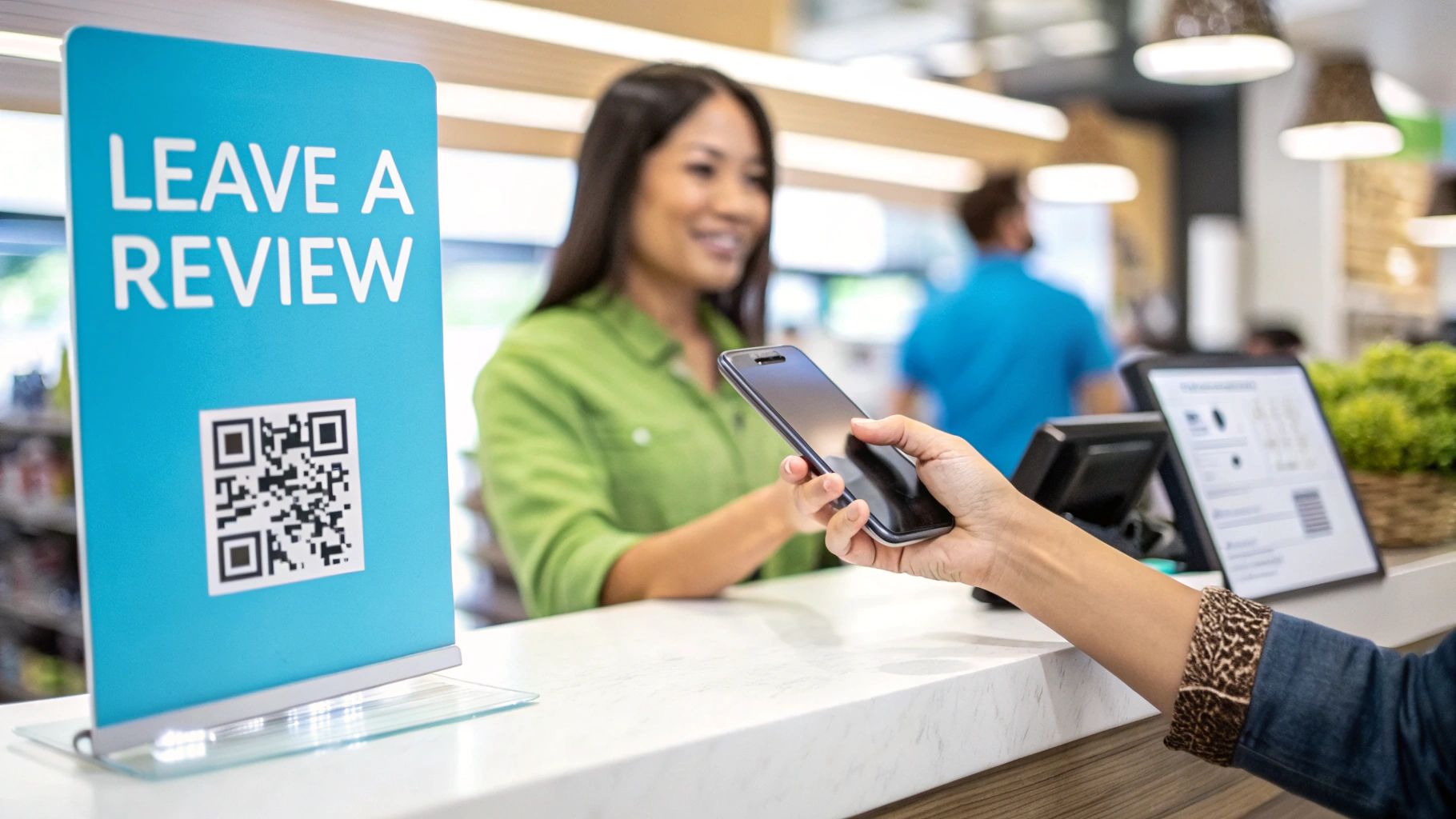
- QR Codes: Put them everywhere—on receipts, business cards, tabletop signs. A quick phone scan should take them straight to your preferred review site.
- Personalized SMS: A simple text message can work wonders. “Hi [Name], thanks for coming in today! If you have a minute, we’d love to hear about your experience here: [Direct Link].”
By removing these tiny roadblocks, you’ll be amazed at how many more people follow through.
You aren’t trying to strong-arm anyone into leaving a review. The goal is simply to make it incredibly convenient for happy customers to tell the positive story they already want to share.
Time and Personalize Your Request
When you ask is just as important as how you ask. A generic email blast sent three weeks after a purchase feels robotic and gets ignored. You need to connect your request to a recent, positive experience.
For service businesses, a follow-up sent 24-48 hours after the job is done is perfect. The great service is still fresh in their mind. For e-commerce brands, timing the request a day or two after the package has been delivered is the sweet spot.
Personalization is huge. Always use the customer’s name and mention what they bought or the service they received. It’s a small touch, but it shows you see them as a person, not an order number, making them far more likely to respond. For a deeper dive, especially if you’re a local company, check out our guide on why online reviews matter for Florida businesses and how to get more.
Respond to Every Review—Not Just the Bad Ones
Everyone knows you need to respond to negative reviews. But engaging with your positive ones? That’s a massive, missed opportunity. When someone takes the time to say something nice, a quick acknowledgment validates their effort and builds incredible loyalty.
Even better, it sends a powerful signal to potential customers that you’re an engaged, appreciative business owner. This isn’t just a feeling; it has a real impact on trust. In fact, 78% of consumers say that seeing management respond to reviews makes them trust a business more.
A simple, “Thank you so much for your kind words!” can solidify a customer relationship for life and shows the public you actually care.
Controlling Your Brand Narrative with SEO
For most people, the first page of Google isn’t just a list of links—it’s the truth. What they find there shapes their opinion of your business instantly, long before they ever click through to your website. This is why learning to manage your online reputation is, at its core, a search engine challenge.
The key is to be proactive, not reactive. You have to create and promote positive, brand-owned content so effectively that it naturally pushes any negative or irrelevant stuff further down the search results. The goal is to own your search engine results page (SERP) with assets you control.
The Power of Owned Content
Your website, your blog, and your social media profiles are your best friends in reputation management. Unlike review sites or forums where anyone can say anything, these are the platforms where you get to set the tone and tell your own story. High-quality content is how you take back the microphone.
The strategy here is pretty straightforward: publish genuinely helpful articles, how-to guides, and case studies that answer the questions your customers are actually asking. When you target the right keywords, you make sure that when someone is looking for a solution you provide, your expert voice is the first one they find.
This isn’t about bragging. It’s about demonstrating your expertise and showing your value. Every single piece of content you publish is another chance to rank for important terms and build a digital footprint that truly reflects your company’s strengths.
Keyword Strategy for Reputation Management
You can’t control the narrative if you don’t know what conversations are already happening. Keyword research uncovers the exact phrases people use when they’re looking for your services or researching your brand. Your mission is to dominate the results for these terms with your positive content.
You’ll want to focus on a few key types of keywords:
- Branded Keywords: Your company name, product names, and any variations like “[Your Brand] reviews.” You absolutely want to own the top spots for these.
- Problem-Based Keywords: These are the phrases customers type in when they have a problem you can solve, like “best local plumber for leaky faucet.”
- “Best of” Keywords: Think “best coffee shop in St. Petersburg” or “top-rated marketing agencies.” Ranking for these provides powerful, implied third-party validation.
Creating content that directly targets these queries helps you build authority and ensures your positive assets show up first. The impact here is huge. Moving up just one spot in Google’s results can boost your click-through rate by 30.8%. And since 92% of all search queries are long-tail keywords (those longer, more specific phrases), creating content that answers detailed questions is a must. It’s what gets your positive information on that all-important first page, where 95% of consumers look.
Your SEO strategy and your reputation strategy are two sides of the same coin. When you get better at one, the other naturally gets stronger. The goal is to make your helpful, positive content impossible for search engines—and customers—to ignore.
Optimizing Your Google Business Profile
For any local business, your Google Business Profile (GBP) is your digital storefront. It’s often the very first thing a customer sees in search, showing your location, hours, photos, and—most importantly—your reviews. An incomplete or neglected profile is a massive red flag.
Fully optimizing your GBP is one of the highest-impact things you can do for your local reputation. It directly influences how you show up in both Google Search and Maps, acting as a central hub for your credibility.
To turn your profile into a reputation-building machine, concentrate on these areas:
- Complete Every Section: Fill out every single field you can, from services and products to accessibility info. The more details you give Google, the more it trusts your business is legitimate.
- Upload High-Quality Photos and Videos: Regularly add recent, professional photos of your team, your work, and your location. This visual proof builds trust and shows you’re an active, real business.
- Use Google Posts Weekly: Share updates, offers, and news through Google Posts. This keeps your profile looking fresh and signals to both Google and customers that you’re engaged.
- Actively Manage Q&A: Keep an eye on the Questions & Answers section. Answer customer questions quickly and even add your own FAQs to get ahead of common concerns.
Now, let’s look at how these SEO tactics fit into a broader reputation strategy. The goal is to control what people see by creating and promoting positive assets that rank highly in search results.
Key SEO Strategies for Reputation Management
By consistently applying key SEO strategies, you build a digital fortress around your brand, making it much harder for negative or inaccurate information to break through to the first page. Here are some tactics and their goals:
- On-Page SEO: The primary goal here is to make your website content highly relevant for target keywords. An example would be optimizing title tags, meta descriptions, and headers on a blog post about “choosing the right contractor.”
- Content Creation: You want to build a library of positive, authoritative assets you control. A good example is publishing a detailed case study showcasing a successful customer project.
- Link Building: Earning authoritative backlinks will boost your content’s ranking. This can be achieved by getting featured in a local business journal or a respected industry blog.
- Local SEO (GBP): This helps you dominate local search results and manage reviews effectively. Start by ensuring your Google Business Profile is 100% complete and responding to all new reviews.
- Social Media Profiles: These help you occupy more search engine real estate with brand-controlled profiles. Create and optimize profiles on LinkedIn, Facebook, and Instagram that rank for your brand name.
For small businesses just starting out, mastering these local SEO tactics is essential. For a complete walkthrough, our small business SEO guide provides a great foundation for building a dominant local presence. By combining targeted content with a perfectly optimized GBP, you create a powerful one-two punch that secures your brand narrative where it matters most.
Shaping Perception on Social Media
Let’s be honest: the conversation about your brand is happening on social media, whether you’re there to hear it or not. Platforms like Facebook, Instagram, and even LinkedIn aren’t just channels for posting marketing updates anymore. They are living, breathing extensions of your company’s reputation. A proactive strategy here isn’t a nice-to-have—it’s absolutely essential.
Managing your presence is about so much more than scheduling posts. It’s about listening to what people are saying, jumping into meaningful conversations, and creating content that genuinely reflects who you are as a brand. This is how you transform your social profiles from simple promotional tools into powerful hubs for positive brand interactions.

Tune In with Social Listening
Before you can steer the conversation, you have to actually hear it. Social listening is the practice of actively monitoring social platforms for mentions of your brand, your competitors, and important industry keywords. It’s the difference between waiting for a complaint to hit your inbox and actively seeking out feedback before it snowballs.
This process gives you unfiltered, raw insight into what your audience really thinks. You can catch negative sentiment early, identify brand advocates you never knew you had, and spot opportunities to engage with potential customers.
Think of social listening as your digital ear to the ground. It alerts you to fires before they spread and highlights what people genuinely love about your business, providing invaluable data for both marketing and operations.
Develop a Content Strategy Beyond the Sale
A social feed packed with nothing but “Buy Now!” posts is a fast track to getting unfollowed. An effective content strategy for reputation management focuses on building a community and showing off your brand’s human side. This means creating content that provides real value, not just a sales pitch.
Your content should aim to:
- Showcase Your Company Culture: Post behind-the-scenes photos of your team or celebrate employee achievements. This builds trust by showing the real people behind the logo.
- Share Customer Stories: Turn positive reviews and testimonials into engaging posts (with their permission, of course). User-generated content is incredibly powerful social proof.
- Highlight Community Involvement: Does your business sponsor a local Little League team or volunteer for a charity? Share it! This shows you care about more than just the bottom line.
This approach forges a connection with your audience that goes much deeper than a simple transaction. It turns followers into a loyal community that’s far more likely to advocate for your brand. For a few more ideas, check out these practical social media marketing tips for small business.
Engage Authentically and Respond Quickly
How you talk to your audience is just as important as what you post. Engagement is a two-way street, and people expect timely, authentic responses. When someone takes the time to comment, they’re looking for a reply—and fast.
Think about it: the average consumer mentions brands 90 times per week on social media, making these platforms a primary battleground for reputation management. By monitoring and responding, you can put out fires in real time and amplify the good stuff.
For B2B companies, this is especially true on professional platforms like LinkedIn. When you optimize executive profiles and encourage your leaders to share industry insights, you transform them into thought leaders. This is huge for attracting top talent and building credibility with potential clients. After all, a staggering 73% of companies now see LinkedIn as their top recruiting tool. A strong presence there is simply non-negotiable.
Common Reputation Management Questions
Once you start digging into your company’s digital presence, the questions start popping up. It’s only natural. Business owners often ask me about timelines, costs, and what they can realistically expect. Let’s tackle some of the most common questions head-on.
How Long Does It Take to See Results?
Look, improving an online reputation is a marathon, not a sprint. You can see some quick wins in just a few weeks—things like responding to all your existing reviews or cleaning up your social media profiles. But for significant, lasting improvement? You should plan for three to six months of consistent work.
The timeline really hinges on how deep the hole is. A few grumpy reviews are one thing; a viral negative story is another beast entirely. It also depends on how competitive your market is. The key isn’t finding a single silver bullet; it’s about the steady, consistent effort of generating positive reviews and creating great content that pushes the good stuff up.
Should My Business Pay for a Service?
For most small and mid-sized businesses, handling this in-house using the strategies we’ve laid out is the most cost-effective route. It also builds valuable skills within your own team that will pay dividends for years.
However, if you’re in full-blown crisis mode—think a coordinated negative campaign or a news story that just won’t die—then calling in the professionals is a smart investment. These firms have specialized legal and technical SEO expertise that goes far beyond the basics. Just be sure to vet any service carefully. Ask for detailed case studies and make sure you understand exactly what they plan to do before you sign anything.
The right answer comes down to two things: the complexity of your problem and the time your team can realistically commit. Be brutally honest about both.
Can I Completely Remove a Negative Review?
Getting a legitimate negative review wiped from the internet is next to impossible. And honestly, it should be. Major platforms like Google and Yelp have strong policies to protect free speech, and for good reason.
You really only have a shot at removal if the review flat-out violates the platform’s terms of service. This usually means things like:
- It contains hate speech or direct threats.
- It was clearly posted by a competitor or a bitter ex-employee.
- It’s provably fake, with no record of the person ever being a customer.
If a review falls into one of those buckets, you should absolutely flag it for removal. But for everything else, the better strategy is to bury it. By generating a steady stream of new, positive reviews, you push that one negative comment so far down the page that its impact becomes practically zero. It’s about drowning out the noise with positivity.
Ready to build an online reputation that actually attracts customers and fuels growth? The team at Netco Design LLC specializes in creating comprehensive reputation management and SEO strategies that get real, measurable results. Schedule your free consultation today, and let’s get to work on your five-star presence.

