

table of contents
If you’re only focused on getting new customers in the door, you’re missing the bigger picture. The real magic happens when you shift from chasing one-off sales to building long-term, profitable relationships.
This is all about nurturing the customers you already have—encouraging them to stick around, buy more often, and spend more over time. It’s a strategy that doesn’t just pad your revenue; it builds a more resilient and sustainable business from the ground up.
Why Customer Lifetime Value Is Your Most Important Metric
So many businesses pour a ton of money into customer acquisition, often forgetting about the goldmine they’re already sitting on: their existing customer base. While bringing in new faces is obviously important for growth, focusing only on acquisition is like constantly trying to fill a leaky bucket.
That’s where Customer Lifetime Value (CLV) comes in. Understanding and improving this metric is how you plug the leaks.
CLV is the total amount of money a customer is expected to spend with your business over the entire time they’re with you. Think of it less as a number and more as a strategic lens. It changes how you view your entire marketing and sales funnel. Instead of just celebrating that first purchase, you start thinking about the entire journey.
The Core Drivers of CLV
At its heart, CLV is moved by three main levers. Getting even small wins in any of these areas can have a huge compounding effect on your bottom line.
- Average Order Value (AOV): This one’s simple—it’s the average amount a customer spends each time they buy. Nudging this up, even by a little, directly increases the value of every single customer.
- Purchase Frequency: This tracks how often a customer comes back to make another purchase. Turning those one-time buyers into repeat customers is one of the fastest ways to boost your CLV.
- Customer Lifespan: This is how long a customer sticks with you before they churn or go elsewhere. The longer they stay, the more valuable they become.
Putting CLV at the center of your strategy completely shifts your priorities. You start to see just how valuable retaining customers is, especially since it costs way less than finding new ones. In fact, research shows a tiny 5% increase in customer retention can jack up profits by 25% to 95%. That stat alone shows why a retention-first mindset isn’t just a nice-to-have—it’s essential.
When you switch from an acquisition-only mindset to a CLV-driven one, the question changes. You stop asking, “How can we make this sale?” and start asking, “How can we make this customer happy and successful for years to come?” That’s a fundamental shift that touches everything from product development to customer support.
From Metric to Mindset
Viewing your business through the CLV lens helps you make smarter decisions across the board. It tells you how much you can really afford to spend to acquire a customer, which segments are your most valuable, and where you should be investing in your customer experience.
When you optimize for CLV, you naturally start improving other parts of your business, which is a fantastic starting point if you’re looking for ways to increase online sales in general.
Ultimately, a high CLV is the sign of a healthy, customer-focused business that’s delivering real value—turning satisfied buyers into loyal fans. This playbook will walk you through the practical steps to make that happen.
Auditing Your Customer Journey to Find CLV Leaks
Before you can boost your customer lifetime value, you have to get a clear-eyed view of where things stand right now. It’s like trying to fix a leaky pipe in your house—you can’t patch the holes if you don’t know where they are. This audit is your “before” picture, giving you a data-backed roadmap to your biggest opportunities.
The first move is to figure out your baseline CLV. While there are some incredibly complex predictive models out there, a simple historical calculation gives you a powerful starting point. This puts a real number on the table to measure your future efforts against, turning a vague goal into something you can actually track.
Calculating Your Baseline CLV
To get your baseline, you just need three key numbers from your existing data. I usually recommend looking at the last 12 to 36 months to get a solid average.
- Average Purchase Value (APV): This is your total revenue divided by the total number of purchases. It’s the simplest way to see what a typical transaction is worth.
- Purchase Frequency (PF): Find this by dividing the total number of purchases by the number of unique customers. This tells you how often your average customer comes back for more.
- Average Customer Lifespan (ACL): This is the average number of years a customer sticks around. It can be the trickiest metric to nail down, but a good starting point is to find the average time between a customer’s very first and very last purchase.
Once you have those figures, the formula is refreshingly simple: (APV x PF) x ACL = CLV. This gives you a solid snapshot of what an average customer is worth to your business today.
Identifying Your Most Valuable Segments
Let’s be honest: not all customers are created equal. A crucial part of your audit is figuring out which segments of your audience bring the most value. This lets you focus your energy and budget where they’ll have the biggest impact.
Start by grouping your customer base by different attributes. If you’re running an e-commerce store, you might separate customers who buy high-margin luxury items from those who only shop during sales. A service business could segment by contract size or the type of service they use.
Now, calculate the CLV for each of those segments. I guarantee you’ll find that a small percentage of your customers—your VIPs—are driving a massive chunk of your revenue. Pinpointing these high-value groups is the first step to understanding what you’re doing right so you can do more of it.
One of the most eye-opening insights from this process is realizing that your loudest or most demanding customers often aren’t your most valuable ones. It’s the quiet, consistent buyers who might have a CLV that’s five times higher. This data helps you separate the signal from the noise.
Walking the Path Your Customer Takes
With your baseline numbers in hand, it’s time for a more hands-on audit of the customer journey. This means putting yourself in their shoes to find the friction points—those moments of frustration, confusion, or disappointment that make people leave and never come back. This is a core part of evaluating your overall digital footprint, and you can learn more in our guide on how to audit your digital presence in under 20 minutes.
Focus on these critical moments:
- The First Purchase Experience: Go through your own checkout process as a new customer. Is it truly seamless? Are there surprise shipping costs at the very end? A clunky checkout is a massive CLV killer because it poisons the very first impression.
- Post-Sale Communication: What happens right after someone clicks “buy”? Do they get a bland, automated confirmation, or do you send them helpful content, a personal thank you, or an invite to your community? The radio silence between purchase and delivery is a huge missed opportunity.
- Customer Support Interaction: Send a test question to your own support team. See how long it takes to get a response. Is the answer actually helpful and friendly? A single bad support experience can undo months of goodwill and cause a customer to churn on the spot.
- The Second Purchase Attempt: Now, pretend you’re a returning customer. Does your site remember you? Are you getting relevant product recommendations based on your first purchase? Making it hard for someone to buy from you again is one of the cardinal sins of e-commerce.
By mapping these experiences and finding the leaks, you’ll end up with a clear, actionable punch list. You’ll know exactly where to invest your time and energy to make the biggest difference in your CLV.
Crafting an Unforgettable Onboarding Experience
The journey to a high customer lifetime value kicks off the second someone clicks “buy.” That initial post-purchase window is a make-or-break moment where you either prove they made a brilliant decision or plant the seeds of doubt. A generic, transactional email is a huge missed opportunity; a thoughtful, engaging welcome sets the stage for a long-term relationship.
Think about it from your customer’s perspective. They’ve just handed over their money and put their trust in you. The immediate follow-up shouldn’t just be a sterile receipt. It needs to be the start of a conversation that makes them feel seen, valued, and genuinely excited about what’s coming next. This is your first—and best—chance to crush buyer’s remorse and build momentum toward their next purchase.
Your number one goal here is to make every new customer feel confident they made the right choice. This isn’t about pushing another sale right away. It’s about delivering on the promise your marketing made and starting a relationship built on real value, not just transactions.
From Purchase to ‘Aha!’ Moment
For any business, the key is to guide new customers to their first win—that “aha!” moment—as quickly as possible. This is the point where they truly get the value your product or service brings to their life.
In e-commerce, it could be the simple delight of unboxing a beautifully packaged product. For a SaaS company, it’s when a user successfully completes a key task and sees the software actually solve their problem. Your onboarding has to be engineered to deliver this experience with almost zero friction.
Here’s how you can map out that initial journey:
- The Welcome Email Series: Don’t just send one confirmation and call it a day. Create a short sequence that builds excitement. The first email confirms the order, the second can share helpful content related to their purchase, and a third could showcase your brand story or invite them to join a community.
- Value-Added Content: Did someone buy a new skincare product? Send them a quick guide on how to incorporate it into their routine. If a business signs up for your software tool, send a quick video tutorial for the most popular feature. This kind of proactive support shows you care about their success.
- Set Clear Expectations: Be totally transparent about shipping times, what happens next, or what they can expect from your service. Clarity eliminates anxiety and builds trust from day one.
The period between a customer’s first and second purchase is where loyalty is either won or lost. A strong onboarding process shortens this gap by demonstrating immediate value and making the path to the next purchase feel like a natural, helpful next step.
Personalizing the First Impression
A generic “thank you for your order” email feels impersonal and cold. Personalization is what turns a good onboarding experience into a truly memorable one. And I’m talking about more than just using their first name.
Look at their purchase data to provide relevant next steps. Did they buy a beginner’s yoga mat? Your follow-up content should focus on beginner-friendly poses, not advanced workshops. It’s a small detail that shows you’re paying attention.
Automating these personalized touches is a game-changer for small businesses. Using simple tools for marketing automation for small business can help you set up triggers based on what customers do, ensuring every new buyer gets a relevant and timely onboarding experience without you lifting a finger.
By crafting a memorable first impression, you’re not just confirming a sale—you’re starting a dialogue that forms the bedrock of customer loyalty. This initial validation is fundamental to how you increase customer lifetime value, turning a single transaction into a long and profitable relationship.
Building Loyalty With Proactive Retention Programs
A solid onboarding experience gets you in the door, but genuine, long-term customer lifetime value is built over months and years, not just the first few days. This is where proactive retention strategies come into play. It’s all about shifting out of “firefighting” mode—where you only engage when something’s wrong—and into a strategic approach that consistently delivers value and forges a real connection.
True loyalty isn’t just about repeat purchases; it’s a feeling of belonging. When customers feel like they’re part of something more than a simple transaction, they stick around. That’s why building systems that anticipate their needs and create a sense of community is so incredibly powerful.
The financial upside here is staggering. Research has consistently shown a direct line between keeping customers happy and boosting profits. In fact, a modest 5% increase in customer retention can jack up profits anywhere from 25% to 95%, depending on your industry. It’s one of the highest-leverage growth strategies you can focus on.
Designing Loyalty Programs That Actually Work
When most businesses think of loyalty programs, they jump straight to discounts and points. But the ones that truly move the needle go much deeper. They create a tiered experience that makes customers feel seen, rewarded, and special for their continued business. The goal is to make them feel like valued insiders, not just another entry in your CRM.
A well-designed program should offer a clear ladder of perks. Here’s a simple framework that many successful brands use:
- Entry-Level Tier: This is for everyone. It could be a simple points-for-purchase system that unlocks small rewards, like a discount on a future order. The key is making it dead simple to join and see some immediate, even if small, value.
- Mid-Tier Status: Customers hit this level after a certain number of purchases or a specific spending amount. Here, the rewards get a bit more tangible—think free shipping for a year, early access to sales, or a complimentary product.
- VIP or Top Tier: This is the exclusive club. Reserved for your best customers, this tier offers perks that money can’t buy. We’re talking invitations to special events, first dibs on new products before anyone else sees them, or even a dedicated person on your team they can contact. This creates a powerful sense of status and recognition.
The real magic of a tiered loyalty program isn’t just the freebies. It’s the psychology behind it. When customers see a clear path to becoming a ‘VIP,’ it gamifies the experience and gives them a reason to consolidate their spending with your brand instead of shopping around.
Anticipating Needs With Personalized Communication
Beyond a formal program, proactive retention is about proving you’re paying attention. Using customer data to send timely, relevant messages makes a customer feel understood. This is where you graduate from generic email blasts to personalized, helpful outreach that actually feels valuable.
For instance, an e-commerce shop selling coffee could set up an automated email reminder just before a customer is likely to run out of their favorite beans, based on their past purchase cadence. This isn’t just a sales pitch; it’s a genuinely helpful nudge that saves them from a caffeine-free morning.
Similarly, if a customer has only ever bought from one specific category, send them a curated email highlighting new arrivals in that exact category. This level of personalization makes your marketing feel less like an ad and more like a useful recommendation from someone who gets them. These interactions are perfect candidates for automation, and tools like chatbots for small businesses are worth the investment for handling these simple, personalized touchpoints at scale.
Making Customers Feel Like Valued Partners
Finally, one of the most potent retention tools you have is simply listening. Actively collecting—and more importantly, acting on—customer feedback makes people feel like they have a real stake in your brand’s success. When they see their suggestions lead to actual changes, they transform from customers into advocates.
Set up simple, automated systems to ask for feedback at key moments. A short survey sent a week after a product arrives can uncover priceless insights. But the crucial step is to close the loop. If a customer leaves negative feedback, a personal follow-up to address their concerns can turn a bad experience into a moment that cements their loyalty for years.
When you combine a smart loyalty program with personalized communication and a genuine feedback loop, you create a powerful retention engine. This proactive approach doesn’t just keep customers happy—it reduces churn and is the most reliable way to drive up customer lifetime value for the long haul.
Boosting Revenue With Smart Upselling and Cross-Selling
While loyalty programs build relationships over the long haul, sometimes you need a faster way to lift your numbers. Increasing how much a customer spends in a single transaction is one of the quickest ways to raise your average order value and, in turn, your overall CLV.
This is where smart upselling and cross-selling come in. But there’s a fine line between being helpful and just being pushy.
The secret is to frame your offers as genuinely useful recommendations that make the customer’s experience better. When you get it right, an upsell or cross-sell doesn’t feel like a sales pitch. It feels like you’re anticipating their next need and solving a future problem for them before they’ve even thought of it.
The Art of the Relevant Recommendation
Generic, irrelevant offers are the fastest way to annoy a customer and lose a sale. The most effective upselling and cross-selling strategies are built on personalization, using a customer’s purchase history and browsing behavior to show them the perfect offer at the perfect time.
Imagine a customer just bought a high-end digital camera. A smart cross-sell isn’t just some random product. It’s a high-speed memory card, a protective camera bag, or a specialized lens—items that make the original purchase more useful. An upsell might be a bundle that includes the camera plus that lens at a slight discount, offering more value right from the start.
These recommendations work best when placed at key decision points in the buying journey:
- On Product Pages: Suggesting “Frequently Bought Together” items or showing what other customers purchased can introduce them to complementary products.
- During Checkout: A last-minute “Don’t forget the batteries!” prompt can be incredibly effective because it’s genuinely helpful.
- In Post-Purchase Campaigns: Follow-up emails are a great place to showcase accessories or related products that enhance their initial purchase.
A great upsell solves a problem the customer didn’t even know they had. If someone buys a new tent, recommending a can of waterproof sealant isn’t just a sale—it’s saving their future camping trip from a downpour. That’s how you build real loyalty.
Creating Compelling Bundles and Tiers
Bundling products is a classic strategy for a reason: it works. It simplifies the decision-making process for the customer and creates a clear sense of value. Instead of selling a coffee maker, a grinder, and filters separately, you could create a “Morning Ritual Starter Kit” at a price that’s slightly lower than buying each item on its own.
This approach not only increases the average order value but can also make your site perform better. For more ideas on this topic, check out our guide on how to improve website conversion rates.
If you’re a service-based business, tiered packages are your version of product bundles. By creating clear “Good,” “Better,” and “Best” options, you anchor the value and make the middle or top tier feel like the most logical choice. Just be sure to clearly outline what extra benefits customers get by upgrading, showing them exactly what they gain by choosing a higher-priced plan.
Looking ahead, technology is making this kind of personalization even more powerful. In fact, 80% of companies that use AI-powered Customer Data Platforms report significant improvements in customer satisfaction and CLV. By 2025, it’s estimated that 95% of all customer interactions will be powered by AI in some way, which is a massive shift in how businesses connect with their customers.
By focusing on relevance and genuine value, you can turn upselling and cross-selling into a core part of your customer experience, driving immediate revenue gains while strengthening that long-term relationship.
Turning Your CLV Strategy Into a Growth Engine
A powerful CLV strategy isn’t a one-and-done project. It’s a continuous cycle of testing, learning, and optimizing. When you weave these tactics into your daily operations, you’re not just chasing a metric—you’re building a sustainable growth engine that keeps refining how you connect with customers.
But let’s be realistic. You’ve got a long list of potential ideas, from overhauling your onboarding to launching a flashy new loyalty program. Where on earth do you start? The secret is prioritizing based on real-world impact and the resources you actually have.
Prioritizing Your Initiatives
Don’t try to boil the ocean. Instead of tackling everything at once, pull out the customer journey audit you did earlier and find the single biggest “leak” in your CLV. Is it a massive drop-off rate after the first month? Or maybe a depressingly low repeat purchase rate?
Whatever it is, focus all your energy there first. This approach lets you channel your team’s limited time and budget into something that delivers a tangible win. That win builds momentum for everything that comes next. A small, focused improvement is always better than a dozen half-finished projects.
A classic mistake I see is teams jumping on the most exciting idea, like a complex VIP program. More often than not, the most profitable first step is fixing something foundational, like a confusing post-purchase email sequence. Nail the basics before you add the bells and whistles.
Testing and Validating Your Ideas
Once you’ve picked your target, you need to prove your ideas will actually work before rolling them out to everyone. This is where simple A/B testing becomes your best friend, and you don’t need complicated software to get started.
For example, let’s say you believe a more personalized welcome email will reduce early churn. Don’t just assume—test it.
- Group A (Control): Gets your current, standard welcome email.
- Group B (Variant): Gets the new, personalized version you created.
Run this test with a small segment of new customers for a few weeks, then sit back and compare the repeat purchase rates between the two groups. This data-driven method takes the guesswork out of the equation and ensures your efforts to increase customer lifetime value are based on real customer behavior.
Tracking the KPIs That Matter
How do you know if any of this is actually working? You need a simple way to monitor progress. I recommend creating a basic dashboard—even a simple spreadsheet will do the trick—to track a few core Key Performance Indicators (KPIs).
Your dashboard should absolutely include:
- Repeat Purchase Rate: The percentage of customers who come back for more.
- Churn Rate: The speed at which you’re losing customers.
- Average Order Value (AOV): The average amount spent each time someone buys.
- Customer Lifetime Value (CLV): Your headline metric. You should aim to recalculate this quarterly to see the big picture.
By keeping an eye on these KPIs, you turn your CLV initiatives from abstract goals into measurable outcomes. This loop of prioritizing, testing, and tracking is what transforms your strategy from a plan on paper into a true engine for long-term, profitable growth.
A Few Final Questions on CLV
Even with a solid game plan, a few questions always come up when you start digging into how to increase customer lifetime value. Let’s tackle some of the most common ones I hear.
What Is a Good Customer Lifetime Value?
Honestly, there’s no magic number for a “good” CLV. It’s completely relative to what you spend to get that customer in the first place—your customer acquisition cost (CAC). The real metric you need to watch is the CLV:CAC ratio.
A healthy benchmark to aim for is 3:1. This means for every dollar you spend acquiring a new customer, you get three dollars back over their lifetime.
If your ratio is 1:1, you’re just breaking even. If it’s way up at 5:1 or higher, you might actually be underinvesting and leaving growth on the table.
Instead of chasing an arbitrary CLV number, focus on maintaining and improving this critical ratio. It gives you a much clearer picture of your long-term profitability and whether your marketing is actually working.
This is all about getting into a rhythm of testing, tracking, and optimizing. It’s a continuous cycle that fuels sustainable CLV growth.
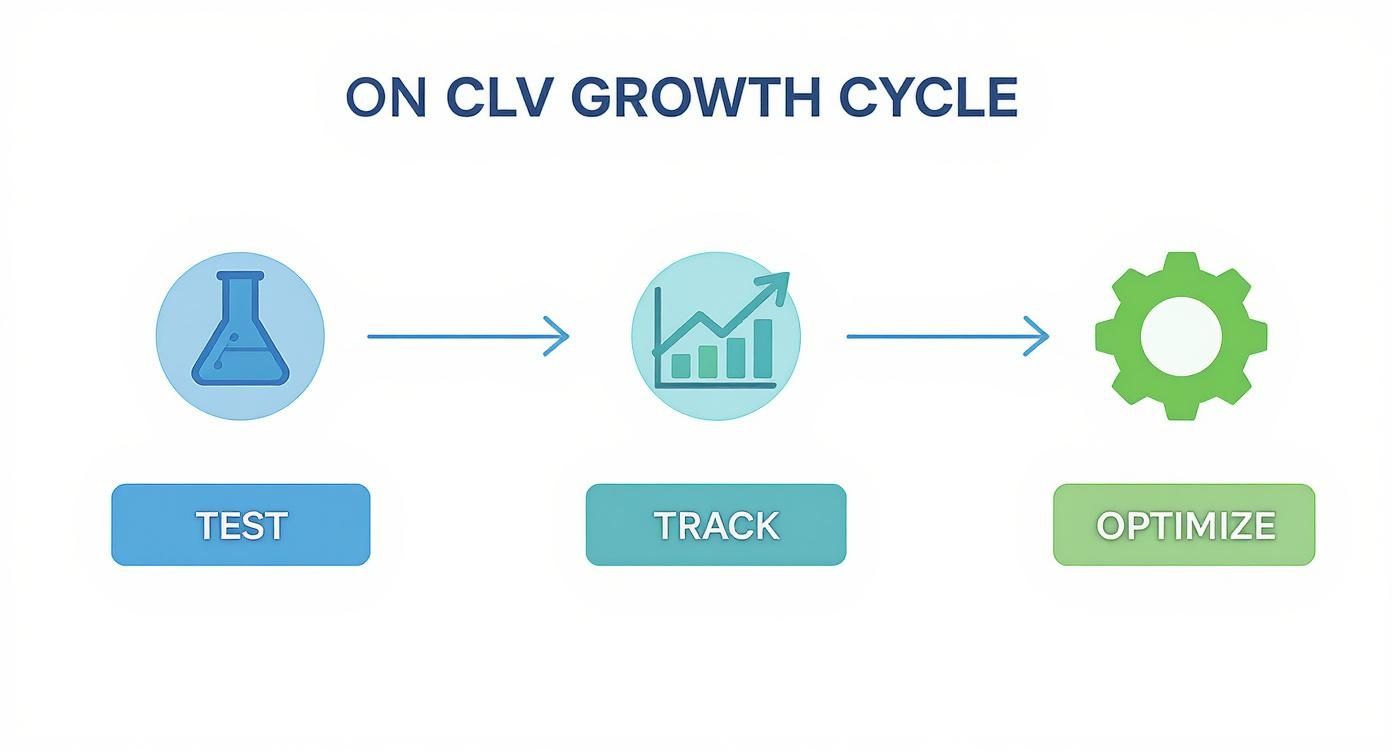
This simple loop is incredibly powerful. You’re constantly trying new tactics, seeing what the data says, and refining your approach based on what you learn.
How Often Should I Calculate CLV?
For most small and mid-sized businesses, running a full CLV recalculation quarterly or semi-annually is the sweet spot. This is frequent enough to spot important trends without getting lost in the weeds of constant analysis.
What you should monitor more often are the metrics that feed into your CLV. I recommend keeping a close eye on these monthly:
- Average order value
- Purchase frequency
- Churn rate
Tracking these smaller pieces lets you react quickly and make adjustments to your strategy before small issues become big problems.
Can I Increase CLV Without a Loyalty Program?
Absolutely. A formal loyalty program can be a fantastic tool, but it’s just one of many ways to build a stronger customer relationship. You can make a massive impact on CLV by doubling down on other parts of the customer experience.
Think about it. A frictionless onboarding process that makes a customer feel smart and welcome? That immediately builds trust and crushes buyer’s remorse. Proactive, friendly customer service that solves a problem before it escalates? That turns a negative into a moment of pure loyalty.
Using customer data to offer genuinely helpful upsell and cross-sell recommendations directly boosts how much each customer spends. These strategies are all powerful ways to increase CLV, no points program required.
Ready to turn these strategies into a reality for your business? At Netco Design LLC, we build revenue-focused digital marketing strategies that attract the right customers and keep them coming back. Let’s create a plan to elevate your digital presence and drive sustainable growth. Learn more at Netco Design LLC.

