

table of contents
If you’re trying to increase online sales, the temptation is to jump straight into spending money on ads or chasing the newest marketing trend. But the smartest, most sustainable approach is to reinforce your foundation first.
So many businesses skip this part and then wonder why their campaigns fall flat. Real growth isn’t about temporary traffic spikes; it’s about building a strategic base that makes every single marketing dollar work harder for you.
This foundational work all comes down to one thing: your customer.
Get Crystal Clear on Your Ideal Customer
You can’t sell effectively to a faceless crowd. You have to know exactly who you’re talking to—what keeps them up at night, what motivates them, and why they choose one brand over another. This is where creating detailed buyer personas is non-negotiable.
And I don’t just mean basic demographics like age and location. Dig deeper.
Ask yourself things like:
- What’s the biggest headache in their life that my product actually solves?
- Where do they hang out online? Are they on Instagram, scrolling through forums, or reading specific blogs?
- What words do they use when they talk about their problems?
- What’s holding them back from clicking “buy”? What are their biggest hesitations?
Answering these questions turns your marketing from a generic broadcast into a one-on-one conversation. Our guide on how to create buyer personas is a great place to start. Getting this right clarifies your messaging and ensures you’re attracting people who are actually likely to become customers.
“The first step to exceeding your customer’s expectations is to know those expectations.” – Roy H. Williams
Honestly, understanding your audience is the bedrock of every single successful sales strategy.
Sharpen Your Unique Value Proposition
Once you know who you’re talking to, you have to nail what you’re telling them. Your unique value proposition (UVP) is just a clear, simple statement explaining why someone should buy from you and not your competitor. It’s the core reason you exist for them.
A weak or confusing UVP is a recipe for high bounce rates. A strong one, on the other hand, grabs attention and communicates value in a split second. It should be front and center on your homepage and product pages, no question.
This kind of clarity is absolutely critical. The market is huge and getting bigger—global eCommerce sales are projected to hit around $6.86 trillion in 2025 and could blow past $8 trillion by 2027. To grab your piece of that pie, your value has to be impossible to miss.
Conduct a Digital Presence Audit
Finally, it’s time for an honest look at your current digital footprint. Think of this less as a critique and more as a hunt for “leaky buckets”—places where you’re losing potential sales right now without even knowing it.
Go through your website’s user experience. Walk through your own sales funnel from a customer’s perspective. Dive into your analytics and see where people are dropping off. A solid foundation means plugging these holes before you spend a dime driving more traffic to a broken system.
Turning Your Website Into a Conversion Engine
Think of your website as more than a digital brochure. It’s your tireless, 24/7 salesperson. If it’s not actively turning visitors into customers, it’s simply not doing its job. The most direct path to increasing online sales is to transform your site into a high-performance machine built for one thing: conversions.
Getting this right isn’t about guesswork. It starts with a solid foundation built on three core pillars: truly understanding your customer, clearly communicating your value, and ruthlessly auditing your site to remove any friction.
This simple flow shows how these pieces fit together.
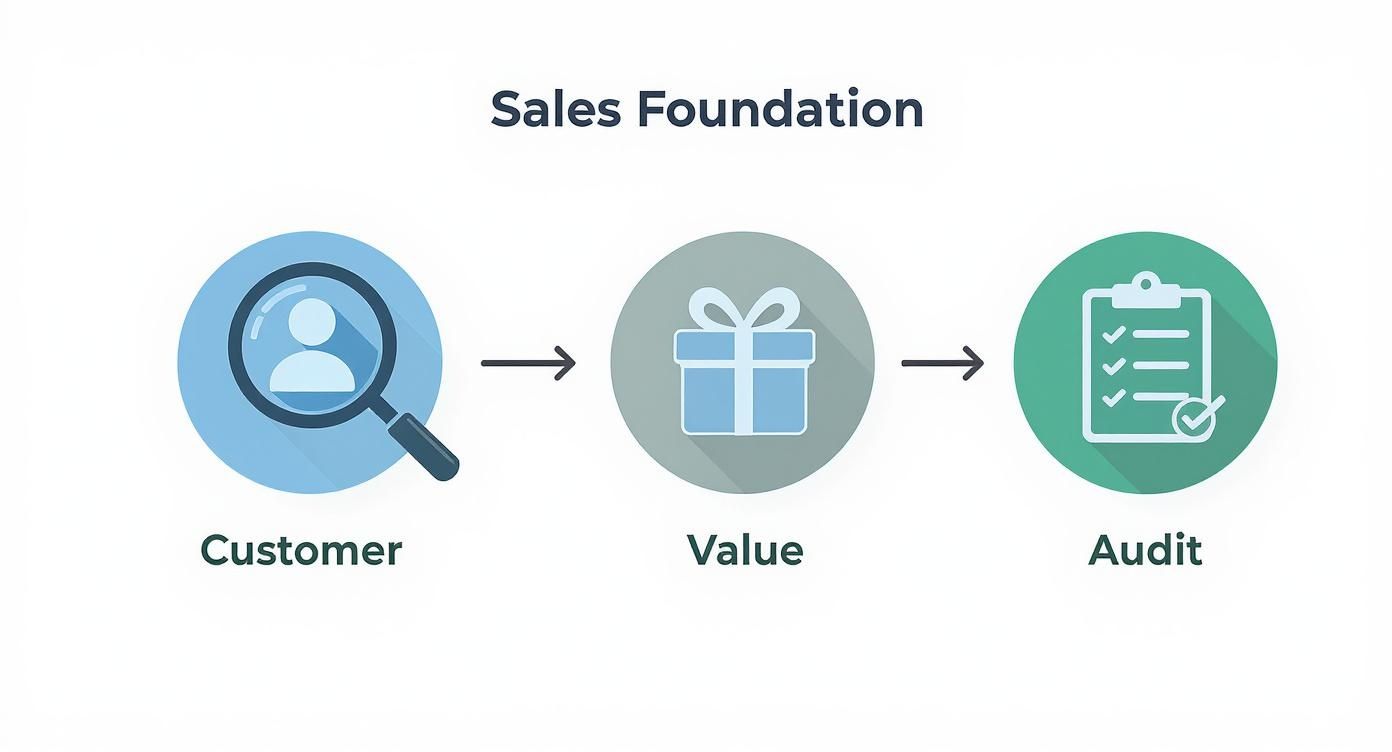
As you can see, a sale begins long before someone clicks “add to cart.” It starts with deep customer insight and a value proposition that hits home.
Crafting Irresistible Product Pages
Your product pages are where the magic happens—or doesn’t. This is where buying decisions are made, and they need to be compelling, trustworthy, and incredibly clear. Generic descriptions and blurry photos just won’t cut it anymore.
First, invest in high-resolution imagery and video. Shoppers want to see your products from every angle, in context, and in use. This isn’t just about making things look pretty; it’s about building the confidence someone needs to make a purchase. When a customer can virtually “touch” the product, they’re that much closer to buying it.
Next, shift your copy from features to benefits. Instead of saying a backpack is “made of waterproof nylon” (a feature), say it “keeps your laptop safe and dry during an unexpected downpour” (a benefit). That small change connects your product directly to a real-world problem your customer wants to solve.
Social proof is the modern-day word-of-mouth. A page with dozens of authentic reviews will almost always outperform a page with none, as it answers the customer’s silent question: “Do other people like me trust this?”
Finally, make social proof impossible to miss. Customer reviews, testimonials, and user-generated photos are powerful trust signals. They show real people using and loving your products, which melts away a new visitor’s hesitation.
Streamline Your Checkout to Stop Abandoned Carts
Did you know that an estimated $4 trillion worth of merchandise is abandoned in shopping carts each year? A huge chunk of that is recoverable. The culprit is often a clunky, frustrating checkout process. Friction is the absolute enemy of conversions.
Here’s how you can start eliminating it:
- Offer Guest Checkout: Forcing users to create an account is a notorious conversion killer. Give them the option to check out as a guest for a faster, smoother experience.
- Minimize Form Fields: Only ask for what is absolutely essential. Every extra field is another tiny reason for a potential customer to give up and leave.
- Show a Progress Bar: Let customers know exactly where they are in the process (e.g., Shipping > Payment > Review). This manages expectations and reduces the anxiety of the unknown.
- Be Transparent with Costs: Unexpected shipping fees are the number one reason for cart abandonment. Display all costs, including shipping and taxes, right up front.
By making the path to purchase as simple and transparent as possible, you’ll start capturing sales that were previously slipping through your fingers. If you’re looking for more actionable tips, check out our detailed guide on how to improve website conversion rates.
Prioritize Site Speed and Mobile Responsiveness
Your site’s technical performance isn’t just a concern for developers; it’s a critical sales tool. A slow-loading website erodes trust and sends frustrated users straight to your competitors. A mere one-second delay in page load time can cause a significant drop in conversions.
Similarly, your website must provide a flawless experience on mobile devices. With mobile commerce growing every year, a non-responsive site is like closing your doors to a huge part of the market. Make sure buttons are easy to tap, text is readable without zooming, and navigation is intuitive on a small screen.
While the average global eCommerce conversion rate hovers around 2.27%, businesses that obsess over these technical details can achieve rates well over 5% or even 10%. Optimizing your site’s speed and mobile experience signals professionalism and respect for your customer’s time—building the subconscious trust needed to turn a browser into a buyer.
Attracting High-Intent Buyers with SEO and PPC
Getting traffic to your website is one thing. Attracting visitors who are actually ready to buy is a completely different ballgame. This is where a smart mix of Search Engine Optimization (SEO) and Pay-Per-Click (PPC) advertising becomes your most powerful playbook for boosting online sales.
Think of them as two sides of the same coin. They work together to grab customers at every single stage of their buying journey.
SEO is your long game—the foundation for steady, sustainable growth. It’s all about fine-tuning your website to rank higher in search results for the exact keywords your ideal customers are typing into Google. When someone searches for “waterproof hiking boots for women,” showing up at the top of the organic results puts your brand right in front of a motivated buyer, and you don’t even have to pay for that click.
The process involves digging into the specific phrases and questions your audience uses, then weaving them naturally into your product descriptions, category pages, and blog posts. It’s a marathon, not a sprint, but the payoff is a consistent stream of high-quality traffic that trusts organic results far more than paid ads.
Capturing Immediate Sales with Targeted PPC
While your SEO efforts build momentum over time, PPC delivers results right now. Platforms like Google Ads let you place your products directly in front of buyers at the very moment they’re searching. For e-commerce brands, Google Shopping ads are a goldmine because they show your product image, price, and brand name right there in the search results.

Winning with PPC isn’t just about throwing money at keywords; it’s about targeting the right intent. For instance, a person searching “best running shoe brands” is still in the research phase. But someone searching “buy Brooks Ghost 15 size 10” is pulling out their credit card. Focusing your budget on these high-intent, long-tail keywords is the secret to a killer return on ad spend (ROAS).
The real magic happens when you combine the two. Your PPC campaigns give you immediate data on which keywords are actually converting into sales. You can then take that intelligence and use it to steer your SEO efforts, focusing your energy on ranking organically for the terms you already know are making you money.
This feedback loop takes all the guesswork out of the equation. Instead of spending months trying to rank for a keyword that might convert, you’re using real sales data to build a smarter, more profitable organic strategy.
The Power of Retargeting to Recover Lost Sales
But what about all those visitors who browse your site, maybe even add something to their cart, and then just… leave? That’s where retargeting comes in to save the day.
By tracking website visitors, you can show them targeted ads as they browse other sites or scroll through their social media feeds, gently reminding them of the products they looked at. It’s incredibly effective because you’re marketing to a warm audience—people who already know your brand. A simple, well-placed ad showing the exact item they left behind can be the nudge they need to come back and finish the purchase.
Here are a few ways to put retargeting to work:
- Abandoned Cart Reminders: Show ads to users who added products to their cart but bailed before checking out. You can even toss in a small discount code to make the offer irresistible.
- Product Page Visitors: Target people who viewed specific products but didn’t add anything to their cart. This keeps your brand top-of-mind while they weigh their options.
- Past Purchasers: Re-engage former customers with ads for new arrivals or complementary products. This is a fantastic way to encourage repeat business and boost customer lifetime value.
Getting paid advertising right requires a solid grasp of campaign structure and continuous optimization. To dive deeper, our guide covering Google Ads best practices breaks down detailed strategies to get more from your campaigns. By pairing the long-term authority of SEO with the immediate, data-rich insights from PPC and retargeting, you create a powerful system for attracting buyers who are ready to act and consistently growing your online sales.
Driving Repeat Business with Email and Social Commerce
Getting that first sale feels like a huge win, and it is. But the real secret to sustainable growth? Turning that first purchase into a lasting relationship. The initial sale isn’t the finish line; it’s the starting point for building loyalty.
This is where smart email marketing and social commerce completely change the game. They’re your best tools for transforming one-time buyers into repeat customers who choose you again and again.
Automate Your Sales with Essential Email Sequences
Forget blasting your entire list with the same generic newsletter. If you really want to increase online sales, you need to build automated email sequences that work for you around the clock. Think of these systems as your most reliable employee, tirelessly sending the perfect message at the perfect time.
There are three email flows every single e-commerce business needs to have running in the background:
- The Welcome Series: When someone new joins your list, don’t just send a confirmation. Roll out a three-to-five part series. Use it to tell your brand story, highlight your bestsellers, and maybe offer a small thank-you discount to encourage that first purchase.
- The Abandoned Cart Reminder: It’s a painful stat, but nearly 70% of online shopping carts are abandoned. A timely, automated email reminding a customer what they left behind—maybe with a friendly nudge—can recover a surprising amount of that lost revenue.
- The Post-Purchase Follow-Up: The conversation shouldn’t end at checkout. Follow up to say thanks, share shipping updates, and ask for a review. This simple act reinforces their buying decision and keeps your brand top-of-mind for their next purchase.
Setting up these flows is non-negotiable for growth. For a deeper dive into the mechanics, our complete guide on marketing automation for small business breaks down the entire process.
The most profitable customer is the one you already have. Nurturing that relationship through thoughtful, automated communication is one of the highest-ROI activities you can undertake. It builds trust and significantly increases customer lifetime value.
By automating these key touchpoints, you create a consistent, personal experience that fosters loyalty and drives repeat sales—all without constant manual effort.
Turn Social Browsing into Seamless Shopping
Social media isn’t just a place to post updates anymore; it’s a full-blown sales channel. Platforms like Instagram have become digital storefronts where someone can discover a product and buy it in just a few taps. This is social commerce, and it’s incredibly powerful.
The whole point is to remove friction. Instead of making a user see your post, leave the app, find your website, and then search for the product, you bring the checkout right to them. That’s how you turn casual scrolling into actual sales.
This screenshot from Instagram Business shows exactly how products can be tagged in posts, creating a shoppable, integrated experience.
Notice how a user can just tap a product in the photo to see its name and price, then click straight through to buy it. No friction.
This seamless flow is crucial for capturing impulse buys and capitalizing on that “I want it now” moment.
To make it work, focus on creating “shoppable” content. Tag your products in every relevant, high-quality photo and video. Even better, encourage your customers to share photos of themselves using your products. This user-generated content (UGC) is pure gold—it’s authentic social proof that builds massive trust with new audiences. By connecting your store to your social platforms, you create a direct path from inspiration to purchase.
Using Data and AI to Make Smarter Decisions
Guesswork doesn’t grow a business—data does. If you really want to increase online sales, you have to stop making assumptions and start making informed decisions based on what your customers are actually doing. This is where analytics and Artificial Intelligence (AI) stop being buzzwords and become your most powerful tools for growth.
The first step is digging into the data you already have. Tools like Google Analytics aren’t just for tracking traffic; they’re treasure troves of customer behavior. By spending time with the numbers, you can quickly see which marketing channels bring in your most valuable customers and, just as importantly, where you might be wasting your budget.
This data-first mindset is critical in today’s global market. China, the United States, and Western Europe account for over 80% of worldwide eCommerce revenue. With over 75% of internet users shopping online in 2024, the opportunity is massive. You can’t afford to guess what works in these key markets. You need data and AI to tailor your approach. For a deeper dive, check out Shopify’s latest e-commerce report.
Putting AI to Work in Your Business
Artificial Intelligence might sound complicated, but its real-world uses in e-commerce are more accessible than ever. At its core, AI is brilliant at sifting through mountains of data to spot patterns and automate decisions, helping you create a more personal and efficient experience for every customer. You don’t need a massive budget to get started.
Many small and mid-sized businesses are already seeing great returns from AI. For a practical look at some easy-to-use tools, check out our guide on AI for small business marketing.
Here are a few high-impact ways to use AI right now:
- Personalized Product Recommendations: AI algorithms analyze a visitor’s browsing history, past purchases, and what’s in their cart to suggest other products they’re highly likely to buy. It’s like giving every single visitor their own personal shopper.
- Intelligent Chatbots: Forget the clunky chatbots of the past. Modern AI-powered bots can answer complex customer questions 24/7, guide shoppers to the right products, and even help with checkout. They free up your team and prevent sales from slipping away after hours.
- Ad Budget Optimization: Let AI be your co-pilot. These tools analyze ad performance in real-time, automatically shifting your budget to the campaigns, keywords, and audiences that deliver the best ROI. It ensures every dollar you spend is working as hard as possible.
The real magic of AI is that it lets you scale personalization. You can deliver a one-on-one experience to thousands of customers at the same time—something that was once impossible for smaller businesses.
From Insights to Action with A/B Testing
Gathering data and using AI tools gets you halfway there. The final, crucial piece is to constantly test and refine your strategy. This is where A/B testing, or split testing, becomes your best friend. It’s simple: you compare two versions of a webpage, email, or ad to see which one performs better.
Instead of guessing, you let your customers tell you what works.
Let’s say you think a green “Buy Now” button will convert better than your current blue one. With A/B testing, you show 50% of your visitors the green button and 50% the blue one. The data tells you, without a doubt, which color drives more clicks and sales.
This method removes ego and opinion from your decisions. You can test almost anything:
- Headlines: Try a benefit-driven headline against one that asks a question.
- Product Images: Compare a clean product shot on a white background against a lifestyle photo of the product in use.
- Call-to-Action Text: Does “Add to Cart” outperform “Get Yours Today”?
- Checkout Process: Test a single-page checkout versus a multi-step process.
When you embrace a culture of data-driven testing, you create a powerful feedback loop. You gather insights, use AI to act on them, and then test your changes to prove they’re actually improving your bottom line. This methodical approach is the most reliable way to increase online sales and build a business that can adapt to anything.
Answering Your Top Sales Growth Questions
As you start putting these strategies into action, you’re going to have questions. It’s only natural. Instead of letting a little uncertainty slow you down, let’s tackle some of the most common hurdles I see business owners face. Getting straight answers here can help you put your energy where it’ll make the biggest difference.
What Is the Fastest Way to Increase Online Sales?
For the quickest results, the answer is almost always a two-pronged attack: conversion rate optimization (CRO) and targeted paid advertising. Think of it as patching the holes in your bucket while turning the hose on full blast.
Start by auditing your checkout process. Seriously, go through it yourself. Are there clunky, unnecessary steps? Do shipping costs pop up as a nasty surprise right at the end? Fixing these obvious friction points can immediately slash your cart abandonment rate, capturing sales you were this close to making. This is your low-hanging fruit.
At the same time, spin up a focused Google Shopping or Facebook ad campaign. Go after users with high purchase intent—the people actively searching for the exact products you sell. While SEO is the engine for long-term, sustainable growth, this dual approach gets cash in the door now by making your site more effective and driving ready-to-buy traffic straight to it.
How Much Should I Spend on Marketing to Grow Sales?
Forget getting bogged down by a fixed percentage of revenue. It’s far more effective to obsess over two key metrics: Customer Acquisition Cost (CAC) and Customer Lifetime Value (LTV). These numbers tell you exactly what you can afford to spend to land a new customer and still make a profit.
A healthy e-commerce business typically aims for an LTV that’s at least three times its CAC. This 3:1 LTV:CAC ratio is the gold standard, ensuring you’re not just making sales, but building a profitable business.
If you’re just starting out, don’t throw a huge budget into the dark. Earmark a small, testable amount for a promising channel like Google Ads. Then, measure your Return on Ad Spend (ROAS) like a hawk. Once you find a channel that’s profitably bringing in customers—where your revenue easily beats your ad spend—that’s your signal to scale up with confidence.
This data-first approach takes all the guesswork out of your marketing budget.
I Have Website Traffic but No Sales. What Should I Fix First?
If you’re getting visitors but nobody is buying, the problem isn’t your marketing; it’s your storefront. The issue is almost certainly on your website, and you need to become a detective to find the culprit.
Start by putting your product pages under a microscope.
- Are your images compelling? You need high-quality, multi-angle shots and, even better, lifestyle photos showing your product in action.
- Is your product description persuasive? It can’t just be a list of features. It has to sell the benefit and solve a problem for the customer.
- Is social proof easy to find? Prominently display customer reviews and ratings. Nothing builds trust faster.
Next, go through your entire checkout process as if you were a first-time customer using a smartphone. Is it dead simple? Forcing someone to create an account before they can buy is a classic conversion killer. Dive into your website analytics to pinpoint the exact pages where people are bailing and focus all your energy on fixing those specific friction points first.
Should I Focus on SEO or PPC for My E-commerce Store?
This isn’t an “either/or” question. The smart move is a “both/and” approach. SEO and PPC are two different tools in your toolbox, and they work together beautifully to increase online sales.
PPC is your sprinter. You can launch a campaign today and start driving targeted traffic—and making sales—within hours. It’s also the perfect testing ground for finding out which keywords, ad copy, and offers actually make people click “buy.”
SEO, on the other hand, is your marathon runner. It’s a long-term investment that builds brand authority and delivers a steady, sustainable stream of “free” organic traffic over time.
Here’s how to make them work together: Use PPC for quick wins and to gather priceless sales data. Then, take what you learn from your paid campaigns to inform and prioritize your SEO strategy. This synergy ensures you’re focusing your long-term content efforts on the proven, money-making keywords you already know will move the needle.
Ready to stop guessing and start growing? The team at Netco Design LLC builds revenue-focused digital strategies that turn traffic into sales. Let’s talk about a custom plan for your business.

