

table of contents
To really move the needle on organic search traffic, you have to start with a solid foundation. This means taking a hard look at your technical SEO, figuring out what content you already have that works, and getting inside the heads of your audience to understand what they’re actually searching for.
This initial diagnostic phase is easily the most critical part of the whole process. It dictates every single thing you do next, making sure you’re pouring your energy into high-impact tasks instead of spinning your wheels on optimizations that go nowhere.
Building Your Foundation for Organic Growth
Jumping straight into writing new blog posts without knowing your website’s current health is like building a house on a shaky foundation. Before you start chasing new keywords or launching that big campaign you’ve been dreaming of, you have to look inward.
A strategic audit isn’t about finding every tiny flaw. It’s about spotting the biggest opportunities for growth that are already sitting right there on your site. This way, your efforts are backed by data from day one, giving you a clear roadmap for everything that follows.
This simple three-step process—audit, analyze, and strategize—is how you build that strong SEO foundation.
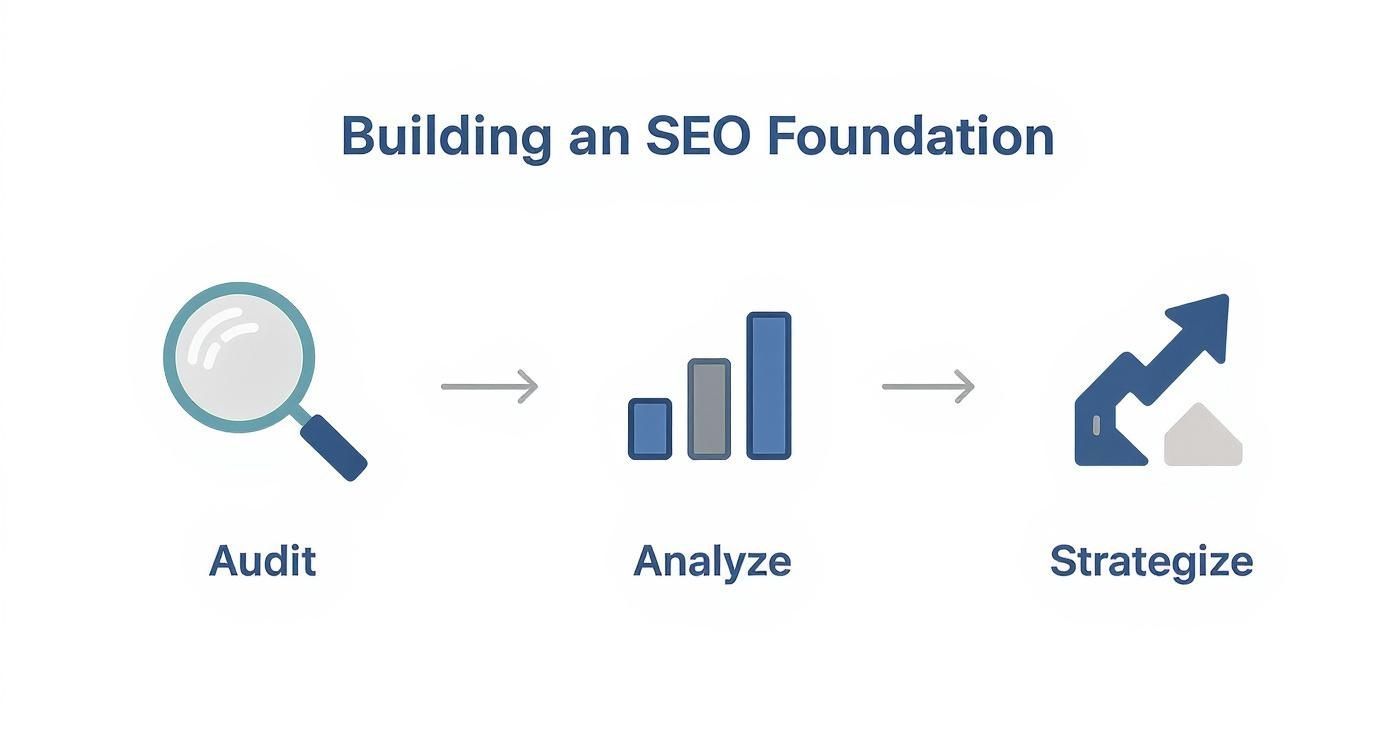
Following this workflow stops you from wasting time and money, and instead focuses your efforts on the activities that will genuinely increase your organic search traffic.
Conduct a Quick Technical Health Check
Your website’s technical health is the bedrock of its performance. If search engines can’t crawl, understand, or index your pages, then even the most amazing content in the world will just sit there, invisible. The good news? You don’t need to be a developer to spot the major red flags.
Your first stop should be Google Search Console. It’s free, and it gives you a firehose of diagnostic info straight from the source.
Here’s where to focus your attention first:
- Indexing Issues: Pop open the “Pages” report. Look for any errors that are stopping Google from adding your pages to its index. If a page isn’t indexed, it doesn’t exist in search results. Period.
- Mobile Usability: The majority of searches happen on phones, so Google is obsessed with mobile-friendly sites. Any errors here are a huge deal and need to be fixed ASAP.
- Core Web Vitals: This report tells you how fast your site feels to real users. A bad score here can hurt your rankings and, more importantly, frustrate your visitors into leaving.
Nailing these technical basics is non-negotiable. It ensures search engines can actually access and evaluate your content. If you want a deeper dive into the principles at play, you can learn more about what search engine optimization is in our detailed guide.
To get started, a focused audit checklist can keep you on track. It helps you zero in on the issues that will give you the most bang for your buck right away.
Identify Your Current Top Performers
Next up, dive into your analytics and see what’s already resonating with your audience. Look for the pages that pull in the most organic traffic. These “power pages” are a goldmine of clues about what your audience loves and what Google sees as authoritative on your site.
Ask yourself these questions for each top page:
- What specific topics do these pages cover?
- Which keywords are they actually ranking for?
- What’s the format? Is it a listicle, a deep-dive guide, or a product page?
Figuring out why these pages are winning helps you build a repeatable formula for success. Maybe your audience loves your in-depth guides, or perhaps it’s the “how-to” articles with embedded videos that are driving all the engagement. This analysis gives you a proven blueprint for your content strategy.
The goal isn’t just to find popular pages—it’s to deconstruct their success. Analyze their structure, the keywords they use, and how users engage with them. This is how you create a repeatable model for generating more winners.
Understand True Search Intent
Finally, and most importantly, put yourself in your audience’s shoes. Why are they typing those keywords into Google in the first place? Are they just looking for a quick answer, trying to compare a few products, or are they ready to pull out their credit card and buy something?
Answering this question is the secret to creating content that actually satisfies users—which is exactly what Google wants to rank.
And never forget that organic search is still the undisputed king of website traffic. Industry data shows that organic search accounts for 53% of all website visits, absolutely dwarfing every other channel, from paid ads to social media. As you can see when you read the full research on organic search traffic dominance, this is not a channel you can afford to ignore. That statistic alone shows why aligning your content with what people are looking for is so vital. It’s how you tap into the biggest source of potential customers on the planet.
Mastering Keyword and Content Mapping
Once your technical foundation is solid, the real fun begins. It’s time to dig deeper than just broad, competitive keywords and start thinking in the exact language your customers use every day. This is where you uncover the questions and phrases that signal genuine interest and a readiness to buy.
This isn’t about guesswork; it’s strategic discovery. We’re on the hunt for long-tail keywords—those longer, more conversational phrases that reveal precisely what problem someone is trying to solve. These are the golden nuggets your competitors often miss in their rush to target high-volume, generic terms.

Uncovering High-Intent Long-Tail Keywords
Think like your customer for a second. Someone searching for “shoes” has a very different mindset than someone searching for “best waterproof running shoes for flat feet.” The first search is casual browsing; the second is from someone with a specific need who is much closer to making a purchase.
Your mission is to find those ultra-specific, multi-word phrases. While they have lower search volume individually, they’re far less competitive and attract a much more qualified audience.
Here are a few practical ways I find them for my clients:
- Google’s “People Also Ask” Box: Search for a broad topic in your industry and just look at the questions that pop up. They’re direct insights into what users are actually wondering about.
- Online Forums like Reddit and Quora: Dive into subreddits or Quora topics related to your niche. Pay close attention to the exact language people use when describing their problems and asking for help. It’s a goldmine.
- Your Own Customer Service Inquiries: What questions do your customers ask over and over again via email, phone, or chat? Each one is a potential long-tail keyword you can build content around.
This focus on specific, in-depth answers is no longer optional. In fact, research shows that a staggering 69% of all search traffic now comes from these long-tail queries. Users want precise answers, and search engines are rewarding comprehensive content. Articles over 3,000 words, for example, tend to attract significantly more traffic, social shares, and valuable backlinks.
Mapping Keywords to the Buyer’s Journey
Finding the right keywords is just one piece of the puzzle. The real magic happens when you map those keywords to the different stages of your customer’s journey. This simple step ensures you have the right content ready to meet their needs, whether they’re just starting to research or are pulling out their credit card.
This process, known as content mapping, transforms a random list of keywords into a cohesive content strategy. Every blog post, guide, and product page gets a specific job to do, guiding users smoothly from one stage to the next.
A well-executed content map ensures you’re not just creating content for the sake of it. You’re building a system where each piece works together to nurture a user from initial awareness to a final conversion, directly impacting your ability to increase organic search traffic.
Structuring Your Content Map
To build your map, think about the three main stages of the buyer’s journey and what kind of keywords fit into each. For a small business, this framework is invaluable. You can explore this further in our small business SEO guide for more tailored strategies.
Here’s a simple breakdown of how to get started:
1. Awareness Stage (Top of Funnel)
At this stage, people know they have a problem, but they don’t know the solution yet. They’re looking for information, answers, and education.
- Keyword Intent: Informational (e.g., “why does my basement leak,” “how to start a budget,” “symptoms of gluten intolerance”).
- Content Format: Blog posts, how-to guides, checklists, infographics, short educational videos.
- Example: A home services company targets “signs of a leaky roof” with a detailed blog post that helps homeowners diagnose the problem on their own.
2. Consideration Stage (Middle of Funnel)
Now, users understand their problem and are actively researching potential solutions. They are comparing options and looking for the best fit.
- Keyword Intent: Commercial Investigation (e.g., “metal roof vs shingle cost,” “quickbooks vs freshbooks,” “best gluten-free flour for baking”).
- Content Format: In-depth comparison guides, case studies, product reviews, webinars.
- Example: The same roofing company creates a comprehensive guide comparing the pros and cons of different roofing materials, positioning their preferred solution favorably.
3. Decision Stage (Bottom of Funnel)
Finally, the user has settled on a solution and is now looking for the right company or product to buy from.
- Keyword Intent: Transactional (e.g., “roof repair st petersburg fl,” “buy quickbooks online,” “gluten-free bakery near me”).
- Content Format: Product/service pages, pricing pages, free consultations, testimonials.
- Example: The company optimizes its “Roof Repair Services” page for local keywords, featuring customer reviews and a clear call-to-action to request a quote.
By systematically assigning keywords to each stage, you create a powerful engine for attracting and converting organic traffic. You meet users exactly where they are, provide immense value, and build the trust needed to turn a searcher into a customer.
Optimizing Your Technical and On-Page SEO
Creating exceptional content is a huge step, but it’s only half the journey. If the technical foundation of your website is shaky, even the best articles can stay buried in the search results. Think of technical and on-page SEO as all the behind-the-scenes work that ensures your content actually gets the visibility it deserves.
This isn’t about becoming a developer overnight. Instead, we’ll focus on the high-impact adjustments that make a real difference, turning your site into a place both users and search engines love to visit.
Crafting Titles and Descriptions That Earn Clicks
Your title tag and meta description are your first impression in the search results. They’re your 15-second pitch to a potential visitor, convincing them to click your link instead of the nine others on the page. Getting this right directly impacts your click-through rate (CTR), a clear signal to Google that your result is relevant.
A compelling title tag should:
- Include your primary keyword naturally, ideally toward the beginning.
- Stay under 60 characters to avoid getting cut off in search results.
- Create curiosity or clearly state the value the user will get from clicking.
Your meta description is your supporting sales copy. While not a direct ranking factor, it heavily influences whether someone clicks. Make it a concise summary (around 155 characters) that expands on the title and includes a subtle call-to-action, like “Learn how to…” or “Discover the best…”
Designing User and SEO-Friendly URLs
A clean, logical URL structure does more than just look good; it helps both users and search engines understand what a page is about before they even click. A jumbled URL filled with random numbers and characters is a huge missed opportunity.
Just look at the difference:
- Poor URL:
yourstore.com/products/item?id=8462&cat=57 - Good URL:
yourstore.com/womens-shoes/waterproof-running-shoes
The second example immediately tells you what’s on the page and even includes relevant keywords. Keep your URLs short, descriptive, and use hyphens to separate words. It’s a simple practice that improves user experience and adds a small but meaningful SEO boost.
Building a Smart Internal Linking Strategy
Internal links are the pathways you create between pages on your own website. A smart internal linking strategy helps search engines discover all your content and understand how different pages relate to one another.
Even more importantly, it distributes authority—often called “link equity”—from your most powerful pages to other pages you want to rank.
For instance, if you have a high-traffic blog post, linking from it to a relevant product page passes some of that authority along, giving the linked page a much better chance to rank. Always use descriptive anchor text (the clickable words) that tells users and Google what the destination page is about. Ditch the generic phrases like “click here.”
A thoughtful internal linking structure acts like a web, connecting your content in a logical way. It not only boosts SEO by distributing page authority but also keeps users engaged, guiding them to more relevant information and increasing their time on your site.
Mastering the Technical Essentials
While the term “technical SEO” can seem intimidating, focusing on a few key areas will yield the biggest returns for your traffic goals. These elements directly impact user experience, which is something search engines care about deeply.
Improve Your Site Speed
Page speed is a confirmed ranking factor. End of story. A slow website frustrates users and leads to sky-high bounce rates. Google’s Core Web Vitals are a set of metrics designed to measure the real-world user experience of a page, focusing on loading, interactivity, and visual stability.
You can check your site’s performance using Google Search Console. The usual culprits for slow speed are massive image files, bloated code, and slow server response times. For a practical walkthrough, check out these Core Web Vitals performance tips to start making improvements today.
Ensure Flawless Mobile-Friendliness
With the majority of searches now happening on mobile devices, Google uses mobile-first indexing. This means it primarily uses the mobile version of your content for indexing and ranking. Your site must provide a seamless experience on a smartphone.
This goes way beyond just having a responsive design. Test your site on an actual mobile device to check for:
- Text that is easy to read without zooming.
- Buttons and links that are easy to tap.
- No intrusive pop-ups that cover the main content.
Use Structured Data for Rich Snippets
Structured data, or schema markup, is a standardized code format you add to your site to help search engines understand your content in much greater detail. By telling Google a piece of content is a recipe, an event, a product, or an FAQ page, you become eligible for rich snippets.
Rich snippets are those enhanced search results that show ratings, prices, or event dates directly on the results page. They make your listing stand out from the crowd, which can significantly increase visibility and click-through rates. It’s a powerful way to get more organic traffic.
Building Authority with Strategic Link Building
Think of high-quality backlinks as the internet’s currency. When another reputable website links to your content, it’s a vote of confidence. It tells search engines that your site is a trustworthy, authoritative source of information, which is the bedrock of any long-term strategy for how to increase organic search traffic.
But here’s the thing: not all links are created equal.
The goal isn’t to pile up hundreds of low-quality links from spammy directories. A single, powerful backlink from a respected industry publication can move the needle more than a hundred weak ones. It’s all about quality and relevance.
Creating Irresistible Linkable Assets
The most sustainable way to build links is to create something so valuable that other people want to link to it. This approach flips the script from begging for links to earning them organically. These “linkable assets” become evergreen magnets for backlinks.
So, what makes an asset truly linkable?
- Original Research and Data Studies: Publish unique data, maybe from a customer survey or an analysis of industry trends. This makes your content a primary source that bloggers and journalists will naturally cite.
- Free Tools and Calculators: A simple, useful tool—like a mortgage calculator for a real estate site or a calorie counter for a fitness blog—can attract an incredible number of links because it provides real, tangible value.
- Ultimate Guides and Resources: A massive, in-depth guide on a complex topic can become the go-to resource in your niche. Over time, it will naturally earn links as others reference it.
The secret is to create something that solves a genuine problem or answers a tough question better than anyone else. This foundational content establishes your site as a pillar of authority.
Mastering Proactive Outreach and Guest Posting
While creating linkable assets is a fantastic long-term play, proactive outreach can deliver more immediate results. This is all about identifying relevant websites and building genuine relationships with their owners or editors.
Guest posting is still a powerful strategy, but only when done right. Forget spamming low-quality blogs with generic articles. Instead, focus on contributing a genuinely helpful, well-researched piece to an authoritative blog in your space. The link in your author bio is secondary to the authority and referral traffic you gain from that association.
Digital PR takes this a step further. It’s about using newsworthy stories, data, or expert insights to get mentions and links from news outlets and top-tier publications. For instance, if you’re a local business, your customer feedback is a goldmine. Our guide on why online reviews matter for Florida businesses dives into how you can leverage this social proof effectively.
The best link building campaigns are built on real relationships and mutual value. Don’t just ask for a link; find a way to contribute to their site and their audience first. This simple shift turns a cold email into a warm introduction.
To help you decide where to focus your efforts, here’s a quick breakdown of common link building tactics:
Link Building Strategy Comparison
| Strategy | Effort Level | Potential SEO Impact | Associated Risk |
|---|---|---|---|
| Guest Posting | Medium | High | Low (if on relevant, high-quality sites) |
| Linkable Assets | High | Very High | Very Low |
| Broken Link Building | Medium | Medium | Low |
| Digital PR | High | Very High | Low |
| Directory Submissions | Low | Low | Medium (risk of spammy, low-value links) |
Choosing the right mix depends on your resources and goals. A balanced approach often works best, blending long-term asset creation with targeted outreach.
Monitoring Your Backlink Profile
As you build new links, it’s just as important to keep an eye on your existing backlink profile. Sometimes, your site can attract toxic or spammy links through no fault of your own—think low-quality directories, scraper sites, or even negative SEO attacks.
Use a tool like Google Search Console or Ahrefs to periodically review the domains linking to you. If you find links that are clearly from irrelevant or malicious sites, you can use Google’s Disavow Tool to tell the search engine to ignore them. This is an advanced tactic, so proceed with caution, but it’s an essential part of maintaining a healthy backlink profile over the long haul.
Broaden Your Horizons Beyond Traditional SEO
If you want to truly grow your organic search traffic today, you have to start looking beyond your own website. The old lines of search are blurring. Google’s results pages aren’t just a simple list of ten blue links anymore; they’re a dynamic mashup of videos, forum discussions, and real-world user content.
What does this mean for you? It means your potential customers are finding answers on platforms like YouTube, Reddit, and Quora long before they even consider visiting a corporate website. Sticking only to your own blog is like setting up shop on a quiet side street while your customers are all hanging out on main street. You have to go meet them where they already are.
Meeting Your Audience in Their Digital Hangouts
Think about how people look for genuine advice. They don’t just search for polished brand messaging. They want authentic conversations and unfiltered opinions, which is exactly why community-powered platforms have become such a force in search.
- YouTube for Visual Learners: For almost any “how-to” question, a video tutorial often grabs the top spot. Creating helpful, well-optimized videos positions you as an expert and pulls in traffic from people who would rather watch than read.
- Reddit for Honest Reviews: Users flock to Reddit for unfiltered product reviews and answers to incredibly specific problems. If you participate authentically in the right subreddits, you can build serious brand trust and drive highly qualified traffic back to your site.
- Quora for Direct Questions: This platform is basically a giant library of questions and answers. By providing thoughtful, detailed answers to common questions in your industry, you establish authority and can even rank directly in Google for those exact queries.
The trick is to avoid spamming these places with links. Instead, become a valuable member of the community. Offer real help, and the traffic will naturally follow.
Optimizing Your Presence on Third-Party Platforms
Getting your brand to show up in search results through these other platforms takes a different kind of thinking. You’re not just optimizing a webpage; you’re optimizing a profile, a video, or a community post.
Take a YouTube video, for instance. You should treat it with the same care as a blog post. Do your keyword research for the title and description. Design a thumbnail that makes people want to click. Use tags that are actually relevant to your topic.
The same logic works for Reddit and Quora. When you answer a question, use the language and keywords your audience is already using. Structure your response with clear headings and formatting so it’s easy to digest. This doesn’t just help the reader; it signals to search engines that your answer is a high-quality, thorough resource. A well-written answer on Quora can easily become a featured snippet right at the top of Google’s search results.
This expanded mindset is critical as search engines continue to evolve. In fact, our own strategies are constantly adapting to stay visible in this new reality. You can read more about how we’re making content appear in chatbot answers and AI search, a trend that’s directly tied to this shift.
Think of these platforms as extensions of your own website. Every helpful video you upload or detailed answer you provide is another potential entry point for a customer to discover your brand through an organic search.
This isn’t just a hunch; the data backs it up. While organic search is still a dominant force, the influence of these other platforms is undeniable. A recent study found that a staggering 50.3% of Google searches now include at least one social platform like Reddit, YouTube, or Quora in the top 10 results. Digging deeper, Reddit alone shows up in 37% of those cases, proving that community chatter is now a fundamental part of the search experience. This connection between search and social platforms is a massive opportunity if you’re willing to engage. As you can discover more insights about social media’s impact on search, being present on these platforms is no longer just an option—it’s essential for a complete organic strategy.
Frequently Asked Questions About Organic Traffic
Diving into SEO always brings up a ton of questions. As you start putting these strategies into action to grow your organic search traffic, you’re bound to run into new challenges and shifting best practices.
This section is here to give you direct, no-fluff answers to the questions we hear most often from business owners just like you. Think of it as a quick reference guide to clear up any confusion and help you tackle specific problems with confidence.
How Long Does It Take to See SEO Results?
This is the big one, and the honest answer is: it depends. SEO is a marathon, not a sprint. While you might see some small wins from technical fixes or on-page tweaks within a few weeks, significant, lasting growth in organic traffic usually takes three to six months of consistent work.
A few things can speed up or slow down that timeline:
- Website Authority: An established site with a solid backlink profile will see results much faster than a brand-new domain starting from scratch.
- Competition: Trying to rank in a packed niche like insurance or real estate is a tougher climb than in a less crowded market.
- Consistency: The more regularly you publish great content, build quality links, and tune up your site, the faster you’ll build momentum.
Patience is the name of the game here. SEO has a compounding effect, meaning the results you build in the first six months will continue to grow and deliver value for years to come.
Don’t get discouraged if you don’t see a huge spike overnight. Every optimized blog post and every quality backlink is another brick in your foundation. The initial work is the hardest, but it’s what supports massive growth down the road.
Should I Focus on High-Volume or Long-Tail Keywords?
For most small and mid-sized businesses, the answer is a hard yes to long-tail keywords. It’s tempting to go after those high-volume, single-word keywords (like “shoes”), but they are incredibly competitive and the search intent is often a total mystery.
Long-tail keywords are multi-word phrases that are way more specific (e.g., “best waterproof hiking shoes for women”). They have lower search volume one by one, but together, they offer massive advantages:
- Less Competition: It’s so much easier to rank for a specific phrase than for a generic term that huge brands have locked down.
- Higher Conversion Rates: Someone searching for a specific phrase knows exactly what they want. They’re often much closer to making a purchase.
- Clearer Intent: You know precisely what problem the user is trying to solve, which lets you create perfectly targeted, helpful content.
The smart play is to build a solid foundation of content around these long-tail keywords. As your site’s authority grows from all that targeted traffic, you’ll naturally start ranking for the more competitive, higher-volume terms over time. It’s about starting with surgical precision and then expanding your reach.
How Important Are Backlinks Today?
Backlinks are still one of the most powerful ranking signals for Google. Period. Think of them as a vote of confidence from another website. When a reputable site links to your page, it’s telling search engines that your content is a valuable and trustworthy resource.
But the game has totally changed—it’s about quality, not quantity. A single, relevant backlink from a respected industry authority is worth more than hundreds of spammy, low-quality links from random directories. The focus now should be on earning links naturally by creating exceptional content that people actually want to share.
Your goal is to build a diverse, healthy backlink profile over time. This establishes your site as an authority in your space, which is critical for locking in top rankings and driving sustainable organic traffic. Focus on building real relationships and creating “linkable assets,” not chasing easy, worthless links. It’s a slower strategy, but it’s the only one that works for long-term success.
Ready to stop guessing and start growing? At Netco Design LLC, we build data-driven SEO strategies that attract qualified customers and deliver real results. Let our team of experts create a custom plan to increase your organic search traffic and turn more visitors into loyal customers. Schedule your free consultation today!

