

table of contents
To really move the needle on website traffic, you have to start with a strong, technically sound foundation. I’ve seen too many businesses jump straight into fancy content or expensive ads, only to see it all fall flat because their site was slow, broken, or confusing to navigate.
Let’s focus on the three pillars of a solid website: a thorough technical SEO audit, lightning-fast site speed, and a great user experience. Getting these fundamentals right from the start makes everything else you do way more effective.
Building Your Foundation for Traffic Growth
Think of it like building a house. You wouldn’t put up the walls and roof on a shaky foundation, right? The same goes for your website. Pouring money into ads or content is a waste if your site is slow, riddled with broken links, or impossible for Google to understand.
This foundational work isn’t the most glamorous part of marketing, but it’s what separates the sites that succeed from those that struggle. It’s all about getting under the hood to make sure your site is built for performance, visibility, and—most importantly—for your users.
Start with a Technical SEO Audit
A technical SEO audit is basically a health checkup for your website. It’s designed to uncover all the hidden issues that could be holding you back in search rankings—problems you might not even know exist.
I’m talking about things like:
- Crawl Errors: Pages that Google’s bots can’t even access, making them totally invisible.
- Broken Links: Dead-end links (404 errors) that frustrate users and waste Google’s time.
- Poor Site Architecture: A messy site structure makes it hard for both people and search engines to find your best content.
- A Bad robots.txt File: This simple file can accidentally tell search engines to ignore important sections of your site.
Fixing these issues clears the path for search engines to crawl and index your site properly. If you want a detailed process to follow, our guide on how to do a site audit walks you through it step-by-step.
Prioritize Site Speed and User Experience
With over 1.13 billion websites out there, you have just seconds to capture someone’s attention. A slow-loading website is the quickest way to send a potential customer packing. In fact, research shows a staggering 88.5% of people will leave a site if it loads too slowly.
Improving your site speed isn’t just a “nice-to-have” anymore; it’s absolutely critical. A page that loads in just one second can have a conversion rate nearly 40% higher than a slower one. Speed and a smooth user experience are now core ranking factors for Google.
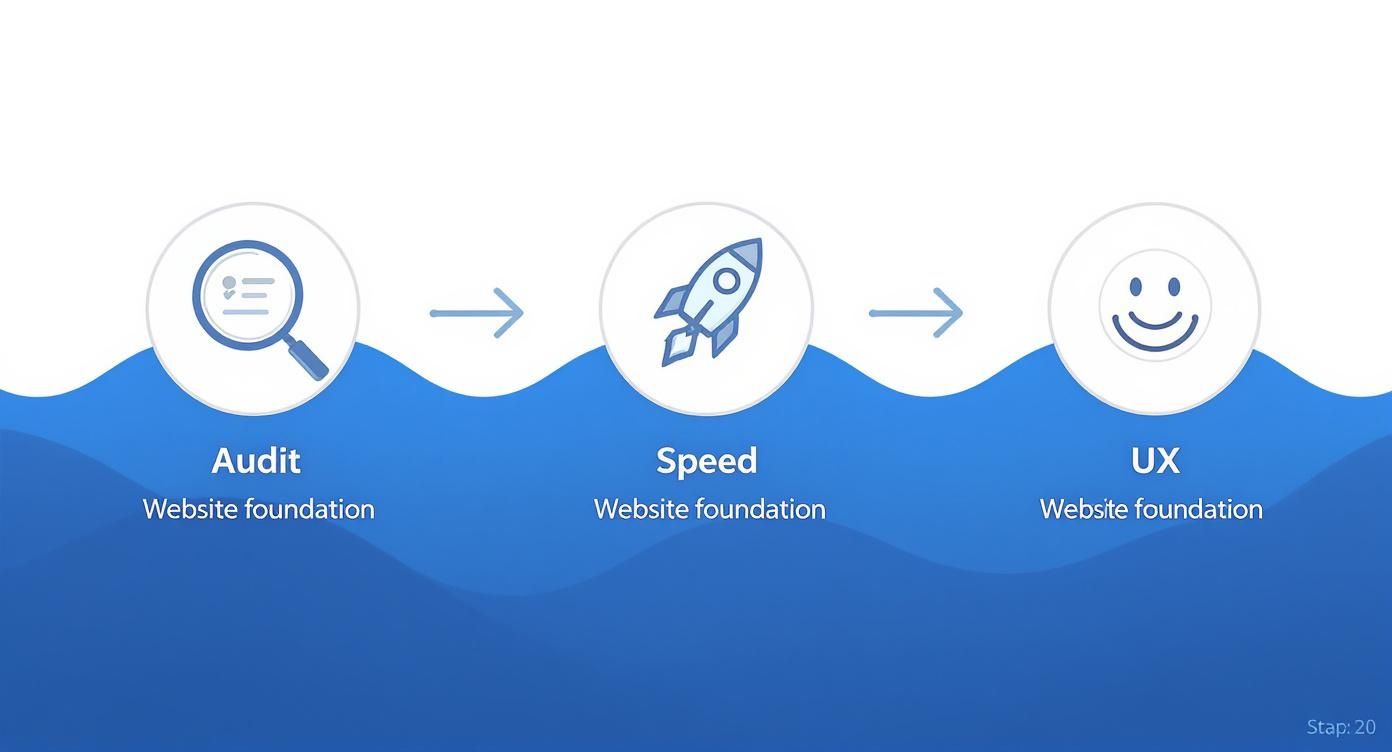
This process is straightforward: start with an audit to find the problems, then focus your efforts on boosting speed and making the site a pleasure to use.
Simple fixes can make a huge difference. Start by optimizing your images to reduce their file size, use browser caching so repeat visitors have a faster experience, and make sure your navigation is clean and intuitive. A fast, user-friendly website directly signals to Google that you provide a quality experience, which can give your search rankings a serious boost.
Make Sure Your On-Page SEO Is On Point
Once the technical backend is sorted, it’s time to fine-tune your on-page elements. This is about signaling to search engines exactly what each page is about, making your content more relevant for specific search queries.
Every single page and blog post you publish should be optimized. It’s a non-negotiable part of any content strategy.
Here’s a quick-reference checklist I use with my team to make sure we hit the most important on-page SEO elements every time.
Essential On-Page SEO Checklist
- Title Tag: Include your primary keyword near the beginning and keep it under 60 characters. This is the most important on-page factor; it tells Google what your page is about.
- Meta Description: Write a compelling summary (155-160 characters) that includes your keyword. While not a direct ranking factor, it heavily influences click-through rates.
- URL Slug: Keep it short, descriptive, and include your primary keyword (e.g.,
/on-page-seo-tips). A clean URL helps both users and search engines understand the page’s content. - H1 Tag: Use one H1 per page that clearly states the topic and includes the main keyword. The H1 tag acts as the main headline for your page’s content.
- Subheadings: Use H2s and H3s to structure content and include related keywords. This breaks up text for readability and helps search engines understand the hierarchy.
- Image Alt Text: Write descriptive alt text for all images, including keywords where natural. This improves accessibility and helps your images rank in Google Images search.
- Internal Links: Link to at least 2-3 other relevant pages on your site using descriptive anchor text. This helps Google discover more of your content and spreads link authority.
By consistently applying these best practices, you create a powerful launchpad for all your traffic-building efforts. You’re not just making your site better for search engines; you’re making it better for the people who actually use it.
Creating Content That Attracts Your Audience
Once your website’s technical foundation is solid, it’s time to shift gears. The next move in driving more website traffic is creating content that people are actually looking for. Think of great content as the engine for sustainable, long-term growth—it’s what turns a first-time visitor into a loyal follower and cements your business as the go-to authority in your industry.
Too many businesses fall into the trap of writing content without a clear plan, just hoping something sticks. A far better approach is to have a marketing plan for every single blog post before you even start writing. You need to know exactly who you’re talking to and how you’ll get the content in front of them long after the initial social media buzz dies down.
This kind of strategic thinking is what separates content that just exists from content that actually performs.
Build Authority with a Topic Cluster Strategy
Instead of churning out random blog posts, it’s time to get organized with topic clusters. This model is straightforward but incredibly powerful: you create a comprehensive “pillar page” on a broad topic, then surround it with several shorter, more specific “cluster pages” that dive into related subtopics.
Let’s say a Tampa Bay roofing company wants to own the topic of roof replacement. Their pillar page might be “The Ultimate Guide to Roof Replacement in Florida.”
From there, their cluster content could branch out into articles like:
- “Best Roofing Materials for Florida’s Climate”
- “How to Spot Hurricane Damage on Your Roof”
- “Understanding Homeowner’s Insurance for Roof Repairs”
- “DIY vs. Professional Roof Inspection Checklist”
This structure does wonders for your SEO. Every time a cluster post links back to the main pillar page, it reinforces your authority on the subject, signaling to Google that you have deep expertise. This creates a tightly knit web of content that captures a huge range of search queries and helps you rank for those big, competitive keywords.
Key Takeaway: The topic cluster model is a game-changer for SEO. By interlinking related content, you create a signal of topical authority that search engines reward, which is a powerful way to increase website traffic from organic search.
This strategy transforms your blog from a simple collection of articles into a structured, valuable library for your audience.
Uncover What Your Audience Is Actually Searching For
Even the most beautifully written blog post is useless if no one is searching for its topic. This is where keyword research becomes your secret weapon. It’s all about finding the exact words and phrases your potential customers are typing into Google every day.
The goal is to find keywords with decent search volume that aren’t impossible to rank for. You can start by just brainstorming topics related to your business, then use a tool like Ahrefs, SEMrush, or Google’s free Keyword Planner to get real data.
As you research, think about the different types of search intent:
- Informational: People looking for answers (e.g., “how to clean tile grout”). These are perfect for “how-to” guides and educational blog posts.
- Commercial: People researching products or services before they buy (e.g., “best pressure washing companies in Tampa”). These are ideal for comparison posts and service pages.
- Navigational: People looking for a specific website (e.g., “Netco Design blog”).
- Transactional: People who are ready to buy now (e.g., “hire local SEO expert”).
Targeting a mix of these intents ensures you’re attracting visitors at every stage of their journey. This well-rounded approach doesn’t just generate traffic; it generates traffic that can eventually turn into customers. For a deeper look at building out your plan, check out our guide to developing a content marketing strategy for small business that drives real results.
Create a Realistic Publishing Schedule
When it comes to blogging, consistency is king. Showing up regularly tells both your audience and search engines that your site is active, current, and reliable.
But let’s be realistic—consistency doesn’t mean you have to publish a new post every single day. That’s just a fast track to burnout.
Instead, create a schedule you can actually stick to for the long haul. For most small businesses, publishing one or two high-quality, well-researched blog posts per week is far more effective than pumping out five short, mediocre ones. Quality always trumps quantity. Once you have a solid backlog of content, you can spend more of your time promoting it and less time writing, squeezing every last drop of traffic out of each piece you create.
Expanding Your Reach Beyond Google
Relying entirely on Google for traffic is a risky game. SEO is a massive piece of the puzzle, but when you put all your eggs in one basket, a single algorithm update can completely disrupt your flow of leads. The smart move is to build a diversified traffic plan.
The goal is to create several reliable streams of visitors, making your online presence more resilient. Think of it like building a fortress. You don’t want just one way in or out. This means getting proactive with social media, building a direct line to your audience with email, and tapping into new networks through smart partnerships. This is how you move from unpredictable traffic spikes to consistent, predictable growth.

Before diving into the channels, it helps to understand what you’re working with. Different platforms attract users with different mindsets, which impacts how you should measure success.
Traffic Channel Comparison
Here’s a quick snapshot, but remember that the real magic happens when you get these channels working together to support your business goals.
- Organic Search (SEO): User intent is typically problem-solving, research, and purchase consideration. Key KPIs include Keyword Rankings, Organic Traffic, and Click-Through Rate (CTR).
- Paid Search (PPC): User intent is high for purchases and immediate needs. Key KPIs are Cost Per Click (CPC), Conversion Rate, and Return on Ad Spend (ROAS).
- Social Media: User intent is geared toward discovery, community engagement, and brand awareness. Key KPIs are Engagement Rate, Website Clicks, and Follower Growth.
- Email Marketing: This channel is for nurturing, repeat business, and direct communication. Key KPIs to track include Open Rate, Click-Through Rate, Conversion Rate, and List Growth.
- Referral Traffic: User intent is based on trust and qualified interest from another source. Key KPIs are Referral Traffic Volume, Bounce Rate, and Time on Site.
Transform Social Media Into a Traffic Engine
Too many businesses see social media as just a place to dump links. That’s a huge mistake. It’s your chance to build a real community that sends engaged, genuinely interested people back to your website. The secret is to stop broadcasting and start conversations.
Don’t try to be everywhere at once. Figure out where your audience actually hangs out and go deep on one or two platforms. A St. Pete interior designer? Their people are on Instagram and Pinterest. A B2B consultant targeting Tampa businesses? LinkedIn is the only place to be.
Once you know where to focus, create content that feels native to that space:
- Share behind-the-scenes looks to put a human face on your brand.
- Run quick polls and ask engaging questions to get people talking.
- Use video and stories to grab attention in a feed that never stops scrolling.
The real goal here is building relationships. When people feel like they know you, they’re far more likely to click through to your website. Our guide on social media marketing tips for small business has a ton of practical ideas for this.
Build an Owned Audience with Email Marketing
Email is still one of the most reliable ways to drive traffic, period. Here’s why: you own your email list. It’s a direct line to your most loyal followers, completely free from the whims of algorithms on search or social platforms.
First things first, you have to build that list. You can’t just ask for an email; you have to earn it. Offer something valuable in return—a free guide, a handy checklist, or a discount code. Make it easy for people to sign up by putting forms in your website’s footer, within blog posts, and maybe a well-timed pop-up.
Once they’re on your list, treat them like gold. Don’t just spam them with sales pitches. Send them your best content, exclusive tips, and news about your business. A simple, well-written weekly newsletter can become a major source of repeat traffic while cementing your status as an expert.
Generate Referral Traffic Through Partnerships
Referral traffic—visitors who come from other websites linking to yours—is incredibly powerful. These people arrive with a built-in recommendation from a source they already know and trust. Building these referral streams is all about strategic outreach and finding win-win collaborations.
Guest blogging is a classic for a reason. Find respected blogs in your niche that serve a similar audience. Don’t just pitch a generic article; come up with a genuinely helpful idea for their readers. In your author bio, you get to include a link back to a relevant page on your own site.
Beyond guest posts, look for other partnership opportunities:
- Co-host a webinar with a complementary business in the area.
- Get featured on industry podcasts to share your expertise.
- Become a source for local journalists in Tampa Bay looking for expert quotes.
Each of these activities exposes your brand to a fresh, relevant audience, opening up entirely new traffic channels. This diversification is your safety net. While Google is still the biggest player—accounting for 63.41% of all website referrals—relying on it alone is a gamble. By layering on strong social, email, and referral channels, you build a much more stable foundation for growth.
Winning Local Search in Tampa Bay
For most local businesses, the best customers are the ones right around the corner. While chasing a global audience sounds impressive, dominating your own backyard is often the fastest, most sustainable way to get more traffic to your website. If you run a business in Tampa Bay—whether you’re a South Tampa café or a Clearwater plumbing service—winning at local search isn’t optional.
This means you have to stop thinking about broad, generic keywords and start focusing on the highly specific, location-based searches people use when they need something now. It’s all about showing up when a potential customer types in “best cuban sandwich near me” or “emergency AC repair St. Pete.”
And the single most powerful tool you have for this? Your Google Business Profile (GBP).
Your Google Business Profile Is Your Digital Storefront
Seriously, think of your Google Business Profile as more than just a map pin. It’s your digital storefront, the first impression someone gets when they find you on Google Search or Maps. If you neglect it, it’s like leaving your physical shop with a broken sign and dirty windows.
To make it shine, you have to go way beyond just listing your name, address, and phone number (NAP). Here’s what you need to do:
- Get Specific with Categories: Don’t just list “Restaurant.” Be the “Cuban Restaurant” or “Seafood Restaurant.” The more precise you are, the better Google can match you with someone looking for exactly what you offer.
- Upload High-Quality Photos and Videos: Show people what you’re about. A Clearwater realtor should be posting crisp photos of new listings. A Dunedin brewery needs videos of their taproom in action. Fresh media tells Google—and customers—that you’re active and open for business.
- Actively Manage the Q&A Section: The Questions & Answers feature is a goldmine. Jump in and answer common questions yourself. This lets you control the narrative and give people helpful info before they even have to ask.
Answering a question on your GBP like, “Do you offer gluten-free options?” doesn’t just help one person. It informs every single future visitor with the same question, turning your profile into a powerful, self-serving FAQ page.
Build Trust with a Steady Stream of Positive Reviews
Reviews are the currency of local SEO. They provide the social proof that convinces both potential customers and Google’s algorithm that you’re the real deal. A constant flow of new, positive reviews signals that your business is trusted and valued by the community.
The best strategy is the simplest: just ask. Make it incredibly easy for happy customers by sending a direct link to your review page via email or text.
And don’t forget to respond to all of them, good and bad. A thoughtful, professional response to a negative review can sometimes win you more future business than a dozen five-star ratings. It shows you care.
Create Content That Speaks to Tampa Bay
To really grab those high-intent local searchers, you have to create content that’s made for them. This means building out location-specific pages and blog posts that solve problems for your local community. It’s one of the clearest signals you can send Google about your local relevance.
For example, a Tampa-based home services company could create individual pages for different neighborhoods they serve:
- “Expert AC Repair in South Tampa”
- “Pressure Washing Services for Hyde Park Homes”
- “Reliable Pool Cleaning in Westchase”
This hyper-local strategy helps you rank for those specific “near me” searches and pulls in qualified leads who are ready to buy. We cover even more tactics for this in our deep dive into local SEO in Tampa Bay.
This focus is more critical than ever, especially since 59.7% of all global website traffic now comes from mobile devices. People are searching on their phones, on the go, looking for immediate solutions. If your site isn’t built for mobile, you’re invisible to the majority of your local customers. You can dig deeper into mobile traffic trends here.
Using Paid Ads and AI to Accelerate Growth
Organic growth from things like SEO and content marketing is incredibly powerful, but let’s be honest—it’s a long game. While you’re putting in the steady work to rank and build authority, paid advertising and artificial intelligence are waiting to give you immediate results, invaluable data, and a serious competitive edge.
Think of it as hitting the accelerator to complement your steady cruising speed. This isn’t about replacing your organic efforts; it’s about amplifying them. By smartly combining paid channels with AI tools, you can drive highly targeted traffic to your site right away and learn what truly resonates with your audience faster than ever before.

Driving Instant Traffic with Pay-Per-Click Ads
Pay-Per-Click (PPC) advertising, especially on platforms like Google Ads, is one of the fastest ways to get more eyeballs on your website. Unlike SEO, which can take months to deliver, a well-built PPC campaign can start sending qualified visitors your way within hours of launch.
You’re essentially buying visibility at the top of the search results for the exact keywords your customers are using. For a Tampa Bay HVAC company, this means you can instantly appear when someone frantically searches for “emergency AC repair near me” instead of waiting to climb the organic rankings for that cutthroat term.
Getting a campaign off the ground involves a few key moves:
- Set Your Budget and Goals: Figure out what you can realistically spend daily or monthly and what a “win” looks like—is it a filled-out contact form, a phone call, or a direct sale?
- Dig for the Right Keywords: Zero in on the high-intent keywords your ideal customers are typing. You want to focus on “buying” keywords that signal someone is ready to pull the trigger.
- Write Ads That Get Clicked: Your ad is your digital handshake. It needs a magnetic headline, a clear reason why they should choose you, and a compelling call-to-action (CTA) that makes them want to click.
- Build Optimized Landing Pages: This is crucial. Don’t just dump ad traffic on your homepage. Create dedicated landing pages that directly match the promise of your ad for a smooth, focused experience that leads straight to conversion.
Managing these campaigns to get a real return can be tricky. If you’re looking for a guiding hand, exploring professional PPC management for small business can help you sidestep common, costly mistakes.
Supercharging Your Efforts with AI
Artificial intelligence isn’t just a buzzword from a sci-fi movie anymore; it’s a practical toolkit that can seriously boost your marketing efficiency and results. AI helps you make smarter decisions, create better content, and fine-tune your campaigns with a level of precision that used to be impossible.
Think of AI as a tireless assistant that can analyze mountains of data and spot patterns you might miss on your own.
Key Insight: The real magic of AI in marketing isn’t just automation; it’s augmentation. It enhances your own strategic thinking by serving up data-driven insights, freeing you up to focus on the big picture instead of getting lost in the weeds.
Here are a few practical ways to put AI to work for your website traffic:
- Smarter Keyword Research: AI tools can dissect competitor strategies and uncover long-tail keywords or content gaps you completely overlooked. Some can even predict which topics are about to trend.
- Content Idea Generation: Writer’s block? AI can brainstorm headlines, outlines, and even rough drafts from a simple prompt. It gives you a solid starting point that you can then polish with your own expertise and brand voice.
- Ad Campaign Optimization: The AI algorithms inside platforms like Google Ads are designed to automatically adjust your bids, test different ad variations, and target audiences more effectively, improving performance over time without constant manual tweaking.
- Deeper Personalization: AI can help you tailor your website experience, showing different content or offers to visitors based on their past behavior. This kind of personalization can dramatically improve engagement and convince more visitors to stick around.
By blending the immediate punch of paid advertising with the intelligent optimization of AI, you create a powerful growth engine. This two-pronged approach lets you capture demand today while you continue building the organic foundation that will sustain your business for years to come.
Common Questions About Increasing Website Traffic
As you start putting these strategies into action, you’re going to have questions. It’s one thing to read about the tactics, but it’s a whole different ballgame applying them to your specific business, budget, and timeline.
This section tackles the most common hurdles and questions we hear from business owners just like you. Let’s clear the air so you can make smarter decisions, set realistic expectations, and stay focused on what actually drives growth.
How Long Does SEO Really Take to Show Results?
This is the million-dollar question, and the only honest answer is: it depends. SEO is a long-term investment, not an overnight lottery ticket. Generally, you should expect to see meaningful movement in your rankings and organic traffic within 4 to 12 months of consistent, focused effort.
Several things can speed up or slow down that timeline:
- Competition: Trying to rank for “Tampa personal injury lawyer” is going to be a much tougher, longer fight than ranking for “mobile dog groomer in Largo.” The more crowded your industry, the more patience you’ll need.
- Your Website’s History: A brand-new site is basically starting from zero and has to build trust with Google, which takes time. An older, established site with a clean track record might see results much faster.
- Your Budget and Resources: The more you can invest in high-quality content, technical fixes, and smart link-building, the quicker you can climb the ladder.
Think of SEO as a compounding effort. The work you put in during month one builds the foundation for month six. The gains you see in year one will continue paying you back for years to come.
Choosing the Right Traffic Channels on a Limited Budget
When money is tight, you can’t afford to waste a single dollar. The trick is to focus your energy where it will have the biggest impact instead of trying to be everywhere at once.
For most small businesses, the best place to start is with a one-two punch of Local SEO and Content Marketing. These channels offer the highest potential for long-term ROI without demanding a huge ad spend right out of the gate.
Kick things off by fully optimizing your Google Business Profile. It’s completely free and incredibly powerful for grabbing the attention of local customers. After that, commit to creating one or two high-quality, keyword-focused blog posts a month that solve your customers’ biggest problems.
Pro Tip: Don’t just hit “publish” and hope for the best. Have a promotion plan for every piece of content before you write it. Know exactly how you’ll get it in front of people—whether through SEO, a small social media push, or your email list—to make sure it keeps working for you long after day one.
Once you’ve got a steady stream of organic traffic coming in, you can strategically reinvest some of the profits into a small, highly targeted PPC campaign to get leads for your most profitable services even faster.
Key Metrics You Should Actually Be Tracking
It’s way too easy to get lost in a sea of data. To avoid “analysis paralysis,” just concentrate on a handful of key performance indicators (KPIs) that tell you if your efforts are actually moving the needle.
Here are the essential metrics to keep an eye on:
- Organic Traffic: This is the clearest sign your SEO strategy is working. It shows how many people are finding you through search engines like Google. You want to see a steady upward trend.
- Keyword Rankings: Keep tabs on your position for your top 5-10 target keywords. Are you moving up from page three to page one? That’s tangible progress.
- Conversion Rate: Traffic is nice, but conversions pay the bills. This metric tells you what percentage of your visitors are actually taking action, like filling out a form or calling you.
- Click-Through Rate (CTR): You can find this in your Google Search Console. It shows the percentage of people who see your site in the search results and actually click on it. A low CTR might mean your page titles and descriptions need a rewrite.
- Bounce Rate: This tracks the percentage of visitors who land on your site and leave after viewing only one page. A high bounce rate could be a red flag that your content isn’t what the searcher was hoping to find.
Focusing on these core metrics will give you a clear, actionable picture of your performance without making your head spin. They tell a story about what’s working, what isn’t, and where to put your energy next.
Ready to stop guessing and start growing? At Netco Design LLC, we build data-driven digital marketing strategies that deliver measurable results for Tampa Bay businesses. Let’s build a plan to increase your website traffic today.

