

table of contents
Website optimization for St. Petersburg businesses is defined as the process of improving site speed, content structure, local SEO signals, and technical health to rank higher on Google and convert more visitors into paying customers. Small business owners in St. Petersburg compete in a market where Google rewards fast, mobile-ready, schema-rich sites with better rankings. The Answer-First Page Framework, Core Web Vitals compliance, and consistent local SEO signals are the three pillars that separate high-performing local sites from ones that go unnoticed. Netcodesign, based right here in St. Petersburg, builds and tunes sites around exactly these standards.
What tools and prerequisites do you need to optimize your website?
Effective website optimization starts with the right tools in place before you touch a single page. Without baseline data, you are making changes in the dark.
Google Search Console is the first tool every St. Petersburg business owner needs. It shows which queries bring visitors to your site, which pages are indexed, and where technical errors exist. Search Console helps identify indexing and ranking problems that are invisible to the naked eye. Fixing those errors is often the fastest way to recover lost traffic.

Speed testing and schema validation come next. Google’s PageSpeed Insights measures Core Web Vitals scores for both mobile and desktop. A schema markup validator confirms that your structured data is formatted correctly so Google can display rich results like star ratings and business hours directly in search.
Before running any tool, gather the following business information. Missing even one item creates gaps that hurt local rankings:
- Business name, address, and phone number (NAP): Must be identical everywhere online.
- Service list with descriptions: Each service needs its own page, not a single catch-all list.
- Operating hours: Include holiday hours and update them in real time.
- High-resolution photos: Google Business Profile listings with photos earn more clicks.
- Customer reviews: At least a handful of recent, verified reviews on Google.
The table below shows which tools map to which optimization goals:
| Tool | Primary goal |
|---|---|
| Google Search Console | Index health and query tracking |
| PageSpeed Insights | Core Web Vitals and load time |
| Schema markup validator | Structured data accuracy |
| Google Business Profile | Local listing visibility |
| Analytics platform | Traffic, behavior, and conversion data |
How can St. Petersburg businesses improve site speed and technical SEO?
Site speed is a direct Google ranking factor, and it also determines whether a visitor stays or leaves. A slow page does not just rank lower. It loses the customer before they read a single word.
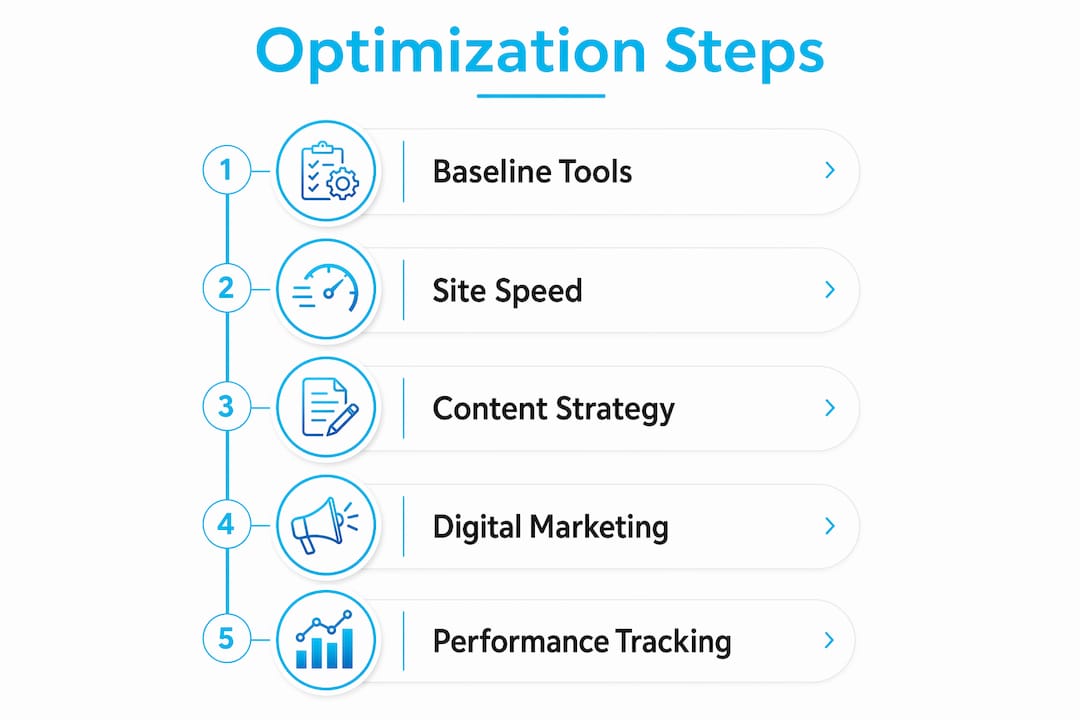
Custom-built sites outperform templates in speed and ranking potential because they carry no unnecessary code. Template-based platforms often load dozens of plugins and scripts that the site does not actually need. A hand-coded, lightweight site built for a St. Petersburg plumber or law firm will consistently score better on Core Web Vitals than a generic template loaded with visual builders.
Structured data, also called schema markup, tells Google exactly what your page is about. For local businesses, the most useful schema types are LocalBusiness, Service, and Review. Adding these does not require a developer if you use Google’s Structured Data Markup Helper, but a developer will implement them more accurately and completely.
Practical steps to improve technical SEO performance:
- Compress all images before uploading. Use WebP format instead of JPEG or PNG where possible.
- Enable browser caching so returning visitors load your site faster.
- Minify CSS and JavaScript files to reduce file size without changing functionality.
- Use HTTPS on every page. Google treats non-secure pages as a trust signal failure.
- Fix broken links flagged in Google Search Console. Each broken link wastes crawl budget.
Pro Tip: Run PageSpeed Insights on your three most important pages, not just the homepage. Service pages and contact pages often have worse scores than the homepage because they receive less attention.
Google rewards fast, mobile-optimized sites with higher rankings. Mobile-first design is not optional for St. Petersburg businesses targeting customers who search on their phones while walking down Central Avenue.
How to create content that converts local St. Petersburg customers
Content structure determines whether a visitor becomes a customer or bounces. The Answer-First Page Framework places the direct answer to a visitor’s question at the top of the page, before any background, history, or company story. This approach improves both ranking and conversion rates because it matches how people actually read web pages.
Here is how to apply the Answer-First framework to a St. Petersburg service business:
- Lead with the solution. The headline and first paragraph state what you do, who you serve, and where you operate. “St. Petersburg roof repair, same-day service” beats “Welcome to our family-owned roofing company.”
- Add a single, clear call to action above the fold. One button. One phone number. Visitors who see multiple competing options often choose none. Well-written calls to action directly increase the percentage of visitors who contact you.
- Create dedicated pages for each service. A general “Services” page with a list ranks for nothing. A page titled “AC Repair in St. Petersburg, FL” ranks for that specific search.
- Add location-specific content. Reference neighborhoods, landmarks, or local context. A page mentioning Kenwood, Pinellas Park, or the Grand Central District signals geographic relevance to Google.
- Layer in social proof. Place two or three customer testimonials near the call to action. Visitors convert better when landing pages close with one clear CTA supported by proof from real customers.
Regular blog posts, FAQs, and updated business info keep rankings fresh and improve engagement over time. A St. Petersburg HVAC company that publishes a monthly post on seasonal maintenance tips builds topical authority that compounds month after month.
Pro Tip: Structure your website for SEO by mapping one primary keyword to one page. Overlapping keywords across multiple pages splits ranking signals and confuses Google about which page to show.
What digital marketing strategies amplify your website’s reach?
A well-built website is the foundation, but digital marketing channels multiply its impact. The goal is to create a consistent presence across every platform where St. Petersburg customers search, review, and engage.
Off-page SEO signals including reviews, local listings, and backlinks directly influence how Google ranks your site. These signals tell Google that your business is legitimate, active, and trusted by real people.
Key integration strategies for St. Petersburg business owners:
- Google Business Profile: Keep hours, photos, and services updated weekly. Respond to every review, positive or negative, within 48 hours.
- Local listings management: Your NAP must match exactly across Google, Yelp, Apple Maps, and every industry directory. Consistent local listings prevent ranking penalties caused by conflicting information.
- Review management: Actively request reviews after every completed job or transaction. More recent reviews with higher ratings improve both local pack rankings and click-through rates.
- Social media signals: Active social profiles linked to your website reinforce your domain’s authority. Post content that drives traffic back to specific service pages.
Tracking performance is what separates businesses that improve from those that plateau. The table below shows the KPIs every St. Petersburg business owner should monitor monthly:
| KPI | What it tells you |
|---|---|
| Total impressions | How often your site appears in search results |
| Top queries | Which searches bring visitors to your site |
| Average position | Where you rank for your most important keywords |
| Review rating trend | Whether customer sentiment is improving |
| Conversion rate | What percentage of visitors take a desired action |
Monitoring total impressions, top queries, and review ratings guides ongoing content and SEO decisions. Without this data, you cannot know which pages to improve or which keywords to target next.
What are the most common website optimization mistakes to avoid?
Most St. Petersburg small business websites fail for the same handful of reasons. Recognizing these problems early saves months of lost traffic and revenue.
Inconsistent NAP information is the most damaging and most overlooked mistake. Consistent NAP across all platforms improves local search reliability and ranking. A single address formatted differently on Google versus your website can suppress your local pack ranking.
Common pitfalls and their fixes:
- Confusing site architecture: Visitors should reach any page within three clicks from the homepage. Bury a service page four levels deep and Google may not index it at all.
- Core Web Vitals failures: A Largest Contentful Paint score above 2.5 seconds signals a slow site. Fix it by compressing images, removing unused scripts, and switching to faster hosting.
- Mixed messaging: Each page should serve one audience with one goal. A page that tries to sell to homeowners and commercial contractors simultaneously converts neither.
- Missing or broken schema markup: Use Google’s Rich Results Test to confirm your structured data is valid. Invalid schema wastes the opportunity for rich search results.
“A website that confuses visitors does not just lose sales. It trains Google to rank it lower because high bounce rates signal poor user experience.”
The SEO tips for small businesses that move the needle fastest are almost always the simplest fixes: consistent NAP, clear page structure, and fast load times. Start there before pursuing advanced tactics.
Key Takeaways
Effective website optimization for St. Petersburg businesses requires fast load times, clear content structure, consistent local signals, and ongoing performance tracking to produce compounding results.
| Point | Details |
|---|---|
| Start with the right tools | Use Google Search Console and PageSpeed Insights before making any changes. |
| Speed drives rankings | Custom-built, lightweight sites consistently outperform template-based ones on Core Web Vitals. |
| Answer-First content converts | Lead every service page with a direct solution and one clear call to action. |
| NAP consistency is non-negotiable | Mismatched name, address, or phone data across platforms suppresses local rankings. |
| Track KPIs monthly | Monitor impressions, top queries, and review ratings to guide ongoing improvements. |
What I have learned optimizing St. Petersburg business websites
Most small business owners I work with underestimate how much a slow, template-heavy website costs them. They see a site that looks fine and assume it is working. The data tells a different story. A site that loads in four seconds on mobile loses a significant portion of visitors before the page even finishes rendering.
The businesses that see the fastest gains are the ones that commit to two things simultaneously: cleaning up the technical foundation and rewriting their content to lead with answers. Neither alone is enough. A fast site with vague content still ranks poorly. A beautifully written site on a slow server still loses visitors.
Local SEO in St. Petersburg is also more competitive than most owners expect. The local SEO case studies I find most instructive are the ones where a business doubled its organic traffic simply by creating dedicated pages for each service area and fixing its Google Business Profile. No paid ads. No complex campaigns. Just fundamentals done consistently.
My honest advice: if you can handle content updates yourself, do it. But leave the technical SEO, site architecture, and schema implementation to a professional. The cost of getting those wrong is far higher than the cost of getting help.
— Lori
How Netcodesign helps St. Petersburg businesses get found online
St. Petersburg small business owners who want real, measurable results from their websites do not need a generic template. They need a site built for speed, structured for local search, and connected to a marketing plan that compounds over time.

Netcodesign is a full-service digital marketing agency based in St. Petersburg, Florida. The team builds custom websites for small businesses that meet Core Web Vitals standards, rank on page one of Google, and convert visitors into customers. Services cover local SEO, content strategy, Google Business Profile management, pay-per-click campaigns, and reputation management. Every engagement includes transparent KPIs and ongoing performance reporting. If your website is not bringing in the customers your business deserves, Netcodesign is ready to show you exactly what needs to change.
FAQ
What does it mean to optimize a website for local search?
Local search optimization means tuning your site’s content, speed, and off-page signals so Google shows it to people searching in your geographic area. For St. Petersburg businesses, this includes location-specific service pages, consistent NAP data, and an active Google Business Profile.
How long does it take to see results from website optimization?
Technical fixes like speed improvements can show ranking changes within a few weeks. Content and local SEO improvements typically take three to six months to produce measurable traffic gains.
Why do Core Web Vitals matter for St. Petersburg businesses?
Core Web Vitals are Google’s official measure of page experience, covering load speed, interactivity, and visual stability. Sites that fail these standards rank lower than competitors who pass them, regardless of content quality.
Is a custom website better than a template for local SEO?
Custom-built sites carry less unnecessary code, which means faster load times and better Core Web Vitals scores. Hand-coded sites outperform templates in speed and ranking potential, especially in competitive local markets.
How often should a St. Petersburg business update its website content?
Google rewards sites that publish fresh, relevant content consistently. Updating service pages seasonally and publishing new blog posts or FAQs monthly keeps rankings active and signals to Google that the site is maintained.

