

table of contents
TL;DR:
- SEO training for marketing teams builds collective knowledge across roles to improve organic visibility and AI search outcomes. Role-specific, workflow-integrated sessions that focus on practical skills like technical basics, keyword research, AI search signals, data interpretation, and collaboration lead to measurable results. Continuous training, real asset exercises, and linking activities to business metrics ensure lasting impact and elevated search performance.
SEO training for marketing teams is defined as a structured program that builds search knowledge across content, brand, PR, and product roles so the entire team drives organic visibility, not just a single specialist. When you train your marketing team in SEO skills, you give every role a clear, repeatable way to contribute to search performance. The payoff is direct: teams with fully integrated SEO and AI search execution report improved traffic and leads at more than twice the rate of teams running separate workflows. Most in-house marketers do not need to become technical SEO experts. They need focused knowledge that makes their existing work more search-effective and discoverable by AI-driven engines.
What core SEO skills should marketing teams learn?
The goal of marketing team SEO education is not to produce a room full of technical specialists. It is to give each role the specific knowledge that sharpens their daily output. Most in-house staff need actionable insights, not deep technical fluency.
The skills worth prioritizing fall into five clear categories:
- Technical basics. Every marketer benefits from understanding page speed, mobile-first indexing, crawlability, and meta tags. You do not need to write code, but you do need to know when something is broken and why it matters.
- Keyword research and content relevance. Content writers and strategists must know how to match search intent, identify topic clusters, and use related terms naturally. Bridging brand positioning with entity signals is now critical for AI search visibility in 2026.
- AI search and brand positioning. AI-powered search engines surface brands based on entity recognition and consistent signals across the web. PR and brand teams need to understand how mentions, structured data, and authoritative content shape that visibility.
- Data interpretation. Reading Google Search Console, understanding click-through rates, and spotting traffic drops are skills every marketer can develop. The ability to act on data separates teams that grow from teams that guess.
- Collaboration and communication. Cross-department SEO collaboration across brand, content, PR, product, and development multiplies impact far beyond what a solo SEO practitioner can achieve. Teaching teams to share findings and flag opportunities is as valuable as any technical skill.
Pro Tip: Start with a skills audit. Ask each team member to rate their confidence in each category above. The gaps you find will shape your entire training plan.
How to create an effective, role-specific SEO training program
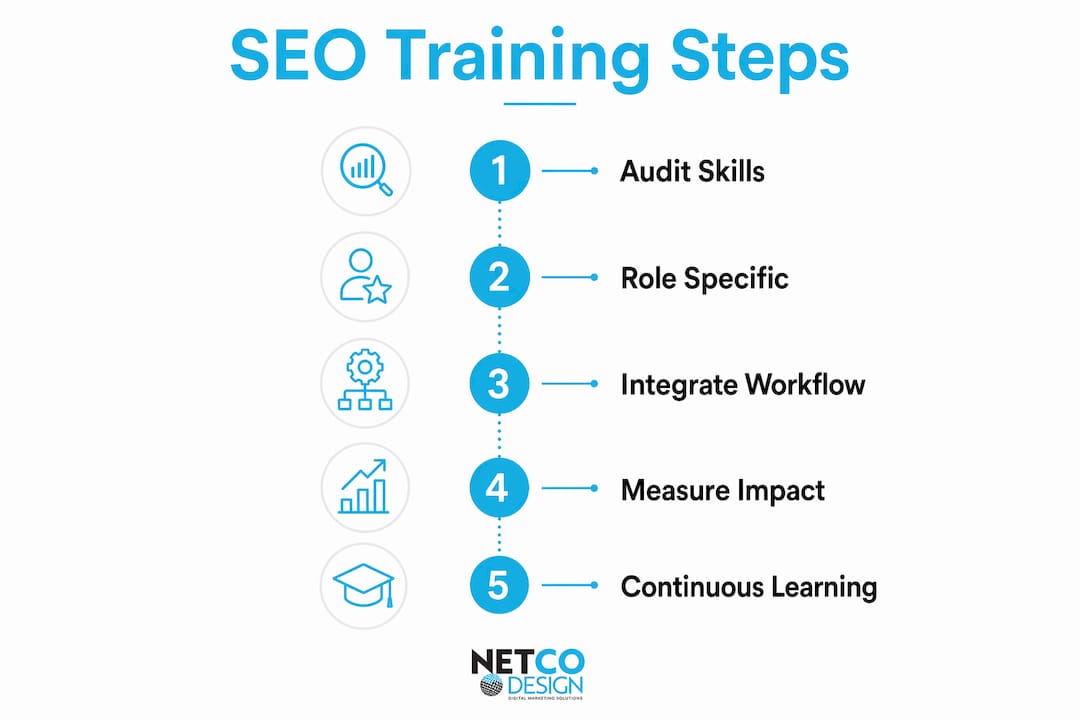
Generic SEO training sessions fail because they try to teach everything to everyone. Treating SEO training like marketing means targeting the right people with the right content, exactly as you would a customer campaign.
Here is a practical framework for building a program that sticks:
- Identify your SEO converts. Every team has two or three people who are already curious about search performance. Start with them. They will absorb training faster, apply it immediately, and become internal advocates who spread knowledge organically.
- Map training content to roles. A content writer needs keyword research and on-page optimization. A PR manager needs to understand link equity and brand mentions. A product marketer needs to grasp how feature pages rank and convert. Tailor each session to the problems that role actually faces.
- Use live assets, not hypotheticals. Effective SEO training programs use hands-on exercises on real marketing assets, not fictional case studies. Run a keyword gap analysis on your actual blog. Audit a real product page. The learning sticks because the stakes are real.
- Build standard operating procedures. Document every repeatable SEO task as a short SOP. A content brief template, a page audit checklist, and an internal linking guide give your team a reference they can use without asking for help every time.
- Set a training cadence. Monthly 60-minute sessions work better than a single all-day workshop. Short, frequent sessions let team members apply what they learned before the next session, which reinforces retention and surfaces real questions.
Pro Tip: Record every training session and store it in a shared folder. New hires can onboard themselves, and existing team members can revisit sessions when they face a specific challenge.
How to integrate SEO tasks into your team’s regular workflow
Training without workflow integration produces knowledge that never gets used. The fix is a 120-minute weekly SEO workflow built around one high-potential page, one target query, and one specific on-page element. That constraint forces prioritization and prevents the unfocused effort that wastes time on low-impact tasks.
Here is how to build that routine across your team:
- Assign weekly page owners. Each week, one team member owns a single page. They check its ranking, review its content against search intent, and make one improvement. Rotating ownership builds skills across the team without overloading anyone.
- Run a quick-wins audit monthly. Identify pages ranking in positions 8–15 for a target keyword. These pages need a title tag update, a stronger introduction, or a few added internal links. Quick wins produce visible results fast, which builds team confidence.
- Add SEO checkpoints to existing workflows. Before any content goes live, a two-minute checklist covers title tag, meta description, heading structure, and internal links. This takes seconds and prevents the most common on-page errors.
- Share AI and traditional SEO tasks. AI tools can prioritize queries, suggest internal linking, and generate technical briefs efficiently. Assign AI-assisted tasks to team members who are less technical. It reduces friction and keeps everyone contributing.
- Hold a 15-minute weekly SEO standup. One person shares one finding: a ranking change, a traffic drop, or a content opportunity. This keeps SEO visible in the team’s daily rhythm without consuming meeting time.
Pro Tip: Pin your SEO workflow checklist inside your team’s project management tool. When SEO tasks live next to design and copy tasks, they get done. When they live in a separate document, they get skipped.
Connecting your workflow to a clear content strategy for AI search makes each weekly session more purposeful and aligned with how search engines now surface results.
How to measure and demonstrate SEO training impact
Measurement is where most SEO training programs fall short. Only 22% of marketing teams have fully integrated AI search and SEO across strategy, execution, and reporting. That gap means most teams cannot connect training investment to business outcomes. You can close it with a clear measurement framework.
Start with these core metrics:
- Organic traffic by page. Track whether the pages your team optimizes gain impressions and clicks over a 60-day window. This ties individual training exercises to real results.
- Keyword ranking movement. Monitor the positions of target keywords before and after training-driven changes. Movement in positions 8–15 is the fastest signal that the work is having an effect.
- Conversion rate on optimized pages. Traffic growth without conversion improvement is incomplete. Tie SEO work to leads, form fills, or purchases to make the business case to leadership.
- AI search visibility. Track whether your brand appears in AI-generated answers for key queries. This is a newer metric, but 49% of teams report that measuring AI impact on revenue is their top challenge. Starting now puts you ahead.
- Team activity metrics. Log how many pages each team member optimizes per month. Activity metrics hold the team accountable and show managers where training is being applied versus ignored.
Present these metrics in a monthly one-page report to leadership. Connecting SEO activity to revenue and visibility gives the training program credibility and secures ongoing support.
Common pitfalls to avoid in SEO training
Most SEO training programs fail for predictable reasons. Knowing them in advance lets you design around them.
- Overloading with technical jargon. Sessions that open with crawl budgets and canonical tags lose non-technical marketers immediately. Lead with the business outcome, then explain the technical mechanism behind it.
- Ignoring role relevance. A PR manager sitting through a session on schema markup will disengage within ten minutes. Every session must answer the question: “What does this mean for my specific job?”
- Siloed SEO efforts. When only one person on the team applies SEO knowledge, the program has failed. The goal is company-wide search visibility, not a single expert doing all the work.
- Skipping AI search trends. Training that ignores AI-driven search engines is already outdated. Teams need to understand how entity signals, structured content, and brand consistency affect visibility in tools like Perplexity and Google’s AI Overviews.
- No accountability loop. Training without follow-up measurement produces no lasting change. Set a 30-day check-in after every session to review what was applied and what was not.
“SEO training should empower various teams with specific, actionable data rather than trying to make every marketer an SEO specialist. The teams that win are the ones where every role contributes to search visibility in a way that fits their existing work.”
Key Takeaways
Effective SEO training for marketing teams works when it is role-specific, workflow-integrated, and tied to measurable business outcomes rather than delivered as a one-time technical lecture.
| Point | Details |
|---|---|
| Role-specific training wins | Tailor each session to the actual tasks and challenges of each marketing role. |
| Workflow integration is non-negotiable | Embed SEO checkpoints into existing content and campaign processes to build lasting habits. |
| Measure activity and outcomes | Track page-level traffic, ranking movement, and conversions to prove training impact. |
| AI search requires new skills | Teams must understand entity signals and brand consistency to appear in AI-generated results. |
| Start with SEO converts | Identify curious early adopters first; they accelerate knowledge transfer across the team. |
What I’ve learned about SEO training that most guides won’t tell you
The biggest mistake I see marketing managers make is treating SEO training as a one-time event. They book a workshop, bring in an expert, and expect the team to change how they work. It never sticks that way. SEO knowledge only becomes useful when it gets repeated, applied, and corrected in real work.
The second thing I have learned is that the best SEO training programs look nothing like SEO training. They look like good marketing practice. When you teach a content writer to match search intent, you are also teaching them to write for a real audience. When you teach a PR manager about link equity, you are reinforcing the value of authoritative placements. The skills overlap more than most people realize.
Cross-department collaboration is the multiplier that most teams underestimate. When your brand, content, and product teams share a common vocabulary around search visibility, the whole organization starts producing content that ranks. That does not happen from a single training session. It happens from consistent, short, role-specific conversations over months.
My honest advice: pick two or three people who are already curious, give them a clear workflow, and let them show the rest of the team what is possible. Results are the best training tool you have. Pair that approach with a solid SEO strategy and you will see compounding gains that no one-day workshop can match.
— Lori Piencykoski
Netco Design’s SEO training resources for your team
Marketing managers who want to build real SEO capability in their teams need more than a reading list. They need current, practical guidance tied to how search actually works in 2026.

Netco Design publishes in-depth resources on 2026 SEO digital marketing trends that marketing teams can use directly in training sessions. The guides cover AI search integration, content strategy, and the technical fundamentals that non-specialist marketers need most. Netco Design also offers customized training programs for in-house teams, built around your specific roles, tools, and business goals. If your team is ready to move from scattered SEO efforts to a consistent, measurable program, Netco Design’s SEO services for small businesses provide the structure and expertise to get there.
FAQ
What is the fastest way to start SEO training for a marketing team?
Identify two or three team members who are already curious about search performance and start with them. Run a live audit on a real page rather than a hypothetical exercise to build skills that transfer immediately.
How often should marketing teams receive SEO training?
Monthly 60-minute sessions outperform single all-day workshops. Short, frequent sessions give team members time to apply what they learned and return with real questions.
Do all marketing team members need the same SEO skills?
No. Content writers need keyword research and on-page skills, PR managers need to understand link equity, and brand teams need to grasp entity signals. Role-specific training produces higher retention and better results than generic sessions.
How do you measure whether SEO training is working?
Track organic traffic, keyword ranking movement, and conversion rates on pages the team has optimized. Set a 30-day review after each training session to confirm the skills are being applied.
How does AI search change what marketing teams need to learn?
AI-driven search engines surface brands based on entity recognition and consistent signals across the web. Teams now need to understand how brand mentions, structured content, and authoritative coverage affect their visibility in AI-generated answers.

