

table of contents
Trying to rank on Google without sorting out your technical SEO is like trying to race a car with flat tires. You might have amazing content and a trunk full of powerful backlinks, but if your site is slow, broken, or just plain confusing for search engines, you’re not going anywhere fast.
This isn’t just about pleasing the Google bots, either. It’s about creating a smooth, frustration-free experience for your actual visitors. A page that takes forever to load is an instant turn-off. And with over 60% of searches now happening on phones, a site that isn’t mobile-friendly might as well be invisible.
Build a Strong Foundation for Google Rankings
Before you can fix anything, you have to know what’s broken. This is where a proper website audit comes in. Think of it as a diagnostic check-up for your site, shining a light on all the hidden technical glitches holding you back.
This process is a deep dive into your site’s overall health, checking for errors that hurt both your users’ experience and Google’s ability to understand what you’re all about. A great place to start is this ultimate 8-point website auditing checklist, which gives you a practical framework for spotting the big issues first.
An audit will almost always uncover a few common culprits:
- Slow Page Speed: How fast your pages load is a known ranking factor. Every single second counts.
- Mobile Usability Issues: Is your site easy to navigate on a small screen? Think font sizes, button spacing, and responsive design.
- Broken Links (404 Errors): These dead ends are frustrating for users and a waste of Google’s crawl budget.
- Crawlability & Indexability Problems: These are the roadblocks that stop Google from finding your pages or adding them to search results in the first place.
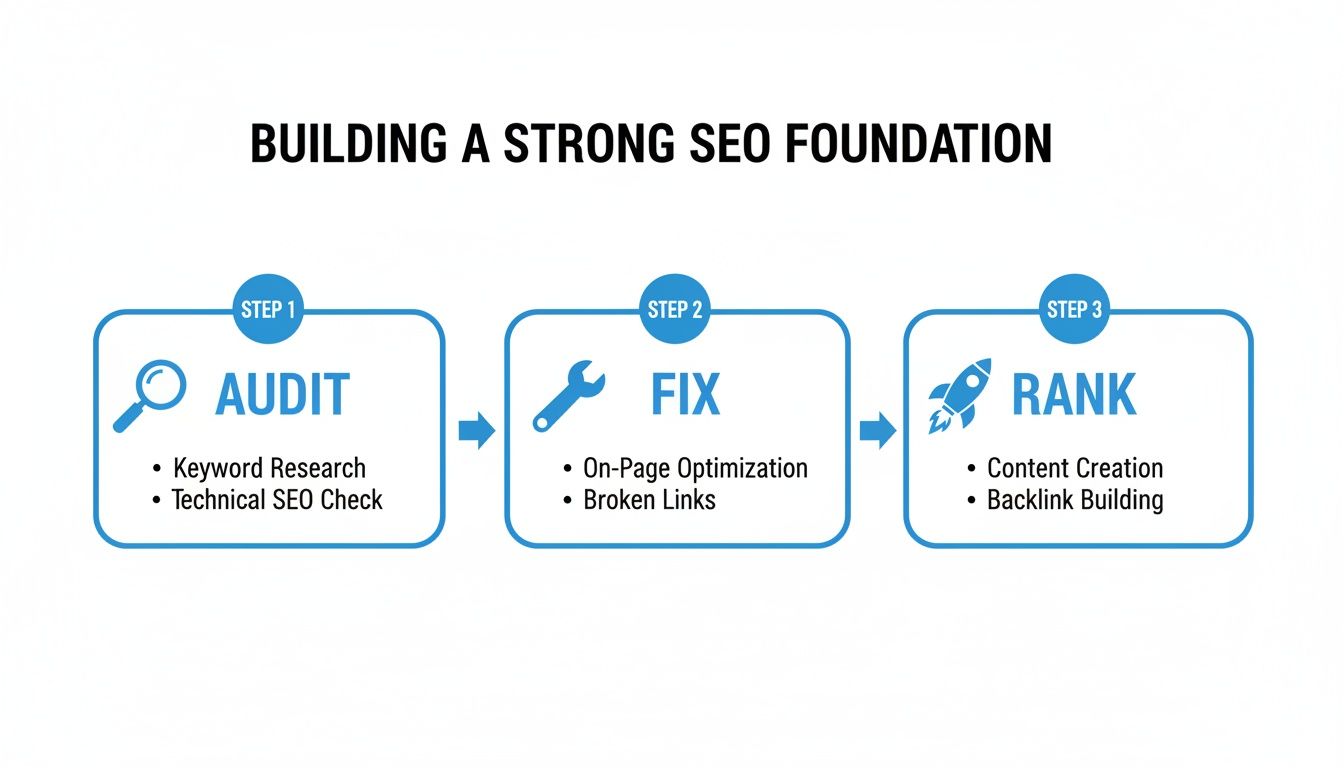
This simple model—Audit, Fix, Rank—is incredibly powerful. It shows that real ranking improvements come from a systematic approach, not random tactics.
Prioritize High-Impact Technical Fixes
Once your audit is done, you’ll probably have a laundry list of things to fix. Don’t panic. The trick is to focus on what will actually move the needle.
For most small businesses I’ve worked with, the top priorities are almost always page speed and mobile-friendliness. Nail these two, and you’re already ahead of the game. They directly impact user experience, which is something Google cares about immensely. A fast, mobile-ready site doesn’t just help with rankings; it helps convert visitors into customers.
A great user experience is the cornerstone of sustainable SEO. When you make your website better for people, you inherently make it better for Google. Fixing technical issues is the first and most critical step in that process.
Another crucial piece of the puzzle is your site’s structure. It needs to be logical. A clear navigation menu and smart internal linking help Google understand how your content is connected and which pages are the most important. For a more detailed walkthrough, our guide on how to perform a technical SEO audit provides a clear, step-by-step process.
By building this solid, error-free foundation, you’re setting the stage for all your future content and link-building efforts to truly pay off.
Create Content That Dominates Search Results
If a solid technical foundation is the chassis of your SEO vehicle, then high-quality content is the engine. It’s what actually drives you up the search results. Just publishing blog posts isn’t going to cut it anymore. To really move the needle, you need to create content so comprehensive and helpful that it becomes the definitive answer for the questions your customers are asking.
This means you have to stop thinking about single keywords and start embracing topical coverage. Instead of writing one article on “small business accounting,” you build a central, in-depth pillar page. Then, you surround it with smaller, focused articles covering things like “choosing accounting software,” “quarterly tax tips,” or “understanding profit margins.”

This “hub and spoke” approach signals deep expertise to Google, making you a far more trustworthy source. The data backs this up completely. One massive study found that pages in the top 10 positions covered about 74% of all relevant subtopics, while pages languishing at the bottom covered only 50%. Google rewards depth because it signals true authority.
Identify and Fill Critical Content Gaps
The smartest way to make your content more valuable is to figure out what your competitors missed. This is called a content gap analysis. It involves digging into the top-ranking pages for your target keywords and pinpointing the questions they failed to answer or the topics they just glossed over.
Let’s say you’re a local plumber. The top articles for “leaky faucet repair” only show simple fixes. That’s your opening. You can create a much better guide that includes:
- A section on identifying the type of faucet first.
- A tool checklist with images for beginners.
- An embedded video walking through the process.
- A quick guide on when to call a pro versus doing it yourself.
By filling these gaps, you create a resource that is objectively more useful. You’re not just creating another piece of content; you’re creating the best piece of content, giving Google a very compelling reason to rank you higher.
The goal isn’t just to be a little better. It’s to be so much better that you become the only logical choice for Google to show its users. Answer every possible question and solve every problem your competitors overlooked.
Master On-Page SEO for Maximum Impact
Once you have a content plan, you need to handle the on-page details that help Google understand what your content is about and why it’s important. These small tweaks can make a huge difference.
Start with your title tag and meta description. These are the first things people see in the search results. Your title needs to be compelling and include your main keyword, while the meta description should act like a mini-advertisement that makes people want to click.
Next, give your content a logical structure with headings (H2s, H3s). This makes your articles easy for people to scan and helps search engines understand the information hierarchy. A well-organized article will almost always outperform a giant wall of text.
Finally, don’t forget internal linking. When you publish a new article, link back to older, relevant posts on your site. This simple action spreads authority (or “link equity”) around your website and helps Google discover all your great content. Planning this requires consistency, which is why checking out a guide on how to create a content calendar can keep you on track. By weaving your content together, you build a powerful web of information that reinforces your expertise.
Earn Backlinks That Build Real Authority
Think of the internet like a giant conversation. When a reputable site links to your page, it’s like someone respected citing your work. These links, called backlinks, are basically votes of confidence that tell Google your content is the real deal—trustworthy and authoritative.
It wasn’t always this way. A decade ago, you could game the system by collecting thousands of cheap, spammy links. Try that today, and you’re asking for a Google penalty. The game is no longer about quantity; it’s all about the quality, relevance, and authority of the sites sending links your way.

Backlinks remain one of the most powerful signals Google uses for ranking. The data doesn’t lie: sites with a healthy mix of high-authority backlinks (from domains with a DA of 50+) tend to rank an average of 3.5x higher for competitive keywords. And ever since Google’s Penguin update cracked down on shady link schemes, we’ve seen sites with clean link profiles get traffic boosts of 20-40% after major algorithm updates.
Start with Foundational Link Building
For a growing business, link building can feel overwhelming. Don’t let it be. You can start with a few accessible, high-impact strategies that create a solid base to build on.
A great first step is getting listed in respected local and industry directories. Go beyond the obvious ones like Yelp. Think about your local Chamber of Commerce, professional associations, and niche business listings. These not only provide a good link but also signal your local relevance to Google, which is a massive win for local SEO.
Another classic move is guest posting. You write a helpful article for another website in your niche, and in return, you get a backlink and exposure to their audience. The key is to be selective. Target relevant, well-regarded blogs, not content farms that will publish anything.
A single, relevant backlink from a highly respected industry blog is worth more than a hundred low-quality links from irrelevant directories. Focus your energy on building relationships and providing genuine value, and authoritative links will follow.
Create Content That Naturally Attracts Links
The best, most sustainable way to earn backlinks is to create content that people want to link to. This is what we call creating “linkable assets.” Instead of chasing links, you build something so valuable that other websites naturally want to cite it.
So what does that look like? Here are a few ideas that consistently work:
- Original Data & Research: Survey your customers or analyze some industry data to uncover a unique insight. People love to cite fresh statistics.
- Comprehensive “Ultimate” Guides: Become the go-to resource on a key topic in your field by creating the most detailed, practical guide available.
- Free Tools or Templates: Build a simple calculator, a handy checklist, or a downloadable template that solves a real problem for your audience.
- Compelling Infographics: Turn complex information into a beautiful, shareable graphic that’s easy for other sites to embed.
This approach takes more work upfront, but the payoff is huge and compounds over time. You’re not just building a link; you’re building your reputation. If you’re looking for a deeper dive, our guide on how to build links covers both foundational and more advanced techniques.
Conduct a Basic Backlink Audit
Earning good links is only half the battle. You also need to keep an eye out for bad ones. A toxic backlink from a spammy, irrelevant, or low-quality site can actively hurt your rankings. That’s why a periodic backlink audit is essential website maintenance.
Using a tool like Ahrefs, Semrush, or even the free reports in Google Search Console, you can see every site that links to you. Look for red flags: sites in foreign languages, pages with completely unrelated topics, or sketchy-looking directories.
When you find these toxic links, your first move should be to contact the site owner and ask them to remove it. If they don’t respond, Google has a Disavow Tool that lets you tell them to ignore those specific links when evaluating your site. This simple clean-up can often lead to a surprising bump in your rankings.
Improve User Experience To Boost Your Rankings
Google’s main job is to give people the best possible answer to their questions. A huge part of “best” isn’t just the information itself—it’s about how that information is presented. This is where user experience (UX) comes in.
If your website is confusing, slow, or just plain frustrating to use, visitors will leave, and Google will notice. These aren’t just vanity metrics; engagement signals like how long someone stays on your page tell Google if your content actually satisfied their search. A great user experience keeps people on your site longer, which directly helps your rankings.
Make Your Website Effortless to Navigate
Imagine walking into a grocery store where the aisles aren’t labeled and products are scattered everywhere. You’d probably just leave. Your website’s navigation works the same way. It needs to be so intuitive that visitors can find what they need without even thinking about it.
A logical site structure, with clear menus and categories, acts as a roadmap for both users and search engines. Your main services or product categories should be immediately visible from the homepage. A good rule of thumb is the “three-click rule”—a visitor should be able to find any important information on your site within three clicks.
Craft a Compelling First Impression
When someone lands on your page from a search result, you have just a few seconds to convince them they’re in the right place. If they immediately feel overwhelmed or can’t find the answer they were promised, they will smash that back button.
This is often called “pogo-sticking”—bouncing back and forth between search results and websites. This behavior sends a strong negative signal to Google, basically telling it your page wasn’t a good match for the search. The fix? Deliver on the promise of your title tag and meta description right away.
Your goal is to eliminate any reason for a user to return to the search results. Lead with a clear answer, use compelling headings, and make sure the page loads instantly. A positive first impression is the key to reducing that bounce-back.
One of the biggest red flags here is a high bounce rate. If you’re seeing big numbers, it’s a clear sign your landing pages aren’t meeting user expectations. For some practical strategies on this, you can learn how to reduce your website bounce rate in our detailed guide.
Design Content for Skimming
Let’s be honest: people rarely read web pages word-for-word. They scan for key information. Your content formatting has to cater to this behavior. If your blog post is a giant wall of text, you’re making it incredibly difficult for visitors to get any value from it.
Breaking up your content makes it far more digestible and easy to skim. A few simple changes can make a massive difference in how people engage with your pages.
- Use Short Paragraphs: Keep paragraphs to 1-3 sentences max. This creates white space and makes the text less intimidating.
- Write Descriptive Subheadings: Use H2s and H3s to guide readers through the content. A good subheading tells someone exactly what they’ll learn in that section.
- Incorporate Bullet Points: Lists are perfect for breaking down complex ideas or highlighting key takeaways, just like this one.
- Add Relevant Visuals: Use images, screenshots, or charts to illustrate your points and provide visual breaks from the text.
When you structure your content for scanners, you help people find answers faster. This increases their time on your page and signals to Google that your content is well-organized and valuable—a crucial step for improving your website’s ranking over the long haul.
Dominate Local Search With Google Business Profile
For any business that serves a specific area—a bakery in Tampa, a plumber in St. Petersburg—showing up in local search isn’t just important; it’s everything. When someone searches for “best coffee near me,” you absolutely have to be the first name they see. This is where mastering your Google Business Profile (GBP) becomes a non-negotiable part of your SEO game plan.
Think of your GBP listing as your digital storefront. It’s often the very first interaction a potential customer has with your brand. A finely tuned profile can land you in the coveted “Map Pack,” that block of three local businesses sitting right at the top of the search results. Landing there is like hitting the visibility jackpot.
Claim and Fully Optimize Your Profile
The first step is a simple one: claim your business listing if you haven’t already. But that’s just the starting line. The real work comes from treating your profile not as a static page, but as a living, breathing extension of your business.
This means you need to dive deep into every single section and fill it out completely. A thorough profile tells Google you’re an active, legitimate business worthy of a high ranking.
Start with the essentials:
- Business Categories: Get specific. Don’t just settle for “Restaurant”; choose “Italian Restaurant” or “Seafood Restaurant.” You can select a primary category and then add secondary ones to cover all your offerings.
- High-Quality Photos: Don’t skimp here. Upload clear, professional photos of your storefront, your products, your team in action, and even happy customers. Profiles with photos get 42% more requests for driving directions and 35% more clicks to their websites. It’s a no-brainer.
- Accurate Hours & Services: Always keep your hours updated, especially for holidays. Use the “Services” or “Products” section to list out exactly what you do.
The Power of NAP Consistency
One of the most critical, yet often overlooked, factors in local SEO is NAP (Name, Address, Phone Number) consistency. Google acts like a detective, cross-referencing your business info across various online directories like Yelp, Yellow Pages, and industry-specific sites to verify you are who you say you are.
If your GBP says “Smith Plumbing Inc.” but another directory lists you as “Smith Plumbing Co.,” that tiny difference creates confusion. It plants a seed of doubt for search engines, which can drag your rankings down.
Think of NAP consistency as building a web of trust. Every time Google finds your exact Name, Address, and Phone number listed correctly on a reputable site, it’s another vote of confidence that reinforces your local authority and helps you climb the rankings.
To get started, just Google your business and see what pops up. Jot down any directories with outdated or incorrect information and start the process of updating them. This simple housekeeping can pay huge dividends for your local search performance. For a complete walkthrough, our guide on how to optimize your Google Business Profile covers these foundational steps in greater detail.
Encourage and Engage with Customer Reviews
Reviews are the lifeblood of any local business profile. A steady stream of positive reviews is one of the most powerful signals to Google that you deserve a spot in the local Map Pack. Google wants to recommend businesses that people trust, and reviews are the ultimate form of social proof.
You have to be proactive here. Actively encourage your happy customers to leave a review. You can do this with a simple follow-up email, a QR code at your checkout counter, or a link on your website. The key is to make it dead simple for them.
Just as important is how you respond to those reviews—both the good and the bad. Responding to positive reviews shows you appreciate your customers. Responding professionally to the negative ones shows you care about customer service and are willing to make things right. To truly nail local search, you need to understand the nuances of managing reviews on your Google Business Profile, as this will help you navigate this critical process.
Answering Your Top SEO Questions
Digging into SEO can feel like opening a can of worms—the more you learn, the more questions you have. It’s easy to get lost in a sea of conflicting advice when all you want to do is improve your Google ranking.
Let’s clear the air. We’ll tackle some of the most common questions we hear from business owners and give you the straightforward answers you need to set realistic expectations.
How Long Does It Really Take to See SEO Results?
This is the million-dollar question, and the honest-to-goodness answer is: it depends. SEO is a marathon, not a sprint. The results build on themselves, but they don’t happen overnight.
For keywords with lower competition, you might start seeing some real movement in the search results within 3 to 6 months. This isn’t usually a jump to the #1 spot, but it could mean climbing from page five to page two, which is a huge win.
But for the highly competitive terms—the ones your rivals are all fighting for—breaking onto the first page can easily take 6 to 12 months, sometimes longer. Your starting point matters, too. A brand-new website has a much steeper hill to climb than an established site with some history and authority. The key is consistency; your efforts compound over time.
What Is More Important: Content or Backlinks?
That’s like asking if a car needs an engine or fuel more. You absolutely need both to get anywhere. They’re two sides of the same coin, and focusing on one while ignoring the other is a recipe for stalled progress.
- High-quality content is your foundation. It’s the “why”—the reason Google should rank you and the value you provide to your audience.
- Quality backlinks are the “how.” They act as votes of confidence, signaling to Google that other reputable sites trust what you have to say. This is how you build authority.
A winning strategy is creating truly valuable content that people want to share, then proactively building links to it to speed up the process.
Think of it this way: great content is your product, and backlinks are the marketing that gets it in front of the right people. One without the other is simply ineffective.
Can I Do SEO Myself, or Should I Hire An Agency?
You can absolutely get your hands dirty with some DIY SEO. If you’re running a new business or have a tight budget, mastering the fundamentals laid out in this guide is a fantastic place to start.
Simple actions, like fully optimizing your Google Business Profile and writing genuinely helpful blog posts, can move the needle in a big way.
But as your business grows or if you’re in a cutthroat market, partnering with an agency can give you the specialized expertise needed to get to the next level. An agency brings advanced strategies, expensive tools, and dedicated time to the table, which frees you up to focus on running your business. The right choice really comes down to your resources, your goals, and just how tough your industry’s digital landscape is.
At Netco Design LLC, we build the strategies that turn search engine visibility into real business growth. Our team specializes in creating custom SEO roadmaps that drive qualified traffic and convert visitors into loyal customers. If you’re ready to improve your website ranking on Google with a plan that delivers results, let’s talk about your project.

