

table of contents
The great in house marketing vs agency debate really boils down to one question: are you optimizing for control or for expertise?
An in-house team gives you unmatched brand immersion and direct, day-to-day control. On the flip side, an agency offers immediate access to a deep bench of seasoned specialists. The right path for you hinges entirely on your company’s budget, how fast you need to move, and your long-term vision.
The Foundations Of Your Marketing Structure
Choosing between building an internal marketing department and hiring an external agency is one of those foundational decisions that will shape how your business grows. This isn’t just about operations; it’s a choice that directly impacts your budget, your brand voice, and how quickly you can pivot in a changing market.
Let’s break down the fundamentals of each model so you can make a call that truly aligns with where your business is headed.
An in-house team is exactly what it sounds like—employees who are 100% dedicated to your company. They live and breathe your brand, your culture, and your products every single day. That deep integration is incredible for maintaining brand consistency and allows you to shift priorities on a dime. But building that team is a serious investment in salaries, benefits, training, and a whole suite of marketing tools.
A marketing agency, in contrast, acts as an external partner. They bring a ton of experience from working with all sorts of clients across different industries. You get instant access to a full team of specialists—from technical SEO pros to paid media wizards—without the overhead of full-time hires. For small businesses just getting started, an agency can be a powerful launchpad; our small business SEO guide offers more context on the kinds of strategies they can execute right away.
This isn’t just about who does the work. It’s about choosing an operating model that best supports your growth—whether that requires the deep focus of an internal team or the broad expertise of an agency partner.
In-House Team vs Marketing Agency At a Glance
To make this initial comparison a bit easier, let’s lay out a high-level overview. Here’s how each model stacks up across key business factors, helping you quickly see which structure might be a better fit for your current priorities.
In-House Team:
- Cost Structure: High fixed costs (salaries, benefits)
- Expertise: Deep but narrow; limited by hires
- Control: Full and direct control over priorities
- Speed to Launch: Slower; requires hiring and onboarding
- Scalability: Difficult to scale up or down quickly
- Brand Knowledge: Deeply integrated and consistent
Marketing Agency:
- Cost Structure: Predictable variable costs (retainers)
- Expertise: Broad and diverse; immediate access
- Control: Less direct control; managed via contract
- Speed to Launch: Faster; ready to execute immediately
- Scalability: Flexible and easy to adjust resources
- Brand Knowledge: Requires significant onboarding
Think of this as your starting point. Now we can dig into the specifics of what these differences mean for your costs, skills, and strategic direction.
A Practical Guide to Marketing Costs
When you’re weighing an in-house team against a marketing agency, it’s easy to get the math wrong. A quick glance might suggest that a marketer’s salary is cheaper than an agency’s monthly retainer, but that comparison is dangerously incomplete. It misses all the hidden costs that come with an internal team, leading to some nasty budget surprises down the road.
To make a smart decision, you have to look beyond the salary and calculate the fully loaded cost of an employee. This gives you a much clearer picture of your actual investment.

Unpacking the Total Cost of an In-House Team
The number on the offer letter is just the starting point. The true cost of an employee includes a stack of additional expenses that can tack on another 25% to 40% to their base salary.
Let’s say you hire a marketing manager with a $90,000 salary. Once you factor in all the necessary overhead, your real annual cost is closer to $121,500.
These aren’t optional perks; they’re essential costs that fall into a few key buckets:
- Benefits and Payroll Taxes: Expect this to add 15-25%. It covers essentials like health insurance, retirement contributions, and legally required taxes.
- Software and Tools: A modern marketing team needs a tech stack for analytics, SEO, social media, and email campaigns. That can easily run $5,000 to $15,000 a year.
- Training and Development: The marketing world moves fast. You’ll need to invest in courses, conferences, and certifications to keep your team’s skills sharp.
- Overhead and Equipment: This covers everything from laptops and software licenses to office space and general administrative support.
The real financial commitment for an in-house team isn’t the salary—it’s the entire ecosystem of support, tools, and benefits required to make that hire effective. Factoring this in is critical for an accurate comparison.
Understanding Agency Pricing Models
Agencies flip the financial script. Instead of adding fixed payroll costs, you get a predictable operational expense, which offers a lot more flexibility, especially for a growing business.
Agency pricing isn’t one-size-fits-all. It usually comes in one of three flavors:
- Monthly Retainer: This is the most common model. You pay a fixed fee each month for an agreed-upon scope of services. It’s great for predictable budgeting and ongoing support.
- Project-Based Fees: Need a website redesign or a specific campaign launch? You pay a flat fee for the entire project. This is perfect for businesses with well-defined, short-term goals.
- Performance-Based Incentives: Some agencies will tie a portion of their fees to hitting specific KPIs, like lead generation or revenue growth. This model directly aligns the agency’s success with your bottom line.
How Financial Efficiency Evolves with Scale
The right choice really depends on where your business is today and where it’s headed. What makes sense for a startup is often inefficient for a mid-sized company.
For early-stage companies, an agency is almost always the more cost-effective route. A single retainer gives you access to an entire team of specialists—a writer, a strategist, an SEO expert, a designer—for less than the fully loaded cost of one senior hire. It’s a big reason why so many new businesses lean on the digital marketing strategies for startups that agencies can deploy right away.
As your company grows, the math starts to change. Once your marketing needs stabilize and you require a large, dedicated team, the cost of multiple agency retainers can eventually outgrow the expense of building your own department. At that point, a hybrid model often becomes the smartest move, letting you bring core functions in-house while keeping agency partners for specialized projects.
Comparing Expertise and Skill Access
When you compare the expertise of an in-house team versus an agency, it’s not a question of who’s smarter. It’s a classic case of depth versus breadth.
An in-house marketer will develop a profound, almost instinctual understanding of your product, your customers, and your company culture. Their knowledge becomes incredibly deep but is naturally focused on the world inside your walls.
An agency, on the other hand, gives you immediate access to a whole roster of specialists. You aren’t just hiring a marketer; you’re tapping a team of pros in SEO, content strategy, graphic design, and data analytics. This is a massive advantage when you need high-level skills in several areas but can’t justify hiring multiple full-time experts.
The Challenge of Building a Specialist In-House Team
Let’s be honest: hiring a single “marketing unicorn” who excels at everything from technical SEO to video editing is a fantasy. Building a truly capable internal team means recruiting for several distinct, highly specialized roles.
For most small and mid-sized businesses, this presents a few major hurdles:
- High Cost: Hiring individual experts for SEO, PPC, and content can easily push your fully loaded payroll costs past $300,000 a year.
- Recruiting Difficulty: Finding and attracting top-tier talent for niche roles is fiercely competitive and can drag on for months.
- Ongoing Training: Marketing moves fast. Keeping an in-house team’s skills sharp requires a continuous investment in training, certifications, and conferences.
For many companies, the sheer logistics and expense make building out a comprehensive internal team a non-starter. This is often the exact point where the in house marketing vs agency debate gets settled.
An in-house team’s strength is its deep, focused knowledge of your brand. An agency’s power lies in its broad, multi-disciplinary expertise that can be deployed instantly without the overhead of hiring.
Gaining a Competitive Edge with Agency Experience
One of the most underrated benefits of working with an agency is tapping into their cross-industry knowledge. An agency team works with a diverse portfolio of clients, constantly testing strategies, tools, and tactics across different markets.
This exposure gives you two key advantages that an internally focused team might miss:
- Innovation and Fresh Perspectives: Agencies see what works—and what doesn’t—in sectors completely outside your own. They can bring fresh, battle-tested ideas to your campaigns that your competitors haven’t even thought of.
- Valuable Market Benchmarks: An agency provides crucial context. They can tell you if your click-through rates are average, your cost-per-lead is too high, or your organic growth is crushing industry standards.
This external perspective helps you avoid the echo chamber that can form inside a company, ensuring your strategy stays sharp and competitive.
Accessing Niche Skills On Demand
Some marketing disciplines are so specialized that hiring a full-time employee just doesn’t make financial sense. Think about a complex technical SEO audit or a highly targeted programmatic ad campaign. These projects require deep, specific expertise but might only be needed once or twice a year.
An agency gives you on-demand access to these niche skill sets without the long-term commitment. This is especially true for things like managing a sophisticated PPC campaign, where small mistakes get very expensive, very fast. You can see the level of detail required for success in our guide on PPC management for small business.
This model allows you to tap into top-tier expertise precisely when you need it. Industry data backs this up. A recent HubSpot report found that 64% of companies believe working with an agency provides better access to specialized skills than keeping it all in-house. This is particularly true for businesses needing advanced skills in analytics, SEO, and creative production that are just beyond their internal capabilities. You can find more on this at f22labs.com.
Evaluating Control, Speed, and Scalability
When you’re weighing an in-house team against a marketing agency, the conversation always comes back to control, speed, and the ability to grow. These aren’t just operational buzzwords. They directly impact how fast you can jump on market opportunities and react to what competitors are doing. Your choice here really defines how nimble your marketing can be.
An in-house team gives you absolute control. Your marketers are in the same meetings, breathing the same air, and absorbing the same company culture as everyone else. This deep integration means you have immediate command over their priorities. You can pivot on a dime without having to draft a new scope of work.

The In-House Pace and Its Limitations
While having direct control feels great, it doesn’t automatically mean things happen faster. An in-house team’s speed is often capped by their current workload and existing skills. If you want to launch a big new initiative, it might mean pulling people off other critical projects, creating internal traffic jams and slowing everything down.
Scalability is another huge hurdle for purely in-house teams. Think about these common situations:
- Scaling Up: You decide to double your ad spend or break into a new social media channel. Does your team actually have the bandwidth or the right expertise? Finding, hiring, and training new specialists can take months, putting your growth plans on hold.
- Scaling Down: If you hit a slow season or need to tighten the budget, you can’t just shrink your team. You’re stuck with fixed payroll costs, no matter what your immediate marketing needs are.
This kind of rigidity can make an in-house team less agile, especially when the market shifts unexpectedly. The very structure that gives you that deep brand connection can also get in the way of making quick operational changes.
Agency Agility and Rapid Deployment
Marketing agencies, on the other hand, are built for speed and flexibility. Their entire business model is based on having a roster of specialists and proven processes ready to go at a moment’s notice. When they sign a new client, they aren’t scrambling to hire—the expertise is already on the bench.
This structure allows agencies to get complex campaigns off the ground much faster than an in-house team could if they were starting from zero. They bring established workflows, vetted tools, and experience from dozens of similar launches, which cuts down the learning curve and gets you to market quicker.
An agency’s value isn’t just in its expertise, but in its operational readiness. They are designed to absorb new projects and scale resources up or down on demand, providing a level of agility that’s difficult to replicate internally.
A study from Understory Agency backs this up, finding that early-stage SaaS companies with under $5 million in revenue often pick agencies to stay nimble. Their research showed agencies can deliver 15%–20% faster turnaround times for campaigns and prove more cost-effective than a static in-house team. You can find the full study about in-house marketing vs agency agility on their site.
Matching Your Model to Your Business Goals
So, which is the right choice? It completely depends on your situation. A mature brand with a complicated product might value the deep integration of an in-house team to make sure every single marketing message is perfectly in sync with product development. In that case, a slower, more deliberate pace is a feature, not a bug.
On the flip side, a startup trying to grab market share needs pure speed. The ability to launch, test, and pivot quickly is everything. An agency can provide the immediate firepower and specialized knowledge to make a big splash in a short amount of time. This speed is often boosted by tools that handle repetitive tasks, a key topic we cover in our guide to marketing automation for small business.
Ultimately, this isn’t about which model is “better.” It’s about taking an honest look at your company’s current stage, your strategic goals, and what level of risk you’re comfortable with to find the operating model that will best support your path forward.
Implementing a Hybrid Marketing Model
The whole in-house marketing vs agency debate usually frames the choice as an all-or-nothing decision, but the smartest path forward is rarely that clean-cut. A third option, the hybrid model, has become the go-to for businesses that want to pair deep brand knowledge with specialized execution. It’s a balanced solution that sidesteps the pitfalls of going all-in on one structure.
This approach blends an in-house team—the folks who live and breathe your brand voice and strategy—with external agencies that handle very specific, technical tasks. You get to keep your hands on the strategic wheel while tapping into top-tier expertise exactly when you need it. The result is a much more flexible and powerful marketing engine.
Structuring Your Hybrid Team for Success
Making a hybrid model work means getting really clear about what stays inside and what goes out the door. The goal is simple: align the right tasks with the right team. A well-designed hybrid structure prevents your internal team from getting stretched too thin and makes sure your agency partners are focused on high-impact work.
Most successful hybrid teams keep these jobs in-house:
- Brand Strategy and Voice: Nobody gets your mission and personality better than your own people. Keeping brand stewardship internal is the only way to guarantee consistency.
- Core Content and Community Management: The day-to-day social media conversations and foundational blog posts need that immediate, authentic connection that only an in-house team can provide. This is a central part of building a solid content marketing strategy for your small business.
- Product Marketing and Sales Alignment: You just can’t outsource deep product knowledge or the close-knit collaboration needed between marketing and sales to create effective campaigns.
On the flip side, some things are almost always better to outsource to an agency:
- Technical SEO Audits: This stuff requires expensive tools and a level of technical depth that’s incredibly difficult and costly to maintain on your own payroll.
- Large-Scale Media Buys: Agencies bring serious value here with their experience, industry connections, and access to sophisticated ad-buying platforms.
- Specialized Creative Production: Think high-end video production, complex graphic design, or a major website overhaul. These are perfect projects for an agency with a dedicated creative team.
The hybrid model isn’t just about offloading work. It’s a strategic play that pairs internal brand ownership with external specialist execution. The goal is to get results that neither an in-house team nor an agency could deliver on their own.
Finding the Right Balance of Control and Expertise
The shift to a hybrid structure isn’t just a trend—it’s a smart response to how complicated marketing has become. An analysis from Fortis Media found that while 91% of major brands have brought some advertising functions back in-house, 78% of them still rely on agencies for specialized campaigns and breaking into new markets. This is the hybrid model in action, proving that companies are getting the best of both worlds. You can find more insights on this blend of in-house control and agency flexibility at Fortismedia.com.
By combining an internal team with agency partners, businesses can keep costs in check, access a wider range of skills, and maintain the strategic direction needed for real growth. It completely changes the conversation from a binary choice to a strategic allocation of your resources.
How to Make the Right Decision
Alright, let’s move from theory to reality. The whole in-house marketing vs. agency debate isn’t settled by a generic pros and cons list. The right answer comes from taking an honest look at your company’s unique situation—your budget, your growth stage, and what you’re actually trying to accomplish.
The best way forward is to ask a few tough questions. Your answers will build a decision-making framework that makes this complex choice feel a lot more straightforward.
A Checklist for Your Decision
Before you commit one way or the other, walk through this quick self-assessment. Be brutally honest here, because clarity is what will keep you from making a choice you regret six months down the line.
- What’s our real, fully-loaded budget? Don’t just think about salaries. You need to factor in benefits, software, training, and overhead for an in-house team. If your budget is tight or fluctuates, an agency’s predictable retainer might be a safer bet.
- How fast do we need results? If you need a multi-channel campaign off the ground in the next 90 days, an agency is almost always the answer. Hiring, onboarding, and training an internal team can take months before the first piece of work even gets started.
- What specific skill gaps are killing our momentum? If you’re struggling with a highly technical area like programmatic ads or advanced SEO, hiring a specialized agency is far more efficient than trying to find and afford a single person with that niche expertise.
- Is brand consistency our absolute top priority? When your brand voice and company culture are incredibly nuanced, nothing beats an in-house brand manager who lives and breathes it every day. No external partner, no matter how good, will ever be that deeply embedded.
This decision often comes down to a core trade-off: Do you invest internally for deep brand knowledge, or do you bring in an agency for specialized, immediate execution?
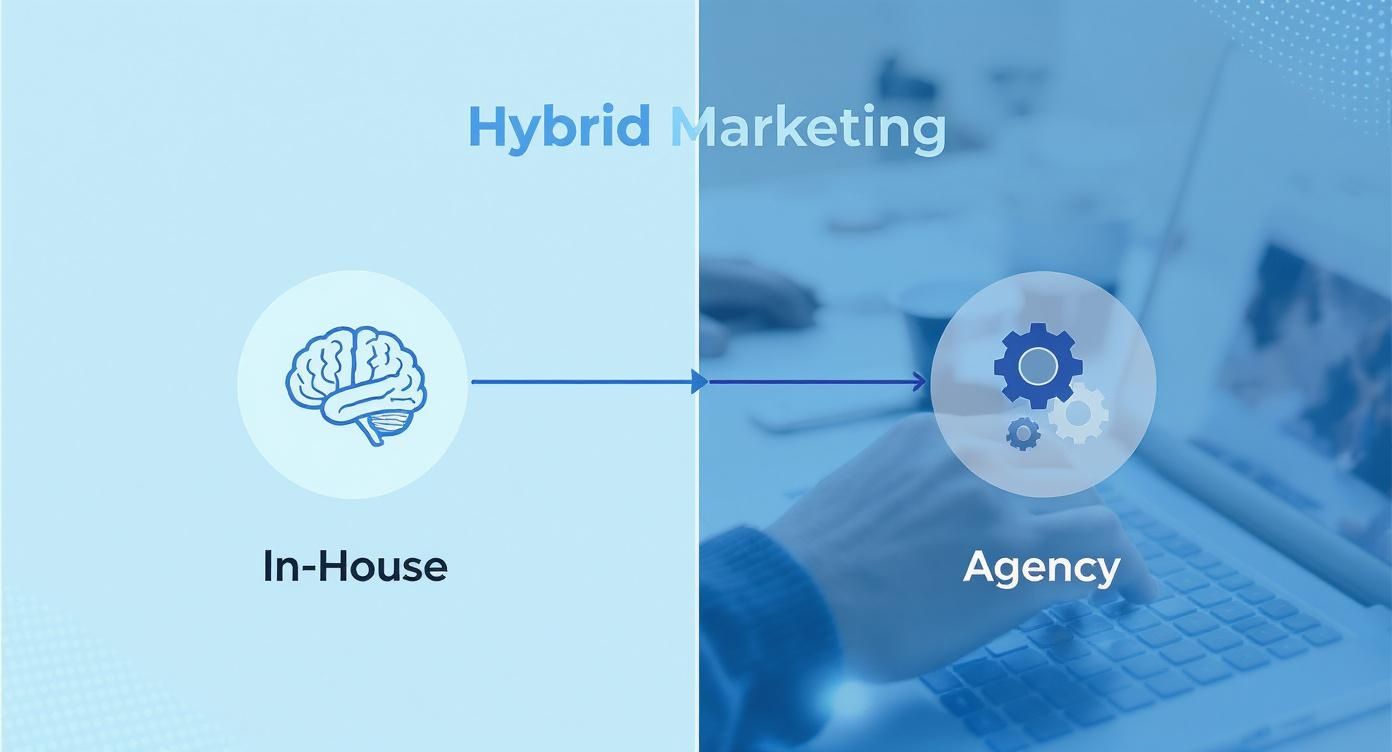
As the visual suggests, the answer isn’t always one or the other. A hybrid model, where an in-house leader sets the strategy and an agency handles the specialized execution, is often the most powerful approach.
Remember, this choice isn’t permanent. The marketing model that works for a scrappy startup is rarely the right fit for a company in its scale-up phase. The key is picking the structure that solves today’s problems while giving you the flexibility to adapt for tomorrow.
Once you have your answers, the path forward gets much clearer. If speed and specialized skills are what you need right now, your next step is to outline a scope of work and start talking to agencies. If deep brand integration and long-term control are more important, it’s time to start drafting that job description for your first key marketing hire.
Frequently Asked Questions
When you’re weighing an in-house team against a marketing agency, a few key questions always come up. Here are some straightforward answers to the most common ones we hear from business owners.
What Is the Main Cost Difference Between an In-House Team and an Agency?
The biggest difference comes down to fixed vs. variable expenses. An in-house team is a major fixed cost. You’re not just paying salaries—you’re covering benefits, payroll taxes, software, and overhead, no matter how much work is in the pipeline. These “hidden costs” can easily tack on 25-40% to a base salary.
An agency, on the other hand, is a predictable variable expense, usually a flat monthly retainer or a project fee. While a senior marketer’s salary might look similar to an agency’s retainer on paper, the total cost to build an in-house team with the same range of skills—think SEO, content, PPC, and design—is almost always significantly higher.
Can a Startup Afford to Hire a Marketing Agency?
Absolutely. In fact, for most early-stage companies, it’s the smarter financial move. Partnering with an agency gives a startup instant access to a full team of specialists without the burden of multiple full-time salaries.
You get the specialized skills you need to grow fast, but with the flexibility to scale your investment up or down. Many agencies even offer packages tailored specifically for startups, helping them get to market faster without the long-term commitment of hiring.
For a startup, it’s all about leverage. An agency lets you leverage an entire team of seasoned pros for less than the fully-loaded cost of a single senior hire. That’s how you accelerate growth.
When Should a Company Bring Marketing In-House?
It’s time to consider bringing marketing in-house when your marketing functions have become a core, predictable part of your daily operations. The move makes sense once you have a well-defined strategy that requires deep, constant integration with your brand and internal teams.
The financial tipping point is often when your annual agency fees start to climb higher than what it would cost to build and manage your own dedicated team. This transition is rarely a sudden switch. Most companies start by hiring a marketing director to own the strategy while still relying on agencies for specialized execution.
How Do You Ensure an Agency Understands Your Brand?
Getting an agency up to speed on your brand takes a structured onboarding process and a commitment to open communication. A great agency will take the lead here, but you need to be an active partner.
A few things are critical for success:
- Provide a detailed brand guide: This should cover your mission, voice, tone, and visual identity. Don’t hold back.
- Schedule deep-dive sessions: Get your key people from sales, product, and leadership in a room with the agency to share real-world insights.
- Assign a single point of contact: Having one person on your team as the primary liaison keeps communication clear and efficient.
- Set up regular check-ins: Weekly or bi-weekly meetings are essential for keeping everyone aligned and providing timely feedback.
Ultimately, a strong agency partner should feel like an extension of your team, not just a vendor you’ve hired to check off tasks.
Ready to see how a dedicated agency partner can drive growth without the overhead of building an in-house team? Netco Design LLC creates revenue-focused marketing strategies that deliver real, measurable results. Schedule your free consultation today and let’s talk about how we can help you win your market.

