

table of contents
If you're serious about increasing organic search traffic for the long haul, you can't just start throwing content and backlinks at your site and hope for the best. You need a solid blueprint, and that starts with a deep dive into three core areas: your site’s technical health, its content performance, and the quality of your backlink profile.
This foundational work is crucial. It ensures every ounce of effort you put in later—whether it’s writing a new blog post or earning a new link—is built on solid ground. Without it, you're just wasting resources on a site that search engines might not even be able to understand properly.
Building a Solid Foundation for Sustainable Growth
Trying to boost traffic without first understanding what’s happening under the hood is like building a skyscraper on a shaky foundation. It’s destined to fail. Before you even think about advanced strategies, you have to establish a clear baseline. That means conducting a few comprehensive audits to diagnose the underlying issues that are holding your site back.
This isn't just a box-ticketing exercise; it's a strategic necessity. These initial diagnostics uncover the why behind stagnant traffic, revealing everything from technical glitches that make you invisible to Google to underperforming content that completely misses the mark with your audience.
The Three Pillars of a Foundational SEO Audit
Think of your SEO efforts as being supported by three critical pillars. If even one is weak, the whole structure is compromised. Before you can build, you need to make sure each one is solid. And before we get into the pillars, it's worth taking a moment to understand what is organic search traffic in the first place.
Here are the three pillars you need to inspect:
- Technical Audit: This is all about your site's backend health. It answers questions like, "Can search engines actually find and read my pages?" and "Is my site fast, secure, and mobile-friendly?"
- Content Audit: Here, you're evaluating the quality and performance of everything you've published. This audit helps you figure out which articles are bringing in traffic, which ones need a refresh, and which ones are just dead weight.
- Backlink Audit: This involves assessing the quality of the websites linking to you. The goal is to spot and disavow toxic links that could be hurting your rankings while also identifying the valuable ones that signal authority to Google.
This simple flow chart shows how these three audits—technical, content, and backlink—work together to form a strong SEO foundation.
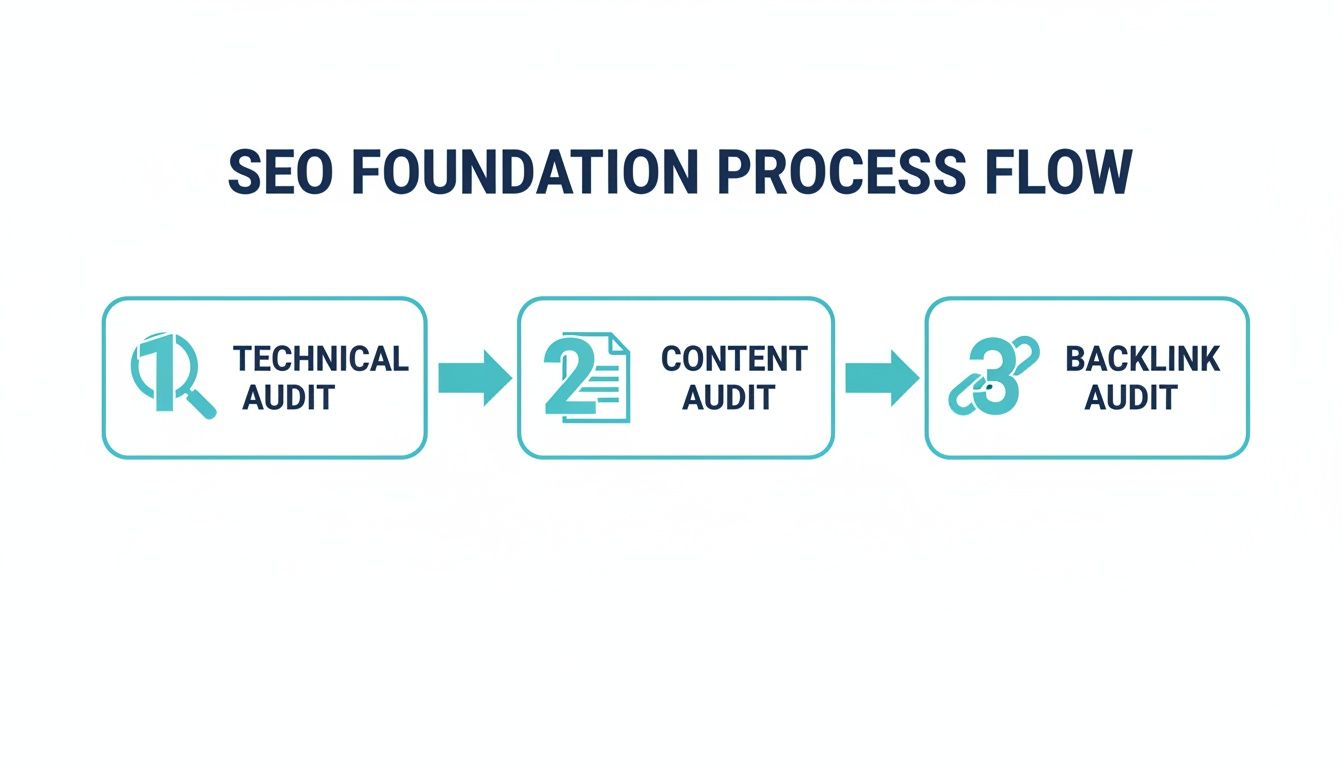
As you can see, these aren't isolated tasks. They're interconnected stages that inform a single, holistic strategy to grow your organic traffic.
Why Audits are a Non-Negotiable First Step
Skipping this foundational work is one of the most common mistakes I see. It leads to immense frustration and completely wasted effort. You could spend months creating brilliant content, only to find out it never ranked because of a simple crawlability issue a technical audit would have caught in a couple of hours.
The return on this initial investment is huge. Despite all the changes in digital marketing, organic search is still a powerhouse, accounting for roughly 53.3% of all website traffic. This isn't just a "nice to have" channel; it's essential for attracting qualified visitors who are actively looking for what you offer.
A proper site audit isn't just about finding problems; it's about uncovering opportunities. It transforms your SEO strategy from a guessing game into a data-driven plan for predictable growth.
Ultimately, a thorough audit gives you the roadmap for everything that comes next. It tells you exactly where to focus your time and money for the biggest impact, making sure your efforts are strategic, not just reactive. By taking the time to truly understand your starting point, you set the stage for sustainable, compounding results. If you want to dive deeper, you can learn more about what a site audit involves in our detailed guide at https://netcodesign.com/what-is-a-site-audit/.
Crafting a Killer Keyword and Content Strategy
Once you've audited your site and shored up the foundation, it's time to build the frame. This is where your keyword and content strategy comes in. Just throwing content at the wall to see what sticks is a recipe for wasted time and budget. A smart strategy ensures every single piece you publish is a magnet for your ideal customers and directly works to increase organic search traffic.
This means we have to stop obsessing over raw search volume. While it’s a piece of the puzzle, the real win is understanding why someone is searching. Capturing user intent at every stage of their journey—from "just browsing" to "ready to buy"—is how you turn a website into a conversion machine.
Go Way Beyond Basic Keyword Research
Effective keyword research isn’t just about finding high-volume phrases. It’s about mapping those phrases to the buyer's journey to attract qualified leads, not just window shoppers. I always advise starting at the bottom of the funnel, where people are closest to making a decision.
Think about a local plumber. Targeting a broad term like "plumbing" is a long, expensive battle. Instead, they should zero in on keywords with obvious commercial intent first.
- Top-Funnel (Informational): "how to fix a leaky faucet"
- Mid-Funnel (Consideration): "best plumbers in St. Petersburg"
- Bottom-Funnel (Transactional): "emergency plumber near me now"
When you prioritize those bottom-funnel keywords, you get quicker wins and generate revenue while you build the authority needed to compete for the bigger, top-of-funnel terms. It’s a practical approach that delivers measurable results right out of the gate.
Build Topical Authority with Content Clusters
Search engines love experts. The single best way to prove you’re an authority is by building content clusters—a structured web of in-depth articles all centered around a core "pillar" topic. This setup tells Google in no uncertain terms that you are the resource on that subject.
It works like this: you create a massive pillar page covering a broad topic, like "Digital Marketing for Small Business." Then, you link out from that pillar to more specific "cluster" articles that dive deep into subtopics, such as "Local SEO Basics," "Social Media Content Ideas," and "Email Marketing ROI."
This isn't just about tidy organization. The cluster model creates a powerful internal linking web that helps search engines map the relationships between your pages. It funnels authority throughout your site and boosts your rankings for an entire topic, not just one page.
This approach is leagues more effective than publishing random, disconnected articles. It transforms your blog into a library, encouraging visitors to stick around and see you as an industry leader—both of which are huge green flags for Google.
Generate Content Ideas That Actually Resonate
Forget guessing what your audience wants. The best content ideas are hiding in plain sight—in your data, your competitors' wins, and your customers' questions. Using data to guide your content plan ensures you're solving real problems.
For a deeper dive, especially if you're in a competitive space, exploring advanced content marketing for tech companies can give you a serious edge.
Here are a few of my go-to methods for finding winning content ideas:
- Spot Competitor Gaps: Use an SEO tool to find keywords your competitors rank for, but you don't. This is a goldmine for high-value topics you've missed. Look at their top pages and ask, "Can I make something 10x better, more detailed, or with a fresh angle?"
- Talk to Your Sales Team: Your sales and customer service reps are on the front lines. They hear every question, objection, and pain point your customers have, day in and day out. These conversations are pure content gold.
- Mine "People Also Ask": Type a target keyword into Google and scroll down to the "People Also Ask" box. These are the literal questions searchers are asking. You couldn't ask for a more direct list of proven content ideas.
The Keyword Intent Mapping Framework
To tie it all together, you need a system for matching the right keywords to the right content. Here is a simple but powerful framework for mapping keyword intent to the buyer's journey and choosing the best content format.
- Awareness Stage (Informational Intent): For keywords like "what is project management software," the best formats are blog posts, guides, and infographics.
- Consideration Stage (Navigational/Commercial Intent): For keywords such as "best project management tools for small teams," you should create comparison guides, case studies, and listicles.
- Decision Stage (Transactional Intent): For keywords like "clickup pricing" or "asana discount," focus on creating product pages, demo pages, and free trial offers.
By aligning your content creation with this framework, you ensure that you're meeting potential customers with the right information at the right time. This builds trust and smoothly guides them from discovery to conversion.
Once you have a backlog of solid ideas, it's time to get organized. Our guide on how to create a content calendar will show you how to map everything out. A solid plan is the engine that drives a consistent flow of high-impact content, which is exactly what you need to steadily increase organic search traffic over the long haul.
Mastering On-Page and Technical SEO Execution
Once your strategy is locked in, it’s time to get your hands dirty. This is the part where all that audit and planning work transforms into real-world website improvements—the kind that actually increase organic search traffic. We're talking about refining every single page to make it clearer, faster, and more valuable for both people and search engine crawlers.
Think of it like this: your audits were the foundation, and your strategy was the framework of a house. Now, it's time to handle the finishing touches—installing the windows, wiring the electrical, and painting the walls. These details are what separate a functional site from an exceptional one.
Perfecting Crucial On-Page Elements
The quickest wins often come from tweaking the elements directly on your pages. These are the signals you send to Google that tell it what your content is all about and why it’s the best answer for a user's search.
Your title tag is, without a doubt, the single most important on-page factor. It's the first thing a user sees in the search results and a massive clue for search engines. It has to be compelling enough to get the click but descriptive enough to manage expectations.
A great title tag is where keyword science meets human psychology. It’s not just some SEO field to fill out; it's your website’s first impression and your best tool for boosting click-through rates (CTR) from the SERPs.
And in this game, every click is gold. The battle for traffic is won on page one. The top position on Google gets an average CTR of 39.8%, a number that plummets with each spot you go down. In fact, the first five results scoop up 67.6% of all clicks, while a tiny 0.78% of people even bother clicking to the second page. Those stats make it crystal clear: if you’re not on page one, you’re practically invisible.
Structuring Content for Readability and Rankings
Beyond the title, the way you structure your content with headings (H1, H2, H3) is a huge deal. A clean heading hierarchy is like a table of contents for your page. It helps users scan for what they need and gives search engines a clear outline of your main topics and subtopics.
Here are a few on-page tweaks you can make right away for an immediate impact:
- Write Compelling Meta Descriptions: It's not a direct ranking factor, but a sharp meta description is your ad copy in the search results. It’s your chance to convince someone to click your link instead of the one above or below it.
- Create a Logical Heading Structure: Stick to one H1 tag per page for your main title. From there, use H2s for major sections and H3s for the sub-points within them. This creates a logical flow that’s easy to follow.
- Add Descriptive Alt Text to Images: Make sure every image has alt text that describes what’s in it. This is crucial for accessibility and gives search engines more context about your content.
- Build Strategic Internal Links: As you write, link to other relevant pages on your own website. This distributes page authority across your site and encourages visitors to stick around longer.
Demystifying Technical SEO Fixes
While on-page SEO is all about the content, technical SEO is about making sure the site itself is built on a solid foundation. These fixes can feel a bit more behind-the-scenes, but they're absolutely critical for getting your site crawled, indexed, and ranked. If you need a deeper dive, our guide on how to do a technical SEO audit has you covered.
One of the most powerful technical tools in your arsenal is structured data, also known as Schema markup. It’s a bit of code you add to your site that helps search engines understand your content on a deeper level. For instance, you can use Schema to explicitly tell Google that a page is about a recipe, a product review, or a local business.
Why bother? Because implementing structured data can earn you rich snippets in the search results. These are the eye-catching extras like star ratings, event dates, or product prices that make your listing pop. They demand attention and can seriously boost your click-through rate.
Another non-negotiable area is site speed and mobile-friendliness. Google now operates on a mobile-first indexing system, which means the mobile version of your site is the one that matters most for ranking. A slow, clunky mobile experience isn't just bad for users—it’s a direct hit to your rankings. Improving your Core Web Vitals—Google's metrics for loading speed, interactivity, and visual stability—is a direct investment in user experience, and Google rewards that.
Acquiring High-Quality Backlinks to Build Authority
If your content is solid and your site is technically sound, you've got two-thirds of the SEO puzzle figured out. But that last piece? It’s all about authority. In Google's eyes, authority is primarily built through high-quality backlinks.
Think of a backlink from a reputable website as a vote of confidence. It's a signal to search engines that your content is trustworthy, valuable, and worth showing to more people. This isn't about chasing huge numbers of links with spammy tactics. It's about a long-term investment in building a strong profile that gives you a real competitive edge. The goal is to earn links that not only lift your rankings but also send qualified referral traffic your way.
Move Beyond Traditional Link Building to Digital PR
The world of link building has changed. A lot. Old-school tactics like blasting out guest posts to low-quality sites just don't work anymore—in fact, they can get you penalized. The modern, sustainable approach is digital PR.
Digital PR is all about creating genuinely newsworthy content that journalists, bloggers, and industry publications actually want to talk about and link to. Instead of begging for links, you're creating assets that earn them naturally. This could be a unique data study you conducted, an insightful industry survey, or even a helpful tool that solves a real problem for your audience.
The idea is to produce something with unique value, making it an obvious source for others to reference. This approach aligns perfectly with Google’s mission: to reward real brands that demonstrate true expertise.
Proven Methods for Earning Authoritative Links
A smart link acquisition strategy is never a one-trick pony. Relying on a single method is risky. A diversified approach is the only way to ensure a steady stream of high-quality backlinks from a variety of authoritative sources.
Here are a few white-hat strategies that I’ve seen deliver consistent results:
- Strategic Guest Blogging: This has nothing to do with spamming hundreds of blogs. It’s about hand-picking a few highly relevant, authoritative sites in your niche and contributing a genuinely fantastic article. The goal is to get your expertise in front of a new audience and earn a powerful, contextually relevant link in the process.
- Broken Link Building: This classic technique is still surprisingly effective. You find dead links on other websites in your industry, then reach out to the site owner. You let them know about the broken link and politely suggest your own relevant content as a replacement. It's a win-win: you help them clean up their site, and you get a quality backlink.
- Resource Page Link Building: Many websites, especially from universities and industry groups, have pages that list helpful resources. If you've created a truly comprehensive guide or a useful tool, you can reach out and suggest they add it to their list.
The common thread here? Value. Whether you're creating a data study or pitching a guest post, your number one focus should always be on providing something genuinely useful to the other site's audience.
How to Vet Potential Link Opportunities
Not all links are created equal. I'd take one link from an authoritative, relevant website over a hundred links from spammy directories any day. Vetting every single opportunity is critical to building a healthy backlink profile that helps—not hurts—your mission to increase organic search traffic.
When you're evaluating a potential link, relevance and authority are everything. Ask yourself: is this site topically related to mine? Does it have a strong reputation in the industry?
Getting this right is a marathon, not a sprint. But it’s an investment that pays off for years. For a deeper dive into these methods, you might find our guide on how to build links the right way helpful.
Turning Clicks into Customers: Conversion, UX, and Local SEO
Getting people to your website is just the first step. The real magic happens when those visitors turn into customers, and that's where Conversion Rate Optimization (CRO) and User Experience (UX) come into play. A site that’s a breeze to use, builds trust, and solves a visitor's problem doesn't just convert better—it also tells Google you're a high-quality result.
Think about it: when someone lands on your page and immediately finds what they need, they stick around. This sends all the right signals to search engines—lower bounce rates, longer time on page—which can give your rankings a serious boost.
Bridge the Gap Between SEO and CRO
SEO gets people to your door; CRO makes sure they come inside and stay awhile. These two aren't separate disciplines; they're deeply intertwined. Small tweaks that make the user journey smoother can pay off big time for both your conversions and your search performance.
Take your website's navigation, for example. Is it dead simple? A visitor should never have to guess where to find your services or contact info. By cleaning up your main menu and peppering in clear calls-to-action (CTAs), you can guide people right where you want them to go, cutting down on frustration and keeping them engaged.
A site that works well for people is a site that search engines want to rank. When you prioritize a smooth, intuitive user experience, you're not just improving conversion rates; you're building a more authoritative and rank-worthy website.
Every minute you spend on user experience optimization is a direct investment in your SEO. They're two sides of the same coin, both driving you toward the same goal: sustainable growth.
Dominate Your Local Market
If your business serves a specific area, local SEO isn't just a good idea—it's everything. It’s all about making sure you’re the first name people see when they’re searching for what you offer in their own neighborhood.
Your Google Business Profile (GBP) is ground zero for any local strategy. This is often a potential customer's very first interaction with your brand. A fully built-out profile is like a mini-website that shows up right in the search results, giving people the key info they need at a glance.
To really own your local search results, run through this checklist:
- Claim and Verify: Make sure you have complete control over your listing.
- Fill Out Everything: Don't skip any sections. Add your services, hours, photos, and a solid business description.
- Go All-In on Reviews: Actively ask happy customers to leave a review. And make sure you respond to all of them, good and bad—it shows you’re paying attention.
- Use Google Posts: Keep your profile looking fresh by sharing regular updates, special offers, and company news.
Beyond GBP, you need to build consistent local citations. These are mentions of your business name, address, and phone number (your NAP) on other sites like Yelp or local business directories. Keeping this information consistent across the web proves your legitimacy to search engines.
E-commerce Specific Optimizations
For online stores, your product and category pages are where the money is made. You absolutely have to optimize them for both shoppers and search engines. High-quality product photos, unique and detailed descriptions, and customer reviews are the bare minimum.
But you can go further. Improving the filtering and sorting options on your category pages is a game-changer. It helps shoppers quickly find what they're looking for, which makes for a better experience and keeps them from bouncing. A site that’s easy to shop is a site that converts.
The link between search and e-commerce is incredibly powerful. Organic traffic doesn't just bring visitors; it brings buyers. In fact, organic traffic conversion rates hover around 16%. Data also reveals that 51% of smartphone users discover new products through mobile search, and a staggering 88% of local mobile searches result in a call or visit within 24 hours. These numbers show just how critical it is to get your e-commerce SEO right.
Answering Your Top SEO Questions
Even with a solid plan, you're bound to have questions as you dive into the world of SEO. It's a complex field, and things are always changing. Here are some straightforward answers to the questions we hear most often from business owners trying to increase their organic search traffic.
How Long Does It Take to See Results from SEO?
This is the million-dollar question, and the only honest answer is: it depends. SEO is a marathon, not a sprint. While you might see a small bump from quick technical fixes in a few weeks, meaningful growth in organic traffic usually takes 4 to 12 months of consistent effort.
So, what does it depend on? A few key things. A brand-new website with no history will naturally take longer to build authority than an established site with years of content. The level of competition in your industry also plays a massive role—ranking for "local bakery in Tampa" is a completely different beast than trying to rank for "personal injury lawyer."
The key is consistent, focused work on your content, technical site health, and earning quality links.
Think of it like pushing a giant flywheel. It starts slow and takes a ton of effort to get its first turn. But as you keep pushing, it builds powerful momentum that becomes easier to maintain and delivers compounding results over time.
What Is the Difference Between On-Page and Off-Page SEO?
Getting this distinction right is fundamental to building a balanced, effective SEO strategy. Both are absolutely critical for success, but they target different parts of your online presence.
-
On-Page SEO is everything you do directly on your website to improve its ranking. This includes things like optimizing your title tags, improving the quality of your content, adding internal links, and making sure your site is fast and mobile-friendly. It’s all about making your site as clear and valuable as possible for both real people and search engine crawlers.
-
Off-Page SEO covers all the actions taken outside of your own website to boost your rankings. By far, the most important piece of off-page SEO is earning high-quality backlinks from other reputable sites. It also includes things like managing your brand's online reputation, social media signals, and local business citations.
A winning strategy needs a strong focus on both. Great on-page SEO makes sure your site is ready to convert traffic, while strong off-page SEO builds the authority you need to attract that traffic in the first place.
Should I Focus on SEO or PPC to Increase Traffic?
This isn't really an "either/or" question. The smartest approach is almost always to use both, because SEO and PPC (Pay-Per-Click) advertising complement each other beautifully. They serve different purposes but work together to hit your growth goals.
PPC is fantastic for getting immediate traffic and visibility. It's perfect for testing new keywords, promoting a time-sensitive offer, or getting quick data on which marketing messages actually convert. The catch? The moment you stop paying, your traffic dries up. It's like renting an audience.
SEO, on the other hand, is a long-term investment that builds a sustainable, organic source of traffic. It establishes your brand's authority, credibility, and trust over time. This is like owning your traffic source.
Here’s a common and powerful approach: Many businesses use PPC to get instant data on which keywords drive actual sales. They then take those proven, high-converting keywords and build them into their long-term SEO strategy. This creates a cost-effective growth loop that delivers both short-term wins and lasting results.
Ready to stop guessing and start growing? The team at Netco Design LLC builds revenue-focused digital marketing strategies that deliver measurable results. Schedule your free consultation today and let's create a plan to put your business on page one.

