

table of contents
Forget about disconnected tactics. Effective marketing for a law firm isn’t about throwing a bunch of things at the wall to see what sticks—it’s about building a cohesive, digital-first plan. The winning approach weaves together a strong brand, sharp SEO, authoritative content, and smart advertising to pull in modern clients.
Think of it as a complete system designed for steady, predictable growth.
Building Your Foundational Law Firm Marketing Strategy
Let’s be honest: old-school methods like relying on print ads or the occasional networking event just don’t cut it anymore. To get a consistent flow of good clients today, you need a structured, multi-channel game plan.
Piecemeal efforts, like a blog post here and a social media update there, almost never move the needle. The real key is to build a powerful, interconnected system where every part supports the others. It’s like building a courthouse. You don’t just dump a pile of bricks on a plot of land and hope a building magically appears—you start with a solid blueprint. The same logic applies to your marketing. A clear strategy ensures every dollar you spend and every hour you invest is pushing your firm forward.
The Core Components of a Modern Strategy
A great marketing plan has several key pieces that work together to attract and sign new clients. Sticking with our courthouse analogy, think of them as the essential parts of the structure:
- The Foundation: This is your brand identity and your professional website. It’s the first impression you make online and the central hub for everything else you do.
- The Support Pillars: These are the channels that drive traffic and build your authority. We’re talking about Search Engine Optimization (SEO), content marketing, and digital advertising.
- The Management System: This covers your client intake process and how you track results. It’s how you efficiently handle new leads and measure what’s actually working.
This flowchart shows how these pieces—foundation, pillars, and management—fit together to create a successful marketing engine.
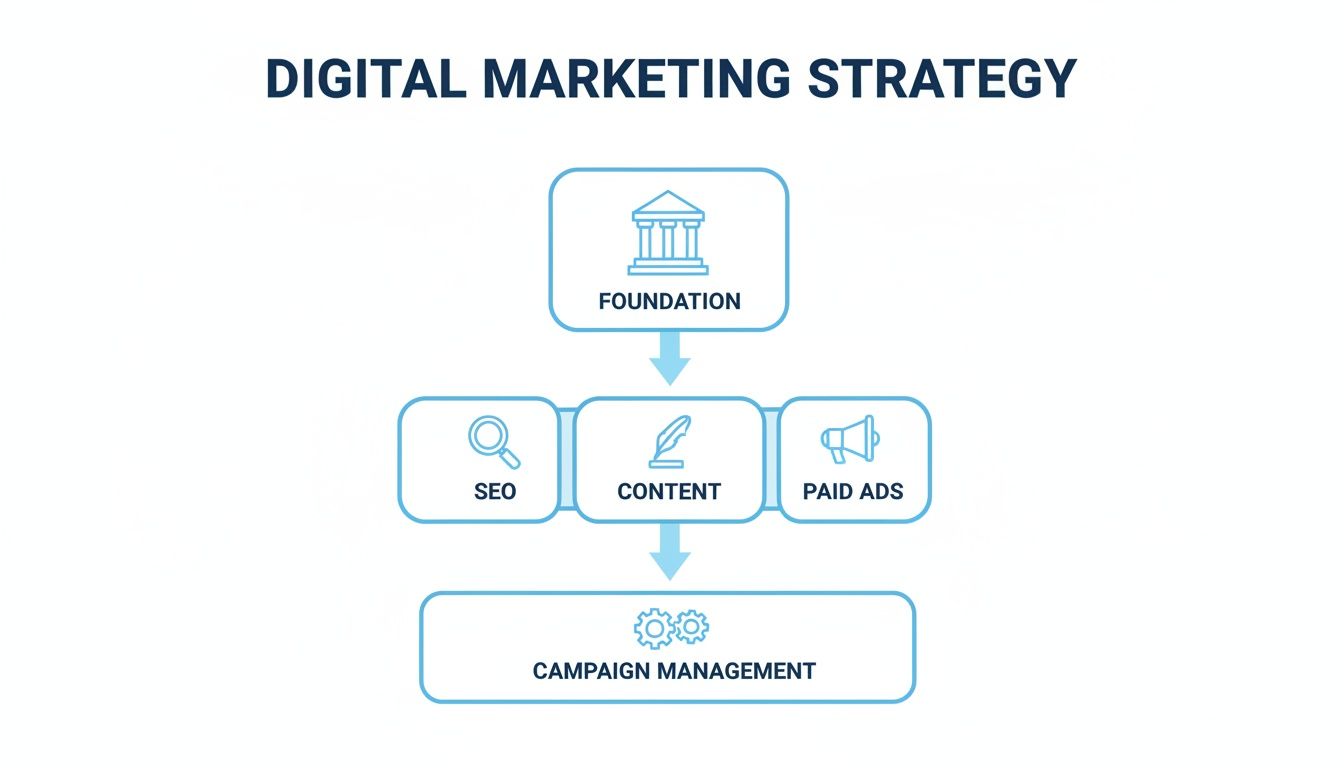
As you can see, without that solid foundation, the pillars holding up your client acquisition efforts will eventually start to wobble.
Why a Cohesive Approach Matters
When these elements are in sync, they create a powerful client acquisition machine. For example, a great blog post doesn’t just build trust with a potential client; it also boosts your SEO rankings, making you easier to find. In the same way, the data from your ad campaigns can tell you exactly what your content should be about, helping you answer your clients’ most urgent questions.
This integrated system keeps your firm visible and credible right when people are searching for legal help.
Your marketing strategy shouldn’t feel like a checklist of separate tasks. It should be a unified engine where SEO, content, and advertising work together to create momentum, turning initial awareness into signed clients.
For firms looking to streamline their workflow and scale up, exploring effective marketing automation for small business can be a game-changer. Once you understand why this cohesive structure is so important, you’ll be in a much better position to implement the how of each tactic we’re about to cover. For a wider view, you can dig deeper into crafting a digital marketing strategy for small business in our detailed guide.
Dominating Local Search With Strategic SEO
For most people needing legal help, the journey starts with a simple search on Google. To win their business, your firm has to be there the moment they start looking. This is where Search Engine Optimization (SEO) comes in—it’s the single most powerful tool for attracting local clients.

Think of good SEO as the digital equivalent of having your office in the best, most visible spot in town. It’s not about just having a website; it’s about making sure that website is the first one people see when they search for phrases like “personal injury attorney near me” or “family lawyer in [Your City].” This isn’t a quick gimmick. It’s a long-term investment that pays off by generating a steady stream of qualified leads.
And the investment really does pay off. With 96% of people now starting their hunt for an attorney online, you can’t afford to be invisible. While a serious SEO effort might cost a firm around $150,000 a year, that commitment can deliver a staggering 526% ROI within three years. You can dig into more legal marketing statistics at andava.com to see the full picture.
Your Digital Storefront: Google Business Profile
Long before someone visits your website, they’ll likely see your Google Business Profile (GBP). This free listing is your firm’s digital storefront on Google Search and Maps, and it is absolutely vital for landing local clients.
An incomplete or sloppy profile is like having a messy, unwelcoming lobby. It sends an immediate signal that you don’t care about the details.
Your Google Business Profile is often the very first interaction a potential client has with your firm. Optimizing it isn’t just a marketing task—it’s the first step in building trust before they even think about clicking through to your site.
To turn your profile into a client magnet, you have to fill out every single section accurately. That means high-quality photos, consistent business hours, a precise address, and a direct phone number. For a step-by-step walkthrough, check out our guide on how to optimize your Google Business Profile.
Building Trust Through Online Reviews
Your reputation is built on client reviews. The latest legal trends reports show that reviews are one of the biggest factors people consider when choosing a lawyer. A steady flow of positive, real feedback gives you the social proof needed to convince a searcher to become a lead.
The trick is to make asking for reviews a standard part of your process. When you wrap up a case on a high note, just ask your happy client if they’d be willing to share their experience.
A smart approach to managing your reputation includes:
- Making It Easy: Give clients a direct link to your GBP review section. No hunting, no hassle.
- Responding Professionally: Always thank clients for positive reviews. Address any negative feedback thoughtfully and ethically, never revealing confidential case details.
- Showcasing Feedback: Feature your best testimonials right on your website to reinforce your credibility.
This consistent effort not only builds a five-star reputation but also sends powerful positive signals to Google’s local ranking algorithm.
Structuring Your Website for Search Success
While your GBP is the welcome mat, your website is where you make your case. To own local search, your site’s structure and content must be perfectly aligned with what potential clients are looking for. That means creating dedicated “practice area” pages for each service you offer.
Each of these pages should be a deep-dive resource on that topic, packed with the local keywords people are actually typing into Google. For example, instead of one generic “Services” page, you need distinct pages for:
- Family Law: Targeting keywords like “divorce lawyer in [City]” and “child custody attorney [City].”
- Personal Injury Law: Focusing on terms such as “car accident lawyer near me” and “slip and fall attorney [City].”
- Estate Planning: Aiming for searches like “will and trust attorney [City]” or “probate lawyer in [City].”
This targeted strategy tells search engines exactly what you do and where you do it. It dramatically increases your odds of ranking for these valuable, client-generating searches. When you combine this with helpful blog content that answers common legal questions, your website becomes an unstoppable force for local leads.
Building Authority With Content and Social Media
While a smart SEO strategy gets your firm on the map, it’s high-quality content that convinces potential clients to actually walk through your digital door. Think of content as the engine that builds your credibility and establishes you as an authority long before someone even thinks about hiring a lawyer. It’s how you show your expertise, not just claim it.
This isn’t about just writing an occasional blog post. It’s about having a thoughtful plan to create and share information that genuinely helps your audience, answering their most pressing questions and calming their anxieties. When you get this right, your website and social media profiles transform into go-to resources that attract, engage, and ultimately, bring in new clients.
The real goal here is to create content that demonstrates what Google calls E-E-A-T: Experience, Expertise, Authoritativeness, and Trustworthiness. This isn’t just some SEO buzzword; it’s the gold standard for building a reputation that both search engines and potential clients will respect.
Developing a Content Strategy That Builds Trust
A powerful content strategy is all about delivering real, tangible value. What are the common questions you find yourself answering over and over in initial consultations? Those are your goldmine—the perfect starting points for blog posts, short videos, or simple downloadable guides.
Your mission is to demystify complex legal topics. Make them accessible to people who are often feeling overwhelmed, confused, and uncertain. Your content should be a beacon of clarity during a difficult time.
Here are a few high-impact content formats to get you started:
- In-Depth Practice Area Guides: Build out detailed pages covering everything a potential client needs to know about a specific legal issue, from the first steps in the process to the potential outcomes.
- Video Explainers: A simple two-minute video breaking down a concept like “what to do after a car accident” can be far more engaging and reassuring to a stressed-out person than a long, dense article.
- Client Success Stories: With your client’s permission, of course, share anonymized case studies. Highlight the problem they faced, how your firm approached it, and the positive resolution you achieved. This builds a powerful emotional connection and provides undeniable social proof.
When you’re crafting your content, remember that clear communication is the bedrock of trust. For some great, practical advice on sharpening your messaging, check out these resources on effective legal writing in plain English.
Using Social Media for Networking and Authority
Social media isn’t just a place to post firm updates; it’s an incredibly powerful tool for professional networking and getting your expert content in front of the right people. For most law firms, LinkedIn is going to be your most valuable platform. It’s the perfect place to connect with other professionals, share insightful articles, and jump into relevant industry discussions.
For consumer-focused practices like family or personal injury law, a professional Facebook presence can also be surprisingly effective for engaging with your local community.
Don’t treat social media like a sales channel. Instead, think of it as a digital networking event. Your goal is to share valuable insights, build genuine relationships, and position yourself as the go-to expert in your field.
The key to making any of this work is consistency. A well-managed profile that regularly shares helpful information reinforces your firm’s brand and keeps you top-of-mind. This steady, consistent effort is the core of any successful social media content strategy.
Creating a Practical Content Calendar
Ideas are great, but execution is what brings in clients. A content calendar is the simple tool that turns your strategy into a real, actionable plan. It doesn’t need to be fancy—a basic spreadsheet is all you need.
Your calendar should map out what you’re going to publish, where you’re going to publish it, and when. This ensures a steady stream of valuable content flows out to your audience without any last-minute scrambling.
Here’s a simple framework to get rolling:
- Brainstorm Topics: Sit down and list 10-15 common client questions for each of your main practice areas.
- Assign Formats: Look at your list. Decide which questions are best answered in a blog post, which would make a great video, and which can be a quick social media update.
- Schedule Publication: Put a date next to each piece of content. Aim for a cadence you can actually stick to, like one new blog post and three social media updates per week.
- Plan to Repurpose: This is the pro move. A single in-depth guide can be sliced and diced into multiple blog posts, several social media graphics, and even a script for a short video. This approach maximizes the return you get on your content creation efforts.
Driving Immediate Leads With Digital Advertising
While SEO is the long game—the foundation for steady, organic growth—sometimes you just need the phone to ring now. That’s where a smart digital advertising plan comes in. Think of it like opening a faucet; it delivers a targeted stream of traffic and inquiries right when you need them most. It’s the perfect fast-acting partner to your slower-burning SEO and content efforts.

This part of your marketing strategy is all about building a powerful client-generating machine using paid channels. By mixing Pay-Per-Click (PPC) ads, sharp social media campaigns, and thoughtful email marketing, you can connect with potential clients no matter where they are in their decision-making process.
Capturing High-Intent Clients With PPC
Pay-Per-Click ads, especially on Google Ads, are hands-down one of the quickest ways to get your firm in front of people actively looking for a lawyer. SEO can take months to gain traction, but a well-run PPC campaign can have you sitting at the top of Google’s search results in a matter of hours.
It’s like renting the best billboard on the busiest highway. You’re paying for a prime spot to catch the eye of motivated searchers typing in urgent phrases like “car accident lawyer near me.” This is a game-changer in competitive practice areas where fighting your way to the top of organic rankings is a long, tough slog. Best of all, you only pay when someone actually clicks your ad, making every dollar a direct investment in a potential lead. Our guide on PPC management for small business digs deeper into how to make these campaigns truly profitable.
To get the most bang for your buck, you have to be tactical:
- Target Locally: Lock your ads down to specific cities or zip codes. This attracts relevant local clients and stops you from wasting money on clicks from people you can’t serve.
- Use Specific Keywords: Go after long-tail keywords that signal someone is ready to hire, like “emergency child custody lawyer.” These are less expensive and convert better than broad, generic terms.
- Create Compelling Ad Copy: Your ad needs to be a mini-elevator pitch. Clearly state your practice area, offer a real benefit, and end with a strong call-to-action like “Call for a Free Consultation.”
Nurturing Prospects With Email Marketing
Let’s be real: not every person who lands on your website is ready to hire you that day. This is exactly where email marketing shines. It’s your tool for building a relationship and staying on their radar. By capturing email addresses on your site—maybe through a newsletter signup or a helpful downloadable guide—you open up a direct line of communication.
This channel is your chance to prove your expertise over time. You can send out useful articles, updates on local laws, or client success stories that quietly build trust and cement your authority. When that person is finally ready to make a move, your firm will be the first one they think of.
Email marketing is your firm’s private conversation with a potential client. It’s an opportunity to build a relationship, offer value, and guide them toward a consultation without the noise of public advertising.
Gone are the days when one marketing channel was enough. Today, a multi-channel strategy is the only way to reliably reach clients. In fact, 65% of law firms now report their marketing budgets are hitting their lead generation goals, largely thanks to this kind of diversified approach. You can dive into the data yourself by checking out the full 2025 State of Law Firm Marketing Report.
Leveraging Social Media Ads for Targeted Reach
Organic social media is great for connecting with your community, but paid social ads on platforms like Facebook and LinkedIn give you surgical precision. You can put your message in front of a very specific audience based on their location, demographics, interests, and even job titles.
This makes social ads incredibly effective for two main goals:
- Brand Awareness: Run simple campaigns to introduce your firm to the local community. Show off your team, share your values, and let people know what makes you different.
- Specific Lead Generation: Target ads for estate planning to users in a certain age bracket, or aim your business law ads directly at local company owners on LinkedIn.
When you combine the immediate visibility of PPC, the long-term relationship-building of email, and the targeted outreach of social ads, you create a complete system that brings in leads today while stocking your pipeline for tomorrow.
Measuring Success and Maximizing Your Budget
A great marketing plan isn’t about who has the biggest war chest; it’s about who invests the smartest. You can pour money into a dozen different channels, but without a clear way to measure what’s actually bringing in clients, you’re just guessing.
It’s easy to get sidetracked by vanity metrics—things like website visitors or social media likes. They feel good, sure, but they don’t sign retainer agreements. The real goal is to ignore the noise and zero in on the key performance indicators (KPIs) that directly fatten your firm’s bottom line.
Key Metrics That Actually Matter
To make sharp, data-driven decisions, you have to track the right numbers. These KPIs cut straight to the heart of your marketing’s health.
Focus on these three core metrics:
- Lead Quality: Not every phone call is a real opportunity. You need a way to separate the tire-kickers from the high-value potential clients who are ready to hire you right now.
- Client Acquisition Cost (CAC): This is your bottom-line cost to land one new, paying client. A low CAC is the sign of an efficient, profitable marketing machine.
- Return on Investment (ROI): This is the ultimate scorecard. For every dollar you put into marketing, how many dollars in revenue are you getting back?
Nailing these numbers tells you which channels are delivering real value and which are just a drain on your budget. For a deeper dive, our guide explains precisely how to calculate marketing ROI for your firm.
Using Data to Guide Your Decisions
Modern tools have thankfully taken the guesswork out of tracking performance. Your two most powerful assets here are your website analytics and your client relationship management (CRM) software.
Platforms like Google Analytics can show you exactly where your website traffic comes from, which pages people love, and how many visitors end up filling out your contact form. That data is gold. When you pair it with the information in your CRM, you can draw a straight line from a specific marketing campaign right to a new signed client.
Your marketing data tells a story. Learning to read it allows you to stop guessing about what works and start making decisions that consistently generate profitable growth for your firm.
For instance, if you see a blog post on “child custody laws” is bringing in a steady stream of qualified leads from organic search, you know that creating more content on that topic is a brilliant investment. On the flip side, if a paid ad campaign is getting plenty of clicks but the phone isn’t ringing, it’s a clear signal to tweak your ad copy or landing page. This cycle of analysis and adjustment is what separates the most successful law firm marketing from the rest.
Navigating Rising Costs With Smart Spending
The battle for online attention has never been fiercer, and marketing costs are climbing to match. Budgets are swelling as firms fight tooth and nail for every click in a high-stakes game where a single major case can change everything. The top 200 U.S. law firms now spend an average of $2,354,946 on marketing each year. Even smaller firms feel the squeeze, with many dedicating an average of $150,000 annually to SEO just to keep up. You can discover more insights about these legal marketing stats on onthemap.com.
With costs soaring, efficiency becomes your secret weapon. You don’t need an unlimited budget to win; you just need to be more strategic. By doubling down on the channels with the highest proven ROI and ruthlessly cutting what doesn’t work, you can outsmart your competition, not just outspend them. This lean, data-backed approach makes sure every single dollar is working as hard as you do to grow your firm.
Your Top Law Firm Marketing Questions, Answered
Jumping into legal marketing brings up a ton of questions. As you start mapping out your firm’s growth, it’s completely normal to wonder about the real costs, how long it’ll take to see results, and which tactics are actually worth your time and money.
We get these questions all the time from partners just like you. Here are some straight, no-fluff answers to help you cut through the noise and make smart decisions from day one.
How Much Should a Small Law Firm Budget for Marketing?
This is always the first—and most important—question. A good rule of thumb is to set aside 5% to 10% of your firm’s gross revenue for marketing.
For a smaller or newer firm that’s serious about growth, that might look like a starting budget of $5,000 to $15,000 per month. This is usually enough to cover the essentials: a solid local SEO campaign, consistent content creation, and a smart pay-per-click (PPC) advertising plan.
The most important thing isn’t the total dollar amount, but how you spend it. A smaller, strategically invested budget will always outperform a large, unfocused one. The key is putting your money where it will generate the highest return for your specific practice and city.
No matter your budget, two things are non-negotiable:
- A professional, easy-to-use website.
- A comprehensive local SEO campaign.
Think of these as the foundation of your house. Without them, everything else you try to build—from ad campaigns to social media—will eventually crumble.
How Long Does It Take to See Real Results From SEO?
Let’s be clear: SEO is a marathon, not a sprint. Patience is absolutely essential, and it’s important to have realistic expectations from the get-go.
You’ll probably start to see some early movement in your local search rankings within three to four months. But getting to the front page for your most valuable, competitive keywords? That typically takes anywhere from six to 12 months of consistent work.
Several things can speed up or slow down this timeline:
- Market Competitiveness: Are you in a huge city with hundreds of other firms, or a smaller town where the competition is lighter?
- Website Authority: Is your site brand new, or does it already have some history and a decent backlink profile?
- Consistency of Effort: Are you regularly publishing new content, optimizing your pages, and building your online footprint week after week?
Think of SEO like building equity. The upfront investment of time and money can feel slow at first, but it pays off with a steady stream of highly qualified, organic leads for years to come—long after you’ve stopped paying for ads.
Is Social Media Actually Necessary for My Law Firm?
The short answer is yes, but with a big caveat: you don’t need to be everywhere. What you need is a strategic, professional presence on the right platforms. It’s all about showing up where your ideal clients already are.
For firms practicing corporate law, commercial litigation, or other B2B services, LinkedIn is non-negotiable. It’s the #1 platform for establishing yourself as a thought leader, networking with other professionals, and connecting directly with business decision-makers.
If your practice is more consumer-focused—like family law, personal injury, or estate planning—then Facebook can be a goldmine. It’s fantastic for building a local community, sharing genuinely helpful content, and running laser-targeted ads to reach specific people in your area. The goal is to build trust and name recognition long before they actually need a lawyer.
Should We Hire a Marketing Agency or Do It In-House?
This is a huge decision, and it really comes down to your firm’s resources, expertise, and growth goals. Both options can work, but for most small to mid-sized firms, one path is usually much more practical.
Building an in-house marketing team is a serious, ongoing investment. You’re not just covering salaries and benefits; you’re also paying for constant training, professional development, and pricey subscriptions to all the necessary marketing software and analytics tools.
For the vast majority of small and mid-sized law firms, partnering with a specialized legal marketing agency is simply more cost-effective and efficient. An experienced agency gives you immediate access to a full team of experts in SEO, PPC, content, and web design, all with proven systems designed to drive results. This frees you up to focus on what you do best—practicing law—while your marketing partner focuses on delivering a clear return on your investment.
Ready to stop guessing and start growing? Netco Design LLC builds custom, revenue-focused marketing strategies that attract pre-qualified clients and turn your website into a powerful lead-generation engine. Schedule your free consultation with us today and discover how our expertise in SEO, web design, and digital advertising can elevate your firm’s online presence.

