

table of contents
When you’re trying to get more local business, the game plan is pretty straightforward: attract potential customers right in your geographic area. The most effective way to do that starts with a rock-solid local SEO foundation. Specifically, you need a killer Google Business Profile so you show up in those “near me” searches the moment a customer decides to buy.
Master Your Local SEO Foundation
Before you even think about putting a single dollar into advertising, your main goal should be to completely own your local search results. Think of it this way: paid ads are like renting an audience, but a powerful local SEO presence is like owning the land. It’s the foundational asset that keeps generating high-intent leads for free, day in and day out.
This whole process begins and ends with your Google Business Profile (GBP). It’s your digital storefront on the biggest search engine in the world. Having a complete and active profile isn’t just a suggestion anymore; it’s a non-negotiable for competing locally.
Go Beyond Basic GBP Optimization
So many businesses set up a profile, fill out the bare minimum, and then just let it collect dust. That’s a huge missed opportunity. If you really want to dominate local search, you have to treat your GBP like an active marketing channel.
Here are the areas you absolutely need to focus on:
- Complete Every Single Section: Fill out everything. I’m talking services, products, accessibility attributes, special hours—the works. The more data you feed Google, the more confidently it can rank you for all the right searches.
- Geotag Your Photos: When you upload photos of your work, your team, or your shop, make sure they’re geotagged with your business’s coordinates. This sends a powerful, direct signal to Google about exactly where you operate.
- Use Google Posts Weekly: Get in the habit of creating Google Posts to share updates, offers, and events. These show up right in your search listing and prove to potential customers that you’re an active, engaged business. If you’re short on time, a tool like a GMB Post Generator can help you create compelling updates quickly.
- Get Proactive with the Q&A Feature: Don’t just wait for customers to ask questions. Seed your own Q&A section by posting and answering common questions about your services, pricing, or process. This lets you control the narrative and tackle customer concerns before they even have to ask.
This simple diagram breaks down how it all connects—from optimizing your profile to building out citations, all leading to a better rank.
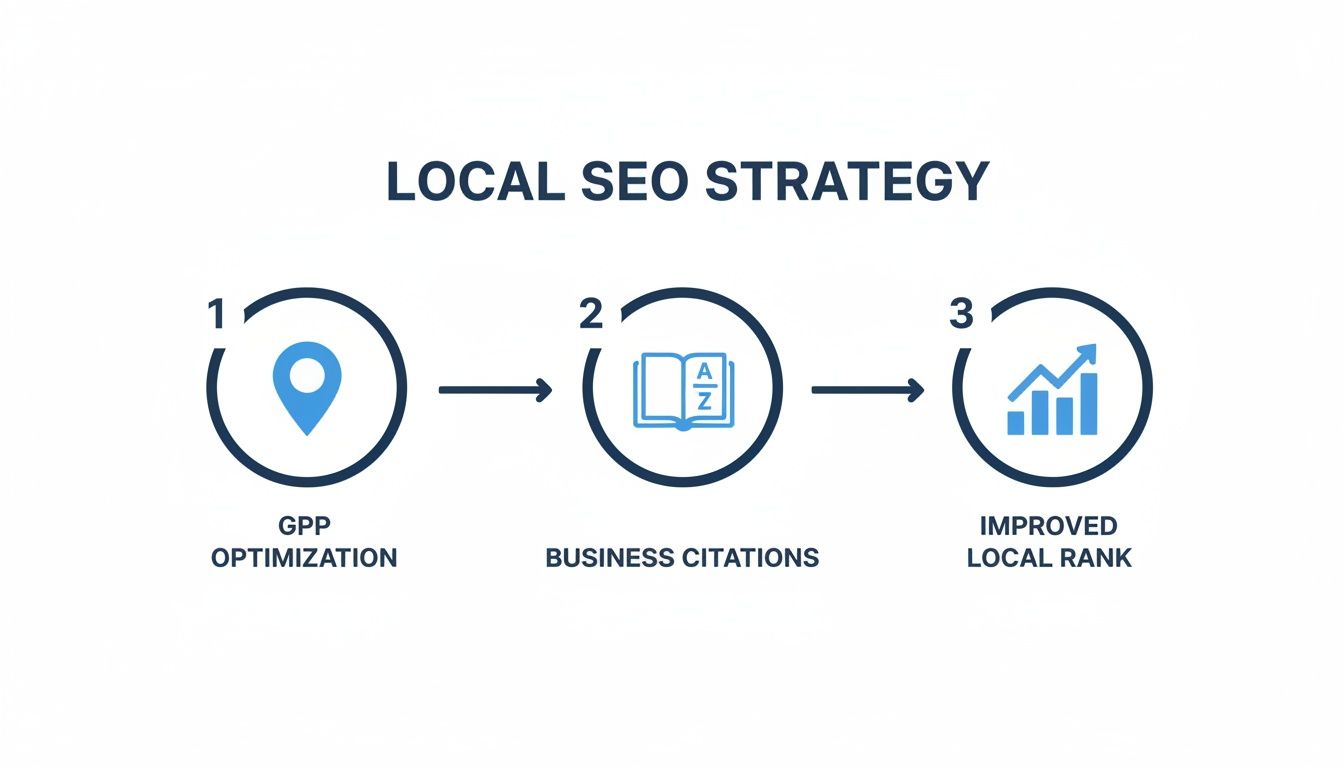
As you can see, a well-kept GBP is the critical first step. It becomes the anchor for your citation-building efforts, which in turn boosts your authority in local search.
The Critical Role of Citations and NAP Consistency
Beyond just what’s on your GBP, Google scours the web for other mentions of your business to verify that you are who and where you say you are. These mentions are called citations, and they almost always include your Name, Address, and Phone Number (NAP).
Inconsistent NAP information is a major red flag for search engines. If one directory lists your business on “Main St.” and another has you on “Main Street,” that tiny bit of confusion can quietly drag your rankings down.
Your business’s digital footprint must be consistent. Every online directory, social profile, and website mention should present the exact same Name, Address, and Phone number. This consistency builds trust with both search engines and potential customers.
The power of being consistent here is huge. It’s projected that by 2026, a staggering 79% of leads for local businesses will still come from Google-dominated channels. That just hammers home the unbeatable power of search for local customer acquisition. Digging in deeper, Google Business Profile (Maps) leads the pack, accounting for 35% of those leads.
How to Audit and Build Your Citations
Running a citation audit doesn’t have to be some complex, drawn-out process. Just start by Googling your business name and address. Take note of the top directories that pop up—think Yelp, Angi, and any sites specific to your industry.
Go through each listing and check for accuracy. Is the name spelled right? Is the address format identical down to the last detail? Is the phone number correct? I find it helps to create a simple spreadsheet to track these listings and flag any inconsistencies you find.
After you’ve cleaned up your existing citations, it’s time to build new ones. Focus on high-quality, relevant directories. Look into your local Chamber of Commerce, neighborhood associations, or industry-specific portals. Building a clean, consistent citation profile is a slow-and-steady game, but it pays off big time in your local search visibility. If you want to dive deeper, you can learn more about improving your local SEO in our detailed guide.
Turn Your Website Into a Lead-Capturing Machine
Think of your website as more than a digital business card. It should be your best salesperson, working 24/7 to turn casual visitors into actual customers. Too many local businesses have a “set it and forget it” mindset, treating their site like a static flyer. But with a few smart adjustments, you can transform it into an engine that consistently brings in new leads.
The whole point is to build a website with a single, clear goal: getting every visitor to take that next step.
It all starts with making it ridiculously easy for people to contact you. Every second someone spends hunting for your phone number or contact form is another chance for them to give up and go to a competitor. Your job is to remove every bit of friction from that process.
Design for Immediate Action
A website that converts well doesn’t just look good; it anticipates what a user needs and gently guides them toward taking action. This isn’t about flashy animations—it’s about practical, user-focused elements that get results. Even small tweaks here can make a huge difference in your lead flow.
Make sure your site has these non-negotiables:
- Prominent Click-to-Call Buttons: Over half of all web traffic is on mobile. Your phone number needs to be a clickable button that’s impossible to miss on every single page, especially in the header.
- Simple Contact Forms: Keep your forms short and sweet. All you really need is a name, email, phone number, and a box for their message. Long, complicated forms are conversion killers.
- Embedded Scheduling Tools: If you run a service business, letting people book appointments right on your site is a game-changer. Tools like Calendly cut out the back-and-forth emails and capture that lead the moment they’re interested.
Your website’s job is to convert interest into action. Every design choice should serve that purpose, from how fast your pages load to how clear your contact info is. If an element doesn’t help a visitor get closer to becoming a lead, it’s just noise.
This isn’t just an opinion; the data backs it up. A staggering 90.7% of marketers consider their website their main tool for generating leads and sales. That’s why a well-designed, optimized site is the cornerstone of any local business’s growth.
Build Trust and Credibility Instantly
Before someone fills out your form or dials your number, they have to trust you. Local customers especially want to feel confident they’re picking a reputable business. Your website needs to build that trust in a matter of seconds.
Sprinkle social proof everywhere it makes sense. This means putting glowing customer testimonials on your homepage and service pages. If you have case studies or a portfolio of your work, feature them prominently. Highlighting local awards, certifications, or even partnerships with other respected businesses in the community builds instant credibility.
These trust signals tell visitors that other people have had a great experience with you, which makes them far more likely to take the next step. For a deeper look at this, check out our complete guide on https://netcodesign.com/how-to-improve-website-conversion-rate/.
Craft Compelling Calls-to-Action
A call-to-action (CTA) is a direct command telling the user what you want them to do. Vague, passive CTAs like “Learn More” just don’t cut it. Your CTAs need to be specific, punchy, and action-oriented.
For instance, instead of a generic “Contact Us,” try “Get Your Free Quote Today.” If you’re a plumber, “Request Emergency Service Now” is way more effective than a bland “Submit” button.
The trick is to match the CTA to what the user is looking for on that specific page. Place these buttons strategically—right after a compelling paragraph, below a list of services, or next to a powerful testimonial. And if you’re ready to really supercharge your follow-up, you can even look into tools like AI voice agents to qualify leads, book appointments, and close faster to streamline the entire process.
Launch Paid Ad Campaigns That Actually Work
While a strong SEO foundation builds authority over the long haul, paid advertising gives you something just as valuable: speed. Paid ads put your business directly in front of high-intent local customers the very moment they’re searching for your services. This isn’t about burning cash; it’s about smart, targeted campaigns that generate leads today.
The whole game is about focusing on platforms where local intent is sky-high. For most service-based businesses, that means starting with Google Ads. It lets you grab the attention of people actively typing phrases like “plumber near me” or “best roofer in St. Petersburg” into their phones.
Dominate Local Search with Google Ads
Google Ads is so effective because it’s built on user intent. You’re not interrupting someone’s social media scroll; you’re handing them a solution right when they’re asking for one. The real trick to running profitable lead generation for local businesses with Google Ads is to get incredibly specific.
Your campaign setup needs to be laser-focused on your actual service area. Don’t just target an entire city if you only work in specific neighborhoods—that’s just wasted ad spend.
Here’s how to set up a campaign that doesn’t drain your budget:
- Go for Transactional Keywords: Focus on keywords that scream “I’m ready to buy!” Think “emergency AC repair Tampa” instead of a generic term like “air conditioning.” The more specific the keyword, the better the lead quality.
- Write Hyper-Local Ad Copy: Your headlines and descriptions should speak directly to your community. Mentioning your city or even a well-known neighborhood builds immediate trust and shows you’re truly local.
- Use Location and Call Extensions: These are non-negotiable for local ads. Location extensions pop your address and a map pin right into your ad, while call extensions add a click-to-call button. This makes it dead simple for mobile users to contact you on the spot.
Reach Customers on Social Media
While Google Ads captures people who are actively searching, platforms like Facebook and Instagram let you reach potential customers before they even realize they need you. The magic here is the hyper-local targeting that goes way beyond just a city name.
You can run ads that target people within a one-mile radius of your storefront or zero in on specific zip codes where your ideal customers live. This is perfect for businesses like restaurants, retail shops, or salons that depend on foot traffic from the surrounding community.
A classic mistake is treating social ads like search ads. On Facebook or Instagram, your job is to interrupt and engage. Use eye-catching images or short videos of your work, and pair them with a clear, low-commitment offer like a “Free Consultation” or “10% Off Your First Visit.”
This approach helps you build brand awareness in your own backyard. When someone eventually does need your services, your business is the first one that comes to mind. It’s a critical, yet often overlooked, part of a solid local lead generation strategy. For a more detailed look into how this fits into a broader strategy, consider exploring our complete guide to paid search advertising.
Bring Back Lost Leads with Simple Remarketing
Ever visited a website, clicked away, and then started seeing ads for that exact business following you around the internet? That’s remarketing, and it’s one of the most cost-effective ad strategies you can run. On average, only 2% of website visitors convert on their first visit. Remarketing is your shot at winning over the other 98%.
The concept is straightforward. A small piece of code on your website “tags” your visitors. From there, you can run ad campaigns that show only to this pre-qualified audience—people who have already signaled interest in your business.
For a local business, this could be a simple display ad on a local news site or a quick video ad on YouTube reminding them about your services. It’s a gentle but powerful way to stay top-of-mind and bring potential customers back to your site when they’re finally ready to pull the trigger.
Build a Powerful Online Reputation
For any local business, your reputation is your most valuable currency. A potential customer might discover you through a clever ad or a top Google ranking, but what really seals the deal is seeing what other customers have to say. That’s why a steady stream of positive online reviews isn’t just a nice bonus—it’s a critical part of generating local leads.
Put yourself in the customer’s shoes. You’re choosing between two local roofers. Both have decent websites, but one has 50 glowing Google reviews while the other has two. Which one are you calling first? It’s not even a contest. Those reviews are powerful social proof, calming a potential lead’s anxieties and giving them the confidence to pick up the phone.
The trick is to build a simple, repeatable process for getting this feedback. You can’t just cross your fingers and hope happy customers leave a review. You have to actively and strategically ask for it.
Create a Simple System for Getting Reviews
The biggest reason customers don’t leave reviews? Friction. If it’s a hassle, they simply won’t bother, even if they loved your work. Your job is to make it ridiculously easy, catching them right at that peak moment of satisfaction.
Timing is everything here. The absolute best time to ask is right after you’ve delivered a fantastic result. A roofer can ask the second the client says, “Wow, the new roof looks amazing!” A restaurant can pop the request right on the receipt after a diner raves about their meal.
Here are a few practical ways to make it easy:
- Use Direct Links: Never just say, “Review us on Google.” That’s too much work. Use a free tool to generate a direct link that opens the review box for your Google Business Profile instantly.
- Embrace QR Codes: Put a QR code on invoices, business cards, or a small sign at your checkout counter. A quick phone scan takes them exactly where they need to go. No typing, no searching.
- Send a Personal Follow-Up: A day after the job is done, send a brief, friendly email or text. Something simple like, “Thanks again for your business! If you were happy with our work, would you mind sharing your experience on Google?” works wonders.
Responding to Every Review—Good or Bad
Getting reviews is only half the job. How you respond is just as important, because you can bet future customers are reading them. Responding shows you’re an engaged owner who actually cares about feedback.
For positive reviews, a simple, personalized thank you is perfect. Mention a specific detail from their review to show you really read it. This not only makes that customer feel great but also encourages others to share their own experiences.
Negative reviews aren’t a disaster; they’re an opportunity. A thoughtful, professional response to a bad review can often win you more business than a dozen positive ones. It shows everyone watching that if something goes wrong, you’ll step up to make it right.
When tackling negative feedback, always acknowledge their issue, apologize that their experience wasn’t perfect, and offer to take the conversation offline to fix it. This public display of accountability builds incredible trust. We cover this in more detail in our guide on how to improve your online reputation.
Showcase Your Best Reviews as Social Proof
Once you start collecting those fantastic reviews, don’t let them just sit on Google or Yelp. Turn them into powerful marketing assets. Your website is the perfect place to feature this social proof and build instant credibility with anyone who lands there.
You can create a dedicated testimonials page, but it’s even more effective to sprinkle your best reviews throughout your site. Drop a powerful quote right on your homepage. Add relevant testimonials to specific service pages. This provides constant reinforcement that you’re a trusted, top-rated local business, turning hesitant visitors into confident leads.
Connect Your Offline and Online Marketing
The best local marketing strategies don’t treat online and offline as separate channels. They build a bridge between the two. When you can seamlessly guide someone from a real-world interaction to a digital one, you create a powerful system that captures leads from every possible angle.
Think about it: your customers move fluidly between their physical and digital lives every day. A flyer they grab at a local coffee shop should point them to your website. A great experience in your store should make it incredibly easy for them to leave you an online review. Every single touchpoint, no matter where it happens, is an opportunity to start a customer relationship.
Turn Physical Interactions into Digital Leads
Your offline materials—business cards, flyers, even your storefront—are often underused assets for driving online action. Instead of seeing them as static ads, think of them as gateways to your digital world. The trick is making that jump from offline to online completely effortless for a potential customer.
A few simple tools can make all the difference. For example, QR codes have gone from a novelty to an expected convenience.
- On Business Cards and Flyers: Don’t just list your website. Add a QR code that sends people straight to your contact page, a special landing page with an offer, or even your Google review form.
- In Your Storefront: Put a small sign at your checkout counter encouraging customers to follow you on social media for a 10% discount on their next visit. The QR code can link directly to your Instagram or Facebook page, making it a one-scan process.
- On Company Vehicles: Your work truck is a mobile billboard. A big, easy-to-scan QR code can take curious onlookers to a gallery of your work or a form to request a free estimate on the spot.
The goal here is to remove every ounce of friction. Someone is far more likely to scan a code in five seconds than they are to remember to type in your URL later that night. Each scan is a potential lead that you otherwise might have lost for good.
Amplify Your Community Involvement Online
Sponsoring the local little league team or setting up a booth at a neighborhood festival is a fantastic way to build goodwill. But that impact multiplies when you get strategic about promoting it online. It proves you’re not just a business in the community; you’re an active part of it.
This approach builds incredible brand loyalty and drives highly relevant local traffic. When you sponsor an event, don’t just settle for a logo on a banner. Ask the organizers for a link back to your website from the event page. Then, post photos of your team at the event on your social media and be sure to tag other local businesses and organizers who were there.
This creates a powerful feedback loop. People who saw you at the event are reminded of your business online. At the same time, your online followers see that you’re invested in the same community they are. That’s a level of connection and trust that generic advertising just can’t buy.
Measure What Matters for Your Business Growth
If you’re not tracking your results, you’re just guessing. Pouring time and money into local SEO, paid ads, and reputation management without knowing the outcome is like driving with your eyes closed. This is where a lot of local business owners stumble, but getting a handle on your analytics is the key to real, predictable growth.
The trick is to ignore the sea of vanity metrics. Instead, laser-focus on a handful of Key Performance Indicators (KPIs) that directly show the health of your lead generation for local businesses. These are the numbers that tell you what’s working, what’s not, and where to put your marketing dollars next.
Tracking Your Most Important Local KPIs
Don’t get bogged down trying to track dozens of data points. For a local service company, only a few numbers truly move the needle.
Think of these as your business’s vital signs:
- Cost Per Lead (CPL): This is the bottom line. It tells you exactly how much you’re spending to get a phone call or a form submission. A low CPL from one channel (like local SEO) might reveal it’s far more efficient than another (like paid ads).
- Conversion Rate: This is the percentage of website visitors who actually take action, like filling out your contact form or calling you. A high conversion rate is a sign that your website is doing a fantastic job of turning casual visitors into real leads.
- Phone Call Volume: For most local businesses, the phone ringing is the sound of money. It’s critical to track how many calls are coming from specific sources—your Google Business Profile versus your website, for example.
Tracking these core metrics isn’t just about collecting data; it’s about making smarter decisions. When you know your CPL from Google Ads is $50 and your CPL from organic search is $10, you suddenly have the clarity and confidence to shift your budget for a much better return.
Using Free Tools to Find Answers
You don’t need to spend a fortune on fancy software to get these insights. Free tools like Google Analytics and the insights panel right inside your Google Business Profile have everything you need to get started.
Setting up simple goal tracking in Analytics can show you exactly how many people filled out your contact form. At the same time, your GBP insights will tell you how many people found you on Maps, clicked to your website, and—most importantly—clicked to call you straight from the search results.
Putting these two data sources together gives you a clear picture of which channels are driving your business forward. If you want to take this a step further, you can learn how to calculate your marketing ROI with our in-depth guide.
A simple monthly check-in is all it takes. Just pull up these numbers and ask yourself two questions: Which channel brought in the most leads? And which one was the most cost-effective? Answering those questions is how you start making data-driven decisions that fuel real, sustainable growth.
Answering Your Local Lead Generation Questions
Even with the best playbook, real-world questions pop up. I get it. Putting a strategy into motion is where the rubber meets the road. Let’s tackle a couple of the most common questions I hear from business owners trying to generate local leads.
How Much Should I Actually Spend on Marketing?
This is always one of the first questions, and the honest answer is: it depends. There’s no magic number, but a healthy starting point for most small businesses is somewhere in the 5-10% of revenue range.
The real key isn’t the starting number, though. It’s about being smart with that budget. Start small, track your Cost Per Lead (CPL) religiously, and then once you see what’s working, you can confidently double down on the channels—whether that’s local SEO or a hyper-targeted Google Ads campaign—that are actually making the phone ring.
How Long Until I See Results?
Another big one. You’re investing time and money, so you want to know when to expect a return. The timeline depends entirely on the channels you’re using.
- Paid Ads (Google, Facebook): This is your fast track. You can start getting leads almost immediately, often within the first week if your campaign is set up correctly. The trade-off? The moment you stop paying, the leads stop coming.
- Local SEO (GBP & Website): This is the long game. Building a strong organic presence takes time, and you likely won’t see significant movement in local search rankings for 3-6 months. But the leads you get are incredibly high-quality, and the results are built to last.
Think of it like this: Paid ads are like a faucet—you turn the handle, you get water instantly. SEO is like digging a well. It takes more work upfront, but once it’s built, it provides a steady, reliable supply for years to come.
The smartest approach combines both. Use paid campaigns for quick wins and a predictable stream of leads right now. At the same time, invest in your organic foundation with SEO and reputation management. This gives you short-term stability while building a long-term, compounding asset for your business.
Ready to stop guessing and start growing? The team at Netco Design LLC specializes in building revenue-focused marketing strategies for local businesses. Schedule your free consultation today and let’s create a plan that delivers measurable results.

