

table of contents
In today’s competitive market, attracting a steady stream of qualified leads is the lifeblood of any small or mid-sized business. Generic advice no longer cuts it. The key to sustainable growth lies in deploying a diverse mix of proven, high-impact lead generation strategies tailored to your specific industry and budget. This roundup moves beyond surface-level tips to provide a detailed, actionable playbook designed for professional services, e-commerce brands, and SMBs.
We will explore twelve distinct strategies, from dominating local search with Google Business Profile optimization to future-proofing your marketing for AI-driven search engines. Each strategy is broken down with step-by-step implementation guidance, key performance indicators (KPIs) to track success, and real-world examples to help you prioritize your efforts for compounding results. To truly unlock sustainable growth, it’s essential to integrate the latest 8 B2B Lead Generation Best Practices into your overall approach.
Whether you’re looking for immediate wins through Pay-Per-Click advertising or aiming to build long-term authority with a robust content marketing plan, this guide will equip you with the insights needed to build a powerful lead generation engine. You will learn how to convert website visitors into customers, leverage social media for direct leads, and implement advanced tactics like AI-powered optimization. The goal is to provide a clear framework for building a system that consistently fuels your business growth.
1. Content Marketing & SEO-Optimized Blog Strategy
One of the most powerful and sustainable lead generation strategies is building a library of high-value, SEO-optimized content. This approach involves creating educational blog posts, guides, and resources that directly address the questions and pain points of your target audience. By ranking on Google for relevant search queries, you attract qualified visitors who are actively seeking solutions your business provides.
This strategy transforms your website from a simple digital brochure into a dynamic resource, establishing your brand as a trusted authority. A dental practice, for example, could publish articles on “what to expect during a root canal” or “benefits of Invisalign,” attracting local patients actively researching these procedures. This method builds trust and captures leads early in their decision-making process, making it a cornerstone of long-term growth.
How to Implement This Strategy
- Target Long-Tail Keywords: Focus on specific, less competitive phrases (e.g., “emergency HVAC repair cost in Tampa” instead of just “HVAC repair”). These keywords often indicate higher purchase intent.
- Create Content Clusters: Develop a central “pillar page” on a broad topic (like home security systems) and link out to more detailed “cluster” articles on related subtopics (like DIY camera installation or smart lock comparisons). This structure signals expertise to search engines.
- Optimize for Featured Snippets: Include concise, 0-100 word summary paragraphs directly answering a specific question at the beginning of your posts to capture the coveted “position zero” on Google.
- Embed Lead Magnets: Integrate clear calls-to-action (CTAs) within your blog posts, offering valuable downloads like checklists, e-books, or case studies in exchange for an email address.
Key Insight: Unlike paid advertising, a well-ranking blog post can generate organic leads for years after its initial publication, delivering an exceptional return on investment over time. Building a strong foundation is crucial. You can learn more about creating an effective content marketing strategy for a small business on netcodesign.com.
2. Local SEO & Google Business Profile Optimization
For businesses serving a specific geographic area, optimizing for local search is one of the most direct and effective lead generation strategies available. This approach focuses on making your business highly visible on Google Maps and in the “Local Pack” search results for queries like “dentist near me” or “plumber in Tampa.” By claiming and meticulously managing your Google Business Profile (GBP), you connect with customers who have high commercial intent and are ready to make a purchase decision.
This strategy is non-negotiable for brick-and-mortar stores, service-area businesses, and professional practices. A law firm, for example, can dominate local search for “personal injury lawyer in [city],” attracting high-value cases directly from motivated searchers. It transforms your digital presence into a virtual storefront, capturing foot traffic and phone calls from your immediate community.
How to Implement This Strategy
- Ensure NAP Consistency: Your Name, Address, and Phone number (NAP) must be identical across your website, Google Business Profile, and all other online directories. Inconsistencies can confuse search engines and harm your rankings.
- Actively Manage Your GBP: Post regular updates (2-4 times per week) with photos, special offers, and news. Use the Q&A feature to proactively answer common customer questions, establishing your profile as a reliable information source.
- Generate and Respond to Reviews: Encourage satisfied customers to leave reviews through follow-up emails or texts. Critically, respond to every single review, both positive and negative, within 24-48 hours to show you value customer feedback.
- Build Local Citations: Get your business listed in reputable local and industry-specific online directories. Each citation acts as a vote of confidence for your business’s location and legitimacy.
Key Insight: A fully optimized Google Business Profile often generates more direct leads (calls, direction requests, website clicks) than any other single source for local businesses. It’s not just about visibility; it’s about converting local search intent into immediate action. You can discover a step-by-step process for optimizing your profile in our complete guide to Google Business Profile optimization on netcodesign.com.
3. Pay-Per-Click (PPC) Advertising – Google Ads & Bing
Pay-Per-Click (PPC) advertising is a powerful strategy for capturing high-intent leads precisely when they are searching for your products or services. By running targeted campaigns on platforms like Google Ads and Bing, you can place your business at the top of search results, achieving immediate visibility. This approach allows you to bypass the time required for organic ranking, making it ideal for competitive keywords and time-sensitive promotions.
The model is simple: you only pay when a user clicks on your ad, making it a highly measurable and cost-effective channel. A home service company, for instance, can bid on terms like “plumber near me” to attract homeowners with urgent needs. Similarly, an e-commerce brand can target users searching for “buy [product name],” capturing them at the final stage of the buying cycle. This direct-response mechanism is one of the fastest ways to generate qualified traffic and leads.
How to Implement This Strategy
- Focus on High-Intent Keywords: Start with keywords that signal a readiness to act, such as phrases including “buy,” “emergency,” “for sale,” or “near me.” These attract users actively looking to make a purchase or hire a service.
- Utilize Negative Keywords: Aggressively add negative keywords to your campaigns to filter out irrelevant searches. For a luxury home builder, this might mean excluding terms like “cheap” or “affordable” to avoid unqualified clicks.
- A/B Test Ad Copy: Continuously test variations of your headlines and descriptions to see what resonates most with your audience. Test one variable at a time (e.g., the headline) for clear results.
- Optimize Landing Pages: Ensure the landing page a user visits after clicking your ad directly matches the ad’s promise. It must be mobile-friendly, load in under three seconds, and have a clear call-to-action to maximize conversions.
Key Insight: PPC’s greatest strength is its immediacy and control. You can turn campaigns on or off, adjust budgets in real-time, and get immediate data on what’s working, making it a critical tool for agile lead generation strategies. You can learn more about crafting effective campaigns with Google Ads best practices on netcodesign.com.
4. Email Marketing & Lead Nurturing Funnels
Among the most profitable lead generation strategies is the development of segmented email lists and automated nurture funnels. This powerful method involves guiding prospects from initial curiosity to conversion through a series of targeted, high-value emails. With an average ROI of over 40:1, email marketing allows you to build a direct, personalized line of communication with potential customers at every stage of their journey.
This strategy nurtures leads by consistently delivering value, rather than just sales pitches. For example, a SaaS company can use a welcome sequence to onboard new trial users, an e-commerce store can recover lost sales with abandoned cart emails, and a financial advisor can send educational content to build trust with prospects. By automating this communication, you stay top-of-mind and build relationships at scale, turning lukewarm leads into loyal customers.
How to Implement This Strategy
- Build Your List with Lead Magnets: Offer valuable, gated resources like e-books, checklists, or webinar recordings on your website and landing pages in exchange for an email address. This ensures you attract a relevant audience.
- Create a Welcome Sequence: Design an automated series of 5-7 emails for new subscribers. This sequence should introduce your brand, set expectations, and provide immediate value to build engagement from day one.
- Segment Your Audience: Group contacts based on their interests, behaviors (like pages visited or links clicked), or demographic data. Segmentation allows you to send highly relevant content that resonates better and drives higher conversions.
- Use Behavioral Triggers: Set up automations that send specific emails based on user actions. For example, send a follow-up offer to someone who viewed a pricing page or a resource guide to someone who downloaded a related case study.
Key Insight: The true power of email marketing lies in automation and personalization. A well-designed nurturing funnel works for you 24/7, systematically building trust and guiding qualified leads toward a purchase decision without constant manual effort. You can see effective email drip campaign examples to build your own on netcodesign.com.
5. Social Media Marketing & Lead Generation
Leveraging social media platforms like LinkedIn, Facebook, and Instagram is a powerful way to engage directly with your target audience and drive leads. This strategy involves more than just posting updates; it’s about building a community, sharing valuable content, and using sophisticated advertising tools to capture prospect information directly within the platform. It allows businesses to connect with customers where they spend their time.
For example, a B2B consulting firm can use LinkedIn to share industry insights and connect with key decision-makers, while a local dental practice can use Facebook ads to promote a new patient special to residents in specific zip codes. This approach is effective because it combines brand building with direct-response marketing, allowing you to nurture relationships and generate leads simultaneously. This is one of the most scalable lead generation strategies available today.
How to Implement This Strategy
- Choose the Right Platform: Focus your efforts where your audience is most active. Use LinkedIn for B2B professional services, Facebook for local businesses and broad consumer targeting, and Instagram for visually driven brands like e-commerce or home services.
- Utilize Platform-Native Lead Forms: Use features like Facebook Lead Ads or LinkedIn Lead Gen Forms. These pre-fill a user’s contact information, dramatically reducing friction and increasing conversion rates compared to sending traffic to an external landing page.
- Engage with Comments Promptly: Respond to comments and messages within the first hour of posting. This not only builds community but also signals to the platform’s algorithm that your content is engaging, often resulting in a boost in organic reach.
- Combine Organic and Paid Content: Use organic posts to build brand authority and trust. Then, use paid advertising to amplify your best-performing content and run targeted lead generation campaigns to highly specific audience segments.
Key Insight: Social media allows for hyper-targeted advertising based on demographics, interests, and online behavior. You can create custom audiences of website visitors or email subscribers to retarget them with specific offers, making your lead generation efforts incredibly efficient.
6. Conversion Rate Optimization (CRO) & Landing Page Design
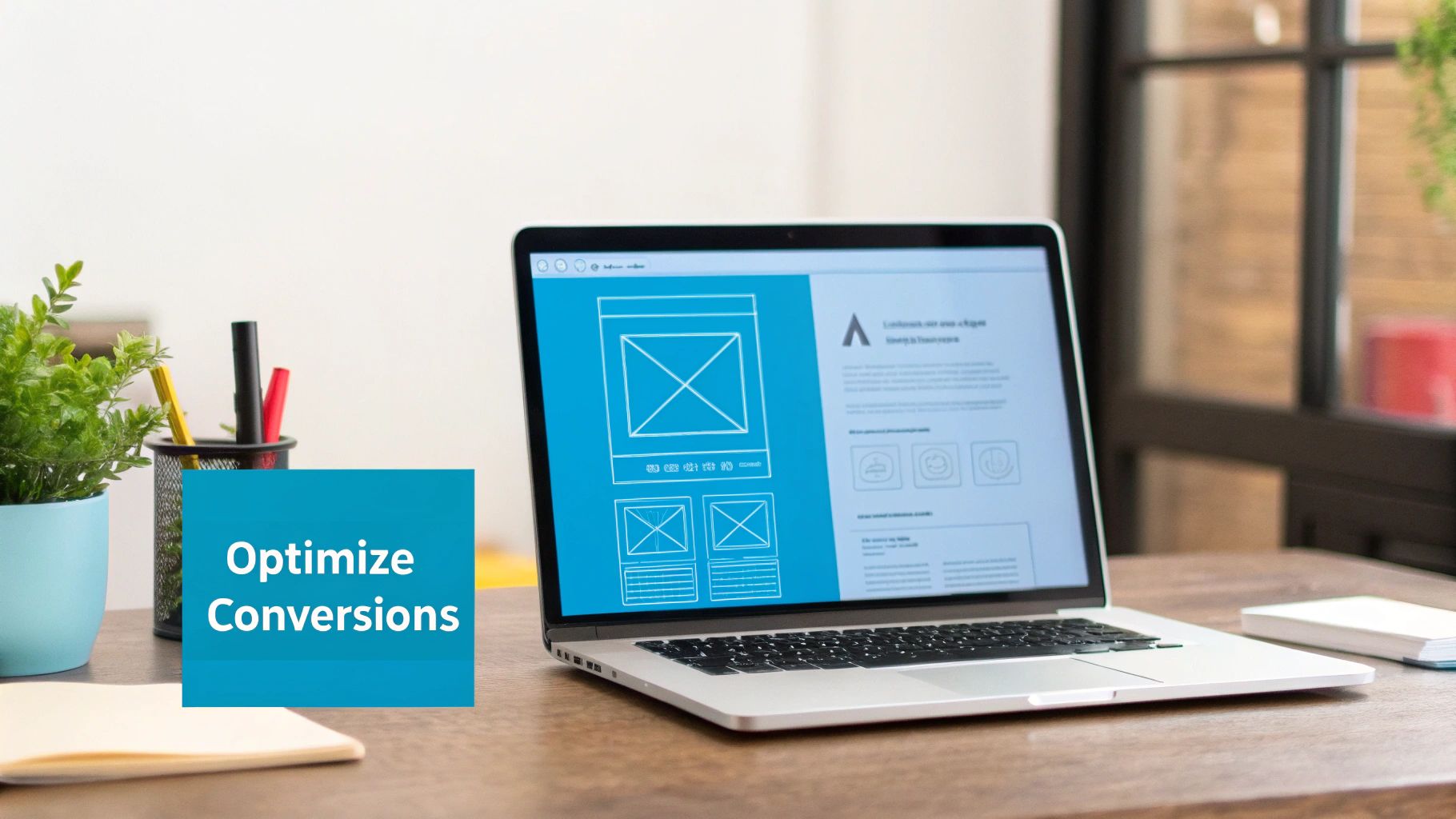
One of the highest-impact lead generation strategies involves optimizing the traffic you already have. Conversion Rate Optimization (CRO) is the systematic process of improving your website and landing pages to increase the percentage of visitors who take a desired action, such as filling out a form, making a purchase, or calling your business. This data-driven approach ensures your digital assets are built not just to attract visitors, but to convert them into valuable leads.
This strategy focuses on maximizing your existing marketing efforts. A law firm, for example, could test removing its main navigation from a landing page to keep users focused on the call-to-action, potentially increasing form submissions by over 20%. Even a small lift in your conversion rate, from 2% to 3%, represents a 50% increase in leads without spending a single extra dollar on advertising, making it one of the most cost-effective growth levers.
How to Implement This Strategy
- Test One Variable at a Time: To get clear, actionable data, isolate your tests. Change only the headline, the call-to-action (CTA) button color, or the primary image in an A/B test to understand exactly what influences user behavior.
- Remove Unnecessary Form Fields: Each additional field you ask a user to fill out creates friction and reduces your conversion rate. Eliminate any non-essential fields; a simple name and email combination often outperforms a form asking for a phone number and company size.
- Add Social Proof Above the Fold: Place compelling testimonials, client logos, or five-star reviews near the top of your page. This immediately builds trust and validates your offer before the user has to scroll.
- Simplify Your Value Proposition: Your headline must instantly communicate what you offer and why it matters. Use clear, benefit-driven language that directly addresses a visitor’s primary pain point.
Key Insight: Generating more traffic is expensive; converting the traffic you already have is smart. CRO delivers a compounding return by making every other marketing channel, from SEO to PPC, more effective and profitable. To go deeper, you can discover more about landing page design best practices on netcodesign.com.
7. Facebook & Instagram Lead Generation Ads
One of the most direct lead generation strategies involves using Meta’s powerful advertising platform to capture user data without them ever leaving the app. Facebook and Instagram Lead Ads are designed to minimize friction by pre-populating a contact form with the user’s profile information, such as their name and email address. This seamless process makes it incredibly easy for interested prospects to submit their details.
This strategy is highly effective because it combines precise audience targeting with a low-effort conversion action. A local real estate agent, for instance, can serve an ad for a new listing directly to users in a specific zip code who have shown interest in Zillow or home buying. When a user clicks, a form instantly appears, making lead capture quick and efficient. This method is ideal for businesses that need to build their contact lists with highly qualified, targeted leads.
How to Implement This Strategy
- Create Lookalike Audiences: Upload a list of your best customers and let Meta’s algorithm find new users who share similar demographics and behaviors. Start with a 1% lookalike for the highest similarity.
- Leverage Video Creatives: Use short, engaging video ads that showcase your product or service in action. Videos typically achieve significantly higher engagement and conversion rates than static images.
- Keep Forms Minimalist: Only ask for essential information. The more fields you add, the lower your completion rate will be. Stick to 3-5 fields like name, email, phone, and one key qualifying question.
- Retarget Warm Audiences: Run dedicated lead ad campaigns targeting users who have previously visited your website, engaged with your social media profiles, or watched your videos but did not convert.
Key Insight: The primary advantage of in-platform lead ads is the drastic reduction in user friction. By eliminating the need to load an external landing page, you can significantly increase your conversion rates, especially on mobile devices where speed is critical. You can learn more about crafting effective social media campaigns and other lead generation strategies at netcodesign.com.
8. Webinars & Virtual Events for Lead Generation
Hosting educational webinars and virtual events is a highly effective method for attracting engaged, high-quality leads. This strategy involves presenting valuable information live to an audience that has opted in, providing a direct channel to demonstrate expertise and build trust. By offering solutions to specific industry problems, you qualify attendees as genuinely interested prospects, making the subsequent sales conversation much warmer.
This approach is especially powerful for B2B services, SaaS companies, and high-ticket consulting, where educating the potential customer is a crucial part of the sales cycle. For instance, a financial advisory firm could host a webinar on “5 Retirement Planning Mistakes to Avoid,” attracting individuals actively seeking financial guidance. This upfront value exchange positions your brand as a helpful authority and generates leads who are already invested in your message.

How to Implement This Strategy
- Create a Compelling, Benefit-Driven Title: Focus on the outcome for the attendee. Instead of “Introduction to Our Software,” use a title like “How to Triple Your Team’s Productivity in 30 Days.”
- Promote Extensively: Begin promoting your event 4-6 weeks in advance across email lists, social media channels, and targeted paid ads to maximize registrations.
- Automate Reminders: Send a sequence of reminder emails: one week, one day, one hour, and even 15 minutes before the event starts to boost live attendance rates.
- Repurpose Your Content: Record the webinar and make it available on-demand as a new lead magnet. You can also break it down into shorter video clips for social media or a YouTube series.
Key Insight: Webinars allow you to connect with hundreds of potential leads simultaneously in a highly personal and interactive format. The key is to deliver 90% educational value and reserve only 10% for a direct, relevant pitch at the end.
9. Strategic Partnerships & Affiliate Marketing
One of the most effective lead generation strategies is leveraging the audiences and credibility of other businesses through strategic partnerships. This approach involves building mutually beneficial relationships with non-competing companies that serve a similar customer base, allowing you to cross-promote services and share qualified leads. It’s a powerful way to tap into a warm, pre-vetted audience with built-in trust.
This strategy works because it’s based on trusted recommendations rather than cold outreach. For instance, a residential plumber could partner with a local electrician to refer clients to each other, knowing the homeowner likely needs both services. This method generates high-quality leads at a low acquisition cost, effectively turning other businesses into a dedicated, motivated sales force for your brand.
How to Implement This Strategy
- Identify Complementary Partners: List 5-10 non-competing businesses that share your ideal customer profile. Think about services your clients need before, during, or after they use yours.
- Establish Clear Terms: Create a formal agreement outlining the commission structure (e.g., 10-30% per sale), payment schedule, and any exclusivity clauses. Clarity prevents future misunderstandings.
- Equip Partners for Success: Provide your affiliates with all necessary marketing materials, including unique tracking links, email templates, social media copy, and dedicated landing pages to ensure consistent messaging and accurate attribution.
- Monitor Performance and ROI: Track the quantity and quality of leads generated by each partner. This data will help you identify your most valuable relationships and optimize the program over time.
Key Insight: Partnerships and affiliate programs provide built-in credibility, as leads arrive via a trusted recommendation, not a cold advertisement. This dramatically shortens the sales cycle. To dive deeper, you can explore a comprehensive guide on lead generation affiliate marketing to structure a high-performing program.
10. Reputation Management & Review Generation
Actively managing your online reputation is one of the most powerful yet overlooked lead generation strategies available today. This approach involves systematically encouraging satisfied customers to leave positive reviews on key platforms like Google, Yelp, and industry-specific directories. Since the vast majority of consumers trust online reviews as much as personal recommendations, a strong digital reputation directly translates into higher trust, better search visibility, and increased conversions.
This strategy is about building social proof that works for you 24/7. A home services company with a 4.9-star rating and dozens of recent, glowing testimonials will almost always win the lead over a competitor with a 3.5-star rating or no reviews at all. It’s a critical trust signal that validates a potential customer’s choice before they ever contact you, significantly shortening the sales cycle and increasing the quality of incoming inquiries.
How to Implement This Strategy
- Automate Your Requests: Use email or SMS automation to send a review request within 24 hours of a completed service or product delivery. Timing is crucial to catching customers when their positive experience is top of mind.
- Make It Effortless: Provide a direct, one-click link to your preferred review platform (e.g., your Google Business Profile). The fewer steps a customer has to take, the higher your success rate will be.
- Respond to Every Review: Engage with all feedback, both positive and negative, within 24-48 hours. Thanking positive reviewers and professionally addressing negative feedback shows you value customer input and are committed to service excellence.
- Leverage Positive Feedback: Showcase your best reviews on your website, in email newsletters, and on social media. Turn your happy customers into your most effective marketing assets.
Key Insight: Your online reputation acts as a conversion multiplier for all other marketing efforts. A stellar review profile can significantly boost the ROI of your SEO, PPC, and content marketing, making it a foundational element of a successful lead generation system.
11. LinkedIn Outreach & Sales Navigator Strategy
For B2B companies, direct outreach on LinkedIn remains one of the most effective lead generation strategies for connecting with high-value decision-makers. Using a tool like Sales Navigator allows you to move beyond simple network building and implement a hyper-targeted prospecting system. This approach focuses on identifying, researching, and engaging key individuals at your target accounts with personalized, value-driven messaging.
This strategy is about precision, not volume. A management consultant, for example, can use Sales Navigator to identify C-suite executives at mid-sized manufacturing firms that recently announced expansion plans. This context allows for a highly relevant and personalized outreach message, cutting through the noise of generic sales pitches. It’s a direct line to the people who can actually make purchasing decisions.
How to Implement This Strategy
- Build Hyper-Targeted Lead Lists: Use Sales Navigator’s advanced filters to target prospects by specific criteria like company size, industry, job title, seniority, and even recent job changes. This ensures you are only spending time on qualified leads.
- Personalize Your Initial Outreach: Before sending a connection request or InMail, research the prospect. Reference a recent company announcement, a post they shared, or a mutual connection. Keep the first message short (2-3 sentences) and focused on providing value, not asking for a meeting.
- Engage Before You Connect: Like and comment on a prospect’s recent posts for a few days before reaching out. This warms up the lead and makes your name familiar when your connection request arrives in their inbox.
- Follow Up with Valuable Content: Once a connection is accepted, don’t immediately pitch. Instead, follow up a few days later by sharing a relevant case study, a helpful article, or an industry report that addresses a likely pain point for their role.
Key Insight: The goal of the initial outreach is not to book a meeting; it’s to start a conversation. By leading with research, personalization, and value, you build rapport and position yourself as a helpful expert, making the eventual transition to a sales discussion feel natural and welcome.
12. AI-Powered Optimization & AI Search Integration
As search evolves beyond traditional browsers, optimizing for AI-driven engines like ChatGPT, Perplexity, and Google’s AI Overviews is becoming a critical lead generation strategy. This approach involves structuring your website’s data and content so AI models can easily understand, verify, and recommend your business in their generated answers. When users ask AI for “the best dental implant specialist in Tampa,” this optimization ensures your practice is a top contender.
This strategy positions your brand for the future of search, where being an authoritative source for AI is as important as ranking on a results page. For instance, a law firm can optimize its content about specific case types, enabling AI to cite their expertise when answering legal queries. This builds immense credibility and captures high-intent leads who trust the AI’s curated recommendations, making it a forward-thinking tactic for sustained growth.
How to Implement This Strategy
- Implement Comprehensive Schema Markup: Use structured data like
LocalBusiness,Organization, andFAQPageschema to explicitly tell AI models who you are, what you do, and what questions you answer. - Focus on Entity Optimization: Ensure that key entities like your company name, founders’ names, and specific services are consistently and clearly defined across your site and linked to authoritative sources (like a LinkedIn profile).
- Format Content for AI Extraction: Structure your content with clear headings, bullet points, and bolded key facts. Create concise, direct answers to common questions, making it easy for AI to pull information for its summaries.
- Establish Expertise and Trust: Clearly display author credentials, qualifications, and bylines. Include publication and “last updated” dates on all content to signal recency and accuracy to AI evaluators.
Key Insight: Optimizing for AI search is not just about keywords; it’s about becoming a recognized, citable authority in your niche. By structuring your data for machine readability, you are essentially preparing your website to be recommended by the next generation of search engines.
Turning Strategy into Action: Building Your Custom Lead Generation Engine
We’ve explored a comprehensive arsenal of twelve powerful lead generation strategies, from the foundational pillars of Local SEO and content marketing to the advanced frontiers of AI optimization. The sheer volume of options can feel overwhelming, but the goal isn’t to implement every single one simultaneously. True success lies in strategic selection and masterful execution, transforming this list from a simple catalog into a custom-built blueprint for your business’s growth.
The most effective approach is not a one-size-fits-all solution; it is a dynamic, integrated engine where each component complements the others. Think of it as a well-oiled machine: your SEO-optimized blog content becomes the fuel for your email nurturing funnels and social media posts. Your targeted PPC campaigns drive high-intent traffic directly to landing pages that have been meticulously refined through Conversion Rate Optimization (CRO). Each lead generated through a webinar or a strategic partnership is then nurtured into a loyal customer through a thoughtful email sequence. This synergy is where sustainable growth is born.
From Blueprint to Reality: Your Actionable Next Steps
To move from theory to tangible results, you must prioritize. Avoid the temptation to spread your resources too thin across too many channels. Instead, focus your energy on the strategies that promise the highest immediate impact for your specific business model.
1. Conduct a Quick Audit and Prioritization:
Review the twelve strategies and ask yourself three critical questions for each:
- Impact: Which 2-3 of these strategies will most directly connect us with our ideal customer persona?
- Resources: What is our current budget, and who on our team has the skills to execute this?
- Timeline: Which tactics can deliver short-term wins to build momentum, and which require a longer-term commitment?
A local home services company in Tampa, for instance, should immediately prioritize Local SEO and Reputation Management to dominate local search results. In contrast, a B2B software startup would likely gain more traction by focusing on a robust LinkedIn Outreach plan and a value-packed Content Marketing funnel.
2. Master the Fundamentals First:
Before diving into complex ad campaigns or AI tools, ensure your foundation is solid. Is your website designed for conversions? Is your Google Business Profile fully optimized? A leaky bucket will waste every lead you pour into it. Securing these core assets ensures that every dollar and hour you invest in more advanced lead generation strategies will yield a much higher return.
3. Embrace a Test-and-Measure Mindset:
Digital marketing is not a “set it and forget it” discipline. Every campaign, landing page, and email is an opportunity to learn.
- Define Your KPIs: Before launching, know exactly what success looks like. Is it cost per lead, conversion rate, or customer lifetime value?
- Track Everything: Use tools like Google Analytics, CRM software, and platform-specific dashboards to monitor performance.
- Iterate Relentlessly: Use the data you gather to refine your targeting, messaging, and offers. Small, consistent improvements over time lead to monumental gains.
Building a powerful lead generation engine is a journey of strategic implementation, continuous learning, and intelligent adaptation. By selecting the right combination of lead generation strategies, focusing on meticulous execution, and committing to data-driven optimization, you can create a predictable and scalable system that consistently delivers qualified leads, drives revenue, and fuels your business’s long-term success.
Ready to transform your lead generation strategies from a list of ideas into a revenue-generating reality? The expert team at Netco Design LLC specializes in creating and executing custom digital marketing engines that drive measurable growth. Let us build the powerful, integrated system your business needs to thrive.

