

table of contents
Think of a LinkedIn marketing strategy as your playbook for turning the platform into a lead-generating machine. It’s not just about posting company updates and hoping for the best. A real strategy involves a deep dive into optimizing your profiles, creating content people actually want to read, engaging with your network, and sometimes, putting a little money behind ads to hit your goals faster.
When you have a solid plan, LinkedIn stops being a professional social network and becomes a core part of your business development toolkit.
Why LinkedIn Is Your B2B Growth Engine
Okay, let’s get past the obvious: LinkedIn is a must-have for B2B. The real question is why it crushes every other platform for serious business growth. The secret is its environment. People are there with a business-first mindset.
Unlike other social media platforms designed for distraction and entertainment, LinkedIn is where professionals go to network, solve work problems, and advance their careers. This creates an incredible opportunity for small and mid-sized businesses to get directly in front of key decision-makers. It’s less of a digital Rolodex and more of a living, breathing ecosystem where you can build real credibility.
The Data-Backed Dominance in B2B
The numbers don’t lie. When it comes to B2B marketing, a mind-blowing 80% of all B2B leads from social media are generated on LinkedIn. That leaves just 13% for X (formerly Twitter) and a tiny 7% for Facebook. That’s no accident—it’s the direct result of a user base filled with people who are paid to make business decisions.
This makes LinkedIn an insanely efficient place to invest your marketing time and money. You’re not just shouting into the void; you’re speaking to an audience with real purchasing power. If you’re looking for broader strategies that work well with LinkedIn, our guide on how to generate leads online is a great place to start.
A Strategic Business Development Tool
Treating LinkedIn as just another social media checkbox to tick is a massive mistake. It’s a powerful business development tool with a clear ROI. When you get your strategy right, you can:
- Build Authority: Sharing genuinely useful insights consistently positions you as the go-to expert in your field.
- Generate High-Quality Leads: The platform’s targeting, both organic and paid, lets you pinpoint your ideal customer with surgical precision.
- Shorten the Sales Cycle: You can build trust and nurture relationships with prospects directly, warming them up long before a sales call ever happens.
A dedicated LinkedIn plan is a serious competitive advantage. You’re building a direct line to the exact people who can move the needle for your business. To go even deeper, you can explore comprehensive LinkedIn marketing strategies that help drive long-term B2B growth.
Building a Profile That Actually Attracts Clients
Before you even dream of writing a single post or launching an ad, we need to talk about your LinkedIn profile. Seriously. It’s not just a digital resume; it’s your primary landing page on the platform. Get this wrong, and every other marketing effort you make will fall flat.
Your mission is to turn both your personal profile and your Company Page into magnets for your ideal clients. This isn’t about just filling in the blanks. It’s about strategically positioning yourself as a go-to resource, not just another person trying to sell something. A solid foundation here makes everything else—from outreach to ads—infinitely more powerful.
Optimize Your Personal Profile for Discovery
Most of the time, your personal profile is the first impression. Put yourself in your ideal client’s shoes for a second. When they land on your page, does it scream “I can solve your problem,” or does it just list your job history?
Your headline is the most valuable real estate you have. Don’t just put your job title, like “Owner at ABC Solutions.” That’s a missed opportunity. Reframe it around the value you deliver. For instance, a marketing consultant could swap that out for: “Helping SaaS Startups Build Predictable Lead Funnels | SEO & Content Strategy | B2B Growth Expert.” See the difference? It’s packed with keywords and speaks directly to a specific audience’s pain points.
Next up is your “About” section. This is your chance to tell a story, not just list skills. Explain who you help, the problems you solve, and what makes you the right person for the job. Break it up with short paragraphs and bullet points so people can actually scan it. This is where you build a real human connection.
Build a Company Page That Converts
Your Company Page plays a different but equally critical role. It’s the official hub for your business, giving you and your whole team an anchor of credibility. The data doesn’t lie: LinkedIn found that fully completed Company Pages get 30% more weekly views. That’s a huge return for a simple task.
Make sure every single section is filled out, especially a compelling “About Us” that nails your value proposition. Use that big banner image at the top to showcase a tagline, announce an event, or highlight a core service. So many businesses waste this prime visual space.
Just look at how LinkedIn uses its own Company Page. The banner isn’t just a pretty picture; it’s a strategic messaging tool.
They use it to reinforce their mission to “connect the world’s professionals.” It’s simple, effective, and works 24/7.
Your profiles are your silent salespeople. They work around the clock. When a potential client searches for a solution you offer, a keyword-rich and value-focused profile ensures you show up as the answer, qualifying leads before you even lift a finger.
Leverage Social Proof and Recommendations
In B2B, trust is everything. Luckily, LinkedIn gives you powerful tools to build it. Recommendations on your personal profile are basically digital testimonials, and they carry a ton of weight. Don’t be shy—proactively ask happy clients to write a quick recommendation about their experience working with you.
Imagine a law firm where the partners feature recommendations from corporate clients, highlighting their expertise in specific legal areas. That provides instant, credible social proof for anyone vetting their services. Of course, this only works if you know exactly who you’re trying to attract in the first place. If you’re fuzzy on that, you should check out our guide on how to create buyer personas in our detailed guide.
On the company side, encourage your employees to link their profiles to your Company Page. This does more than just expand your collective network; it humanizes your brand. When prospects see a team of active, engaged professionals tied to your company, it builds confidence and makes your business feel much more approachable and real.
Your High-Impact Content and Engagement Plan
Once your profiles are dialed in, it’s time to focus on the fuel for your LinkedIn engine: your content. A powerful LinkedIn marketing strategy really comes down to what you say and how you say it. The goal isn’t to just shout into the void—it’s to start meaningful conversations and become a go-to voice in your industry.
Think about it: content is the bridge between having a polished profile and actually generating leads. It’s how you prove your expertise, build trust over time, and stay top-of-mind with your ideal clients. Without a plan, your feed is just a random collection of updates. With a plan, it becomes a strategic asset.
This visual breaks down a simple but effective way to think about how your profile supports your content.
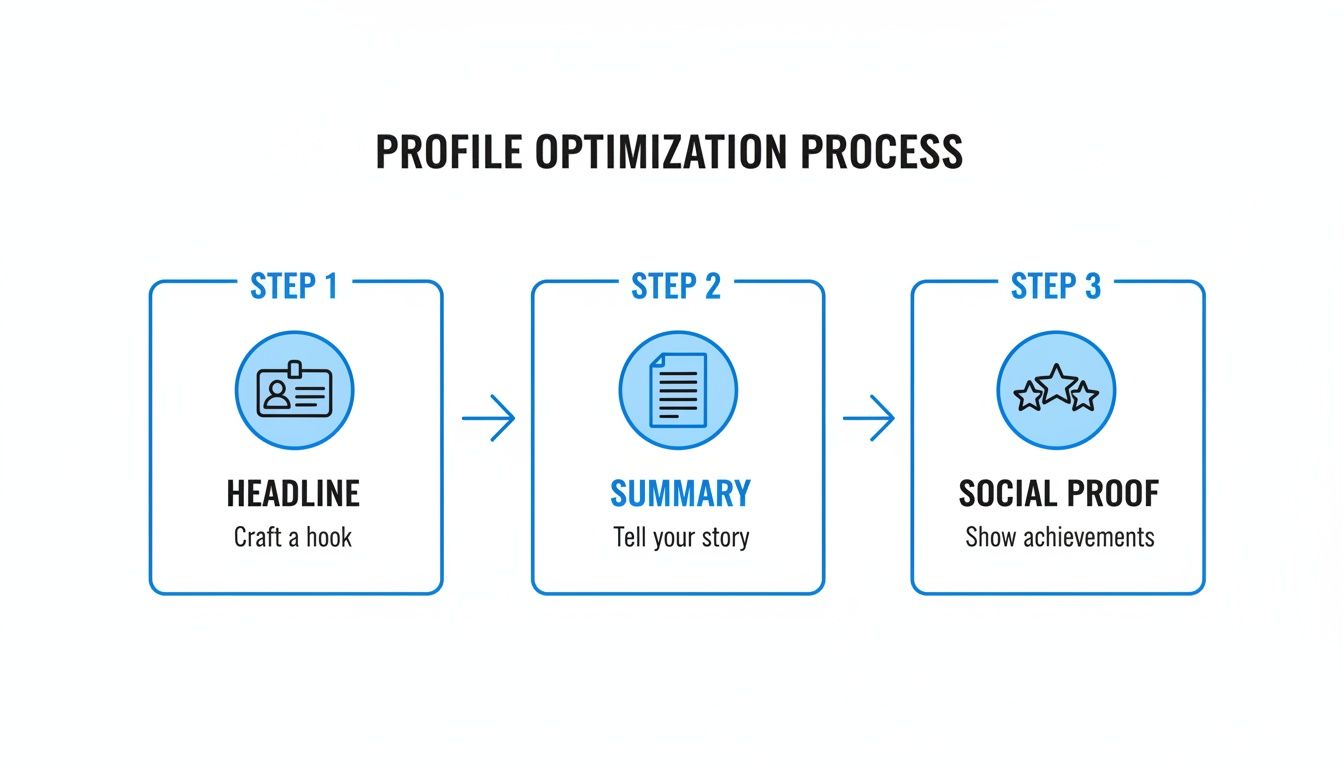
It all works together. A compelling headline, a clear summary, and solid social proof give your content the credibility it needs to land with your audience.
Identify Your Core Content Pillars
Before you even think about writing a post, you need to define your content pillars. These are the 3-5 core themes you’ll consistently talk about. I like to think of them as the intersection of what you know best and what your audience struggles with the most.
For example, a B2B SaaS company that sells project management software might build their content around pillars like:
- Team Productivity Hacks: Simple, actionable tips for getting more done.
- Remote Work Leadership: Real-world advice for managers leading distributed teams.
- Project Management Trends: Insights on where the industry is headed.
- Customer Success Stories: Proof that their software solves real problems.
These pillars are your North Star. They keep your content focused, ensuring every post reinforces your authority and attracts the right kind of followers.
Choose the Right Format for the Message
LinkedIn gives you a whole toolbox of content formats, and the best strategies mix it up to keep the feed interesting. Each one has its own strengths, and knowing when to use which is a game-changer.
- Text-Only Posts: These are fantastic for sparking quick discussions or sharing a strong opinion. They’re easy to read, so they often get great engagement right out of the gate.
- Carousels (PDF Documents): Perfect for teaching. Use them to break down a complex idea into bite-sized slides, share a step-by-step process, or repurpose a blog post into a visual guide.
- Video Content: Nothing builds a personal connection faster. Short videos are great for sharing a quick tip, giving a behind-the-scenes look at your business, or explaining something that’s easier to show than tell.
- Polls: A super simple way to get a ton of engagement and gather quick feedback from your audience.
The data backs this up. 97% of B2B marketers now use LinkedIn for content marketing, and the platform’s algorithm loves content that sparks real conversation—especially native videos and in-depth carousels. When you consider that four out of five LinkedIn users have a say in business purchasing decisions, you can see why a varied content plan is non-negotiable.
Pro Tip: Don’t just post content—create conversations. Always end your posts with a question to get people talking. When someone leaves a comment, respond thoughtfully to keep the dialogue going. The algorithm eats this stuff up.
For a deeper dive, check out this excellent guide on developing a comprehensive LinkedIn content strategy.
Below is a simple matrix to help you visualize how to map different content formats to your pillars. This ensures you’re not just posting text all the time.
LinkedIn Content Pillar and Format Matrix
Here’s a breakdown of how you might map different content formats to your chosen pillars:
Pillar 1: Team Productivity Hacks
- Text-Only Post Idea: “What’s one underrated tool your team can’t live without? Ours is…”
- Carousel/Document Idea: 5-slide guide on “The Pomodoro Technique for Remote Teams”
- Video Idea: 60-second video: “My #1 trick for a more focused workday”
Pillar 2: Remote Work Leadership
- Text-Only Post Idea: A short story about a leadership mistake and the lesson learned.
- Carousel/Document Idea: “10 Common Mistakes New Remote Managers Make (and How to Fix Them)”
- Video Idea: Quick interview with another leader on managing team morale.
Pillar 3: Customer Success Stories
- Text-Only Post Idea: A brief post tagging a client and celebrating their recent win using your tool.
- Carousel/Document Idea: A case study carousel showing the “Before & After” results for a client.
- Video Idea: A testimonial video featuring a happy customer sharing their experience.
This kind of planning helps you stay consistent and keeps your content calendar from feeling overwhelming. If you want a bigger-picture framework, you might find our guide on building a complete social media content strategy helpful.
Master the Art of Proactive Engagement
A smart content plan isn’t just about what you post on your own profile. A huge part of any successful LinkedIn marketing strategy is getting out there and engaging in conversations happening on other people’s turf. This is how you get on the radar of new prospects and expand your network organically.
Carve out just 15-20 minutes a day for this. Here’s what to do:
- Comment on Posts from Industry Leaders: Find the key influencers in your niche and add thoughtful, value-add comments to their content. Don’t just say, “Great post!”—add your own perspective or ask a smart follow-up question.
- Engage with Your Ideal Clients: Make a list of companies or people you want to work with and interact with their posts. This builds genuine familiarity and rapport long before you ever think about sending a connection request.
- Participate in Relevant Groups: Active LinkedIn Groups can be a goldmine. Jump in, answer questions, and share your expertise. You’ll quickly establish yourself as a helpful resource.
This proactive approach does more than just build relationships. It signals to the LinkedIn algorithm that you’re a valuable member of the community, which can give your own content a nice little visibility boost.
Using LinkedIn Ads to Accelerate Your Reach
If your organic content plan is the foundation, think of LinkedIn Ads as the jet fuel. It’s how you put your message directly in front of your ideal buyers, right when they’re in a business mindset.
Paid advertising isn’t a replacement for your organic work. Instead, it’s a powerful tool that guarantees visibility, drives predictable leads, and seriously speeds up your growth. The platform’s ad system is built for B2B precision, letting you target prospects with a level of detail that’s just not possible anywhere else. This is where your LinkedIn marketing strategy goes from building an audience to activating it on demand.
Choosing the Right Campaign Objective
Before you spend a single dollar, you have to know what you want to achieve. LinkedIn organizes its ad campaigns around specific business goals, and this first choice is critical. It determines everything that comes next—ad formats, bidding options, and how the algorithm optimizes your campaign.
Your options boil down to three main stages:
- Awareness: All about getting your brand name and message out there. The key metric here is impressions.
- Consideration: Designed to get people to interact with your brand. Think website visits, video views, or engagement on a post.
- Conversion: This is the bottom-of-the-funnel stuff. You’re driving direct action like lead generation, website conversions, or even job applications.
For most small and mid-sized businesses, the Lead Generation objective is the perfect place to start. It uses LinkedIn’s native Lead Gen Forms, which pre-fill with a user’s profile data. This makes it ridiculously easy for someone to show interest without ever leaving the platform, a simple step that can boost your conversion rates in a big way.
Building Your Hyper-Targeted Audience
This is where LinkedIn’s advertising power really comes to life. You can build audiences based on incredibly specific professional criteria, making sure every ad dollar is spent on the people who actually matter to your business.
Let’s say you’re a local IT services provider in Tampa. You could create an audience that targets:
- Job Titles: “IT Manager,” “Operations Director,” “Office Manager”
- Company Size: Companies with 10-100 employees
- Geography: Pinned right to the Tampa Bay area
- Industry: “Legal Services,” “Healthcare,” “Financial Services”
Or maybe you’re a national SaaS company selling accounting software. Your audience could target:
- Job Seniority: “CFO,” “VP of Finance,” “Controller”
- Member Skills: People who list skills like “Financial Reporting” or “QuickBooks” on their profile.
- Company Growth Rate: High-growth companies that are probably looking for new solutions.
The real secret is to shift from a broad marketing mindset to one of surgical precision. When you layer these targeting options, you create an audience that isn’t just likely to be interested—they’re pre-qualified by their professional identity.
Creating Ads That Stop the Scroll
Your ad has one job: interrupt the endless scroll and offer immediate value. The LinkedIn feed is a noisy place, so generic visuals and vague headlines are a death sentence for your budget.
For your copy, lead with a hook that hits a specific pain point. Instead of, “Our Software Does X,” try something like, “Tired of Manual Expense Reporting? Automate it in Minutes.” This problem-solution angle is far more compelling.
Visually, keep it clean and professional. Single-image ads with bold text overlays work great. Short video ads (under 30 seconds) that show off a key benefit are also winners. For more in-depth content, Document Ads (carousels) are fantastic for walking your audience through a mini case study or a step-by-step guide.
Setting a Budget That Makes Sense
You don’t need a massive budget to see results on LinkedIn. You can set a daily or total campaign budget, giving you complete control over your spend.
For a small business just dipping its toes in the water, a daily budget of $25 to $50 is a perfectly realistic amount to start testing and gathering data.
The most important metric to watch at the beginning is your Cost Per Lead (CPL). As you run campaigns, you’ll figure out what a qualified lead costs in your industry. That data is gold for forecasting your budget and scaling your efforts down the road. It can feel like a lot to manage, which is why many businesses look into specialized services for PPC management for small business to maximize their return. Once you know your CPL, you can build a predictable lead generation engine that keeps your sales pipeline full.
From Connection to Client: How to Convert on LinkedIn

Watching your connection count climb is a nice ego boost, but it doesn’t pay the bills. The real magic happens when you have a system for turning those digital handshakes into actual client relationships. This is the bridge between building an audience and activating it—where your LinkedIn marketing strategy starts generating real revenue.
This is all about nurturing the leads you get from both your organic posts and your paid ads. You need a smooth, non-pushy path that guides someone from a simple connection to a real sales conversation. Without a plan, you’re just letting good leads go cold.
Crafting Connection Requests That Actually Work
First impressions matter. A generic, default connection request is the digital version of a limp handshake—it’s forgettable and does nothing to build rapport. To cut through the noise, your request has to be personal and add value from the get-go.
Show them you’ve done your homework. A killer request might mention:
- A piece of content they recently shared or commented on.
- A mutual connection or a group you’re both in.
- Their specific role in the context of a problem you solve.
Instead of the default message, try something like: “Hi [Name], I saw your insightful comment on [Influencer’s] post about remote team productivity. I’ve been exploring similar challenges with my clients and would love to connect and follow your work.” This approach immediately finds common ground and proves you have a genuine interest.
Following Up Without Being Salesy
Once they accept, the real work begins. Bombarding them with a sales pitch is the fastest way to get ignored or, worse, removed as a connection. The key is to nurture the relationship with patience and value.
Your follow-up messages should feel less like a sales cadence and more like a helpful conversation. Wait a day or two after they connect, then send a message that offers something useful without asking for anything in return. Share a relevant article, invite them to a free webinar, or just ask a thoughtful question about their industry.
Remember, the goal is to build trust, not to close a deal in the first message. Your initial follow-ups should be 90% value and 10% ask. As you build rapport over time, you can slowly shift that balance.
The data backs this up. Studies show LinkedIn is 277% more effective for lead generation than Facebook and X combined, precisely because it’s built for these kinds of professional, trust-based interactions. It’s why 89% of B2B marketers use it to generate leads, and why its audience has twice the buying power of the average web user. If you want to dive deeper, you can explore more of these powerful LinkedIn lead generation statistics.
Using Lead Gen Forms to Make It Easy
For your paid ads, LinkedIn Lead Gen Forms are an absolute must. These forms pre-fill with a user’s profile info—like their name, email, and job title.
This simple feature makes signing up for a demo, downloading an ebook, or registering for an event ridiculously easy. A prospect can convert with just a couple of clicks, all without ever leaving the LinkedIn app. This seamless experience almost always delivers a higher conversion rate than sending people to an external landing page.
Taking the Conversation Off LinkedIn
Ultimately, the goal is to move high-intent conversations to a more direct channel, like a phone call, a Zoom meeting, or your email list. But this transition has to feel like a natural next step, not an awkward pivot.
After a few value-driven exchanges on LinkedIn, you can suggest moving things forward. Just be sure to frame it around their needs, not yours.
A great transition message could sound like this: “Based on our chat about [their pain point], it sounds like you’re wrestling with [specific challenge]. I have a few ideas that might help. Would you be open to a quick 15-minute call next week to explore them?”
This approach is respectful, specific, and positions the call as a valuable use of their time. It’s the final piece of the puzzle, turning a simple LinkedIn connection into a genuine sales opportunity.
How to Measure and Optimize Your Strategy
Running a LinkedIn strategy without tracking your data is like driving blind. You might be moving, but you have no clue if you’re heading in the right direction. Measuring your performance is what turns guesswork into a predictable growth engine, letting you fine-tune your approach for better and better results over time.
The good news? LinkedIn gives you a solid suite of built-in analytics right out of the box. Think of this data as your direct feedback loop—it tells you exactly what’s resonating with your audience and what’s falling flat. If you’re serious about long-term success, making a habit of checking these numbers is non-negotiable.
Key Metrics for Your Company Page
When it comes to your organic efforts, your Company Page analytics are the source of truth. It’s easy to get caught up in vanity metrics, but you need to focus on the numbers that signal a real connection with your audience.
Here’s where I’d start:
- Follower Growth: Is your audience actually expanding? A steady climb here shows your content and profile are pulling in the right kinds of people. It’s a basic but vital health check.
- Engagement Rate: This is the big one. It’s the percentage of your audience that actually interacts with your posts through likes, comments, and shares. A high engagement rate is a powerful signal to the LinkedIn algorithm that your content is valuable, which in turn boosts its reach.
- Visitor Demographics: Who’s stopping by your page? LinkedIn breaks down their job titles, industries, and seniority levels. This is your reality check—are you attracting the people you think you are?
Analyzing Your Paid Campaign Performance
Once you start putting money behind ads, the stakes get higher and your metrics need to get sharper. Your goal isn’t just to get clicks; it’s to connect every dollar you spend to a real business outcome. Forget about simple impressions and look at the numbers that really matter.
For paid campaigns, I keep a close eye on these:
- Click-Through Rate (CTR): This tells you how compelling your ad creative and copy are. If your CTR is low, it’s a strong sign that your message isn’t landing with your target audience. Time for a rewrite or a new visual.
- Cost Per Lead (CPL): For any lead generation campaign, this is your north star metric. It tells you exactly how much it costs to get one new prospect in the door, which is absolutely critical for managing your budget and deciding when to scale up.
- Conversion Rate: Of all the people who clicked and became a lead, how many took the next step you wanted them to? This metric helps you gauge the quality of the leads your ads are bringing in. A high CPL with a low conversion rate is a recipe for wasted ad spend.
A simple monthly review is all it takes to stay on track. Just ask yourself: What content drove the most comments and shares? Which ad campaign delivered the lowest CPL? Then, double down on what works and cut what doesn’t.
This cycle of continuous improvement is the real secret behind an effective LinkedIn marketing strategy. By tying these platform-specific metrics back to your bigger business goals, you start making much smarter decisions. If you want to get even more granular, you can learn more about how to calculate marketing ROI to connect your LinkedIn efforts directly to revenue.
Your Top LinkedIn Questions, Answered
Jumping into any platform brings up questions. Here are the straight answers to the most common ones we hear from businesses building out their LinkedIn marketing strategy.
How Often Should I Post on LinkedIn?
Forget the old “post every day” mantra. What really matters is consistency, not just frequency.
Aim for three to five high-quality posts per week. This is the sweet spot—enough to keep you on your audience’s radar without flooding their feed. One thoughtful post that gets people talking is worth far more than five generic updates that fall flat.
What Is a Realistic Budget for LinkedIn Ads?
You don’t need a huge war chest to make an impact. For most small businesses, a daily budget of $25 to $50 is a perfect starting point. It’s enough to get your ads in front of the right people and start testing which messages and offers actually work.
The most important metric to watch is your Cost Per Lead (CPL). Once you know what it costs to get a qualified lead, you can scale your budget confidently and build a truly predictable sales pipeline.
Don’t get fixated on the spend; focus on the return. A higher CPL is perfectly fine if those leads turn into high-value clients. It’s all about tying your ad performance directly back to business growth.
How Long Does It Take to See Results?
LinkedIn results come in two flavors: fast and slow.
With paid ads, you can see tangible results—like new leads from a Lead Gen Form campaign—within the first few days of going live. It’s direct and immediate.
But building a real reputation and generating organic leads? That’s a long game. For your content and engagement strategy, you should plan to put in at least three to six months of consistent work. After that, you’ll start to see the powerful compounding effect of inbound messages, connection requests, and a network that actually knows, likes, and trusts you.
Ready to build a LinkedIn marketing strategy that drives real, measurable growth? The team at Netco Design LLC specializes in creating data-driven campaigns that attract pre-qualified customers and turn connections into clients. Learn how we can elevate your digital presence.

