

table of contents
Local SEO is all about showing up when potential customers in your area are actively looking for what you offer. It’s the art and science of getting your business to appear in local search results, like Google Maps and the “local pack,” so you can turn those neighborhood searches into real-world customers. If you serve a specific geographic area, this isn’t just a nice-to-have; it’s essential.
Why Local SEO Is Your Strongest Growth Engine
Let’s get straight to the point: local SEO isn’t just another item on your marketing checklist. It’s the most powerful lever you can pull for real, measurable business growth.
When someone searches for “emergency plumber near me” or “best coffee in Tampa,” they aren’t just window shopping. They have an immediate need and are ready to pull out their wallet. If you’re not showing up in those crucial moments, you’re not just missing out—you’re basically handing business over to your competitors. For local shops and service providers, a solid local SEO strategy is non-negotiable.
The Modern Customer Journey Starts Online
Face it, the days of a customer cracking open the Yellow Pages are long gone. Today, the journey to your front door almost always starts with a few taps on a smartphone. This shift means your digital storefront—your website and especially your Google Business Profile—has become your most valuable real estate.
Think about the scale of this. Every single day, a massive 46% of all Google searches have local intent. We’re talking about billions of queries from people looking for businesses right in their backyard. The numbers don’t lie: 97% of people use online searches to find local businesses, and an impressive 28% of those searches lead directly to a purchase.
This simple journey from search to sale is what it’s all about.
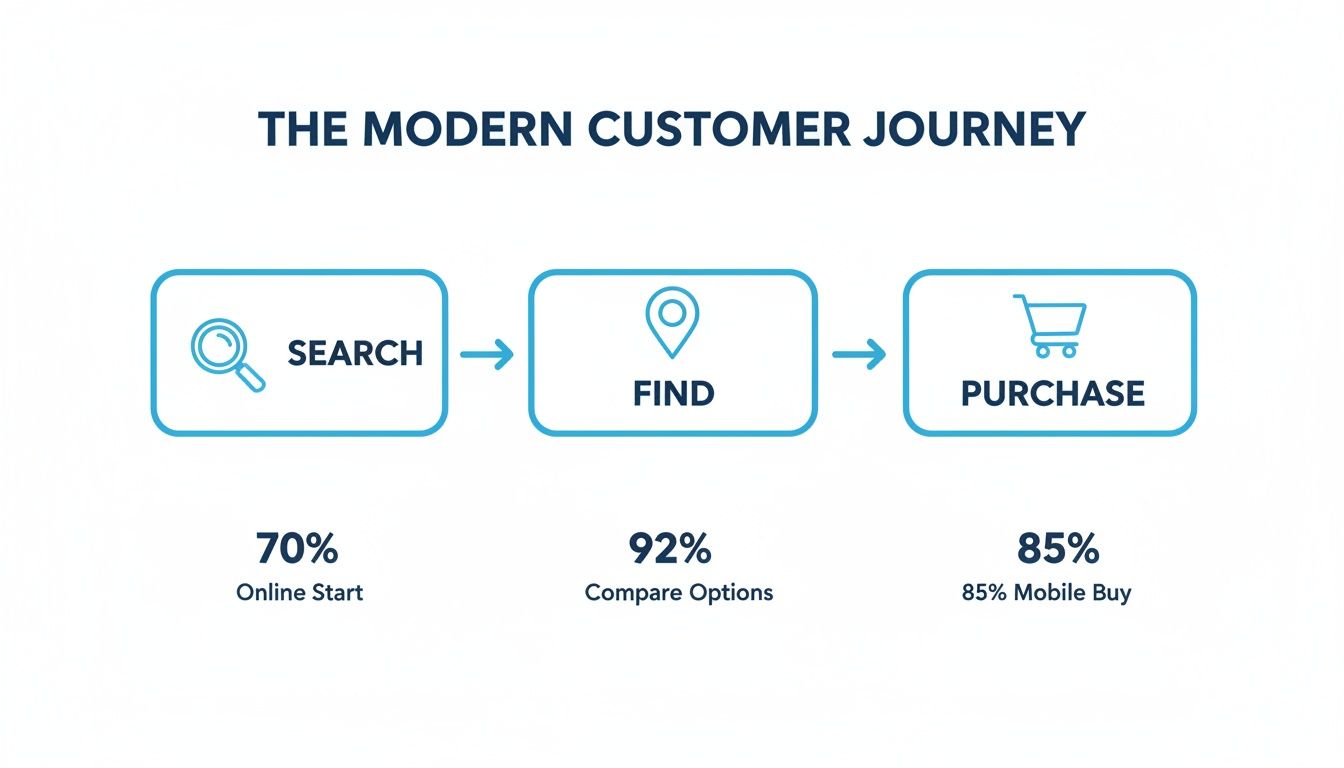
As you can see, the path from discovery to a transaction is incredibly short. Being visible in those first two stages is where the magic happens.
Tapping Into High-Intent Searches
The real power of local SEO is its laser focus. You’re not casting a wide, expensive net hoping to catch a few customers. Instead, you’re connecting with people who have a specific, urgent problem that you can solve right now.
Let’s paint a picture with a few real-world examples:
- A homeowner in St. Petersburg walks into their kitchen to find a puddle under the sink. Their first move? Grabbing their phone and searching for a “plumber in St. Pete.”
- A tourist exploring downtown Tampa gets hungry and searches for “best restaurants near me.”
- A parent in Clearwater has a sick child and needs to find a “same-day pediatrician appointment.”
In every one of these scenarios, the searcher is on a mission. They need a solution, and fast. Being the first business they see often means you’re the first one they call. You can dig deeper into the benefits of SEO for small business in our other guide.
Here’s the bottom line: When you nail your local SEO, you stop chasing customers and start letting them find you. It’s about positioning your business as the most obvious, credible answer to their immediate need. That’s how small and mid-sized businesses don’t just compete—they win.
Getting Your Google Business Profile to Work for You
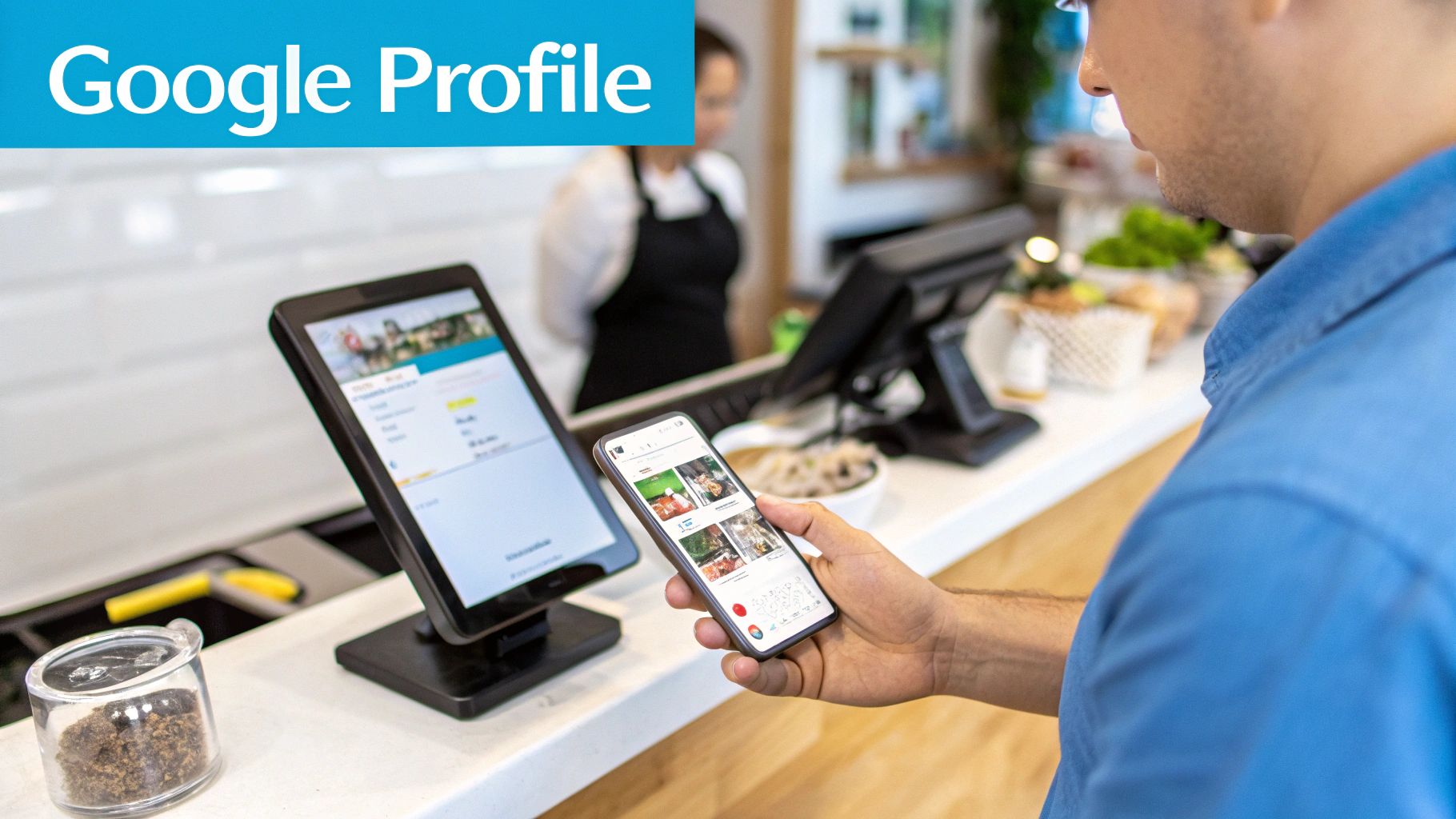
Think of your Google Business Profile (GBP) as your digital front door. For a huge number of potential customers, it’s their first impression of your business—often long before they even think about clicking through to your website.
A truly optimized profile does more than just list your hours. It’s a powerful tool that actively pulls in the right customers and convinces them to take the next step. Moving beyond a simple setup checklist is where the real wins in local business seo are found. It’s time to treat your GBP as the dynamic, customer-attracting machine it can be.
Nailing Your Business Categories
Your business categories are one of the most powerful levers you can pull on your GBP. This is how you tell Google, in no uncertain terms, what you do and what kind of customers to send your way. Don’t just pick one and forget it.
Your primary category is the big one. It needs to be the most accurate, high-level description of your core business. For that St. Petersburg dental clinic we’re using as an example, the best choice is “Dentist” or “Dental Clinic”—not something vague like “Health.”
Then, you can get more specific with secondary categories to catch all those long-tail searches.
- For the Dental Clinic: Think about what makes you different. Add categories like “Cosmetic Dentist,” “Emergency Dental Service,” and “Teeth Whitening Service.”
- For a Landscaper: Sure, the primary is “Landscaper,” but adding “Lawn Care Service,” “Tree Service,” or “Garden Designer” helps you show up for those specific needs.
These extra categories are like little signposts guiding searchers who know exactly what they want right to your profile. Getting this right is a cornerstone if you truly want to understand how to rank higher on Google Maps.
Writing a Business Description That Connects
Your business description is valuable real estate. Don’t waste it with a boring, keyword-stuffed paragraph. This is your chance to tell a short story that connects with locals and answers their unspoken questions.
Instead of this: “We are a dental clinic in St. Petersburg offering cleanings and fillings.”
Try something with more personality and local flavor:
“Your trusted family dentist right here in the heart of St. Petersburg, FL. We specialize in gentle pediatric care and advanced cosmetic dentistry, helping our Pinellas County neighbors find their most confident smiles. From routine cleanings to urgent dental emergencies, our team uses the latest tech to ensure you’re comfortable and receive top-rated care.”
See the difference? It naturally weaves in terms like “family dentist,” “St. Petersburg, FL,” and “emergency dental services” while also building a genuine sense of trust and community.
Using Every Feature Google Gives You
An empty, static GBP is a massive red flag to both Google and customers. Google gives you a whole suite of tools to keep your profile fresh and active, and using them sends strong signals that you’re an engaged, trustworthy business.
Google Posts
Think of these as mini-ads or social media updates right on your profile. Share promotions, announce events, or link to a new blog post. A quick post once a week keeps things fresh. The dental clinic could post, “Limited Time! Get our $99 New Patient Special right here in St. Pete!” or a helpful tip like, “3 Easy Ways to Prevent Gum Disease.”
Q&A Section
Don’t wait for customers to ask questions—pre-load the Q&A section yourself. Think of your most frequently asked questions and answer them clearly. This saves everyone time and lets you control the information. For example:
- Question: “Do you accept Delta Dental insurance?”
- Answer: “Yes, we are in-network with Delta Dental and many other major providers. Give our St. Petersburg office a call to confirm your specific coverage.”
Products and Services
This is where you get granular. Don’t just say you offer “dentistry.” Create separate entries for “Teeth Whitening,” “Dental Implants,” and “Invisalign,” each with a dedicated description and maybe even a price range. This detail is exactly what helps you show up when someone searches for a very specific service.
Photos and Videos
Nothing builds trust faster than great visuals. Upload recent, high-quality photos of your storefront, your team in action, and finished projects. Here’s a pro tip: geotagging your photos before you upload them adds another subtle layer of local relevance. The dental clinic should be showing off its modern equipment, friendly staff, and those incredible before-and-after smile transformations.
For a deeper dive and more hands-on advice, this Google My Business Optimisation Guide is an excellent resource.
Finding Your Keywords and Creating Hyper-Local Content
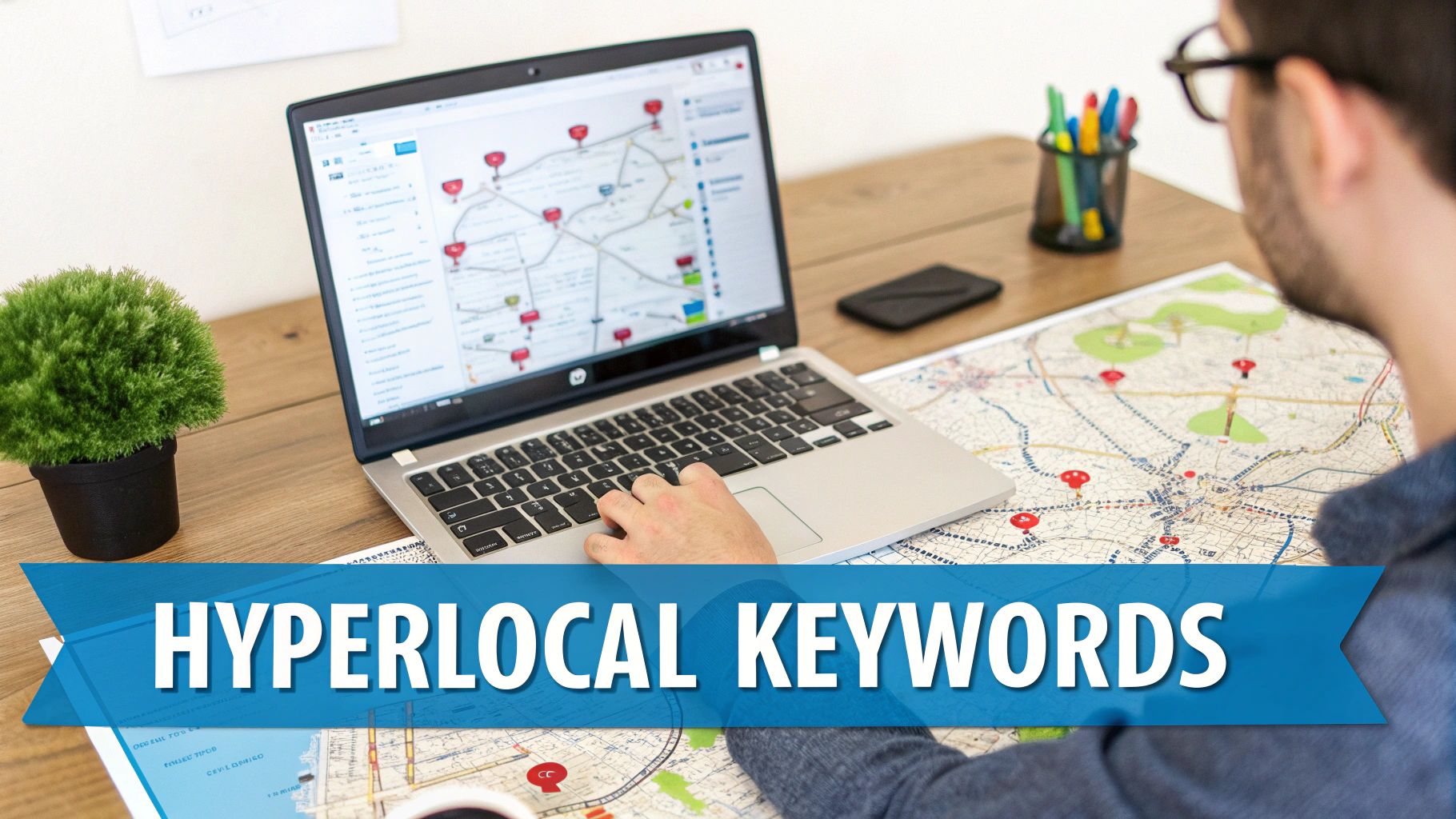
Getting your Google Business Profile dialed in is a fantastic start, but it’s only half the battle. To really make an impact, you need to pair it with website content that speaks directly to your local audience. This is where you bridge the gap between your expertise and the exact phrases real customers are typing into Google.
The trick is to uncover those high-intent “money” phrases that signal someone needs help right now. You have to think like a local. A person with a busted AC unit isn’t just searching for “HVAC services.” They’re searching for “same-day AC repair Tampa.” That tiny geographic detail changes everything.
Uncovering Your Local Money Phrases
Local keyword research is all about finding terms that hit the sweet spot between relevance, search volume, and, most critically, local intent. Your goal is to get in front of people who are physically close enough to walk through your door or book your service.
Start by just brainstorming your core services and tacking on location modifiers. Let’s say you’re a roofer in Pinellas County. Your keyword list shouldn’t stop at “roof repair.” It needs to get specific:
- Service + City: “metal roofing St. Petersburg,” “tile roof repair Clearwater”
- Service + County: “roofing contractor Pinellas County”
- “Near Me” Modifiers: “emergency roof leak repair near me”
- Problem-Based + Location: “hurricane-resistant roof installers Pinellas County”
These phrases are worth their weight in gold because they attract a pre-qualified audience. We dive deeper into finding these terms in our guide on local keyword research.
Spying On Your Competitors (The Smart Way)
One of the quickest shortcuts to finding valuable keywords is to see what’s already working for the competition. You don’t need fancy, expensive tools for this, either. Just Google your main services and see who pops up in the map pack and top organic results time and again.
Take a look at their website. What do their page titles and headings say? What kind of language are they using in their service descriptions? If you see a competitor’s page is titled “Affordable Tree Trimming in Largo & Seminole,” you’ve just been handed two great geographic keywords to target.
Don’t just copy what others are doing. Use their success as a starting point. If you notice a competitor ranks for “24/7 plumbing,” but you’re the only one offering a specific service like “hydro-jetting in Clearwater,” you’ve just found a competitive gap you can own.
This kind of simple reconnaissance work is invaluable for finding opportunities your rivals have missed.
Crafting Hyper-Local Content That Actually Connects
Once you have a solid list of keywords, it’s time to build content that genuinely serves your community. This isn’t about stuffing keywords onto a page. It’s about becoming the go-to local authority. Hyper-local content is your proof that you understand the unique challenges and interests of your neighbors.
Think about these real-world examples:
- A St. Pete cafe creates a blog post titled, “Our Favorite Dog-Friendly Patios in the Grand Central District,” complete with a map and photos. For a local, this is infinitely more useful than a generic “why we love coffee” post.
- A Clearwater roofer writes a detailed guide on “Choosing the Best Roof to Withstand a Florida Hurricane,” referencing local building codes and common issues in coastal homes.
This is the kind of content that builds trust while naturally incorporating your keywords. It answers the questions your local customers are actually asking, positioning you as the helpful expert they need.
Why You Need Dedicated Location Pages
If your business serves multiple towns, neighborhoods, or even counties, creating dedicated pages for each one is a non-negotiable strategy. A single “Service Areas” page is fine, but individual location pages are far more powerful for ranking in those specific places.
For instance, a pressure washing company covering the Tampa Bay area should absolutely have separate pages for “Pressure Washing in Tampa,” “Pressure Washing in St. Petersburg,” and “Pressure Washing in Clearwater.”
Make each page unique. Don’t just swap out the city name. Include things like:
- The specific services offered in that town.
- A testimonial from a client in that exact location.
- Photos of a job you completed in that area.
- Mentions of local landmarks or neighborhoods to add authenticity.
This sends a crystal-clear signal to Google that you have a strong, relevant presence in each community, which dramatically improves your odds of showing up when people there are searching. It’s the most direct path from a keyword idea to content that truly dominates local search.
Building Trust with Citations and Online Reviews
When it comes to local SEO, what’s said about you online is just as important as what you say on your own website. Think of Google as a digital detective. It scours the web for clues to verify that your business is exactly who—and where—you say you are.
The more consistent and positive signals it finds, the more it trusts you. That trust translates directly into higher visibility in local search results. This all boils down to two key areas: managing your business listings (citations) and actively cultivating great customer reviews.
The Power of NAP Consistency
One of the foundational trust signals for Google is dead-simple: NAP consistency. This stands for your business Name, Address, and Phone number. When this core information is identical everywhere it appears online, it tells search engines you’re a legitimate, stable operation.
Inconsistencies, even minor ones, create doubt. If Yelp lists you as “St. Pete Plumbing Inc.” but your Google profile says “St. Pete Plumbing,” that’s a red flag for an algorithm. It’s a small detail that can slowly chip away at your rankings.
Your first job is to run a citation audit. You need to hunt down and fix every incorrect or outdated listing out there.
- Start by Googling your business name, including common misspellings or old names.
- Check the big players first: Yelp, Apple Maps, Bing Places, and other major data aggregators.
- Don’t forget niche directories relevant to your industry, like TripAdvisor for a restaurant or Avvo for a law firm.
- Your mission is to correct every instance of a wrong name, an old address, or a disconnected phone number.
This isn’t the most glamorous work, but it’s absolutely critical. It ensures that no matter where a potential customer finds you, they get the right information every time.
Responding to Every Single Review
Your online reviews are a public conversation happening about your business, and you need to be an active participant. Responding to all feedback—both glowing and critical—is non-negotiable for modern reputation management. It sends a clear message that you’re listening and that you care.
When you get a great review, don’t just leave a generic “Thanks!” Get specific. A personal touch goes a long way.
“Thank you so much for the kind words, Sarah! We’re thrilled you enjoyed the waterfront view from our patio. We hope to see you and your golden retriever back at our St. Pete cafe again soon!”
See the difference? This acknowledges the customer by name and subtly reinforces unique selling points of your business (waterfront view, dog-friendly patio).
Negative reviews are tough, but they’re also an opportunity. Always reply publicly with a calm, professional tone focused on finding a solution. Then, try to take the conversation offline by providing a direct phone number or email. This shows everyone else that even when things go wrong, you’re committed to making it right. Learning to handle this correctly is a skill, and you can learn more about how to improve online reputation in our dedicated guide. For deeper strategy, some businesses even bring in AI reputation management consultants.
Turning Happy Customers Into Advocates
Most of your happy customers are perfectly willing to leave a review. You just have to ask. The trick is to make it incredibly easy for them. While you can never offer incentives (that’s against Google’s rules), you can and should remove any friction from the process.
Here’s a simple system to put in place:
- Time it right: The best time to ask is right after a great experience, when the positive feeling is still fresh.
- Make it easy: Send a follow-up email or text with a direct link to your Google review page. The fewer clicks it takes, the more reviews you’ll get.
- Keep it simple: A friendly, low-pressure ask works best. Something like, “Would you mind sharing your experience? Your feedback helps other local customers find us.”
Building a steady stream of positive reviews is one of the most powerful moves you can make in local business seo. The social proof it creates is a massive revenue driver. We know that optimized Google Business Profiles are 70% more likely to drive visits, and a well-reviewed profile can boost customer trust by 2.7 times. When you remember that a staggering 80% of local searches convert, this trust translates directly into your bottom line.
Advanced Strategies to Dominate Your Local Market
Once you’ve nailed the basics of your content, citations, and reviews, it’s time to really pull away from the pack. The jump from being a visible local business to the dominant one happens when you start layering in more advanced tactics.
These strategies aren’t about confusing code or overly technical SEO wizardry. Instead, they’re about sending crystal-clear signals to search engines that build undeniable authority and make you the obvious choice in your local area. We’ll dig into three powerful areas: schema markup, local link building, and site performance.
Speaking Google’s Language with Local Business Schema
Think of schema markup as a direct line of communication with Google. It’s a bit of code you add to your website that acts like a set of labels, telling search engines exactly what each piece of your information means. This removes any guesswork.
When Google can perfectly understand your business details, it can reward you with “rich snippets” in the search results. This is where the magic happens. Instead of a plain blue link, potential customers might see your star ratings, business hours, or even upcoming events displayed right there on the results page.
Local business schema gives Google absolute clarity on your services, hours, and location. This small, behind-the-scenes tweak can have a huge impact on how you show up in search, making your listing far more compelling than your competitors’.
Adding this code is easier than you might think. You don’t need to be a developer. Tools like Google’s Structured Data Markup Helper can generate the code for you.
Here’s what you should absolutely mark up on your site:
- Business Name: Your official, registered business name.
- Address: Your physical storefront or service area address.
- Phone Number: Your primary business line.
- Business Hours: Your up-to-date operating hours.
- Reviews/Ratings: Aggregate rating data from customer reviews.
By defining this information so clearly, you’re just making it easy for Google to trust your data and boost your visibility.
Earning High-Authority Local Backlinks
In the world of SEO, backlinks—links pointing from other websites to yours—are like votes of confidence. For a local business, links from other respected local organizations are pure gold. They signal to Google that you are a trusted and integral part of the community fabric.
Forget the old, spammy link schemes. The real goal here is to build genuine relationships that lead to natural, authoritative links. Think of it as community engagement that just happens to have amazing SEO benefits.
For a much deeper dive into this, you might find our guide on how to build links effectively helpful.
Here are a few practical ideas to get you started:
- Sponsor a Local Event: Getting behind a local 5K, sponsoring a Little League team, or supporting a community festival almost always earns you a link from the event’s website. It’s fantastic for your brand and your backlink profile.
- Partner with Neighboring Businesses: Team up with a non-competing business nearby. For example, a local roofer and an insurance agent could co-author a blog post on storm preparedness, each linking to the other’s site.
- Get Featured in Local News: Do you have a unique story? Celebrating a milestone anniversary? Pitch your story to local bloggers, news sites, or the online version of your town newspaper. A single feature can land you a powerful, high-authority link.
Links like these prove to Google that you aren’t just located in the community; you’re an active part of it.
Optimizing for Mobile and Page Speed
Let’s face it: local searches happen on the go. When someone is out and about searching for “pizza near me,” they are on their phone. If your website is slow or a pain to navigate on a small screen, they’re gone. They’ll simply back out and click on your competitor’s site.
It’s not just a guess—a study found that 53% of mobile site visitors will leave a page that takes more than three seconds to load.
Mobile-friendliness and site speed are no longer just “nice-to-haves.” They are critical ranking factors.
First, get a baseline by running your site through Google’s PageSpeed Insights tool. It will spit out a performance score and, more importantly, a list of specific things you can fix. Usually, the biggest culprits are huge, unoptimized images or clunky code bogging things down.
A truly mobile-friendly site is more than just a shrunken-down version of your desktop site. Buttons need to be big enough to tap easily, text must be readable without pinching and zooming, and your phone number should always be “click-to-call.”
Every little bit of friction you can remove for a mobile user massively increases the odds they’ll become a customer. This focus on their experience is the final piece of the puzzle for truly owning your local market.
How to Measure Your Local SEO Success
Throwing effort at your local SEO without tracking the results is like driving blind. You’re putting in the time and money, but you have no real idea what’s actually bringing customers through the door. It’s time to stop guessing and start looking at the data that truly impacts your bottom line, using tools you can access for free.
The trick is to ignore the “vanity metrics” that feel good but don’t mean much, like a random spike in website visitors. Instead, we’re going to zero in on the tangible customer actions that prove your investment is paying off.
Key Metrics Inside Google Business Profile Insights
Your Google Business Profile (GBP) is a goldmine of actionable data. It’s the most direct window you have into how local customers are engaging with your business, often before they even think about clicking through to your website.
Here’s what you should be keeping a close eye on every single month:
- Search Views: This tells you how many people saw your profile. But the real insight is in how they found you. GBP breaks it down into “branded” searches (they typed in your business name) and “discovery” searches (they were looking for a service you offer, like “plumber near me”). A steady climb in discovery searches is a huge win—it means your SEO is working.
- Customer Actions: This is where the money is. GBP tracks three critical actions: clicks to your website, requests for driving directions, and direct phone calls. When you see a consistent rise in calls and direction requests, you know your local visibility is translating directly into potential customers.
Don’t just glance at these numbers. Pop them into a simple spreadsheet each month. Seeing a 25% jump in phone calls from your GBP after you updated your services list? That’s the kind of hard data that proves your strategy is on the right track.
Connecting Local SEO to Website Performance
While GBP tells you what’s happening on Google, you also need to understand how that local traffic behaves once it lands on your website. This is where Google Analytics (GA4) comes in, helping you connect the dots between your ranking efforts and the leads you generate.
To get a clear picture, you’ll want to focus on a few specific areas within your analytics reports.
First, you need to segment your organic traffic. This sounds technical, but it’s pretty straightforward. You just filter your website traffic to isolate visitors coming from organic search. Then, you can drill down even further by creating a segment for users located in your specific city or service area. This shows you exactly how much traffic your local SEO work is driving.
Next, it’s all about conversion tracking. You have to set up goals for the most important actions on your site. This could be anything from a customer filling out your “Request a Quote” form to someone clicking the phone number on your homepage. When you can attribute these conversions back to your local organic traffic, you get a direct measurement of your return on investment.
By combining the intel from GBP Insights with the targeted data from Google Analytics, you create a powerful feedback loop. You can see which tactics are driving calls and which pages are converting local visitors into leads, allowing you to make smarter, data-driven decisions to keep improving.
Your Local SEO Questions, Answered
If you’re diving into local SEO, you’ve probably got some questions. It’s a common feeling, and a lot of business owners wonder about the same things. Let’s clear up a few of the most frequent ones I hear.
How Long Does It Really Take to See Results?
This is the big one, isn’t it? The honest answer is: it depends, but you’re playing the long game here. Local SEO is a marathon, not a sprint.
You might see some quick wins in just a few weeks, especially if your Google Business Profile was neglected and we get it tuned up. But for the kind of meaningful, consistent results that actually grow your business, you should realistically expect to wait three to six months.
Things like how competitive your city is, where you’re starting from, and how consistently you work on it all factor in. The most successful businesses treat local SEO as an ongoing part of their marketing, not a one-and-done task.
What’s the Difference Between “Regular” SEO and Local SEO?
It’s a great question that gets to the core of the strategy. Think of it this way: traditional SEO is casting a wide net. It’s for businesses, bloggers, or brands that want to reach a national or even global audience. Their customer could be anywhere.
Local SEO is more like spear-fishing. It’s all about getting your business in front of people in a specific geographic area—your city, your neighborhood, your service radius. It’s laser-focused on searches with local intent, like “plumber in Austin” or “best coffee shop near me.” The “where” is just as important as the “what.”
Is Local SEO Actually Worth It for a Small Business?
For any business with a physical location or a defined service area? Absolutely, and the numbers back it up. Consider that nearly one-third of all mobile searches are location-related. Even more telling, a staggering 78% of local searches on a mobile device lead to someone making a purchase offline.
Putting a solid local SEO strategy in place isn’t just another marketing line item on your budget. It’s a direct investment in connecting with customers who are literally searching for your services, right now, in your own backyard. The ROI is often one of the best you’ll see from any marketing channel.
Ready to stop being invisible to local customers? The team at Netco Design LLC specializes in building powerful local SEO strategies that drive calls, clicks, and customers to your door. Get in touch with us today to see how we can help you dominate your local market.

