

table of contents
So, what exactly is local keyword research?
It’s the art of figuring out the exact words and phrases people type into Google to find businesses like yours in their immediate area. We’re talking about queries like “best pizza in Brooklyn Heights” instead of just “best pizza.” This small shift is everything—it connects you directly with nearby customers who are ready to open their wallets.
Why Local Searches Are Your Most Valuable Asset

For any business with a physical location, local search isn’t just another marketing tactic. It’s the most direct line you have to customers with high intent. When someone makes a local search, they aren’t just browsing—they’re actively looking for a solution right now, right here.
Think about the mindset behind the search. Someone looking up “how to fix a leaky faucet” is in research mode. They could be weeks away from actually doing anything. But a search for “emergency plumber in St. Petersburg” signals a completely different level of urgency. That person needs help now and is ready to hire someone. That’s the power of local SEO.
Tapping into High Purchase Intent
The data backs this up, big time. A staggering 46% of all Google searches have local intent. That’s nearly half of all queries aiming to find a local business, product, or service.
It gets even better on mobile. Roughly 76% of people who run a local search on their phone visit a physical store within 24 hours. And even more impressive, about 28% of those searches lead directly to a purchase.
This isn’t just about getting seen; it’s about connecting with people who have already decided they need what you offer. Your job with local keyword research is to make sure your business is the one they find in that critical moment. To really get a handle on this, it helps to understand the foundational principles of Local SEO and how all the pieces fit together.
From Search Query to Foot Traffic
Every local keyword you target represents a potential customer walking through your door. By optimizing for these terms, you’re putting your business directly in their path right when they’re most likely to buy.
This focus pays off in several huge ways:
- Higher Conversion Rates: Local searchers are ready to act. Their queries are specific and often time-sensitive, which means they convert at a much higher rate.
- Increased Foot Traffic: Ranking for “near me” or city-specific keywords is a surefire way to drive real people to your physical location. (For more on this, check out our guide on how to rank higher on Google Maps).
- A Real Competitive Edge: You’d be surprised how many small businesses completely ignore a dedicated local keyword strategy. This creates a massive opportunity for you to own your service area.
The real goal of local keyword research isn’t just to rank on Google. It’s to become the automatic, go-to choice for customers in your community.
How to Brainstorm Your Initial Keyword List

Before you ever touch a fancy SEO tool, the most effective keyword research starts with something much simpler: thinking like your customer. The goal here isn’t to find every keyword under the sun. It’s to build a solid, foundational list of terms that people actually search for when they need your help.
We’ll kick things off by identifying your core seed keywords. These are the broad, fundamental terms that describe your business at its most basic level—usually just one to three words. They are the backbone of your entire local SEO strategy.
For a plumbing company, your seed keywords are the obvious ones: “plumber,” “plumbing services,” and “pipe repair.” If you own a cafe, you’d jot down “coffee shop,” “bakery,” and “espresso bar.” Don’t overthink it. Just list the simplest ways you describe what you do.
Start With What You Know
The absolute best source for your first batch of keywords is your own brain. You know your business, your services, and your customers better than anyone. Start by making a few simple lists.
- Your Services: Jot down every single service you offer, and get specific. Instead of a generic term like “car repair,” break it down into the real-world tasks people look for: “oil change,” “brake replacement,” “engine diagnostics,” and “tire rotation.”
- Your Products: If you sell physical goods, list them out. A bakery’s list might include “sourdough bread,” “custom wedding cakes,” “gluten-free muffins,” and “croissants.” Each one is a potential keyword.
- Customer Problems: Now, think about the pain points that drive someone to call you. A roofer doesn’t just sell shingles; they solve problems. Their keyword list should include terms like “leaky roof repair,” “storm damage assessment,” and “new roof installation.” These problem-focused searches often have the highest commercial intent.
This simple exercise will give you a rich pool of relevant terms that go way beyond the basics. You’re building a vocabulary that mirrors the real needs of your community.
Expand With Local Modifiers
Once you have your seed and service keywords, it’s time to make them local. This is where you anchor your general terms to a specific service area using local modifiers. These are the geographic phrases that turn a generic search into a local one.
Think bigger than just your main city. People often look for services right in their own part of town. Compile a list of every relevant geographic identifier you can think of.
Be sure to include these:
- City: The most obvious one, like “Tampa.”
- Neighborhoods: Get granular with well-known areas, such as “Hyde Park” or “Ybor City.”
- Counties: If you serve a broader region, include it, like “Pinellas County.”
- ZIP Codes: Some customers, especially for home services, search by ZIP code.
- Informal Names: Don’t forget local slang or common nicknames for certain areas.
Now, just combine your keywords with these local modifiers. “Plumber” becomes “plumber in Tampa,” “Hyde Park plumber,” or “plumber 33701.” This simple formula is the heart of local keyword research.
Listen to Your Customers
One of the most powerful—and most overlooked—brainstorming methods is to just pay attention to how your customers talk. The language they use on the phone, in emails, or in person is a goldmine of keyword ideas. They might use completely different words than you do internally.
For instance, you might call a service “HVAC maintenance,” but your customers are probably searching for “AC tune-up” or “heater check-up.” Listening to their phrasing ensures your keyword list aligns with real-world language, not just industry jargon. This is also a critical step in understanding your audience. For a more structured approach, learning how to create buyer personas can help you document the exact language your ideal customers use.
Your customers are telling you exactly what they’re looking for every single day. The secret is to capture that language and use it to build your keyword list.
By starting with broad seed keywords, adding in your specific services, layering on local modifiers, and tuning into customer language, you’ll have a comprehensive and highly relevant list. This groundwork is what sets you up for success when we move on to the more data-driven parts of the process.
Finding Keyword Opportunities with Smart Tools
You’ve got your starting list of seed keywords and local modifiers. Now it’s time to let the data do the heavy lifting. This is where we shift from brainstorming to strategic discovery, using both free and powerful paid tools to find out what your customers are actually searching for. The goal here is to expand your list with high-intent, low-competition terms you would’ve otherwise missed.
Your first stop should always be Google’s own ecosystem. It’s free, direct, and gives you a peek into real user behavior. You don’t need a fancy dashboard to start uncovering valuable local keywords.
Just start typing your core services into the Google search bar and watch what Google Autocomplete suggests. For instance, typing “emergency plumber in Tampa” might bring up phrases like “emergency plumber in Tampa FL no call out fee” or “24 hour emergency plumber Tampa.” These aren’t random—they’re popular, long-tail searches that signal a customer is ready to make a call.
Tapping into Google’s Free Keyword Tools
Beyond the search bar, the “People Also Ask” (PAA) box is another goldmine. These are the exact questions Google knows people have about your initial query. A search for “AC repair St. Petersburg” could easily show PAA questions like:
- How much does it cost to fix an AC in Florida?
- Who is the most reliable AC company in Pinellas County?
- Is it worth repairing a 15 year old air conditioner?
Each one of those questions is practically a headline for a blog post or a new section on your service page, perfect for catching people who are still in the research phase. And before you leave, always scroll to the bottom of the results page to check the “Related searches” section. It’s great for finding different ways people phrase their needs.
Unlocking Deeper Insights with Paid Platforms
While Google’s free tools are a fantastic start, dedicated SEO platforms like Semrush, Ahrefs, or BrightLocal provide the hard data you need to prioritize. These tools take the guesswork out of the equation by showing you critical metrics like monthly search volume, keyword difficulty, and what your competitors are ranking for.
With a tool like Semrush’s Keyword Magic Tool, you can plug in a seed keyword like “landscaper St. Pete” and get hundreds of related terms in seconds. From there, you can filter the list to find popular queries (high search volume) or spot the low-hanging fruit (low keyword difficulty).
This is what it looks like when a tool generates variations, questions, and related terms for a local keyword.
See how it gives you not just ideas, but also metrics like volume and intent? That’s the data that helps you make smart decisions.
This approach is especially powerful for digging up long-tail keywords—those longer, more specific phrases. They might have lower search volume one by one, but they almost always have much higher conversion rates. Our comprehensive guide on long-tail keyword research goes deep into how to find and use these valuable terms.
Smart tools don’t just give you more keywords; they provide the data to choose the right keywords. Focusing on terms with clear local intent and manageable competition is the key to an effective local SEO strategy.
The Rise of Mobile and Voice Search
It’s also crucial to remember how people search today. It’s not just on a desktop anymore. Data shows that somewhere between 75% and 84% of local searches now happen on mobile devices. This mobile-first world has supercharged the growth of “near me” and voice searches.
In fact, studies reveal that 58–72% of people use voice search to find information on local businesses, and a whopping 76% of those searches are for immediate, location-based needs. This shift makes it absolutely vital to target conversational, question-based phrases. You can find more stats on these local SEO trends and what they mean for your business.
To capture this traffic, you have to think about how people speak, not just how they type.
- Instead of typing “best pizza downtown,” a voice search is more likely to be, “Hey Google, what’s the best pizza place open now near me?”
- Instead of “emergency vet,” someone might ask their phone, “Siri, where is the closest 24-hour animal hospital?”
By weaving these natural language queries into your strategy, you’re meeting a huge chunk of your local audience right where they are. Combining free and paid tools lets you build a killer list that covers everything from broad service terms to super-specific long-tail queries and conversational voice searches, giving you total coverage of your local market.
Analyzing and Prioritizing Your Keyword List
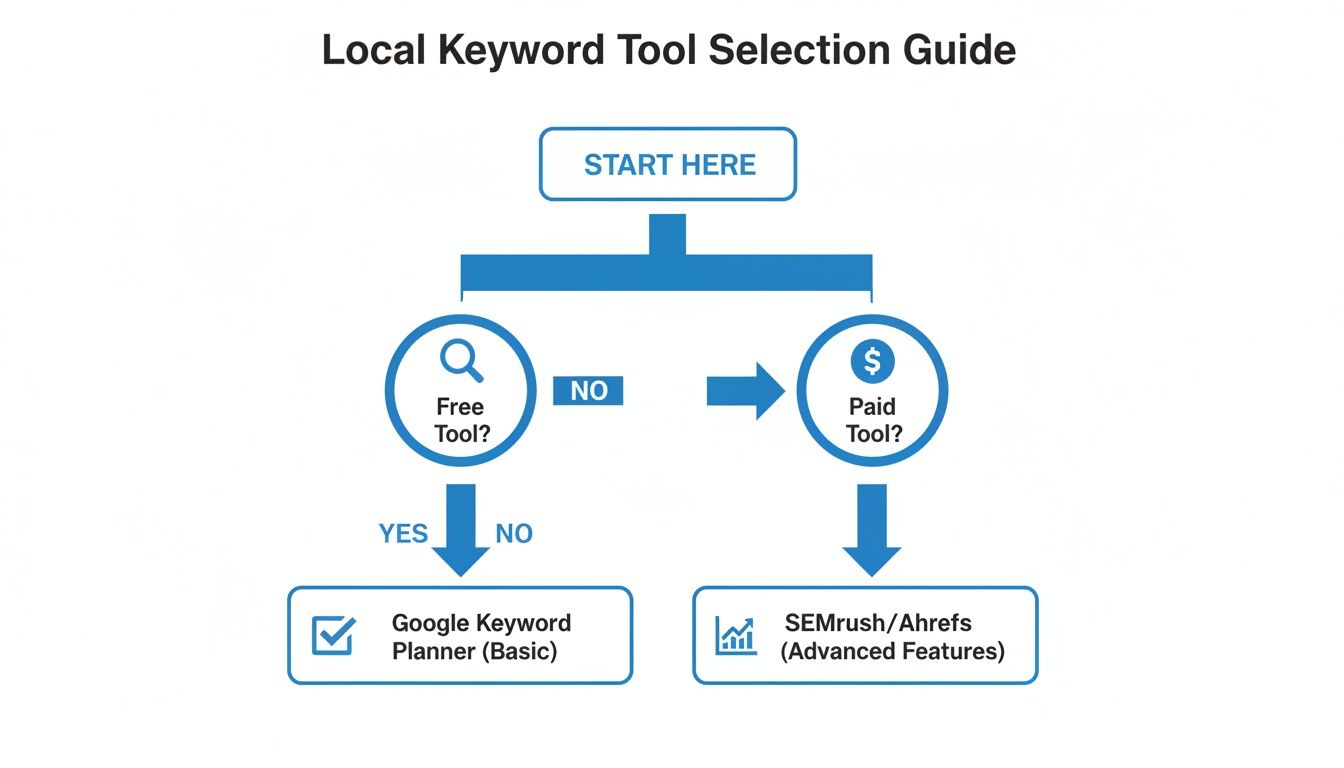
This decision tree cuts right to the chase, helping you pick the right tools for the job. The main takeaway here is that both free and paid options have their place. Your choice really boils down to your budget and just how deep you need to dive into the data.
So, after all the brainstorming and tool-assisted digging, you’re probably staring at a massive spreadsheet full of keywords. It’s a great start, but a raw list that long is more overwhelming than actionable.
Now comes the crucial part: turning that data dump into a smart, strategic roadmap. This isn’t just about chasing the keywords with the biggest search volume. It’s about finding the terms that bring the right customers to your door—people who are ready to pull out their wallets. We’ll break this down into three core pillars: Relevance, Intent, and Competition.
Gauging Keyword Relevance
First things first: relevance. This is your most important filter. For every single keyword on your list, ask yourself one simple question: “Does this perfectly match a service or product I actually offer?”
If the answer isn’t a definite “yes,” ditch it. That keyword is just noise.
For instance, a plumber who only does residential repairs might stumble upon “commercial plumbing contractor Houston.” Sure, it’s local and gets traffic, but it’s not relevant to their business. Targeting it would only attract the wrong leads and be a complete waste of time and effort.
Think of relevance as your foundation. It makes sure every bit of traffic you earn is from people who genuinely need what you’re selling.
Decoding Search Intent
Once a keyword passes the relevance check, you have to figure out the user’s intent. What is someone typing this into Google really trying to do? For local businesses, intent usually falls into a few distinct buckets.
- Informational Intent: The user is just looking for information. Think “how to fix a leaky faucet” or “signs of a broken water heater.” These are great for blog posts that build authority, but they aren’t going to drive immediate sales.
- Commercial Intent: This is the gold mine. These people are ready to buy or hire someone now. Keywords like “emergency plumber Houston,” “24-hour AC repair Tampa,” or “best cuban sandwich near me” are dripping with high commercial intent.
- Navigational Intent: The searcher is looking for a specific business, like “Netco Design St. Petersburg.” These are fantastic for your brand, but less useful for attracting new customers who’ve never heard of you.
Your highest priority should always be keywords with obvious commercial intent. These are the money terms that lead directly to phone calls, appointments, and sales. “Emergency plumber Houston” is infinitely more valuable than “how to fix a leaky faucet” because it signals an urgent, immediate need.
Assessing the Competition
The final piece of the puzzle is competition. Just because a keyword is relevant and has high intent doesn’t automatically make it a winner. You have to be realistic about whether you can actually rank for it.
Most SEO tools give you a “keyword difficulty” score, which is a solid starting point. But don’t stop there—do a manual check. Google your target keyword and see who’s on the first page. Is it dominated by giant national corporations with bottomless marketing budgets, or is it other local businesses like yours?
Sizing up your rivals is a non-negotiable part of this process. To go deeper, our guide on how to do competitor analysis in SEO offers a clear framework for breaking down their strategies. And for small businesses wanting to get better at managing this kind of data, a practical guide to data analysis for small businesses can provide key insights into using tools like Excel and AI to make sense of it all.
By balancing these three pillars—Relevance, Intent, and Competition—you can finally sort your huge list into actionable tiers. Start with the high-intent, low-competition “quick wins” to get some momentum, while you build a long-term plan for the tougher, high-value keywords.
Putting Your Local Keywords into Action

You’ve done the hard work of digging through relevance, intent, and competition to build a solid list of local keywords. But a list sitting in a spreadsheet doesn’t bring in customers. Action does.
It’s time to put those terms to work where Google and your future customers can actually find them. This is how you turn all that research into real-world traffic and leads.
The two most critical places to deploy your local keywords are your website and your Google Business Profile (GBP). Think of them as a one-two punch for local search dominance. Your website is your digital storefront, while your GBP acts as a massive, flashing billboard in local results and Google Maps.
Weaving Local Keywords into Your Website
Integrating local keywords isn’t about stuffing them everywhere you can. It’s a more delicate process of weaving them into the key spots that search engines scan to figure out what your pages are about and where you operate. Your goal is to send a crystal-clear signal to Google about what you do and where you do it.
Focus your on-page SEO efforts on these high-impact areas first:
- Title Tags: This is arguably the most important home for your primary keyword. A great title tag for a plumber in St. Petersburg might be: “Emergency Plumbing Repair in St. Petersburg, FL | ABC Plumbing”. It’s direct, clear, and tells Google the service and location right away.
- Meta Descriptions: While not a direct ranking factor, a well-written meta description that includes your keyword is your sales pitch in the search results—it gets people to click. For example: “Need a 24-hour plumber in St. Petersburg? ABC Plumbing offers fast, reliable service for leaky pipes, clogged drains, and more. Call us now!”
- Header Tags (H1, H2, H3): Your primary keyword should be in your main H1 page title, with variations and related terms used in your subheadings (H2s and H3s). This structures the content for readers and shows search engines the hierarchy of your topics.
- Page Content: Make sure your keywords show up naturally within the first 100 words of your content and are sprinkled logically throughout the rest of the text. Don’t just repeat the same phrase over and over; use synonyms and related terms to avoid sounding robotic and to capture a wider range of searches.
A common mistake I see is businesses trying to optimize a single page for all their keywords. Instead, assign a primary local keyword to each specific service or location page. Your “Water Heater Repair” page should target “water heater repair Tampa,” while your “Drain Cleaning” page targets “drain cleaning Tampa.”
Creating Dedicated Location Pages
Does your business serve multiple distinct areas, like different cities or even large, well-known neighborhoods? If so, creating dedicated location pages is a total game-changer.
These pages let you hyper-target your keywords for each market, making your business far more relevant to searchers in those specific areas.
For each location page, make the content unique. Don’t just copy and paste. Mention local landmarks, talk about common problems specific to that area, and feature testimonials from customers who live there. A page for a “roofing contractor in Clearwater” should look and feel different from your page for a “roofing contractor in St. Petersburg,” even if the service is identical.
Supercharging Your Google Business Profile
For local SEO, your Google Business Profile is your single most valuable asset. It’s often the very first thing a potential customer sees, especially in the Google Maps “Local Pack” results. Optimizing it with your local keywords is absolutely non-negotiable.
Here’s a quick checklist to get you started:
- Business Name: Stick to your official business name. Don’t stuff keywords here unless they’re part of your actual name.
- Categories: Choose the most accurate primary category, then add any relevant secondary categories. A pizzeria that also serves pasta should have “Pizza Restaurant” as primary and “Italian Restaurant” as secondary.
- Services: This is a goldmine. Use the services section to list everything you offer, using the exact keyword phrases you found during your research.
- Business Description: Write a compelling summary of your business and naturally work in your top 2-3 local keywords.
- GBP Posts: Regularly create posts about special offers, company updates, or helpful tips. Treat them like mini-blog posts and include your keywords and a clear call to action.
- Questions & Answers: Don’t wait for customers to ask. Proactively add your own FAQs and answer them using your keywords. For example: “Do you offer emergency AC repair in the 33701 area?” followed by a helpful answer.
Properly managing all these GBP elements is crucial. For a deeper dive, our complete guide on how to optimize a Google Business Profile walks you through every step to maximize your visibility. When your website and GBP are perfectly aligned, you send a powerful, consistent message to Google about who you are, what you do, and the community you serve.
Your Local Keyword Research Questions, Answered
Even with the best plan, you’re going to have questions. When it comes to local keyword research, a few common ones pop up again and again. Getting these cleared up is the key to moving forward with confidence and keeping your strategy sharp.
Let’s walk through some of the most frequent sticking points. Think of this as your quick-reference guide for those moments when you’re not quite sure what to do next.
How Often Should I Update My Local Keyword Research?
Local SEO isn’t a “set it and forget it” game. While you might do a major, deep-dive keyword review once a year or when launching a new service, you can’t just let it gather dust.
I always tell clients to schedule quarterly check-ins. This is your chance to spot new search trends, see what your competitors are up to, and catch any “near me” phrases that are gaining steam. Seasonality is a huge driver here, too. An HVAC company, for example, should be looking at “AC repair” keywords in the spring and pivoting to “furnace maintenance” in the fall.
What’s the Real Difference Between Local and General Keywords?
It all boils down to one thing: geographic intent. A general keyword like “best running shoes” is incredibly broad. The person searching could be anywhere in the world, and they’re probably just browsing.
A local keyword, on the other hand, pins down a location. This happens in two main ways:
- Explicitly: The user types in a location, like “best running shoes in Chicago.” They’re telling you exactly where they are.
- Implicitly: The user just searches for “running shoe store” on their phone, and Google is smart enough to know they mean “near me.”
Local keywords are where the money is. They connect you with customers who are physically in your service area and almost always have a much higher intent to buy.
Should I Target Neighborhoods or My Entire City?
The short answer is both, but your priority depends entirely on your business model. A local coffee shop lives and dies by foot traffic, so neighborhood-level keywords like “coffee shop Lincoln Park” are gold. Their customers are looking for something just around the corner.
But what about a specialized contractor who covers an entire metro area? They need to be visible for broader, city-level terms like “roofing contractor Chicago” to attract that wider audience.
A smart, tiered approach usually wins. Optimize your homepage for your main city-level keywords. Then, build out dedicated service or location pages that go after the specific, high-value neighborhoods you serve. It’s the best of both worlds.
Do I Really Need Expensive Tools to Succeed?
Nope. Especially not when you’re starting out. You can build a surprisingly powerful and effective keyword list using nothing but free resources—and Google’s own tools are a goldmine.
You can uncover fantastic local keyword ideas just by looking at:
- Google Maps suggestions
- Google’s autocomplete feature in the search bar
- The “People Also Ask” box that shows up in search results
Paid tools are great for scaling up, doing deep competitive analysis, and getting hard data on search volume. But don’t let a lack of budget stop you. A thoughtful, manual approach can drive serious business growth right out of the gate.
Ready to stop guessing and start ranking? The team at Netco Design LLC specializes in creating data-driven local SEO strategies that connect you with customers in your area. Let’s build a plan that gets you found.

