

table of contents
Local SEO for brick-and-mortar businesses is the focused process of optimizing your online presence to appear prominently in local search results and maps, directly driving nearby customers through your front door. The industry term for this practice is “local search optimization,” and it covers everything from your Google Business Profile to citation consistency and customer reviews. 97% of consumers use the internet to find local businesses. That number alone tells you where your next customer is looking before they ever leave home. This guide covers every major ranking factor and tactic you need to compete and win in your local market.
How does Google rank local businesses in 2026?
Google’s local ranking algorithm uses three core factors: relevance, distance, and prominence. Understanding each one tells you exactly where to focus your effort.
Relevance measures how well your business profile matches what someone searched for. A bakery that lists itself only as “food service” will lose to a competitor that correctly identifies as “bakery” with secondary categories like “wedding cakes” and “custom desserts.” A narrow primary category in your Google Business Profile limits your eligibility for broader local queries. Adding the right secondary categories directly expands the searches you can appear for.

Distance is the factor you control least. Google calculates how far your location is from the searcher or the location they specified. You cannot move your store, but you can make sure your address is accurate and consistent everywhere it appears online.
Prominence is where most brick-and-mortar businesses have the most room to grow. It reflects how well known and trusted your business is, based on reviews, backlinks, citations, and overall web presence. Photos increase direction requests by 42%, which shows that even visual content on your profile feeds directly into prominence signals.
The payoff for ranking well is significant. The top three local pack listings capture 44% of all clicks. Businesses outside those top three positions split the remaining attention. Getting into that pack is the single most impactful goal for any physical store.
Here is what directly affects your local pack ranking:
- Google Business Profile completeness: Every field filled in signals reliability to Google.
- Review count and recency: More recent reviews carry more weight than older ones.
- Photo engagement: Profiles with active photos get more clicks and direction requests.
- Website authority: Your site’s backlinks and content reinforce your prominence score.
- Citation consistency: Matching name, address, and phone across all directories confirms your entity to Google.
Pro Tip: “Near me” search volume grew over 200% in two years. Make sure your GBP description includes natural phrases like “near [neighborhood name]” to capture that intent.
What are the foundational local SEO assets every brick-and-mortar must optimize?
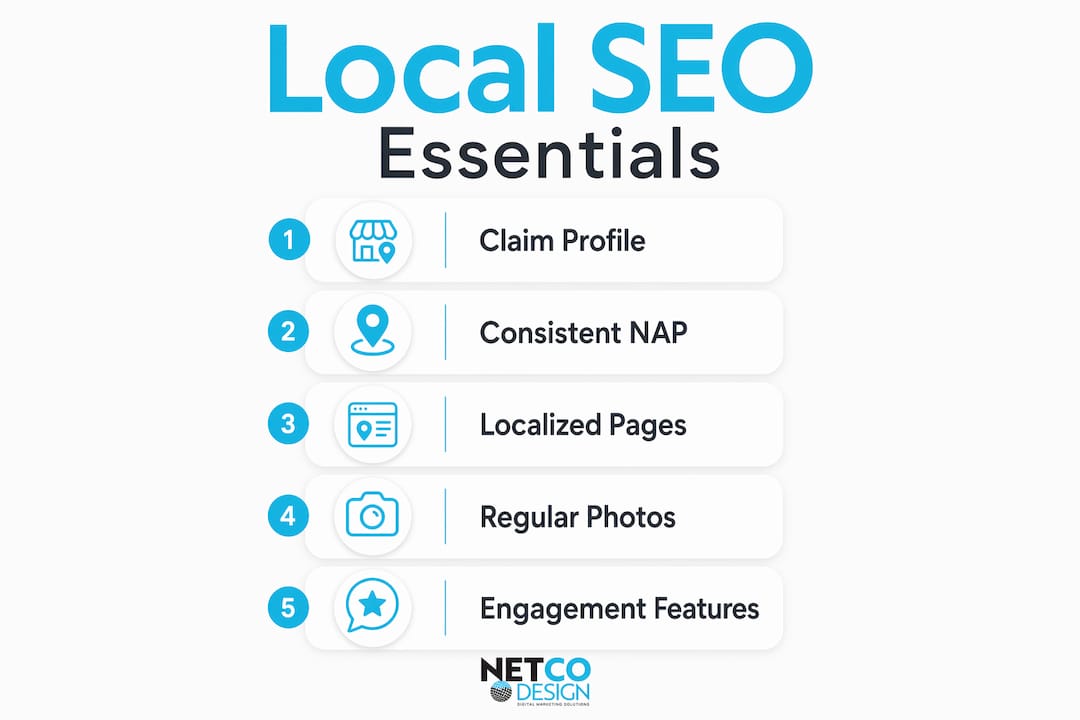
Before Google ranks you, it has to correctly identify you. Consistent Name, Address, and Phone (NAP) data is foundational for Google to establish your business entity boundaries and confirm your eligibility to rank. Think of NAP consistency as your business’s identity card. If your address appears differently on Yelp, Facebook, and your own website, Google treats those as potentially different businesses and loses confidence in all of them.
1. Claim and fully optimize your Google Business Profile
Your Google Business Profile is the single most visible asset in local search. GBP is often more significant than your website for local discovery in 2026. Fill in every section: business name, address, phone, hours, website, and a detailed description. Choose your primary category carefully. Then add secondary categories that reflect every service you offer.
2. Build consistent citations across major directories
Citations are any online mention of your business name, address, and phone number. Start with the major platforms: Google, Apple Maps, Bing Places, Yelp, and Facebook. Then expand to industry-specific directories relevant to your business type. Every listing should use the exact same NAP format, down to whether you abbreviate “Street” as “St.” or spell it out.
3. Create localized landing pages on your website
Your website should have at least one page that speaks directly to your local area. Include the neighborhood name, nearby landmarks, and locally relevant content. A plumber in St. Petersburg, Florida, should have a page that mentions specific neighborhoods like Old Northeast or Kenwood, not just “St. Petersburg.” This signals geographic relevance to Google and matches the way local customers actually search.
4. Add and update photos regularly
Upload real photos of your storefront, interior, products, and team. Google rewards active profiles. Aim to add new photos at least once a month. Customers also upload photos, so monitor those and respond when appropriate.
5. Use Google Business Profile engagement features
Posts, Q&A, and special offers are underused by most businesses. Publishing a weekly post about a promotion or event keeps your profile fresh. Answering questions in the Q&A section before customers even ask them builds trust and reduces friction before a visit.
A few additional best practices worth following:
- Verify your listing through Google’s official process before making major changes.
- Set your service area if you also serve customers at their location.
- Keep your hours updated, especially for holidays.
- Link your GBP directly to a local SEO-optimized page on your site, not just your homepage.
How to attract and leverage customer reviews to boost local SEO
Reviews are the largest controllable input in your prominence score. Google weighs review count, average rating, recency, and whether you respond to them. A business with 200 reviews and an active response pattern will outrank a competitor with 50 reviews and no responses, even if the competitor has a slightly higher average rating.
The most effective way to grow reviews is to build a system around it. Businesses that trigger review requests at the “moment of delight” using warm SMS messages see response rates 5 times higher than email requests. The moment of delight is the point right after a customer has a positive experience: after a great meal, after a successful service call, or right when a product is delivered. That is when they are most likely to act.
Here are the best practices for building a review system:
- Time your ask correctly. Send the request within 30 minutes of the positive experience, not days later.
- Use SMS over email. Text messages get opened far more often and feel more personal.
- Keep the message warm and brief. Something like “We loved having you in today. Would you mind sharing your experience?” works better than a formal template.
- Make it one tap. Include a direct link to your Google review page. Never make customers search for where to leave a review.
- Respond to every review. Thank positive reviewers by name. Address negative reviews calmly and offer to resolve the issue offline.
Pro Tip: Never offer incentives for reviews. Google’s guidelines prohibit it, and it can get your profile suspended. Earn reviews through genuine service and a frictionless ask.
Negative reviews are not disasters. A business with a mix of 4.8-star and 3-star reviews looks more credible than one with only perfect scores. Respond to criticism professionally. Other potential customers read your responses as much as they read the original complaint.
How can brick-and-mortar businesses expand reach with multi-location SEO?
Businesses with more than one location face a specific challenge: each location needs its own local presence. A single “Contact Us” page listing three addresses does not give Google enough signal to rank each location independently. Dedicated location landing pages with unique, truly local content are the correct approach.
Each location page should include content that is genuinely specific to that area. Generic pages that swap out only the city name are called doorway pages, and Google penalizes them. Real local content includes:
- Mentions of nearby landmarks and neighborhoods.
- Testimonials from customers in that specific area.
- Local events your business participates in or sponsors.
- FAQs that reflect questions specific to that location’s customers.
- Photos of that actual storefront and team.
Local link building also plays a role. Partnerships with nearby businesses, sponsorships of local events, and mentions in local news outlets all build the geographic authority that helps each location rank. A coffee shop that sponsors a local 5K race and gets mentioned on the race’s website earns a locally relevant backlink that no amount of generic content can replicate.
For single-location businesses, the same principle applies at the neighborhood level. Writing a blog post about “the best morning routine in the Warehouse Arts District” serves your local audience and signals geographic relevance to Google at the same time. This kind of hyperlocal content is a proven SEO strategy that most competitors ignore.
Key takeaways
Local search optimization works when you treat Google Business Profile, NAP consistency, reviews, and localized content as a connected system, not separate tasks.
- Google Business Profile is your top asset. Fill in every field, choose accurate categories, and post updates regularly to stay active.
- NAP consistency builds trust with Google. Mismatched address formats across directories confuse Google’s entity recognition and hurt your rankings.
- Reviews drive prominence. Use SMS requests at the moment of delight to generate consistent review volume and always respond to every review.
- Category selection determines eligibility. A narrow primary category creates a ranking ceiling. Add secondary categories to expand the searches you qualify for.
- Location pages beat generic pages. Each location or service area needs unique, genuinely local content to rank independently.
What I’ve learned about local SEO after working with physical stores
The biggest mistake I see brick-and-mortar owners make is treating their Google Business Profile as a one-time setup task. They claim it, fill in the basics, and walk away. Six months later, they wonder why a competitor with a newer store is outranking them. The answer is almost always activity. Google rewards profiles that show signs of life: fresh photos, new posts, recent reviews, and owner responses.
The second thing that surprises most owners is how much category selection matters. I have seen businesses stuck in a ranking plateau for months, and the fix was simply adding two secondary categories and updating the website to reflect those services. Entity boundaries in local SEO are real and they are limiting. Google has to understand exactly what you are before it will show you to the right people.
Reviews are where I push hardest with clients. Most owners feel awkward asking for them. But a warm, personal SMS sent right after a great experience does not feel pushy. It feels like a natural extension of good service. The businesses I have seen grow fastest in local search are the ones that made review collection a weekly habit, not an occasional afterthought.
If I had to pick one place to start for the fastest impact in a competitive market, it would be a full Google Business Profile audit. Fix the categories, add photos, set up a review request system, and then build from there. Everything else compounds on top of that foundation.
— Lori
Netco Design’s local SEO services for physical stores
Physical stores need a different approach than purely online businesses. Netco Design works specifically with brick-and-mortar owners to build the local search presence that brings customers through the door.

The team handles Google Business Profile setup and optimization, citation building, review management systems, and localized website content. Every strategy is built around your specific location, market, and competition. Netco Design also covers the broader digital marketing strategies that support long-term local growth, from content to paid search. If your store is not showing up where your neighbors are searching, that is a solvable problem. Reach out to Netco Design at netcodesign.com to get a clear picture of where you stand and what it takes to rank.
FAQ
What is local SEO for brick-and-mortar businesses?
Local SEO for brick-and-mortar businesses is the process of optimizing your online presence so nearby customers find your physical store in Google search results and maps. It covers Google Business Profile, citation consistency, reviews, and localized website content.
How long does local SEO take to show results?
Most businesses see measurable results within 60–120 days of focused local SEO work. Competitive markets may take longer, but Google Business Profile improvements often produce faster visibility gains than website changes alone.
Why does my Google Business Profile category matter so much?
Your primary GBP category tells Google what type of business you are and which searches you qualify for. A narrow or incorrect category creates a ranking ceiling, limiting the local queries where your business can appear.
How do I get more Google reviews for my store?
Send a warm SMS to customers immediately after a positive experience and include a direct link to your Google review page. This approach generates response rates significantly higher than email requests and builds review volume consistently over time.
Does NAP consistency really affect local rankings?
Consistent Name, Address, and Phone data across all online directories confirms your business identity to Google. Inconsistent NAP data creates confusion about your entity boundaries and directly reduces your eligibility to rank in local search results.

