

table of contents
For any home service business, local SEO isn’t just a marketing tactic—it’s your direct line to a customer in need. Think of it as the modern-day phonebook. You want to be the first name a homeowner sees the moment they desperately search for help “near me.”
Why Local SEO Is Your Strongest Customer Magnet
Let’s get real for a second. A pipe bursts under the kitchen sink at 10 PM on a Tuesday. The homeowner isn’t scrolling through Yelp reviews for an hour or casually asking a neighbor for a recommendation. They’re grabbing their phone and typing “emergency plumber near me” into Google.
That exact moment is where local SEO for home services stops being a buzzword and starts making you money. Your business has to be the first, most trusted option they see.
This isn’t just a theory; it’s how people solve problems now. They expect instant, location-based answers. If your business doesn’t show up in the Google Map Pack or at the top of the organic results for your service area, you’re basically invisible to the overwhelming majority of people who have an urgent, high-intent problem that you can solve.
The New Word-of-Mouth Is a Search Query
The days of getting by on truck wraps and neighborhood flyers alone are long gone. Your digital presence is your new storefront. A solid local SEO strategy ensures that when someone in your town searches for “HVAC repair in Tampa” or “roofer in St. Petersburg,” your business pops up as a credible, nearby solution. This builds instant trust and cuts the sales cycle down to minutes.
It all boils down to a simple but powerful idea: Be there, and be prominent, at the exact moment a potential customer needs you the most. Local SEO is what makes that connection happen.
The numbers don’t lie. A staggering 98% of customers now search online for local companies, which is a huge leap from 90% just a few years back. For home services, it’s even more critical—87% of people use Google to find local help.
Even better, 90% of those local searchers make a purchase within a week, turning their online search directly into your next job. (You can dig into more of these local search trends over at WiserReview.com).
Ultimately, investing in a strong local SEO plan isn’t just about climbing the rankings. It’s about fundamentally connecting with your community right when they need you. For a deeper dive into the core concepts, our small business SEO guide offers some great additional context.
Optimizing Your Google Business Profile
Your Google Business Profile (GBP) is no longer just a listing. It’s your digital storefront, your 24/7 salesperson, and often the very first impression a potential customer has of your business. If you’re in home services, think of it as the most valuable piece of real estate you own online. Mastering it is non-negotiable for dominating local search.
This isn’t about just checking a few boxes. It’s about strategically turning your profile into a powerhouse that attracts and converts homeowners who are searching right now for what you do.
And people are definitely searching. Home service queries like ‘electrician near me’ have shot up 19% year-over-year. With Google owning a staggering 91.5% of the search market, if you’re not visible here, you’re practically invisible.
This flow chart nails it—the customer journey starts with a local search and leads straight to a sale, putting a well-tuned GBP profile right at the center of your lead generation.
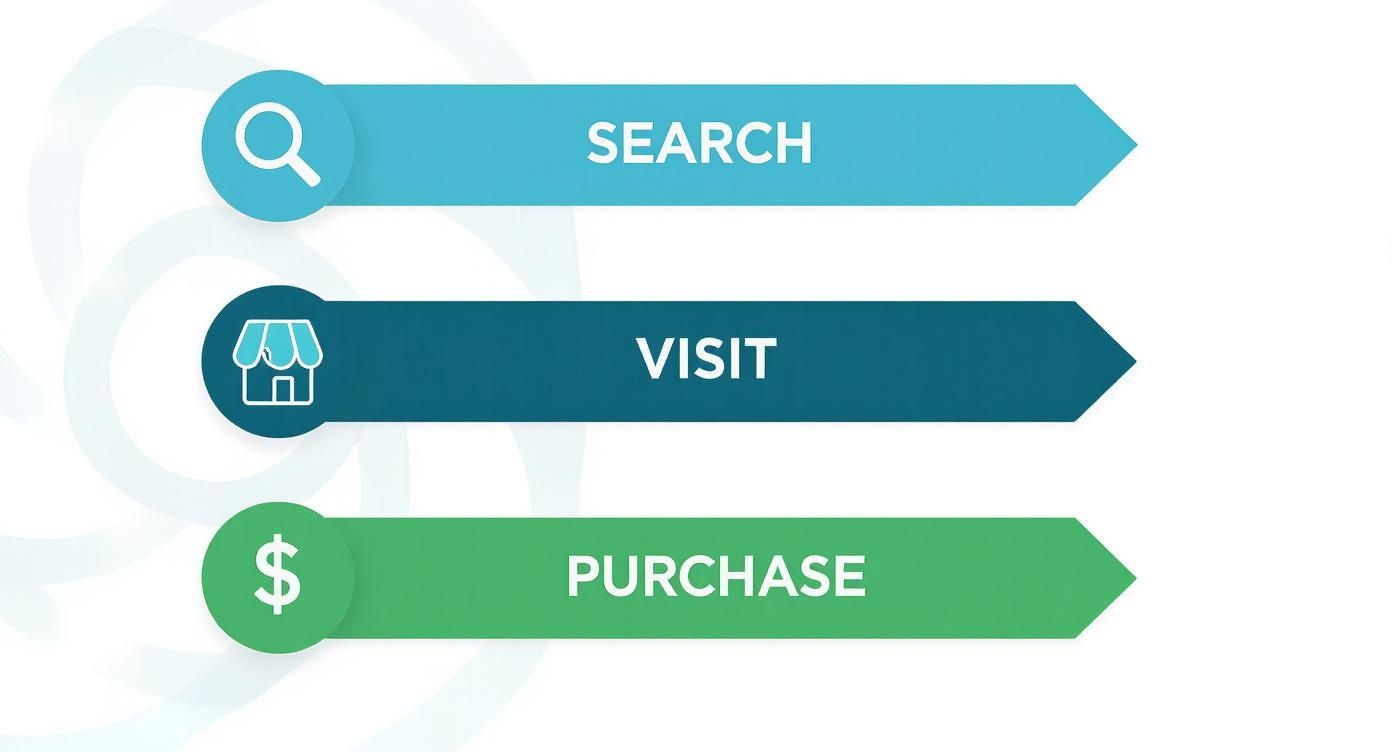
As you can see, showing up at that initial search is the make-or-break moment for capturing new local business.
Selecting Your Service Categories
Your first big move is choosing the right categories. Your primary category is the most powerful signal you can send to Google about what your business is all about. It needs to be the most accurate, high-level description of your core service.
Let’s say you’re a plumber who also does HVAC work. You need to decide which service line brings in the most business or which one you want to grow. If plumbing is your bread and butter, then “Plumber” has to be your primary category. Simple as that.
From there, you can add secondary categories to cover your other offerings. In this scenario, “HVAC contractor” and “Water heater installation & repair service” would be perfect additions. The key is not to go crazy and add every category under the sun. Stick to what you actually specialize in, or you’ll just dilute your authority.
Defining Precise Service Areas
One of the biggest blunders I see home service businesses make is setting their service area way too broadly. Don’t just list “Tampa Bay Area” and call it a day. Get granular. List the specific cities, zip codes, and even the neighborhoods you actually work in.
This precision is a game-changer for two reasons:
- It tells Google exactly where you’re relevant, boosting your chances of showing up for specific searches like “roofer in South Tampa.”
- It saves you from wasting time and gas money on calls from customers who are way outside your profitable service radius.
Pro Tip: Your service area needs to reflect reality. Don’t claim to serve a town you only visit once a year. Google is smart and uses various signals to verify your activity. An honest service area builds trust with both users and the algorithm.
Leveraging Underused GBP Features
A lot of pros stop after filling in their name, address, and phone number. The real edge, however, comes from digging into the features your competitors are completely ignoring.
Google Posts
Think of this as a mini-blog right on your profile. You should be using it every single week to showcase things like:
- Completed Jobs: Post a great photo of a recently finished project (with the customer’s permission, of course) and a short description of the work.
- Special Offers: Running a seasonal tune-up special or a discount on a specific service? Announce it here.
- Company News: Did you hire a new technician or earn a new certification? Share the good news!
Posts expire, so keeping a steady stream of content signals to Google that your business is active and engaged.
The Products Feature
This one’s a goldmine, even if you only offer services. Don’t get hung up on the word “Products.” Instead, use this tab to showcase your service packages.
- A landscaping company could list “products” for their “Weekly Lawn Maintenance Package,” “Full Garden Design & Installation,” and “Seasonal Cleanup Service.”
- An electrician could create entries for “EV Charger Installation” or “Smart Home Security Setup.”
Each “product” can have its own photo, a detailed description, and even a price or price range. This instantly turns your profile into a rich service catalog.
The Q&A Section
Your customers have questions—so answer them before they even have to ask. Proactively populating your own Q&A section is a brilliant move.
An HVAC contractor, for instance, could add and answer these common queries:
- “How often should I get my AC serviced?”
- “What are the signs my furnace needs repair?”
- “Do you offer 24/7 emergency services?”
This move not only provides immediate value to potential customers but also gives you another natural way to include relevant keywords. For more expert advice, check out our guide on effective ways to improve your Google Business Profile. By fully optimizing every one of these elements, you transform your GBP from a static listing into a dynamic, lead-generating machine that works for you around the clock.
Building a Website That Ranks Locally
A killer Google Business Profile gets leads, no doubt. But it’s only half the battle. When a homeowner clicks from your profile to your website, that experience has to be absolutely seamless. Your site is your home turf—it’s where you control the entire narrative, turning a curious searcher into a scheduled job.
Think of it this way: your GBP is the billboard that gets them to pull over. Your website is the showroom that closes the deal. It needs to confirm everything your profile promised, and then some. That means it has to be fast, clear, and built from the ground up to rank in the specific neighborhoods you serve.
Architecting Your Site for Local Dominance
A generic website structure just won’t cut it for home services. To really win at local SEO for home services, you need a site architecture that mirrors your actual service area. This isn’t about having a single “Services” page; it’s about building a smart network of pages that target specific services in specific locations.
This structure sends incredibly strong signals to Google about what you do and where you do it. It makes it a no-brainer for the algorithm to show your site for those valuable, high-intent searches.
The two non-negotiable page types in this setup are Service Pages and Service Area Pages.
- Service Pages are all about the “what.” These pages take a deep dive into a single offering, like “Emergency Leak Repair” or “AC Unit Installation.”
- Service Area Pages focus on the “where.” These pages are built to rank in a specific city, town, or even a key neighborhood you work in, like “Plumbing Services in North Austin.”
By creating this clear hierarchy, you build a website that perfectly matches a user’s exact search, whether they’re looking for a service first or a location first.
Crafting High-Converting Service Pages
Your individual service pages are your expert sales pitches, plain and simple. Each one needs to be laser-focused on a single offering, optimized to convince both homeowners and search engines that you’re the absolute best choice for that job.
Let’s start with some on-page SEO basics. Your title tags and H1 headers are huge ranking factors. I’ve found a simple, proven formula works wonders here.
Title Tag Formula:
[Service Name] in [City, State] | [Your Business Name]
Example: Tankless Water Heater Installation in Tampa, FL | Apex Plumbing Pros
H1 Header Formula:
Expert [Service Name] in [City]
Example: Expert Tankless Water Heater Installation in Tampa
This immediately tells Google you’re relevant and confirms to the user they’ve landed in the right spot. But don’t just stop there. Flesh out the page with real details about the service, the common problems you solve, what your process looks like, and top it off with clear calls to action.
Winning Neighborhoods with Service Area Pages
While service pages target what you do, service area pages are how you conquer the map. These pages are designed to grab search traffic from homeowners in the specific towns and neighborhoods you want to own. A lazy page that just lists 20 towns is useless. Each location page has to feel unique and genuinely local.
Here’s how to make these pages powerful:
- Hyper-Local Content: Drop in names of local landmarks, specific neighborhoods, or common local issues. For instance, “We know the hard water in the Carrollwood area can be tough on pipes…”
- Embedded Google Maps: Visually plant your flag by embedding a map of that specific service area right on the page.
- Neighborhood-Specific Testimonials: Nothing works better than social proof. Feature reviews from customers in that exact town. A glowing review from a neighbor is gold.
- Proof of Work: Show, don’t just tell. Include photos from jobs you’ve actually completed in that community.
A well-crafted service area page tells a homeowner, “We don’t just work in your town—we are a part of your community.” This local familiarity builds instant trust and significantly boosts conversion rates.
Don’t Forget Local Business Schema
Behind the scenes, you can give Google a cheat sheet about your business using local business schema. This is just a snippet of code you add to your website that spells out critical information for search engines in a language they can easily digest.
It clarifies details like:
- Your official business name, address, and phone number (NAP)
- Your hours of operation
- The specific services you offer
- Your precise service area
Implementing schema helps eliminate any guesswork for Google, strengthening your local signals and helping your site show up in more detailed search results. It’s a technical step, but it’s a crucial part of a solid local SEO for home services strategy.
Speaking of technical foundations, site speed is another one you can’t ignore. For more on that, you can learn about Core Web Vitals performance tips to make sure your pages load lightning-fast, especially for users on their phones.
Driving Trust with Citations and Reviews
Once your website and Google Business Profile are dialed in, it’s time to build your reputation across the wider web. This comes down to two things: showing up consistently everywhere and letting your happy customers do the talking.
These elements are powerful trust signals for both Google and the homeowners you want to reach. Think of it as digital word-of-mouth. When a potential customer sees your correct business info on multiple trusted sites, it builds confidence. When they see a flood of recent, positive reviews, that confidence turns into a phone call.

Nail Your Citations for Rock-Solid Consistency
A local citation is simply any online mention of your business’s name, address, and phone number (what we call NAP). You’ll find them in directories like Yelp and Angi, on social media, or on websites specific to the trades.
Consistency is everything here.
When Google’s crawlers find the exact same NAP information for your business across dozens of reputable sources, it validates your location and contact details. It’s a huge green flag. But if it finds inconsistencies—an old address, a wrong phone number, or even a small variation in your business name (“Joe’s Plumbing” vs. “Joe’s Plumbing, LLC”)—it creates confusion.
That confusion can directly tank your local search rankings. It’s like having multiple, conflicting addresses on file. Google isn’t sure which one is right, so it might just hesitate to show you in the local map pack at all.
Your game plan should be:
- Audit your existing citations to hunt down and fix any errors.
- Find the high-value directories that matter most in the home services world.
- Build new, consistent citations on those platforms to expand your digital footprint.
Build Your Reputation One Review at a Time
In the home services industry, trust is the entire game. You’re asking homeowners to let you into their personal space, and they need to feel completely secure about that decision. Online reviews are the single most powerful way to build that trust before they even pick up the phone.
A healthy stream of recent, positive reviews on your Google Business Profile does way more than just look good. It directly impacts your ranking in the local pack and can massively boost how many people click on your listing.
A roofer with a 4.8-star rating from 150 reviews will almost always get the call over a competitor with 3.5 stars and only 12 reviews. It’s just human nature—social proof is a powerful shortcut for busy homeowners.
The goal isn’t just to get some reviews, but to create a system that brings them in consistently. A steady flow tells Google that you’re actively serving customers and doing great work. This is a non-negotiable part of any serious local SEO for home services strategy. For a deeper dive, check out our guide on why online reviews matter and how to get more of them.
Crafting a Winning Review Strategy
Getting more reviews often just comes down to asking at the right time and making it dead simple for the customer. You can’t be passive about this.
When to Ask:
- Immediately after the job is done and the customer is beaming about your work.
- In a follow-up email or text message sent a few hours later.
How to Ask:
- Email Template: “Hi [Customer Name], thanks again for choosing us for your [Service] today! We aim for a 5-star experience every time. If you have a moment, would you mind sharing your feedback on Google? It helps our local business immensely. [Direct Link to GBP Review Page]”
- SMS Template: “Thanks from the team at [Your Business Name]! We’d love to hear your feedback on Google: [Shortened Link to Review Page]”
The speed at which homeowners make decisions is wild. Research shows that 78% of local mobile searches in home services result in a purchase within 24 hours. Many of these customers prefer to call directly, and about 40% of those calls convert into a sale, highlighting the immediate power of a trusted online reputation.
Always Respond to Every Single Review
Your work isn’t finished when the review comes in. Responding to every single one—good or bad—is absolutely crucial.
For positive reviews, a simple, personalized thank you reinforces that great experience and shows future customers you’re engaged.
For negative reviews, a prompt and professional response is your chance to shine. Acknowledge their issue without getting defensive, express a genuine desire to make it right, and give them an easy way to take the conversation offline. This not only shows the unhappy customer you care but also proves to every prospect reading your reviews that you stand behind your work, no matter what.
Gaining an Edge with Local Link Building
Once your website and Google Business Profile are dialed in, it’s time to build your site’s authority. In the SEO world, authority is mostly built with backlinks—links from other websites pointing back to yours. You can think of each link as a vote of confidence, like a professional referral from another respected business in your community.
A steady stream of high-quality, locally relevant backlinks tells Google that your business is a trusted, legitimate player in the local scene. This has a direct impact on your ability to outrank competitors who might have a decent website but lack a strong online reputation. The whole world of link building can seem complicated, but understanding the key differences between organic SEO vs. local SEO is the perfect place to start, as it helps you focus your energy where it’ll count the most.
Focus on Community Connections Not Complex Tactics
Forget about trying to get links from national publications or launching complicated email outreach campaigns. For a home service business, the most valuable links come from right in your own backyard. These are the connections that are not only easier to secure but also send the strongest possible local signals to search engines.
The real goal here is to embed your website into your digital community, making it impossible for Google to overlook your local relevance.
A single link from your city’s Chamber of Commerce or a local community blog is often more valuable for local rankings than ten generic links from a random website. It’s all about context and relevance.
Your link-building strategy should feel natural and reflect your real-world business activities. It’s much less about “SEO tactics” and much more about good old-fashioned digital networking.
Actionable Local Link Building Opportunities
Here are some practical, achievable ways to start earning links that will actually move the needle for your home service business. These aren’t just theories; they are tried-and-true methods I’ve seen work time and time again.
- Sponsor a Local Youth Sports Team: This one’s a classic for a reason. Whether it’s the local Little League team or a youth soccer club, sponsorships almost always come with a link from their website’s sponsor page back to yours. It’s a true win-win—you support the community and earn a powerful local link in the process.
- Partner with Non-Competing Trades: Start building relationships with other reputable home service pros in your area. A roofer can partner with a painter, or an HVAC company can team up with an electrician. You can recommend each other to clients and feature one another on a “Trusted Partners” page on your websites.
- Get Featured on a Local Blog: Reach out to neighborhood association blogs or local lifestyle bloggers. Offer to write a guest post with seasonal home maintenance tips, like “5 Ways to Prepare Your Tampa Home for Hurricane Season.” This positions you as the local expert and earns you a highly relevant backlink.
- Join the Chamber of Commerce: Most local chambers of commerce have an online member directory. Becoming a member typically gets you a listing with a direct link to your website, which is a high-authority local signal that’s hard to beat.
The Power of Local Partnerships
Think about the other businesses your clients use right before or after they need your services. This is a goldmine for strategic partnerships.
For example, a plumber could connect with:
- Real estate agents who need pre-sale inspections.
- Flooring companies that often deal with water damage restoration.
- Kitchen and bath remodelers who need plumbing work for their projects.
Proposing a simple content collaboration, like co-authoring a “Home Renovation Checklist” that you both publish on your blogs and link to, can create natural and valuable connections. This approach builds your professional network and your backlink profile at the same time. It’s an authentic way to integrate your business into the local service economy, both online and off.
Answering Your Top Local SEO Questions
When you’re running a home service business, you’ve got questions about local SEO. Everyone does. Let’s cut through the noise and get straight to the answers for the most common things I hear from pros just like you.
How Long Does This Actually Take to Work?
This is the big one, and I’ll be blunt: it depends. Local SEO isn’t like flipping a switch on a paid ad. It’s an investment in your business’s long-term reputation.
You might see some early wins, maybe more calls coming in a few weeks after we dial in your Google Business Profile. But the real, lasting results—the kind that build authority with content, reviews, and local links—take time. Generally, you should plan on seeing significant, measurable growth within 3 to 6 months of consistent work. Think of it like building a solid reputation in a new town; it doesn’t happen overnight, but doing quality work consistently builds trust that pays dividends for years.
Do I Really Need a Physical Address to Rank?
This is a critical point, especially for home service pros who work from home or an unmarked warehouse. The answer is a clear no, you do not need to show your physical address to rank locally.
When you set up your Google Business Profile, you’ll choose the “service-area business” option. This lets you hide your street address while telling Google exactly which cities, zip codes, and neighborhoods you cover. Your rankings will be tied to your relevance in that service area, not your physical location.
Pro Tip: Whatever you do, never use a P.O. Box or a virtual office for your Google Business Profile. This is a direct violation of Google’s rules and one of the quickest ways to get your profile suspended. Just be honest about how your business operates.
What’s More Important: My Website or My Google Profile?
Honestly, they’re two sides of the same coin. You can’t have one without the other if you want to dominate your local market. It’s not an “either/or” situation; it’s about how they work together.
- Your Google Business Profile is your billboard on the digital highway. It’s what gets you seen in the map pack and is designed for quick action—getting that phone call or a click for directions. It’s often the very first impression a potential customer has of you.
- Your Website is your digital showroom. This is where you control the entire conversation, build deep trust with detailed service pages, show off your work, and capture leads with contact forms. Google looks at your website’s authority to decide how much to trust your GBP.
A great GBP gets you the click, but a professional, locally-focused website is what closes the deal. Neglecting one will always hamstring the other. A winning local SEO for home services strategy demands a powerful presence on both fronts to consistently bring in new clients.
Ready to stop guessing and start getting real, measurable results from your local SEO? At Netco Design LLC, we build the digital foundation your home service business needs to attract pre-qualified customers and dominate your local market. Let us handle the complexities of SEO so you can focus on what you do best. Book a strategy call today and see how we can help you grow.

