

table of contents
TL;DR:
- Optimizing a complete Google Business Profile, consistent online NAP data, and localized content improve local search rankings for small businesses. Regular review management and implementing structured data also boost visibility and engagement, making local SEO a sustained system. Small businesses should treat local SEO as an ongoing investment to achieve sustained growth and higher search rankings.
Local SEO is defined as the practice of optimizing your online presence so your business appears in location-based search results when nearby customers are actively looking for what you sell. To implement local SEO for a small business effectively, you need three things working together: a fully completed Google Business Profile (GBP), consistent business information across every online directory, and localized content that signals relevance to your community. Businesses with complete GBP profiles receive 70% more location visits than those with incomplete ones. That single stat tells you where most of your competitors are leaving the door open. The standard industry term for this discipline is “local search optimization,” and it covers everything from your GBP to your website’s structured data.
What tools do you need to implement local SEO for a small business?
The right foundation prevents wasted effort later. Before you publish a single Google Post or ask for a review, get these assets in place.
- Google Business Profile. This is your most important local SEO asset. Claim and verify it at business.google.com before doing anything else. A fully optimized GBP is the single highest-return action available to most small businesses.
- NAP consistency audit tool. NAP stands for Name, Address, and Phone number. 64% of small businesses have NAP inconsistencies across directories, and fixing them lifts average rankings by 2.4 positions. Use a citation management platform or manually audit your listings on Google, Yelp, Facebook, Apple Maps, and Bing Places.
- Review acquisition system. Set up automated post-service email or SMS requests. Manual follow-up works at low volume, but automation scales without adding labor.
- Mobile-ready website. 78% of local mobile searches lead to an offline visit within 24 hours. If your site loads slowly or breaks on a phone screen, you are losing those customers before they ever call.
- Structured data markup. Add LocalBusiness schema to your website’s homepage and FAQ schema to relevant pages. These tell Google exactly what your business does and where it operates.
Pro Tip: Run your website through Google’s PageSpeed Insights before touching anything else. A slow site undermines every other local SEO tactic you implement.
How to fully optimize your Google Business Profile for local rankings
A complete GBP is not just better than an incomplete one. It operates in a different league. Follow these steps in order.
- Select your primary and secondary categories carefully. Your primary category carries the most ranking weight. Choose the most specific option available, such as “Plumber” rather than “Contractor.” Add secondary categories for each additional service you offer.
- Write a keyword-rich business description. Use your 750-character limit. Include your city, core services, and one or two phrases your customers actually search. Avoid stuffing; write for a person, not an algorithm.
- Upload 30 or more geo-tagged photos. GBP profiles with 30+ photos receive 2.7x more clicks than those with fewer than 10. Photograph your storefront, team, completed work, and interior. Geo-tag images before uploading using a free metadata editor.
- Publish weekly Google Posts. Weekly posts increase GBP engagement by 18%. Use them to announce promotions, share tips, or highlight recent projects. Treat each post like a mini ad with a clear call to action.
- Seed your Q&A section. Write and answer your own frequently asked questions before customers do. This controls the narrative and adds keyword-rich content directly to your profile.
- Set service areas precisely. For service-area businesses, define your actual coverage zones rather than a broad metro area. Ranking first in your real service radius beats ranking twentieth across an entire city.
Pro Tip: Add your services and products sections with individual descriptions and prices where applicable. Google uses this data to match your profile to more specific search queries.
What strategies help small businesses generate and manage local reviews?
Reviews are not just social proof. They are a direct ranking signal. Google weights review velocity and sentiment more heavily than total review count alone. A business that collects five new reviews this week outperforms one that collected 200 reviews two years ago and stopped.
- Automate your review requests. Send a follow-up text or email within two hours of service completion. Response rates drop significantly after 24 hours. Keep the message short, personal, and include a direct link to your GBP review form.
- Respond to every review within 24 hours. GBPs that respond within 24 hours see 18% higher review velocity than those that do not. Responding signals active management to Google and builds trust with prospective customers reading your profile.
- Personalize negative review responses. Acknowledge the issue, apologize without admitting fault where appropriate, and offer a resolution path. A well-handled negative review often converts skeptical readers into customers.
- Encourage natural local language. Ask customers to mention the neighborhood, city, or specific service in their review. Do not script it. Simply say, “Feel free to mention what you had done and where you’re located.” Natural local terms in reviews reinforce your geographic relevance.
Pro Tip: Profiles with more than 50 reviews get 4.4x more clicks than those with fewer than 5. Set a milestone goal of 50 reviews before focusing on any other GBP enhancement.
How to use localized content and structured data to extend your reach

Your GBP gets you into the local pack. Your website gets you into the organic results below it. You need both. Small businesses that invest in location-specific content consistently outperform competitors who rely only on directory and review optimizations.
Here is how to build that content layer:
- Create dedicated location pages. Build one page per key service area, targeting phrases like “roof repair in Clearwater” or “dog grooming St. Petersburg.” Each page needs unique content. Do not copy and paste the same text with the city name swapped.
- Include neighborhood-specific details. Reference local landmarks, community events, or real project examples from that area. This signals authenticity to both Google and the reader.
- Embed local reviews on each location page. Pull in reviews that mention the specific neighborhood or service. This adds social proof and reinforces geographic relevance on the page itself.
- Implement LocalBusiness schema on your homepage. LocalBusiness schema boosts GBP click-through by 14%, and FAQ schema adds another 9%. These are free gains that most small businesses skip entirely.
- Use local events and news as content hooks. Write a post about sponsoring a local 5K or comment on a zoning change affecting your industry. This content earns local links and signals community involvement.
The local entity strategy Google now uses relies on entity matching and behavioral signals, not just keyword proximity. Your website, GBP, directories, and reviews must all tell the same consistent story about who you are and where you operate.
What ongoing tactics sustain local search visibility over time?
Local SEO is not a one-time project. It requires monthly attention to maintain rankings and quarterly reviews to grow them. Here is what that maintenance looks like in practice:
- Join local business associations. Chambers of commerce, neighborhood business groups, and industry associations often link to member websites. These are among the highest-quality local links available, and they are free with membership.
- Run citation cleanup quarterly. New directory listings appear constantly, and old ones drift out of sync. Audit your NAP data every three months across your top 20 directories. Consistency is a ranking signal that compounds over time.
- Track local rankings monthly. Monitor your position in the local pack and organic results for your core service-plus-city keyword combinations. Use rank tracking to spot drops before they become problems.
- Maintain a local content calendar. Plan content around seasonal demand, local events, and community topics. A landscaping company in Tampa Bay, for example, should publish hurricane prep content every june and irrigation tips every october.
- Review your analytics quarterly. Look at which location pages drive calls, direction requests, and form submissions. Double down on what works. Cut or rewrite pages that generate traffic but no conversions.
The unified local entity approach means no single channel works in isolation. Your local SEO strategy must treat GBP, website, citations, and reviews as one interconnected system, not four separate tasks.
Key Takeaways
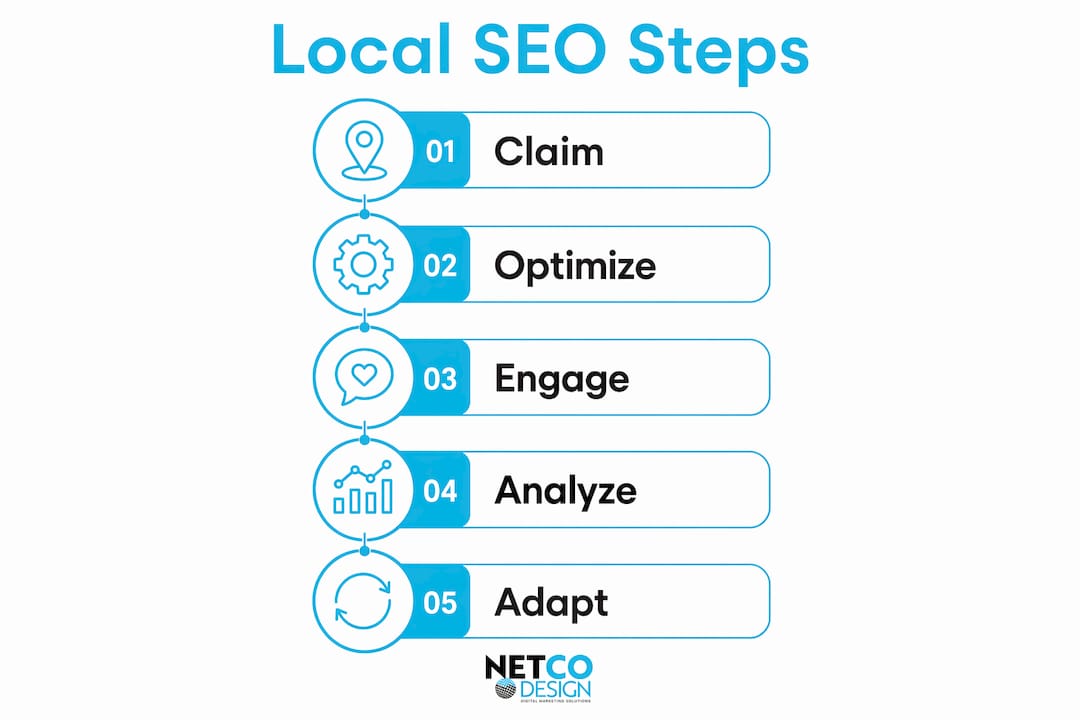
Local search optimization works best when your GBP, website, citations, and reviews function as one unified system rather than separate tasks.
| Point | Details |
|---|---|
| Complete your GBP first | Businesses with fully complete profiles receive 70% more location visits than those with gaps. |
| Fix NAP inconsistencies | Consistent name, address, and phone data across directories lifts average rankings by 2.4 positions. |
| Build review velocity | Responding to reviews within 24 hours increases new review velocity by 18% and signals active management. |
| Add structured data | LocalBusiness schema lifts GBP click-through by 14%; FAQ schema adds another 9% at no cost. |
| Create location-specific pages | Unique neighborhood content outperforms generic pages and extends your reach beyond the local pack. |
What I have learned from watching small businesses get local SEO wrong
After working with small business owners across Tampa Bay and beyond, the pattern I see most often is this: owners treat local SEO as a checklist rather than a system. They claim their GBP, upload a few photos, and then walk away expecting results. Six months later, they wonder why a competitor with half their experience is ranking above them.
The competitor is winning because they respond to every review, post to their GBP weekly, and have location pages that actually describe the neighborhoods they serve. None of that is complicated. All of it requires consistency.
The second mistake I see constantly is review management handled reactively. Business owners respond to bad reviews when they feel like it and ignore good ones entirely. That approach misses the compounding benefit of active engagement. Google reads your response behavior as a signal of how you treat customers. Businesses that respond to all reviews, including the positive ones, build entity trust faster than those that only show up when there is a fire to put out.
The third thing I want you to take seriously is localized content. Generic “we serve the Tampa Bay area” copy does not move rankings. A page that references the specific streets, neighborhoods, and community context of Seminole or Gulfport or Dunedin tells Google something specific and verifiable. That specificity is what separates businesses that rank from businesses that wonder why they do not.
Treat local SEO as an ongoing investment with compounding returns. The businesses I have watched grow the fastest are the ones that commit to the system for 12 months and then look back at where they started. The gap is always larger than they expected.
— Lori Piencykoski
How Netco Design helps small businesses build local search presence
Small business owners who want results without spending months learning the technical side of local search optimization work with Netco Design. The team handles GBP setup and full optimization, citation cleanup, review acquisition systems, location page creation, and structured data implementation. Every strategy is built around your specific market and service area, not a generic template.
Netco Design also tracks performance monthly and adjusts based on what the data shows, so your local visibility grows over time rather than plateauing after the initial setup. If you want to understand how local SEO fits into a broader growth plan, the 2026 digital marketing trends resource covers the full picture. For small business owners ready to move from guessing to a clear plan, Netco Design offers a no-pressure online presence analysis to show exactly where your local visibility stands today.
FAQ
What is the most important first step to implement local SEO?
Claim and fully complete your Google Business Profile. Businesses with 100% complete profiles receive 70% more location visits than those with gaps in their information.
How many reviews does a small business need to see results?
Profiles with more than 50 reviews receive 4.4x more clicks than those with fewer than 5. Set 50 reviews as your first milestone before focusing on other GBP enhancements.
Why does mobile SEO matter for local businesses?
78% of local mobile searches lead to an offline visit within 24 hours. A slow or broken mobile site loses those customers before they ever contact you.
How often should a small business update its local SEO?
Monthly rank tracking and citation audits, combined with weekly GBP posts, keep your local presence active. Quarterly strategy reviews let you adjust based on what is actually driving calls and visits.
What is LocalBusiness schema and why does it matter?
LocalBusiness schema is structured data code added to your website that tells Google exactly what your business does and where it operates. It boosts GBP click-through rates by 14% and improves how Google understands your business entity.

