

table of contents
Imagine your marketing working around the clock, warming up leads and engaging customers while you focus on running your actual business. That’s the power of marketing automation for small business. It’s like having a brilliant assistant who never sleeps, handling all the repetitive stuff with perfect timing, saving you dozens of hours a week, and helping you close more sales.
Why Marketing Automation Is Your Secret Weapon

For a lot of small business owners, the term “automation” brings to mind something complex, expensive, and frankly, out of reach. Something for the big guys. But that’s an old way of thinking. Today, marketing automation is an accessible superpower that completely levels the playing field, letting you compete with the giants without needing a massive team or budget.
Let’s break it down. Instead of you manually sending a welcome email every time someone subscribes, an automated system fires it off instantly. Instead of trying to remember which lead needs a follow-up call, the software has already been sending them helpful content. It’s not about getting rid of the human touch; it’s about automating the routine tasks so you have more time for real, meaningful conversations.
The Real Impact on Your Business
The most immediate win with marketing automation is pure efficiency. It takes the time-sucking, repetitive tasks off your plate—the ones that eat up your day but don’t move the needle. This frees you up to think about strategy, build customer relationships, and actually grow the business.
That newfound efficiency leads directly to better results and a healthier bottom line. It’s a straight line. Businesses that get on board with automation consistently see a jump in sales productivity and a drop in marketing overhead.
Thanks to a wave of affordable, user-friendly platforms, small businesses are finally getting in on the action. The numbers don’t lie: companies using these tools report a 14.5% increase in sales productivity and a 12.2% reduction in marketing overhead costs. It just works.
More Than Just Saving Time
But this is about more than just clawing back a few hours. Automation is a growth engine. It creates consistent, personalized experiences for your customers, making sure no lead ever falls through the cracks and every customer feels seen at each step of their journey. This kind of systematic follow-up is how you build trust and loyalty.
This is huge for small businesses, where every single customer relationship is gold. The key advantages are clear:
- Improved Lead Nurturing: Automatically send potential customers the right info at the right time, gently guiding them toward a purchase without you lifting a finger.
- Enhanced Customer Retention: Keep your existing customers happy and engaged with timely follow-ups, special offers, and personalized content.
- Scalable Growth: As your business takes off, your automated systems handle the new volume of leads and customers without breaking a sweat.
At the end of the day, marketing automation is the secret weapon that lets you do more with less. By taking over the follow-ups, reminders, and segmentation, it frees you up to build a stronger, more profitable business. To see how other tech can help, check out our insights on integrating AI for small business marketing.
Essential Automation Workflows to Start With
Jumping into marketing automation doesn’t mean you have to build some massive, complicated system overnight. The best way to get started is to pick a few high-impact workflows that give you immediate results. These first automations tackle the most important customer moments, saving you a ton of time while building real relationships from day one.
Think of these workflows as your core digital employees. They show up every time, say the right thing, and make sure no customer ever feels ignored. For a small business, that kind of consistency is a huge advantage.
The Welcome Series: An Instant Connection
Your first and most important automation has to be the welcome email series. When someone signs up for your newsletter or downloads a guide, that’s the moment they’re most interested in what you have to say. A welcome series grabs that moment by the horns, greeting new subscribers, showing off your brand’s personality, and setting the stage for what’s next.
This isn’t just a single “thanks for subscribing” email. A great welcome series is a short sequence of three to five emails sent over a week or two.
- Email 1 (Immediate): Send the resource they asked for (if they did) and include a warm, personal greeting, maybe from the founder. This creates an immediate human connection.
- Email 2 (2 Days Later): Share your brand’s story or mission. Why do you do what you do? This helps new subscribers feel like they’re part of something.
- Email 3 (4 Days Later): Give them something valuable. Share your most popular blog post, a genuinely useful tip, or a customer success story. This shows you know your stuff and builds trust.
This simple sequence turns a passive subscriber into an engaged fan, all without you lifting a finger after the initial setup.
Lead Nurturing: Guiding Prospects to a Decision
Let’s be real: not everyone who shows interest is ready to buy on the spot. That’s where lead nurturing comes in. This workflow is all about automatically guiding potential customers with valuable, relevant content until they’re ready to pull the trigger.
Imagine a homeowner in St. Petersburg downloads your “Guide to Kitchen Renovations.” A good lead nurturing workflow would then send them a series of helpful emails over the next few weeks—maybe an article on budgeting for a project, a case study of a similar local renovation you did, and finally, an invitation for a free consultation.
This process doesn’t just sell; it educates. It positions your business as the go-to expert. By the time they’re ready to hire someone, you’re the only one that makes sense.
Lead nurturing is the art of building a relationship before asking for a sale. Prospects who are nurtured with targeted content produce a 20% increase in sales opportunities compared to non-nurtured leads.
Abandoned Cart Reminders: Recovering Lost Sales
If you run an e-commerce store, the abandoned cart is public enemy number one. It’s a huge source of lost revenue. Customers get distracted, have second thoughts, or hit a snag at checkout. An abandoned cart reminder is a simple but incredibly powerful workflow that automatically nudges these almost-customers to finish what they started.
This workflow kicks in the moment someone adds an item to their cart but leaves without buying. A short series of emails can make all the difference.
- Reminder 1 (1 Hour Later): A friendly, “Did you forget something?” email showing them the items left in their cart with a direct link back to checkout. Keep it simple.
- Reminder 2 (24 Hours Later): A follow-up that might address common worries, highlight a few customer reviews, or offer help if they had trouble checking out.
- Reminder 3 (3 Days Later): A final nudge. This is where you might offer a small discount or free shipping to create a little urgency and seal the deal.
Businesses using these simple reminders can recover between 3% and 14% of otherwise lost sales. That’s pure profit from opportunities you would have otherwise missed.
Re-Engagement Campaigns: Winning Back Inactive Customers
Over time, it’s normal for some subscribers to go quiet. A re-engagement campaign is an automated workflow built to win back these inactive contacts. Instead of just letting your email list get stale, you can proactively reach out with a targeted message to spark their interest again.
This could be a “We Miss You!” email with a special offer, a quick survey asking for feedback, or an announcement about something new and exciting. These campaigns help clean your list and can turn dormant contacts back into active, paying customers. It’s all about getting the most value out of every single person who trusted you with their email address.
You can also explore our guide on how chatbots for small businesses are worth the investment to add another powerful layer to your re-engagement strategy.
Your Step-By-Step Implementation Roadmap
Jumping into marketing automation can feel like trying to drink from a firehose. It’s exciting, but overwhelming. The secret is to start small, grab an easy win, and build from there. A phased approach takes the pressure off and makes sure you build a system that actually helps your business, instead of just creating more busywork.
This roadmap breaks the whole process into four simple phases. By focusing on one thing at a time, you can get automation working for you and see a real return much faster. The goal isn’t to automate everything at once; it’s to automate the right thing first.
Phase 1: Define Your First Goal
Before you even glance at software options, you need a clear target. What’s the single biggest headache or opportunity you want to solve right now? Trying to do everything at once is the fastest way to get nowhere. Instead, pick one specific, measurable goal.
Think of this first goal as your north star. It will guide every decision you make from here on out, keeping you focused and stopping you from getting distracted by shiny features you don’t need yet.
Here are a few great starting points for a small business:
- Turn more new subscribers into customers. This is perfect if you get a decent number of sign-ups but the follow-up feels a little hit-or-miss.
- Recover sales from abandoned carts. If you run an e-commerce store, this is a direct line to more revenue. Easy win.
- Nurture leads for a specific service. For service businesses, this keeps you top-of-mind with potential clients who aren’t quite ready to pull the trigger today.
Once you have your goal, sketch out the customer journey that goes with it. What are the steps a person takes? What do they need to know at each stage? This simple map is the blueprint for your first automated workflow. If you want to get your priorities straight first, our guide on how to audit your digital presence in under 20 minutes is a huge help.
Phase 2: Build Your First Workflow
Okay, you have a plan. Now it’s time to pick a tool and get building. When you’re just starting out with marketing automation for small business, find a platform with a friendly interface and a free or low-cost plan. Your priority is ease of use, not a hundred features you won’t touch for months.
With your tool picked out, build the workflow you mapped in Phase 1. If your goal was to welcome new subscribers, your workflow is a simple welcome email series.
Focus on impact, not complexity. Businesses that use automation generate twice as many leads as those that don’t. Your first simple workflow is the first step toward that kind of growth.
The key here is to get it done and switch it on. Don’t chase perfection. A good, functioning automation that’s live is infinitely better than a “perfect” one that never leaves your draft folder.
Phase 3: Expand with a Second Workflow
Once your first automation has been running for a few weeks, you’ll start seeing results and feeling more comfortable. Great! Now it’s time to build on that success by adding one—and only one—new workflow. Use the momentum from your first win to tackle the next logical task.
For example, if your first workflow was a welcome series, a smart second move would be a lead nurturing sequence for people who clicked a specific link in those first emails. See how that builds on what you’ve already done? It makes your marketing smarter and more connected.
This infographic shows how these essential automations flow together.
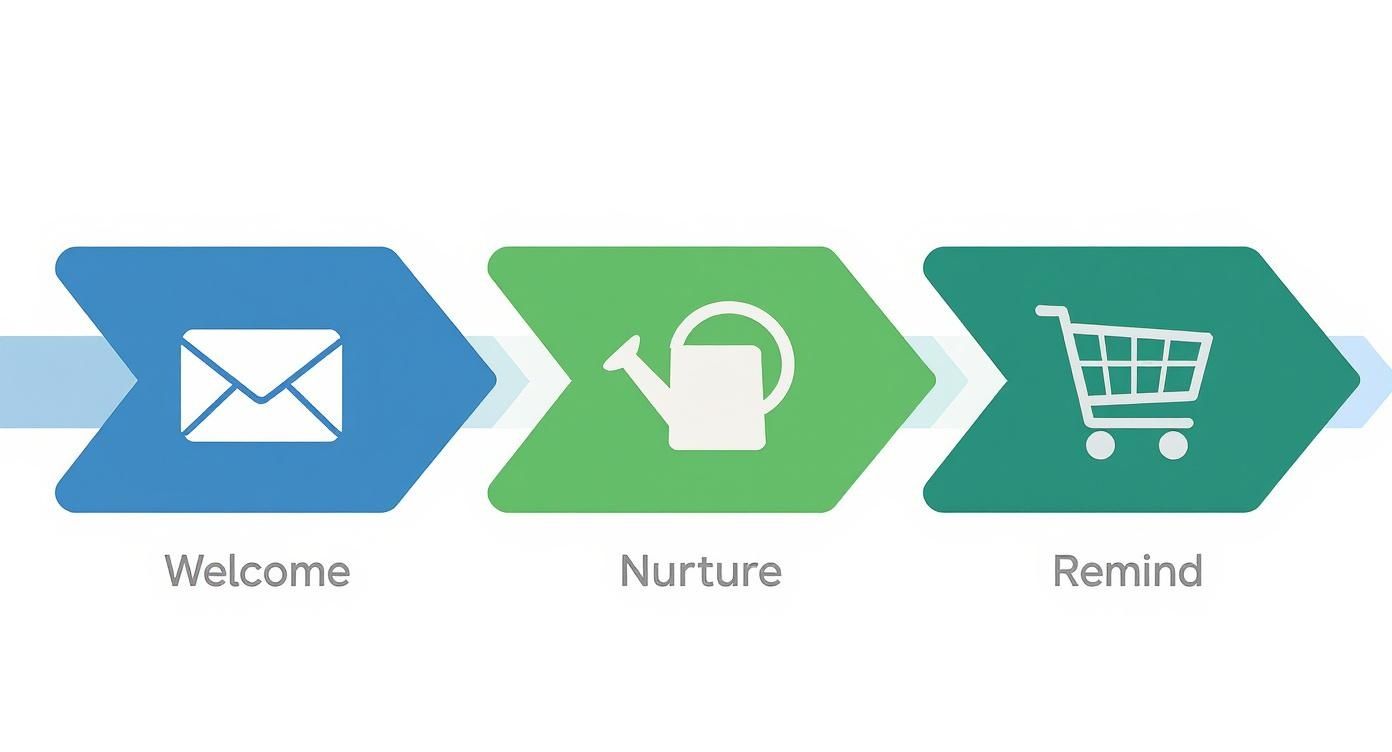
This visual shows a customer moving from a simple welcome, to deeper nurturing, and finally to a sales reminder, creating a journey that makes sense.
Phase 4: Optimize and Improve
With two workflows humming along, you now have data. Phase 4 is all about looking at that data to see what’s working and what could be better. You don’t need to be a data scientist—just look at the basic numbers your software gives you.
Check things like:
- Which emails are getting the most opens?
- Which links are people actually clicking?
- Is there a point in the sequence where people drop off?
Use what you find to make small tweaks. Maybe you rewrite a subject line on a low-performing email or add one more helpful tip before you ask for the sale. This cycle of building, measuring, and tweaking is how you create a powerful, self-improving marketing machine over time.
How to Choose the Right Automation Software
Picking your first automation software is a big step. With a whole sea of options out there, it’s ridiculously easy to get stuck in “analysis paralysis.” The secret? Ignore the super-complex, enterprise-level platforms. Your focus should be on what you, as a small business owner, actually need to get results right now.
Think of it like buying your first car. You don’t need a race car with a hundred confusing buttons on the dash. You just need a reliable ride that gets you where you’re going safely and efficiently. The same goes for this software. You’re looking for a tool that solves your immediate problems, not one that creates a bunch of new ones.
Must-Have Features for Small Businesses
When you’re just getting started, a handful of core features will give you 80% of the value. Don’t let yourself get distracted by shiny, advanced tools you might not touch for years. What matters is that your chosen platform absolutely nails the fundamentals.
Here’s your non-negotiable checklist:
- An Intuitive Workflow Builder: This is the heart and soul of automation. You want a simple, visual, drag-and-drop editor. It should let you map out your customer journeys easily without needing a degree in computer science.
- Reliable Email Marketing: The tool has to be great at sending emails. That means easy-to-use templates that look good and, most importantly, high deliverability. Your messages need to land in the inbox, not the spam folder.
- Basic Contact Management (CRM): You need one central place to keep all your customer info organized. The system must let you tag and segment contacts based on what they do or what they’re interested in—that’s how you send messages that actually feel personal.
Any platform that masters these three things gives you everything you need to start building powerful automations from day one. To really nail your segmentation, you have to know your audience inside and out. You can dive deeper by reading our guide on how to create buyer personas.
Finding the Right Balance of Price and Power
For a small business, the budget is always top of mind. The good news is the market is full of affordable—and even free—options built for companies just like yours. The trick is finding that sweet spot between cost and capability.
Lots of platforms offer a free plan, which is a fantastic way to dip your toes in the water. These are usually limited by the number of contacts (say, under 1,000) or a few features. A free plan is perfect for testing things out and building your first simple workflow. As your list grows, you can move up to an affordable paid plan, which often starts around just $20 per month.
Marketing automation is a powerful tool for small businesses looking to boost efficiency and revenue. A significant benefit is improved customer loyalty; small businesses using automation see up to a 60% improvement in customer retention. Many achieve a 3 to 5 times ROI within their first year, proving it’s an investment that pays for itself. You can discover more insights about the benefits of automation for small businesses on deliberatedirections.com.
Popular Tools and Who They Are Best For
Not all budget-friendly tools are the same. Some are geared toward e-commerce, while others are a better fit for service businesses or bloggers.
Here’s a quick breakdown to help point you in the right direction:
- For the Absolute Beginner (MailerLite): If you just want something simple that works, MailerLite is a great place to start. Its interface is incredibly user-friendly and it has a generous free plan, making it perfect for setting up your first welcome email series.
- For the E-commerce Shop (Klaviyo): Klaviyo was built from the ground up for online stores. It integrates deeply with platforms like Shopify, which makes setting up abandoned cart reminders and product recommendations a total breeze.
- For the All-in-One Seeker (Brevo): If you’re looking for a platform that can handle email, SMS, and even website chat, Brevo (which used to be Sendinblue) packs a lot of power for a reasonable price. It’s a solid choice if you see yourself expanding into other channels down the road.
By focusing on what you need right now and starting with a tool that fits your goals and budget, you can make a choice that will become a true engine for your business’s growth.
Measuring Success with Metrics That Matter
Alright, so you’ve got your marketing automation running. That’s a huge first step. But how do you actually know if it’s working? Launching automated campaigns without tracking them is like driving down I-275 with your eyes closed—you’re moving, but you have no idea if you’re headed in the right direction.
To get a clear picture, you have to cut through the noise. Vanity metrics like social media likes feel nice, but they don’t keep the lights on. Instead, we need to focus on the numbers that directly link your automation efforts to real business growth.
Tracking Audience Engagement
The first thing to check is simple: are people even paying attention? Your initial engagement numbers are the earliest clues to whether your messaging is hitting the mark or falling flat.
You’ll want to keep an eye on these two core metrics:
- Open Rate: This is the percentage of people who actually opened your email. If this number is low, your subject lines probably aren’t compelling enough to stand out in a crowded inbox.
- Click-Through Rate (CTR): This tells you the percentage of recipients who cared enough to click a link inside your email. A solid CTR is a great sign that your content was relevant and your call-to-action was crystal clear.
These figures give you instant feedback, showing you what’s resonating and what needs a rethink.
Measuring True Business Impact
While opens and clicks are important, they’re just the opening act. The real goal is to get people to take action—book a demo, buy a product, or fill out a form. This is where you connect the dots between your automation and your bank account.
Statistical research shows that marketing automation directly fuels growth. Small businesses using it have reported an 18% increase in lead generation and a 12% improvement in conversion rates. Beyond that, companies leveraging automation see a 34% average increase in total revenues, proving its powerful effect on the bottom line. You can explore more findings about automation’s impact on small business growth at 310creative.com.
To see this impact for yourself, start tracking these critical KPIs:
- Conversion Rate: This is the big one. It’s the percentage of people who completed the goal of your campaign, whether that’s making a purchase or requesting a quote. For practical tips on boosting this number, check out our guide on how to improve website conversion rates.
- List Growth Rate: Are you consistently adding new people to your email list? A healthy growth rate means your marketing is attracting fresh leads and expanding your audience.
- Customer Retention Rate: How many customers stick around? Automation can be a game-changer here, using follow-up emails and re-engagement campaigns to keep customers coming back for more.
Finally, you need to calculate your Return on Investment (ROI). At its simplest, this means comparing the money you made from your automated campaigns to what you spent on the software and your time. This number tells you, without a doubt, whether your marketing automation is a profitable part of your strategy.
Watching Out for Common Mistakes
Jumping into marketing automation is a great move, but like any powerful tool, there are a few traps for the unwary. Honestly, the fastest way to get it right is to learn from the mistakes others have already made. If you know what to watch for upfront, you can build a system that actually strengthens your customer relationships instead of making them feel robotic.
The whole point is to make your marketing more human and efficient, not just… more.
Over-Automating and Losing That Personal Touch
This is the biggest danger by a mile. It’s so easy to fall in love with the technology and completely forget there are real people on the other end. You can set up a slick machine that sends emails and tracks behavior, but if it strips away your brand’s personality, you’ve already lost.
Small businesses run on authenticity. Automation should pour gas on that fire, not put it out.
Think about a local St. Pete bakery. They could automate reminders for weekly specials. A robotic message just says, “Our croissant special is this Friday.” But a personal one? “Hey [Customer Name], hope you’re having a great week! Just a heads-up, your favorite almond croissants are our special this Friday.” The first is spam; the second is a friendly note from a neighborhood spot.
Your automation should always sound like it came from you, not a server. Before you launch any workflow, just ask yourself: “If I were sending this one message to one person, is this what I would say?”
Trying to Boil the Ocean on Day One
Another classic mistake is trying to build a perfect, all-knowing automation system from the get-go. This path almost always ends in frustration and burnout. You don’t need a ten-step, multi-branching lead nurturing sequence that covers every possible customer action right away. You just need to solve one problem, really well.
Take a freelance consultant in Tampa. Instead of mapping out a massive system for leads from six different sources, she could start with a simple automation: a two-email sequence that follows up after an initial consultation. It’s a small, focused workflow that delivers immediate value and is way easier to manage and tweak.
Forgetting About Your Contact List
Your automation machine is only as good as the fuel you put in it. Too many business owners get wrapped up in creating workflows and forget about the most basic part: keeping a healthy contact list. A neglected list quickly fills up with unengaged subscribers and bad email addresses, which tanks your deliverability and messes up all your metrics.
Make list hygiene a regular habit. It’s not hard:
- Clean your list periodically. Use your tool to find subscribers who haven’t opened an email in six months and politely remove them.
- Segment your contacts. Don’t just collect emails. Use tags to note interests or purchase history. This keeps your automated messages relevant.
- Make unsubscribing easy. I know it sounds backward, but a clear unsubscribe link means only the people who want to hear from you stay on your list. That improves everything.
By sidestepping these common blunders, your marketing automation for small business becomes a true asset for growth. It saves you time while deepening the very customer connections that make your business special in the first place.
Got Questions? We’ve Got Answers.
Even with a clear plan, stepping into something new always brings up a few last-minute questions. It’s completely normal. Getting solid answers is the best way to build the confidence you need to move forward. Here are a few of the most common ones we hear from small business owners about marketing automation.
How Much Does Marketing Automation Cost?
It’s way more affordable than you probably think. Many of the best platforms out there actually have free plans for businesses with a smaller email list, usually under 1,000 subscribers. These free tiers are the perfect sandbox for building your first couple of workflows without any financial risk.
Once your list grows, you’ll find that paid plans often start in the $20 to $50 per month range. From there, the price scales up based on how many contacts you have or if you need more powerful features. The trick is to pick a tool that fits where you are today but gives you plenty of room to grow.
Will Automation Make My Brand Feel Robotic?
Absolutely not—in fact, when you use it right, it does the exact opposite. Good marketing automation for small business makes your marketing more personal, not less. It’s what lets you have one-on-one conversations, just at a much larger scale.
Instead of blasting the same generic email to your entire list, automation lets you send a super-relevant message triggered by a specific action. Someone keeps visiting your pricing page? You can send them a targeted follow-up. Have a customer with an upcoming birthday? Send a personalized greeting with a special offer.
Think of it this way: automation handles the delivery, freeing you up to focus on the relationship. The message itself can be every bit as warm and authentic as an email you’d type out by hand.
It’s all about getting the right message to the right person at the right moment. That’s the core of any great customer experience.
How Much Time Does This Actually Take to Manage?
Okay, let’s be real: there’s an initial time investment. You’ll need to set aside a few dedicated hours to learn the platform and build your first couple of workflows.
But the whole point is to win back a massive amount of your time in the long run. Once an automation is up and running, it works for you 24/7, nurturing leads and engaging customers while you’re busy running your business. Ongoing management is pretty minimal—often just a couple of hours a month to check on performance and think about what to build next.
Ready to stop wasting time on repetitive marketing tasks and start building a real system for growth? Netco Design LLC specializes in creating digital marketing strategies that actually drive revenue for small businesses in Tampa Bay and beyond. We can help you implement the right automation to bring in qualified customers and turn more of those leads into sales.
Learn how we can elevate your digital presence at netcodesign.com

