

table of contents
When people talk about on page vs off page SEO, the fundamental difference really boils down to one thing: control.
On-page SEO covers everything you do directly on your own website to improve its ranking. Off-page SEO, on the other hand, involves all the actions taken away from your site to build its authority and reputation online. A winning strategy needs both, because without a solid on-page foundation, your off-page efforts will never truly take off.
Defining On Page vs Off Page SEO
Let’s use an analogy to make this crystal clear. Imagine your website is a brand-new restaurant.
Everything you do inside the restaurant to make it an amazing place for customers is your on-page SEO. This includes crafting the perfect menu (your content), ensuring lightning-fast service (site speed), and creating a beautiful, welcoming atmosphere (user experience). You have direct control over all of it.
Now, everything that builds your restaurant’s reputation around town is your off-page SEO. This is the buzz—the glowing reviews in a local food blog, mentions in magazines, and people recommending your spot to their friends. These things happen outside your restaurant’s walls, but they are absolutely crucial for building trust and bringing new people through the door.

Core Components and Goals
On-page SEO is all about optimizing your website’s content and underlying structure to make it as clear and relevant as possible for both search engines and human visitors. This means diving into things like keyword research and placement, creating genuinely helpful content, boosting site speed, and making sure your site works perfectly on mobile. The goal here is simple: make your website easy for Google to understand and a delight for people to use. For a deeper dive, check out our guide on what search engine optimization is.
Off-page SEO has a different mission: building your website’s authority and credibility across the internet. The undisputed heavyweight tactic here is earning backlinks from other reputable websites. Think of these links as votes of confidence, signaling to Google that your site is a trustworthy resource. Other important off-page signals include brand mentions, social media engagement, and online reviews.
Quick Comparison On Page and Off Page SEO
To make the distinction even clearer, here’s a quick side-by-side look at the two disciplines.
On-Page SEO
- Location of Actions: Directly on your own website.
- Primary Goal: Improve content relevance and user experience.
- Key Tactics: Content quality, keyword use, site speed, internal links.
- Level of Control: 100% within your direct control.
Off-Page SEO
- Location of Actions: Outside of your website on other sites, platforms, and channels.
- Primary Goal: Build authority, trust, and reputation.
- Key Tactics: Backlinks, brand mentions, social signals, online reviews.
- Level of Control: Influenced by you, but ultimately controlled by others.
This comparison simplifies the core differences, but the real magic happens when they work together.
The relationship is simple: On-page SEO gets your house in order, while off-page SEO spreads the word about how great your house is. You can’t successfully do the latter without doing the former first.
Ultimately, the conversation isn’t really about “on page vs off page SEO,” but rather how the two integrate. A technically sound, user-friendly website loaded with fantastic content (on-page SEO) is the launchpad for any effective off-page strategy. Without that solid base, you’re just promoting a destination that’s bound to disappoint visitors, wasting your time and money.
Mastering Your On-Page SEO Foundation
Think of on-page SEO as everything that makes your house a home—from the solid foundation and sturdy walls to the interior design and clear signs telling people where the kitchen is. It’s the bedrock of your entire digital presence. Pouring money into off-page promotion is pointless if you’re sending high-value traffic to a site that’s slow, confusing, or just plain irrelevant.
This foundational work goes way beyond just sprinkling keywords on a page. It’s about crafting high-quality, genuinely helpful content that solves a user’s problem while also fine-tuning all the technical signals search engines use to understand and rank your site. A rock-solid on-page strategy makes it dead simple for search engine crawlers to index your content and see its value.

Optimizing Core On-Page Elements
The most obvious parts of on-page SEO are what both your visitors and the search engines see right away. These elements are like signposts, telling everyone what your content is about and why they should care.
- Title Tags and Meta Descriptions: This is your digital storefront window. A sharp title tag and meta description must include your main keyword, but more importantly, they need to give someone a compelling reason to choose your link over the ten others on the page. They have a direct line to your click-through rates (CTR).
- Header Tags (H1, H2, H3): Headers are all about organization. They break your content into a logical, scannable structure. Your H1 is the main event, while H2s and H3s create digestible subsections that improve readability for people and provide critical structural clues for search bots.
- High-Quality Content: This is the absolute heart of on-page SEO. Your content has to be original, thorough, and directly answer the questions your audience is asking. To really get this right, you need to understand and apply current SEO content writing best practices, which means focusing on things like smart keyword integration and demonstrating expertise (E-E-A-T).
When these pieces work together, they tell a clear story to search algorithms, making it undeniable what your page is about and who it’s for.
The real goal of on-page optimization isn’t just to make search engines happy; it’s about creating a fantastic, seamless user experience. When you put the user first, you’re automatically sending all the right signals to Google.
The Technical Backbone of Your Website
Behind the scenes, a whole layer of technical SEO elements controls how easily your site can be crawled and how people actually experience it. Google cares a lot about these factors because they tie directly to user satisfaction. If you ignore them, even the most amazing content can fall flat.
Let’s talk numbers for a second. The top organic search result pulls in an incredible 39.8% of all clicks. Even just moving from position two to position one can generate 74.5% more clicks. This is why nailing on-page details like crafting title tags with question-based keywords (which can boost CTR by 15.5%) and ensuring a mobile-friendly design is so critical for growth.
Key Technical Optimizations to Master
Getting your technical foundation right isn’t optional if you want to compete.
- Core Web Vitals: These are specific metrics Google uses to measure your site’s loading speed, interactivity, and visual stability. A bad score here means a frustrating experience for users, which can seriously tank your search visibility.
- Mobile Responsiveness: With most searches now happening on phones, your site has to look and work flawlessly on every screen size. This is a non-negotiable, top-tier ranking factor.
- Clean URL Structures: Your URLs should be short, easy to read, and contain relevant keywords. A logical URL like
/services/local-seois miles better than/p?id=12345. - Strategic Internal Linking: Linking to other relevant pages on your own site is a powerhouse move. It helps users find more of your great content and spreads “link equity” across your domain. A well-planned internal linking map is a core part of a strong site architecture. You can learn more in our guide to improving SEO with site architecture.
By mastering both the content and technical sides of on-page SEO, you build a powerful foundation that doesn’t just improve rankings—it makes the entire user journey, from search result to conversion, that much better.
Building Authority with Off Page SEO
If on-page SEO is laying a solid foundation for your house, then off-page SEO is building its reputation in the neighborhood. It covers all the things you do outside of your website to show search engines that your content is credible, authoritative, and deserves a top spot. Think of it as generating powerful, digital word-of-mouth.
This process is about so much more than just driving traffic; it’s about building trust. When reputable websites, well-known social media accounts, and industry forums mention or link back to your site, they’re essentially vouching for you. Google sees these external signals as strong proof that your brand is a legitimate and valuable player in its field.
The Central Role of High Quality Backlinks
At the heart of any strong off-page strategy is the art and science of earning high-quality backlinks. Search engines view these links as votes of confidence—the more votes you get from trusted, relevant sites, the higher your authority climbs.
But let’s be clear: not all links are created equal. A single, relevant link from a major industry publication is worth infinitely more than a hundred low-quality links from spammy directories. In fact, toxic backlinks can actively hurt your rankings, which is why the focus must always be on quality, not just quantity.
This is where the difference between on-page and off-page SEO really sharpens: you earn off-page signals; you don’t just implement them.
Off-page SEO is reputation management at its core. It’s the long-game of proving your website’s value to the rest of the internet, and every quality backlink you earn is a powerful endorsement.
Sustainable Strategies for Earning Links
Getting valuable backlinks takes a smart, persistent approach. The real goal is to create assets and build relationships that attract links naturally over time. Sustainable link-building isn’t about quick tricks; it’s about establishing your brand as a go-to authority.
Some of the most effective strategies include:
- Digital PR: This involves creating newsworthy content—like original research, data studies, or unique infographics—and pitching it to journalists and bloggers. When they cite your work, you earn incredibly powerful, authoritative backlinks.
- Guest Blogging: Writing insightful articles for respected websites in your industry doesn’t just put your brand in front of a new audience; it also secures a relevant backlink in the process.
- Creating Linkable Assets: Developing “ultimate guides,” free tools, or in-depth case studies gives other websites a solid reason to link to you. These resources become valuable references for their own readers.
The data backs this up completely. Top-ranking pages have 3.8x more backlinks than those in positions two through ten. What’s more, businesses that maintain active blogs attract 97% more backlinks, yet 41% of SEOs still say link-building is their toughest challenge. If you’re ready to get started, our guide on how to build links effectively is the perfect next step.
Beyond Backlinks Other Vital Off Page Signals
While backlinks are definitely the main event, they aren’t the only piece of the off-page SEO puzzle. Search engines are constantly looking at a variety of other signals that contribute to your site’s overall reputation and authority online.
These other important off-page elements include:
- Brand Mentions: Even when your brand is mentioned without a link on other websites, forums, or social media, it still contributes to your online authority.
- Social Media Engagement: Shares, comments, and general buzz on social platforms signal that your content is resonating with a wider audience.
- Online Reviews: Positive reviews on platforms like Google Business Profile, Yelp, and industry-specific sites are huge trust signals, especially for local businesses.
- Local Citations: Consistent listings of your business’s name, address, and phone number (NAP) in online directories build local authority and trust.
Ultimately, a strong off-page SEO profile tells search engines a complete story about your brand’s credibility and influence. It’s a long-term investment that cements your position as a trusted leader in your field.
On-Page and Off-Page SEO: A Powerful Partnership
It’s a classic mistake to view on-page vs. off-page SEO as a competition. They aren’t rivals; they’re two sides of the same coin, working together in a continuous loop. Think of it this way: great on-page SEO creates the fuel for powerful off-page signals, which then drive authority and traffic right back to your well-built site.
One side simply can’t perform without the other. You could have the most technically sound, user-friendly website on the planet, but if nobody links to it, it’s like a fantastic shop with no roads leading to it. On the flip side, you can build a massive network of backlinks, but if they all point to a slow, confusing, or irrelevant website, visitors will bounce immediately. That tells Google your site doesn’t deserve its rank.
How a Great Website Fuels Off-Page Wins
The best, most sustainable off-page strategies always start with stellar on-page work. When you create genuinely useful, well-researched, and engaging content, you’re building what we call a “linkable asset.” This is content so good that other websites, bloggers, and journalists want to reference it, earning you high-quality backlinks without you having to ask.
Imagine a local contractor who publishes an in-depth guide, complete with original photos, on “Choosing Hurricane-Resistant Roofing Materials in Florida.” They’ve just created a prime linkable asset. Local news outlets covering storm season, home improvement blogs, and even material suppliers now have a compelling reason to link to that guide. The on-page effort directly generates off-page authority.
The core idea is simple: fantastic on-page SEO makes your off-page efforts ten times easier and more effective. You stop begging for links and start giving other sites a valuable resource to share with their own audience. It’s a win-win.
This symbiotic relationship is what drives long-term success in search. A strong backlink profile sends authoritative traffic your way, and an excellent on-page experience makes sure that traffic sticks around, engages, and converts.
Nailing Google’s E-E-A-T Guidelines
This integrated approach is exactly what Google looks for with its E-E-A-T guidelines—Experience, Expertise, Authoritativeness, and Trustworthiness. These aren’t just buzzwords; they’re the core criteria Google’s own quality raters use to judge a website.
Here’s how the two parts work together to satisfy E-E-A-T:
- Expertise & Experience (On-Page): You show this by publishing detailed, accurate, and insightful content. A smart SEO keyword strategy ensures this content perfectly matches what real people are looking for.
- Authoritativeness & Trustworthiness (Off-Page): This is built when other reputable sites link to your expert content. Every quality backlink and brand mention acts as a vote of confidence, validating your expertise to Google.
Let’s look at a real-world scenario. An e-commerce store selling high-end running shoes starts by investing in on-page SEO. They write unique product descriptions, create detailed buyer’s guides, and publish blog posts comparing different shoe technologies. This establishes their expertise.
Next, for their off-page strategy, they send shoes to trusted product reviewers and fitness bloggers. Because the website is already so informative and easy to use, these reviewers are happy to link back to specific product pages and guides. This external validation builds authority and trust, completing the E-E-A-T picture.
This balanced approach is the only way to achieve sustainable, page-one rankings. Relying on on-page SEO alone leads to a plateau; you simply won’t have the authority to outrank established competitors. Likewise, focusing only on off-page SEO is like building a house on a shaky foundation. The data is clear: Google’s top three results get a whopping 68.7% of all clicks, and pages that master both on-page and off-page signals see a 42.9% click-through rate on featured snippets. You can explore more about these integrated strategies by reading the full on-page vs off-page seo guide.
How to Prioritize SEO Efforts for Your Business
Figuring out the difference between on-page and off-page SEO is one thing, but knowing where to actually spend your time and money? That’s a whole different ballgame. There’s no one-size-fits-all answer here. The right move depends entirely on your business, your market, and what you need to achieve right now.
Think about it: a brand-new website has zero authority. Its first job has to be nailing the on-page fundamentals to build a solid foundation. On the flip side, an established site with years of great content might get a much bigger lift by pouring its resources into off-page authority building.
This decision tree shows how on-page and off-page efforts really work together to land those top rankings.
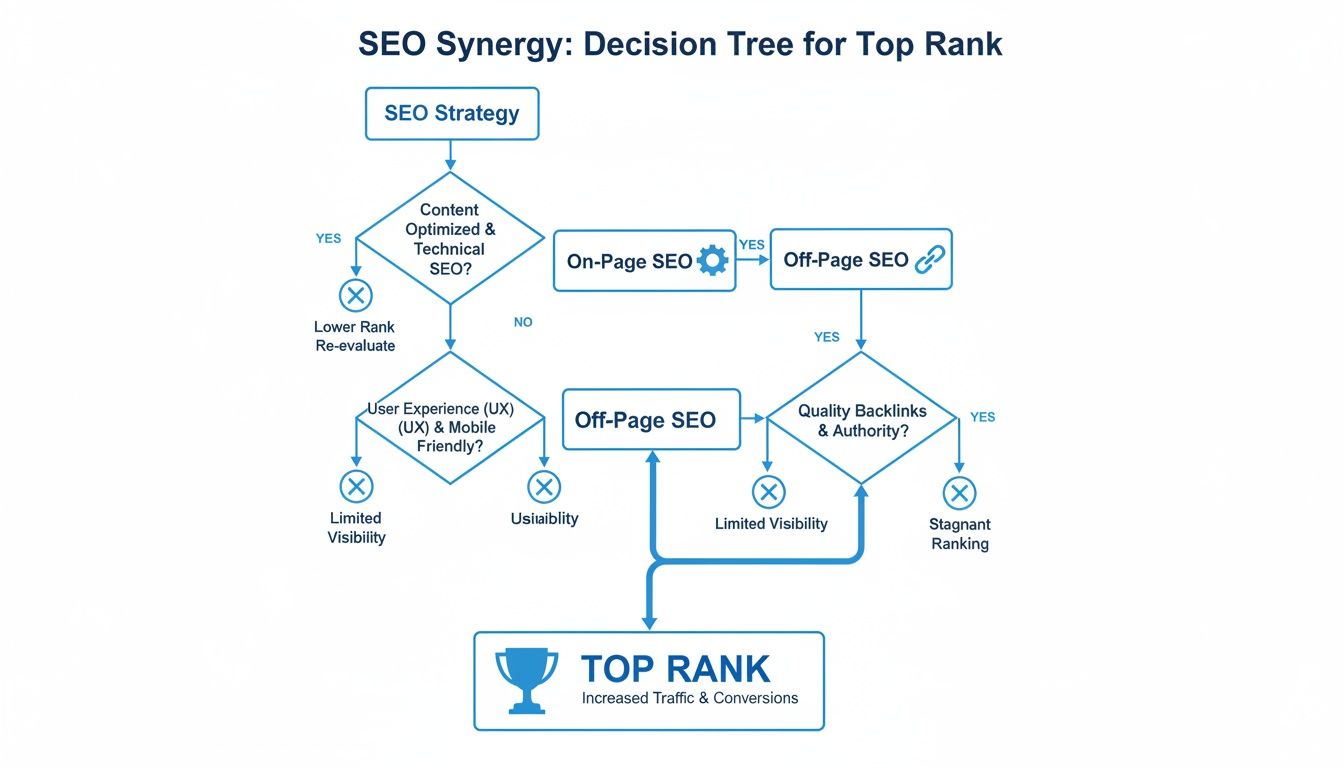
The main takeaway here is that you can’t just pick one and ignore the other. They are parallel tracks that have to merge for you to truly win at SEO.
Priorities for Local Businesses
If you’re a plumber, dentist, or restaurant, being visible in your specific geographic area is everything. The goal is simple: show up in the “local pack” and on Google Maps when a potential customer down the street searches for what you offer. This calls for a very targeted mix of tactics.
Top On-Page Priority:
- Hyper-Local Content and Keywords: Your service pages and blog posts need to scream “local.” Optimize for terms like “emergency roof repair in St. Petersburg” instead of a generic “roof repair.” Your homepage title tag and main heading should clearly state what you do and where you do it.
Top Off-Page Priority:
- Local Citations and Reviews: Your most critical off-page task is building and maintaining consistent NAP (Name, Address, Phone Number) information across directories like Google Business Profile, Yelp, and other industry sites. Actively asking for—and responding to—customer reviews sends massive trust signals to both people and search engines.
For a local business, your Google Business Profile isn’t just a listing; it’s your digital storefront. Optimizing it is arguably the single most impactful off-page SEO activity you can do.
Priorities for E-commerce Brands
E-commerce sites live and die by their ability to rank for product and category keywords, often on a national or even global scale. Since you’re dealing with potentially thousands of pages, technical health and scalable authority-building are non-negotiable. The path from search result to checkout has to be completely seamless.
Top On-Page Priority:
- Technical SEO and Site Architecture: You absolutely need a clean, logical site structure. This means creating clear category hierarchies, optimizing faceted navigation so search engines can crawl it, and implementing schema markup for your products. Product schema is what gets you those eye-catching rich results like star ratings and pricing right in the search listings, which can seriously boost your click-through rates.
Top Off-Page Priority:
- Product-Focused Link Building: The best backlinks come from places that actually influence buyers. Focus your energy on getting your products featured in gift guides, “best of” listicles, and product reviews on niche blogs. This strategy doesn’t just build powerful, relevant links; it also drives high-intent referral traffic that’s ready to buy.
Priorities for B2B Service Providers
B2B companies like SaaS firms or marketing agencies are playing a different game. The sales cycle is longer and the audience is more specialized. Here, the primary goal is to establish deep expertise and build trust with key decision-makers. SEO is less about raw traffic volume and more about attracting the right qualified leads through thought leadership.
Top On-Page Priority:
- Authoritative Long-Form Content: Your website needs to be a library of expertise. Your top priority should be creating in-depth content like whitepapers, case studies, original research, and comprehensive guides. These assets prove you know your stuff and become the foundation for your off-page campaigns. They’re designed to answer complex questions for a professional audience.
Top Off-Page Priority:
- Industry-Specific Guest Articles and PR: Build your authority by contributing insightful articles to respected trade publications and industry blogs your target clients actually read. Getting mentioned or quoted in reports from industry analysts also builds incredible credibility. These off-page signals are the proof that backs up the expertise you claim on your own site.
By aligning your on-page and off-page priorities with your specific business model, you can invest your resources far more effectively. This focused approach ensures every action you take contributes directly to your most important goals—whether that’s making the phone ring locally, selling more products online, or generating high-quality B2B leads.
Measuring the Impact of Your SEO Strategy
Drawing a line between on-page and off-page SEO tactics is one thing, but proving they actually work is the real test. Without a smart way to track your success, you’re just throwing effort into the void. A solid measurement plan connects your actions to real results, showing you exactly what’s working and where you need to adjust.
When it comes to on-page SEO, your most important metrics are found inside tools like Google Analytics and Google Search Console. These platforms give you a direct window into how both users and search engines are responding to your website’s content and technical health.
For off-page SEO, the game shifts to tracking external signals of authority and trust. Here, you’ll lean on specialized tools like Ahrefs or SEMrush to monitor how your brand’s reputation is growing across the web. Success isn’t just about getting more links; it’s about earning the right links from the right places.
Tracking On-Page SEO Success
The results of your on-page work show up in how people interact with your site and how search engines decide to rank it. These metrics tell a clear story about whether your content is hitting the mark and if your site’s foundation is solid.
Key on-page metrics to keep an eye on include:
- Organic Traffic Growth: This is the most direct indicator of success. Are more people finding you through search engines over time?
- Keyword Ranking Improvements: Are you moving up in the search results for your target keywords? Watching this shows if your content optimization is paying off.
- User Engagement Metrics: Dig into numbers like Time on Page and Bounce Rate. High engagement tells you your content is valuable and meeting what users are looking for.
Measuring Off-Page SEO Authority
Off-page success is all about building your website’s credibility, and the metrics you track should reflect that. It’s a measure of how other websites and online communities perceive your brand’s trustworthiness.
Key off-page metrics to monitor are:
- Referring Domain Growth: The number of unique websites linking back to you is often a more powerful metric than the total number of backlinks you have.
- Backlink Quality: You have to assess the authority of the sites linking to you. A single link from a highly trusted source can be worth more than dozens from low-quality, spammy sites.
- Domain Rating (DR) or Authority Score (AS): These are third-party metrics from tools like Ahrefs and SEMrush that estimate your site’s overall authority based on its backlink profile.
A powerful feedback loop is created when your on-page and off-page efforts are measured together. Strong off-page authority drives more traffic, which gives you more on-page data to analyze and improve the user experience, further boosting your credibility.
By analyzing this data, you can make smarter, more informed decisions. For example, if a high-quality backlink (an off-page win) is sending a lot of referral traffic but those visitors leave immediately, that’s a clear sign you need to improve the on-page experience of that landing page.
For a complete picture, you can learn more about what to include in a comprehensive SEO report that tracks both on-page and off-page KPIs. This integrated view is the key to achieving continuous, sustainable growth.
Got Questions? We’ve Got Answers.
Even after laying it all out, a few common questions always seem to pop up. Let’s tackle them head-on to make sure you have a rock-solid understanding of how on-page and off-page SEO really work together.
What’s the Real Difference Between On-Page and Off-Page SEO?
It all boils down to two things: control and location.
On-page SEO is everything you do on your actual website. Think content creation, tweaking your site’s code for speed, and setting up internal links. You have direct control over all of it.
On the other hand, off-page SEO covers all the actions taken away from your website to build up its reputation and authority. This is where things like earning backlinks from other sites and getting mentioned online come into play.
Which One Should I Start With?
This one’s easy: on-page SEO always comes first. It’s non-negotiable, whether your site is brand new or has been around for years.
You have to build a solid foundation—a site that’s technically sound, fast, and full of great content—before you even think about off-page strategies. Trying to promote a clunky, poorly optimized website is like throwing money away. Visitors won’t stick around, and Google will never see it as a credible source.
Think of it this way: You need to build a great destination (on-page SEO) before you start putting up billboards around town to attract visitors (off-page SEO).
How Long Until I Actually See Results from SEO?
The timeline can vary quite a bit. You might see some on-page tweaks move the needle on your rankings in just a few weeks.
But off-page SEO is a marathon, not a sprint. It’s a long-term investment. Building a strong backlink profile and establishing your site as an authority can easily take 3 to 6 months or more before you see significant, lasting gains in your search visibility.
At Netco Design LLC, we build balanced SEO strategies that deliver compounding results over time. If you’re ready to create a powerful online presence with a team that gets both sides of the SEO coin, let’s connect. Find out how we can help your business grow at https://netcodesign.com.

