

table of contents
Think about the last time you searched for something you needed right away. A local plumber, a new pair of running shoes, or maybe a last-minute gift. The first few results you saw, probably marked with a small “Ad” label, were no accident.
That’s paid search advertising in action.
What Is Paid Search Advertising
Imagine setting up a storefront directly on the path where every single passerby is actively looking for exactly what you sell. That’s the essence of paid search advertising. It’s not just about throwing money at ads; it’s a strategic way to get your business front and center on search engine results pages (SERPs) the very moment a potential customer is ready to buy.
Unlike organic search (SEO), which is a marathon of building visibility over time, paid search is a sprint. It gives you a direct, almost instant, line to your audience. Most people know this model as pay-per-click (PPC), which means you only pay when someone is interested enough to actually click your ad. This makes it an incredibly efficient way to pull highly motivated traffic to your website.
The Immediate Impact of Paid Search
The biggest win here is speed. You can launch a brand-new campaign and see traffic rolling in within just a few hours. This makes it perfect for promoting a sale, launching a new product, or just testing the waters to see if people are interested in a new idea. It’s an agile tool that lets you react to the market on the fly.
Paid search is so effective because it’s built on a few powerful ideas:
- Intent-Driven Targeting: You’re not interrupting someone’s day. You’re meeting them right when they’re raising their hand and asking for a solution. These people are much further down the buying path.
- Measurable Results: Every click, every view, and every sale can be tracked. This firehose of data gives you a crystal-clear picture of your return on investment (ROI) and tells you exactly what to tweak for better results.
- Total Control: You’re in the driver’s seat. You set the budget, write the ad copy, and choose exactly who sees your ads. Every dollar is spent with precision.
Paid search puts your brand directly in the path of motivated buyers. In fact, research shows that visitors from paid search ads are 50% more likely to purchase than visitors from organic search.
Paid Search Versus Organic SEO
While both paid search and SEO are trying to win traffic from search engines, they play by different rules and on different timelines. SEO is a long-term investment. You’re building authority and earning “free” rankings, but that can take months, sometimes even years, to pay off. For a deep dive into the platform that practically defines this space, check out this complete guide to Google Ads for more.
Paid search, on the other hand, delivers that visibility today.
The magic really happens when you use both together. Insights from your paid campaigns can give your SEO keyword strategy a massive head start, and a strong organic presence makes your paid ads feel more credible. To see how these two strategies can work in tandem, take a look at some of our proven Google Ads best practices.
Bottom line? For any business looking for fast, scalable growth, paid search isn’t just an option—it’s essential.
Understanding the Paid Search Ad Auction
Every time you search for something, a lightning-fast auction happens behind the scenes to decide which ads pop up. Think of it as a silent, automated marketplace where countless advertisers compete for your attention. But here’s the twist: the highest bidder doesn’t always win the top spot. The whole system is designed to reward ads that actually help you, the user.
There’s a good reason paid search advertising is such a dominant force in digital marketing. Projections show it will command nearly 40% of global digital ad spend in 2025, hitting a staggering $295 billion worldwide. This massive investment is fueled by one simple fact: paid search visitors are 50% more likely to convert than organic ones. Businesses often see a 200% ROI—that’s $2 back for every $1 spent.
This infographic helps visualize the core components that make a paid search strategy click.
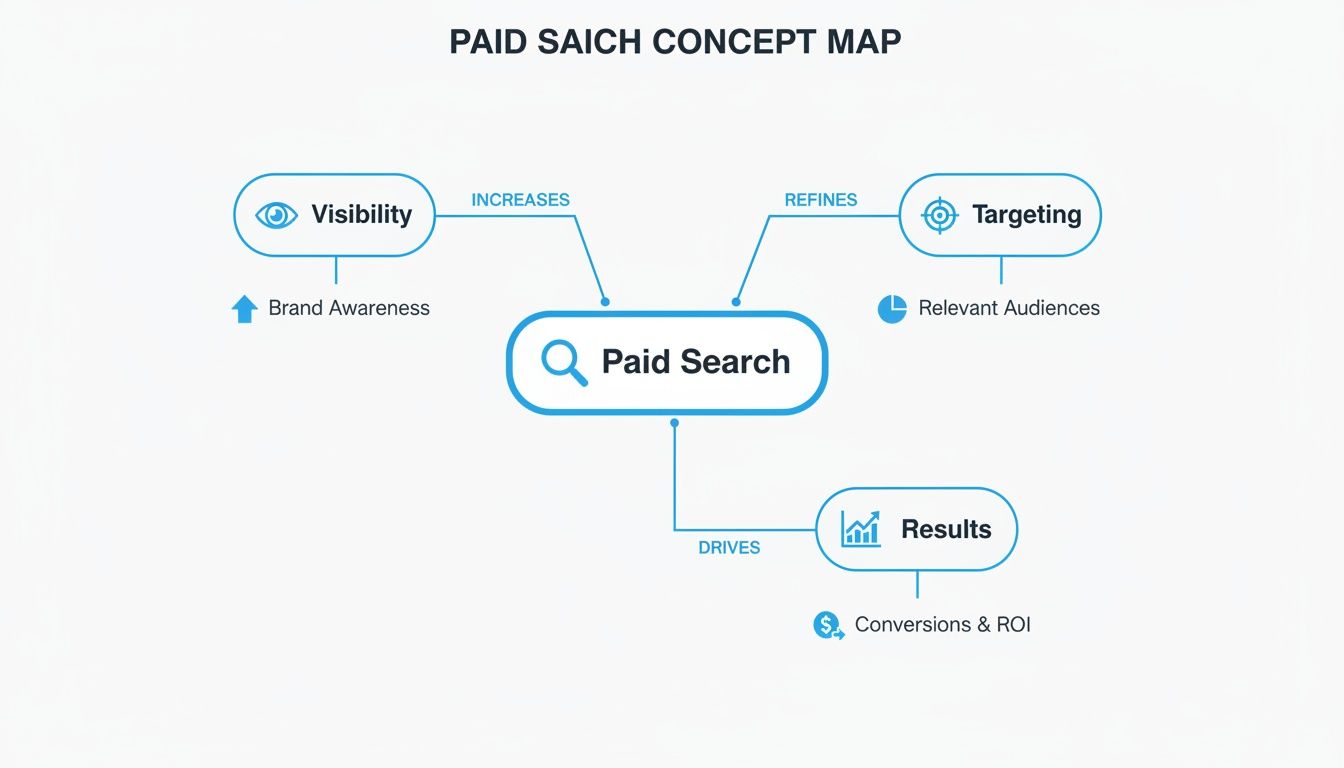
As you can see, it all comes down to combining visibility, precise targeting, and measurable results to create a powerful growth engine for any business.
The Winning Formula: Ad Rank
So how do platforms like Google decide an ad’s position on the page? They use a formula called Ad Rank. It’s a simple multiplication of your maximum bid by your Quality Score.
Ad Rank = Maximum Bid x Quality Score
This little equation is the heart of the ad auction. It proves that a high-quality, relevant ad can easily outperform a higher-bidding competitor who has a poor-quality ad.
This system is brilliant because it encourages advertisers to create ads that are genuinely useful, not just throw money at the problem. A strong Quality Score can actually lower your advertising costs, helping you secure a better position for less money. For a more detailed breakdown of these expenses, you might be interested in our guide on the cost of PPC advertising.
Unpacking Your Quality Score
What exactly is this “Quality Score”? Think of it as a diagnostic tool that search engines use to rate the overall quality of your ads, keywords, and landing pages on a scale from 1 to 10. A higher score signals that your ad is relevant and helpful to someone searching for your keyword.
Three main pillars support your Quality Score:
- Expected Click-Through Rate (CTR): This is the search engine’s prediction of how likely someone is to click your ad when it shows up. It’s based on your past performance and how well your ad copy matches what the user is looking for.
- Ad Relevance: This one’s pretty straightforward. It measures how closely your ad’s message matches the keywords you’re targeting. An ad for “women’s running shoes” that has a headline about running shoes is highly relevant.
- Landing Page Experience: The user’s journey doesn’t stop at the click. The search engine also peeks at your landing page to check for relevance, transparency, and ease of navigation. Does the page deliver on the promise made in your ad?
Nailing these three components is the key to a better Quality Score, which in turn leads to a higher Ad Rank and a more efficient ad spend.
Choosing Your Bidding Strategy
Your bid is the other half of the Ad Rank equation. It’s simply the maximum amount you’re willing to pay for a single click on your ad. There are several ways to manage your bids, each suited to different business goals.
- Manual Cost-Per-Click (CPC): This strategy gives you the most control. You set a maximum bid for each keyword yourself. It’s a great choice for advertisers who like to be hands-on and manage their budget with total precision.
- Target Cost-Per-Acquisition (CPA): With this automated strategy, you tell the platform how much you’re willing to pay for a conversion (like a sale or a lead). The algorithm then automatically adjusts your bids to hit that target, focusing on results, not just clicks.
- Maximize Clicks: This automated approach is designed to get as many clicks as possible within your daily budget. It’s a solid option if your primary goal is driving a high volume of traffic to your website to build awareness.
Choosing the right bidding strategy really depends on what you want to achieve. Whether your goal is brand awareness, lead generation, or direct sales, there’s an approach designed to help you get there.
Choosing Keywords and Using Match Types
Keywords are the fundamental bridge connecting a customer’s search to your solution. Think of them as the language of intent. Choosing the right ones is the difference between casting your line in an empty pond and finding a spot teeming with hungry fish. Success starts with getting inside your ideal customer’s head to figure out what they’re actually typing into that search bar.

This isn’t about guesswork. It’s about understanding the difference between someone just browsing for information and someone ready to pull out their wallet. Your goal is to aim your ad spend squarely at the keywords that signal a strong desire to buy.
Targeting Commercial Intent
Not all searches are created equal. Someone typing in “how to fix a leaky faucet” is in a very different headspace than someone searching for “emergency plumber near me.” The first is looking for information; the second is a clear signal they’re ready to hire someone.
To capture these high-intent customers, you need to target keywords loaded with modifiers that suggest a purchase is imminent. Think of terms like:
- Product-specific searches: “Nike Air Zoom Pegasus 40”
- Service-oriented queries: “roof repair st petersburg fl”
- “Buy now” keywords: “order pizza delivery” or “buy houseplants online”
- Location-based terms: “best sushi restaurant downtown”
Focusing on these transactional keywords ensures your budget goes toward clicks that are far more likely to turn into real business. For a deeper dive into this, check out our guide on how to choose keywords for your website.
Controlling Reach with Match Types
Once you have your keywords, you need to tell the search engine how closely a person’s search should align with them to trigger your ad. This is where match types come in. Sticking with our fishing analogy, you have different tools depending on what you want to catch.
Match types are your control valve for ad spend. They allow you to balance reach and relevance, ensuring you don’t waste money on clicks from people who aren’t looking for what you offer.
Each match type has a distinct strategic purpose, giving you the power to fine-tune your targeting from incredibly broad to surgically precise.
Understanding the Three Main Match Types
Let’s break down the primary match types. Each gives you a different level of control over who sees your ads.
- Broad Match (Casting a Wide Net): This is the default setting and gives you the widest reach. Your ad can appear for searches related to your keyword, including synonyms, misspellings, and related concepts. If your keyword is women’s hats, your ad might show up for “winter headwear for ladies.” While it offers maximum visibility, it demands close monitoring to avoid paying for irrelevant clicks.
- Phrase Match (Using a Selective Net): This strikes a balance between reach and control. Your ads will show on searches that include the meaning of your keyword. For example, the phrase match keyword “running shoes” could trigger ads for searches like “best shoes for running” or “buy running shoes online.” The core intent is preserved, making it a reliable workhorse for many campaigns.
- Exact Match (Spearfishing a Specific Target): This is your most restrictive and precise option. Your ads will only show up for searches that share the exact same meaning or intent as your keyword. So, the keyword [men’s formal shoes] would match “formal shoes for men” but not “men’s boots.” This type almost always delivers higher conversion rates because the user’s intent is crystal clear.
The Importance of Negative Keywords
Finally, one of the most essential tools in your paid search tackle box is the negative keyword. These are terms you specifically tell your campaign to avoid. If you sell premium, high-end coffee beans, you might add “-free” and “-cheap” as negative keywords to filter out bargain hunters.
Using negative keywords is absolutely crucial for protecting your budget and sharpening your campaign’s performance. They act as your filter, making sure you only pay for clicks from truly qualified potential customers.
How to Structure Your Campaigns for Success
A profitable paid search campaign starts with a solid blueprint. Messy, disorganized campaigns bleed money. Well-structured ones, on the other hand, are efficient, effective, and drive real results.
Think of your ad account like a library. The campaigns are the major sections—’Fiction,’ ‘History,’ ‘Science.’ The ad groups are the individual bookshelves within those sections. Your keywords and ads are the books, all neatly organized so visitors can find exactly what they’re looking for, fast.
This organization isn’t just for tidiness. It’s a huge factor in your Quality Score. When your keywords, ad copy, and landing pages are all tightly aligned, search engines see you as highly relevant. Your reward? Better ad positions at a lower cost. A sloppy structure does the opposite, signaling that you’re a poor match for the user’s search and leading to wasted spend.
Building Tightly Themed Ad Groups
The heart of a great structure is the tightly themed ad group. This simply means grouping a small, very specific set of keywords that all share the exact same user intent.
For instance, a local florist wouldn’t just lump everything into one “flower delivery” ad group. That’s a recipe for disaster. Instead, they’d build out separate, hyper-focused ad groups like these:
- Ad Group 1 Keywords: “rose bouquet delivery,” “send red roses,” “dozen roses delivered”
- Ad Group 2 Keywords: “sympathy flower arrangements,” “funeral flowers delivery,” “condolence flowers”
- Ad Group 3 Keywords: “birthday flower delivery,” “happy birthday bouquet,” “flowers for birthday”
By splitting them up, you can write incredibly specific ad copy for each. The ads for the first group can talk about romance and anniversaries, while the ads for the second group can adopt a more compassionate, respectful tone. This deep level of relevance is what boosts your Quality Score and, more importantly, connects with what the user actually needs in that moment.
A well-structured campaign ensures your message is never generic. By matching specific keywords to specific ad copy, you create a seamless and compelling user experience that drives higher click-through rates and conversions.
This granular approach gives you surgical control over your messaging. You can guarantee someone searching for sympathy flowers never sees a cheerful “Happy Birthday!” ad. If you’re curious about how this level of detail is managed day-to-day, our overview of pay-per-click advertising management breaks down the entire process.
Crafting Ad Copy That Converts
Once your ad groups are organized, it’s time to write ad copy that grabs attention and earns the click. Think of your ad as a tiny billboard competing for eyeballs on a crowded highway. Every single word has a job to do.
A winning ad has three key components working together:
- An Irresistible Headline: This is your first and only shot to make an impression. It needs to include the user’s keyword to show relevance and offer a clear benefit. Instead of a generic “Shoe Store,” try something like “Durable Running Shoes – Free Shipping.”
- A Clear Value Proposition: The description answers the searcher’s unspoken question: “What’s in it for me?” Use this space to highlight what makes you different. Mention key benefits like “24/7 Customer Support,” a “5-Year Warranty,” or “Locally Sourced Ingredients.”
- A Strong Call-to-Action (CTA): You have to tell people what to do next. A CTA creates clarity and a little bit of urgency. Don’t just let your ad trail off—use action-oriented phrases like “Shop the Sale Now,” “Get Your Free Quote,” or “Download the Guide Today.”
The Power of Continuous A/B Testing
Your first ad is almost never your best ad. The most successful advertisers are relentless testers. A/B testing, also known as split testing, is the simple practice of running two or more versions of an ad to see which one performs better. It’s how you replace guesswork with hard data.
You can test just about any part of your ad to find a winning combination. The trick is to only test one thing at a time, so you know exactly what caused the change in performance.
Some common elements to test include:
- Different Headlines: Does a question-based headline outperform a benefit-driven one?
- Varying Descriptions: Try highlighting different features or benefits.
- Multiple CTAs: Does “Buy Now” work better than “Order Online”?
- Landing Page Variations: Send traffic to different page layouts to see which one converts better.
By constantly testing and refining, you make small, incremental improvements that compound over time, leading to major boosts in click-through and conversion rates. This cycle of optimization is what separates the campaigns that struggle from the ones that are wildly profitable.
Measuring Performance and Optimizing Your Ads
Launching a paid search campaign is just the start. The real work—and the real profit—comes from the ongoing cycle of measuring performance, digging into the insights, and making smart, data-driven adjustments. This isn’t a “set it and forget it” channel. It’s a marathon where constant tuning separates the winners from the campaigns that slowly bleed money.
Success begins with tracking what actually matters. Without clear data, you’re flying blind, guessing whether your ad spend is generating a return or just vanishing into thin air. You need to zero in on the key performance indicators (KPIs) that connect directly to your business goals.
This process turns abstract clicks into a clear story about what’s working, what isn’t, and where your best opportunities for growth are hiding.
Defining Your Key Performance Indicators
Not all metrics are created equal. While things like impressions and clicks are nice for gauging reach, they don’t tell you a thing about profitability. To understand the true impact your campaigns are having, you have to focus on the KPIs that measure actual results.
Here are the essentials every advertiser should be watching like a hawk:
- Click-Through Rate (CTR): This is simply the percentage of people who click your ad after seeing it. A high CTR tells you your ad copy and keywords are hitting the mark with your audience. A critical part of any campaign’s success is understanding How to Improve Click Through Rates.
- Conversion Rate: This tracks the percentage of clicks that lead to a meaningful action, whether that’s a sale, a form submission, or a phone call. It’s the ultimate test of how effective your landing page really is.
- Cost Per Acquisition (CPA): This number tells you exactly how much you’re spending to land one new customer. A low CPA is a sign of a healthy, efficient campaign.
- Return on Ad Spend (ROAS): This is the big one—the metric that really gets to the heart of profitability. It calculates how much revenue you earn for every single dollar you spend on ads.
A campaign with a 2% conversion rate and a $50 CPA is far more valuable than one with thousands of cheap clicks but no conversions. Focusing on these bottom-line metrics ensures your paid search advertising efforts are directly contributing to business growth.
Setting Up Conversion Tracking
To measure KPIs like conversion rate and ROAS, you absolutely must have conversion tracking installed correctly. This is non-negotiable. It works by placing a small snippet of code on your website that reports back to the ad platform whenever a user completes a goal you’ve defined.
Without it, you have no way of knowing which keywords, ads, or campaigns are actually driving sales. It gives you the hard data you need to make smart optimization moves, like shifting your budget toward your top performers and cutting the dead weight. This is also a fundamental piece of figuring out your overall marketing ROI. For a deeper dive, check out our guide on how to calculate marketing ROI.
Practical Optimization Tactics
Once your tracking is up and running and the data starts rolling in, the real fun begins. This is where you use the insights from your KPIs to make strategic improvements and get the most out of every dollar you spend.
Here are a few high-impact tactics to get you started:
- Adjust Bids on Top Performers: Find the keywords and ad groups that are bringing in the best ROAS and conversion rates. Don’t be shy about increasing your bids on these proven winners to improve their ad position and capture even more of that high-value traffic.
- Refine Your Keywords: Make a habit of regularly reviewing your search query reports. Add irrelevant search terms to your negative keyword list to stop wasting money on clicks that will never convert. At the same time, you’ll uncover new, high-intent keywords to add to your campaigns.
- Enhance Your Landing Page: Your ad is only half the battle. If your landing page is slow, confusing, or doesn’t deliver on the promise your ad made, your conversion rate is going to suffer. A/B test different headlines, calls-to-action, and layouts to create a seamless user experience that guides visitors toward conversion.
How Netco Design Delivers a Better Paid Search ROI
If you’ve made it this far, you know that running successful paid search campaigns is a lot more than just picking a few keywords and setting a budget. Success lives in the details—the constant bidding adjustments, the endless ad copy tests, and the deep dives into performance data. It’s a full-time job, and frankly, it’s where most businesses get overwhelmed.
This is where our team comes in. At Netco Design, we take all that complexity off your plate and turn it into what actually matters: clear, measurable results. Our specialists live and breathe this stuff. We don’t do generic, one-size-fits-all strategies. We get to know your business, your market, and your goals to build campaigns that drive real growth.
Your Partner in Growth
We handle all the intricate, time-consuming work so you can get back to what you do best—running your business. Our entire approach is built on transparency and a relentless focus on performance.
- Custom Strategy: We build a paid search plan from the ground up, designed specifically to hit your goals, whether that’s getting more local leads through the door or driving online sales.
- Expert Management: Our team is obsessive about efficiency. We’re constantly managing bids, refining ad copy, and hunting for new opportunities to make sure every dollar of your ad spend is working as hard as it can.
- Measurable Results: We cut through the vanity metrics. Our reports are straightforward and focus on what impacts your bottom line, like your Return on Ad Spend (ROAS) and Cost Per Acquisition (CPA).
Stop letting qualified customers slip away. Let our team build and manage a paid search strategy that puts your brand in front of buyers at the exact moment they’re ready to act.
Contact Netco Design today for a free consultation and find out how we can turn your ad spend into sustainable growth.
Frequently Asked Questions About Paid Search
Even after you get the hang of how paid search works, it’s totally normal to have a few questions before you’re ready to jump in. We get it. Let’s clear up some of the most common concerns business owners have about budgets, timelines, and strategy so you can move forward with confidence.
How Much Should I Budget for Paid Search Advertising?
There’s no magic number here. The right budget depends entirely on your industry’s competitiveness, what you want to achieve, and how fast you need to grow. A local contractor might start seeing real traction with $500 to $1,500 a month, while a national e-commerce brand could easily invest ten times that.
The best way to start is with a test budget you’re comfortable with. This isn’t about hitting home runs on day one; it’s about gathering crucial data. Once you know what your cost per new customer (CPA) looks like, you can scale up what’s actually working. A quick competitive analysis can help set a realistic starting point so you’re not just guessing.
Think of your initial budget as an investment in data. The first few months are less about immediate profit and more about learning what resonates with your audience, which keywords actually convert, and how much a new customer is truly worth.
This learning phase is what separates the campaigns that fizzle out from the ones that become long-term profit engines.
What Is the Difference Between Paid Search and SEO?
The easiest way to think about this is speed versus endurance. Paid search and SEO are two different ways to win on the search results page, and they work best when you use them together.
- Paid Search (PPC): This is your sprinter. You pay for immediate placement right at the top of the search results, driving traffic the second your campaigns go live. It’s perfect for getting leads in the door fast, testing out new offers, or targeting customers who are ready to buy now.
- SEO (Search Engine Optimization): This is your marathon runner. SEO is the organic process of earning visibility over time by creating valuable content and having a technically sound website. It builds long-term brand authority and a steady stream of “free” traffic.
The smartest digital strategies don’t pick one over the other—they use both. Paid search gets you instant traffic and valuable keyword data that can supercharge your SEO efforts. At the same time, a strong organic presence makes your paid ads look even more credible. Together, they create a powerful presence that captures customers no matter where they are in their journey.
How Long Does It Take to See Results From Paid Search?
You’ll start getting clicks and website traffic almost immediately after your campaigns launch. But turning those clicks into consistent, profitable results? That takes a bit of patience and refinement.
While the activity is instant, the first 30 to 90 days are really a critical data-gathering and optimization period. During this time, a specialist is analyzing performance, cutting out keywords that don’t work, testing different ad copy, and stopping wasted spend in its tracks. You will see results right away, but you should expect it to take about three months of active management to build a stable, high-performing campaign that delivers a predictable return.
Ready to turn all that complexity into clarity and results? The team at Netco Design specializes in building and managing paid search campaigns that attract qualified customers and drive real growth. Learn more about our PPC management services.

