

table of contents
As a small business owner, every dollar has a job to do, and wading into paid advertising can feel like a gamble. But effective PPC management for small business isn’t about just ‘buying ads’—it’s about strategically driving immediate, targeted traffic from people who are right now looking for what you sell.
When you get it right, even a small budget can turn into a powerful, reliable engine for growth.
Why PPC Is Your Small Business Growth Engine
I talk to a lot of business owners who worry they’ll just waste money on complicated ad platforms. The reality is that Pay-Per-Click (PPC) advertising actually levels the playing field, giving you a degree of control that traditional marketing just can’t touch. Instead of casting a wide, expensive net, you can zero in on your exact audience.
Imagine you run a local plumbing company here in Tampa. With PPC, you can set your ads to show only to homeowners inside a 15-mile radius who are actively searching Google for “emergency plumber near me.” That kind of precision means your budget is spent reaching real potential customers, not the entire city.
Immediate and Measurable Impact
Unlike SEO, which is a long game that takes months to show results, a well-built PPC campaign can start sending traffic to your website within hours of launch. That speed is a game-changer when you need to generate leads quickly, promote a seasonal sale, or test the waters with a new service.
And the results? They’re completely measurable. You can track exactly how many people saw your ad, clicked on it, and—most importantly—how many actually took action, like calling your shop or filling out a contact form. This data-driven approach takes the guesswork out of your marketing.
A common myth is that you need a huge budget to compete. The truth is, a smart strategy and sharp targeting will always beat a huge ad spend paired with a sloppy setup. I’ve seen well-optimized campaigns with modest budgets run circles around poorly managed ones with big money behind them.
Unmatched Control and Flexibility
PPC platforms put you in the driver’s seat of your ad spend. This flexibility is a huge plus for businesses watching their resources. You decide your daily budget, how much you’re willing to pay for a single click, and you can pause or adjust your campaigns at any time.
It’s no surprise that 65% of small to mid-sized businesses now run PPC campaigns—it’s a testament to how effective this model is for delivering scalable results. You can find more stats on PPC adoption in recent studies if you’re curious.
This adaptability lets you be nimble. If a certain service is suddenly in high demand, you can instantly ramp up your budget to capture more of those leads. This agility is a key theme you’ll find in many successful digital marketing tips for small businesses. It turns your advertising from a fixed expense into a dynamic tool for driving revenue and building sustainable growth.
Building Your PPC Foundation for Success
Jumping into pay-per-click advertising without a solid plan is like driving across the country without a map. You’ll burn through a lot of fuel (your budget) and probably won’t end up where you want to be. A strong foundation is what prevents those costly mistakes and sets you up for actual, measurable success. This isn’t about getting lost in theory; it’s about making smart, practical choices from day one.
First thing’s first: you need to get way more specific than just “I want more traffic.” What does a real win look like for your business? That’s your starting point.
Define Your Campaign Goals
Your goal is your north star. It dictates every single decision you’ll make, from the keywords you bid on to the words you use in your ads. A vague objective is a recipe for a wasted budget.
For example, “I want more customers” is a wish, not a goal. A sharp, measurable PPC goal sounds more like this:
- “Generate 15 qualified leads through our website contact form this month.”
- “Drive 50 online sales of our new product line in the next quarter.”
- “Increase phone calls from local customers by 25% over the next 30 days.”
These kinds of targets give your campaign a clear purpose and make it dead simple to figure out if you’re getting a positive return on your investment.
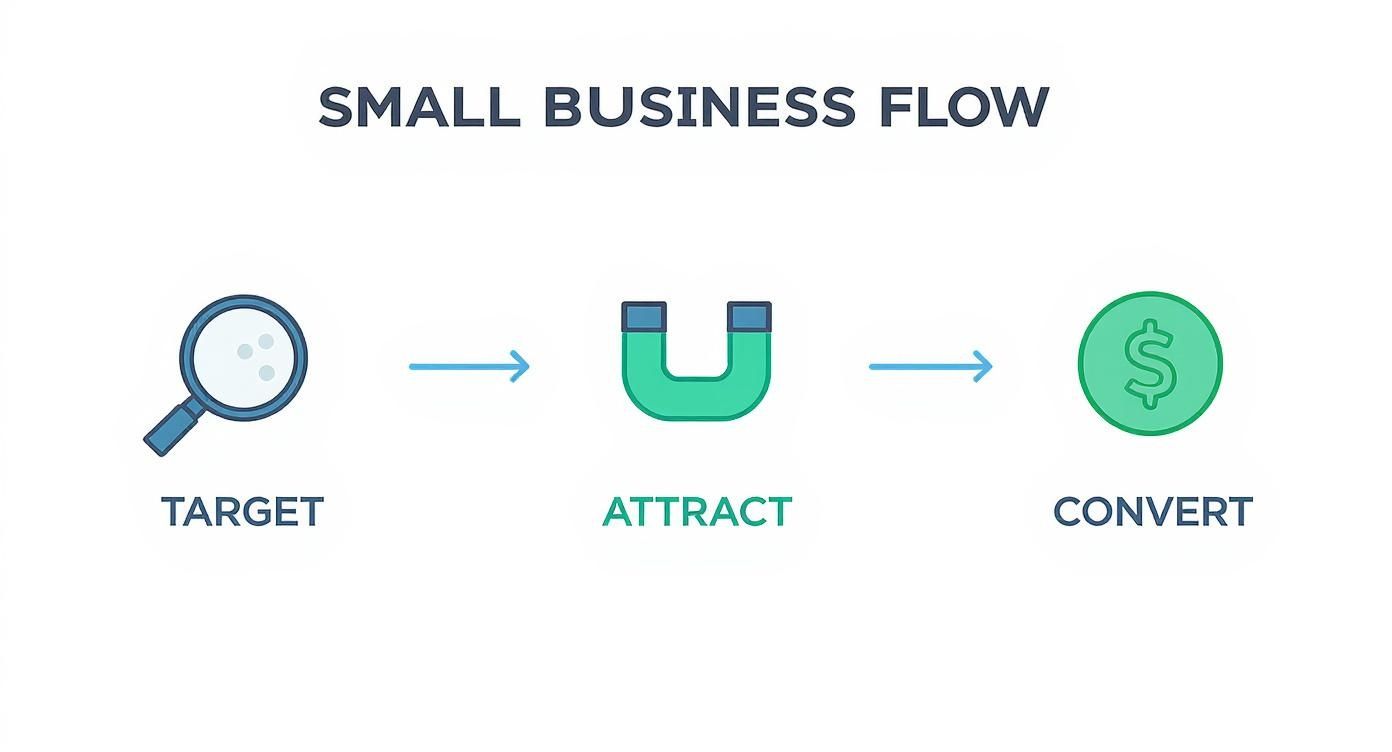
This simple flow chart really breaks it down: target the right people, attract them with a great offer, and turn them into customers. It’s a reminder that every step has to be intentional.
Choose the Right Campaign Type
Once you know what you’re trying to achieve, you can pick the right playground in Google Ads. Each campaign type does something different, and choosing the right one is critical to not burning through cash.
- Search Campaigns: This is where most businesses should start. Your text ads show up on Google the moment someone is actively searching for what you sell. It’s perfect for capturing customers with high intent—people who are ready to make a move.
- Display Campaigns: Think visual ads, like banners, that appear on websites all over the Google Display Network. These are fantastic for building brand awareness and reaching people based on their interests, not just what they’re typing into a search bar right now.
- Remarketing Campaigns: This is your secret weapon. It lets you re-engage people who have already visited your website but left without converting. Your ads essentially “follow” them around the web, reminding them to come back and finish what they started.
For a local home service company in Tampa, a Search campaign targeting keywords like “air conditioning repair Tampa” would be priority number one. Later, they could layer in a Display campaign to show ads to homeowners in specific zip codes to build that all-important brand recognition.
Structuring Your Account for Clarity
A well-organized account is a manageable account. Think of it like a filing cabinet: your campaign is the drawer, ad groups are the folders inside, and your keywords and ads are the documents in those folders. Keeping things tidy from the start makes optimizing so much easier later on.
Imagine you’re a dentist. A clean account structure might look like this:
- Campaign 1: General Dentistry
- Ad Group A: Family Dentistry (Keywords: “family dentist near me,” “kids dentist”)
- Ad Group B: Teeth Cleaning (Keywords: “dental cleaning cost,” “teeth cleaning special”)
- Campaign 2: Cosmetic Dentistry
- Ad Group A: Teeth Whitening (Keywords: “professional teeth whitening,” “zoom whitening”)
- Ad Group B: Veneers (Keywords: “porcelain veneers,” “cost of veneers”)
This tight structure ensures your ads are hyper-relevant to the search terms, which helps boost your Quality Score and can actually lower your cost-per-click. It all comes back to knowing exactly who you’re talking to. For a deep dive into this, check out our guide on how to create buyer personas to get even more precise with your targeting.
Initial Keyword Research and Budgeting
You don’t need to spend a fortune on fancy tools right away. Just use Google’s own Keyword Planner—it’s free inside your Google Ads account—to find the terms people are actually using to find businesses like yours.
Focus on high-intent, long-tail keywords. These are longer, more specific phrases like “emergency roof leak repair St Petersburg” instead of a broad term like “roofer.” They might have less search volume, but the conversion rates are often much higher because the user’s need is so clear.
When it comes to your budget, pick a number you’re comfortable testing with for at least 30 days. For many local businesses, a starting budget of $15-$25 per day is enough to gather the data you need to see what’s working. This initial phase is all about learning, not hitting a home run on day one.
Crafting Ads and Landing Pages That Convert
Getting someone to click your ad is a win, but it’s only half the battle. The real goal—the one that actually grows your business—is turning that click into a lead, a call, or a sale.
This is where your ad copy and landing page have to work together perfectly. Think of it this way: your ad makes a promise, and your landing page has to deliver on it. When these two are in sync, you’ll see your conversion rates climb and get a much better return on your ad spend.
Writing Ad Copy That Speaks to Your Customer
Your ad copy has a tough job. It has just a few characters to grab attention, show value, and convince someone to click. The secret is to stop thinking about what you want to say and start focusing on what your customer needs to hear.
Get straight to the point and solve their problem. Is their AC broken in the middle of a brutal Tampa summer? Your ad needs to reflect that urgency and offer an immediate fix.
Let’s imagine you run a local HVAC company. A generic ad doesn’t cut it:
- Generic Ad: “Tampa HVAC Services – We Fix AC Units – Call Us Today”
It’s forgettable. It blends in. Now, let’s write an ad that speaks directly to the customer’s pain point:
- Compelling Ad: “Emergency AC Repair Tampa Bay | 24/7 Service, Fast Relief From The Heat. Get A Free Quote Now!”
This version works because it hits on the urgency (“Emergency,” “24/7 Service“), promises a clear benefit (“Fast Relief From The Heat”), and gives a strong, no-risk call-to-action (“Get A Free Quote Now!”).
The Crucial Role of Message Match
Once you’ve earned that click with a great ad, the experience can’t fall apart. The single most important concept here is message match. This just means that the headline, offer, and general vibe of your landing page must directly reflect what the ad promised.
If your ad screams “50% Off Your First Service Call,” that exact phrase needs to be the first thing people see when they land on your page. Any disconnect creates confusion, and confused visitors hit the back button. That wastes your click and tells Google your page isn’t relevant, which can hurt your Quality Score.
Strong message match does more than just reassure the visitor; it signals to Google that you’re providing a relevant and high-quality user experience. This can lead to a higher Ad Rank and potentially a lower cost-per-click, making your entire campaign more efficient.
Building a Landing Page That Closes the Deal
Your website’s homepage is for browsing. A landing page is for one thing and one thing only: converting. It should be laser-focused, which means stripping away all distractions like navigation menus or links to other parts of your site.
Here are the must-have elements for a landing page that works:
- A Powerful Headline: It must echo the ad’s promise and clearly state your value.
- Trust Signals: Show off testimonials, customer reviews, industry certifications, or “As Seen On” logos. These build instant credibility.
- Benefit-Driven Content: Use simple bullet points to quickly explain how you solve the customer’s problem.
- A Simple, Obvious Contact Form: Only ask for what you absolutely need. Fewer fields almost always mean a higher conversion rate.
- A Clear Call-to-Action (CTA): Make your button stand out and use action-oriented text like “Get My Free Estimate” instead of a boring word like “Submit.”
A solid landing page is the linchpin of any effective PPC management for small business strategy. It’s where your investment finally pays off. If you’re in e-commerce, checking out some great ecommerce landing page examples can give you some fantastic ideas for building pages that actually sell.
When done right, the power of PPC is undeniable. Google’s own research shows businesses typically make $2 in revenue for every $1 spent on their ads. With 84% of marketers reporting positive results, it’s clear why it’s so popular. PPC often converts around 50% better than organic search and is far easier to measure, giving you a crystal-clear look at your return on investment.
Your Guide to Daily PPC Optimization
Successful PPC management for a small business is never a “set it and forget it” activity. I like to think of campaigns like a garden—they need regular, consistent attention to flourish. If you can establish a simple, repeatable optimization routine, you’ll turn your ad spend into a predictable source of leads and sales, not a frustrating expense.
This all starts with understanding what the numbers in your dashboard are actually telling you. It’s incredibly easy to drown in data, but focusing on just a few key metrics will give you the clarity you need to make smart decisions.
Decoding Your Core PPC Metrics
Instead of getting lost in dozens of columns, zero in on the metrics that directly impact your business goals. These are the vital signs of your campaign’s health and will guide all of your adjustments.
Here are the big three to master first:
- Click-Through Rate (CTR): This is the percentage of people who see your ad and actually click on it. A high CTR is a strong signal that your ad copy and targeting are resonating with your audience.
- Conversion Rate: This measures the percentage of clicks that turn into a desired action—a form submission, a phone call, or a sale. This is arguably the most important metric because it tells you if your ads are generating real business value.
- Return On Ad Spend (ROAS): This is the ultimate bottom-line metric. It calculates how much revenue you’ve earned for every dollar spent on ads. A ROAS of 4:1, for example, means you’re making $4 for every $1 you invest.
Monitoring these key performance indicators (KPIs) is the foundation of good campaign management. They tell a story about what’s working and, more importantly, what isn’t.
A Practical Weekly Optimization Checklist
Consistency is your best friend in PPC. Just carve out a little time each week to run through a simple checklist. This proactive approach stops small issues from becoming costly problems and makes sure your budget is always working as hard as possible.
Your weekly routine should include these essential tasks:
- Review the Search Term Report: This is where the gold is. The report shows you the exact search queries people typed before clicking your ad. Your job is to hunt for irrelevant terms that are wasting your money.
- Add Negative Keywords: When you find a wasteful search term (like “free,” “DIY,” or “jobs”), add it to your negative keyword list. This simple action immediately stops your ads from showing for those searches, saving you money on useless clicks.
- Adjust Bids on Top Performers: Find the keywords, ad groups, or devices that are driving the most conversions at a good cost. Nudge your bids up slightly on these winners to improve their ad position and capture more high-quality traffic.
- Pause Underperforming Ads: If an ad has a low CTR or a poor conversion rate after getting enough data, don’t be afraid to pause it. You can then test a new version with a different headline or call-to-action to see if you can beat your current champion.
I’ve seen it time and time again: the most common mistake is letting an account run on autopilot. Just 15-30 minutes of focused review each week can dramatically improve your results by plugging budget leaks and doubling down on what’s proven to work.
Monthly Strategic Campaign Reviews
While weekly check-ins are for tactical tweaks, your monthly review is for looking at the bigger picture. This is your chance to analyze broader trends and make strategic shifts that will guide your campaigns for the next 30 days.
During your monthly review, focus on these larger questions:
- Budget Reallocation: Are some campaigns consistently outperforming others? It might be time to shift budget away from the laggards and into your proven winners to maximize your overall ROAS.
- A/B Testing New Ad Copy: Use what you’ve learned to write new ad variations. Test a completely different headline, a new value proposition, or a more urgent call-to-action.
- Performance Trend Analysis: Look at your performance over the last 30-90 days. Are costs per conversion rising? Is your CTR dropping? Identifying these trends early allows you to diagnose the root cause before it seriously hurts your bottom line.
Making this a repeatable process transforms PPC management from a confusing chore into an empowered, data-driven strategy. For more actionable advice, our guide on navigating Google Ads tips and tricks for optimizing PPC campaigns provides even more depth on these topics.
Avoiding Common Mistakes and Wasted Ad Spend

Making money with PPC is great, but not losing money is just as important. I’ve seen too many small business budgets slowly bleed out from a few common, easily fixable mistakes. Spotting these problems early is what separates a profitable campaign from a costly experiment.
One of the most frequent errors? Sending all your paid clicks straight to your website’s homepage. A homepage is designed for browsing, with a dozen different paths a visitor can take. A dedicated landing page, on the other hand, has one job and one job only: get the conversion.
Another classic budget-waster is neglecting your negative keyword list. If you don’t build one, you could easily end up paying for clicks from people searching for “free plumbing tutorials” when you’re trying to sell emergency plumbing services. Every one of those irrelevant clicks is money that could have gone toward a real customer.
Sidestepping Common PPC Pitfalls
Smart PPC management for small business is really about being proactive. The good news is that the solutions to these common problems are straightforward and can make an immediate difference to your bottom line.
Here are the biggest budget-draining mistakes I see and how to fix them, fast:
- Mistake 1: Sending Traffic to Your Homepage. This just confuses visitors and kills your conversion rates.
- Solution: For every ad group, build a simple, dedicated landing page. The message on that page needs to perfectly match the promise in your ad, creating a seamless path from click to conversion.
- Mistake 2: Ignoring Negative Keywords. You’ll pay for clicks from searchers with zero intent to buy, like job seekers, students, or DIY enthusiasts.
- Solution: Get in the habit of reviewing your Search Term Report weekly. Add irrelevant queries like “jobs,” “free,” “pictures,” or competitor names to your negative keyword list.
- Mistake 3: Using Vague, Broad Match Keywords. This gives Google way too much control, letting it show your ads for all sorts of loosely related searches that just don’t convert.
- Solution: Stick with Phrase Match and Exact Match keywords. They give you far more control and ensure your ads only show up for highly relevant searches.
A “set it and forget it” mindset is the fastest way to lose money with PPC. Consistent, active management is what separates profitable campaigns from expensive failures. Even 30 minutes a week can plug budget leaks and double down on what’s working.
Gaining a Competitive Edge with Modern Strategies
Avoiding mistakes is defense. The offense involves using modern tools and tactics to stay ahead of your competition. The PPC world changes constantly, and what worked last year might not work today.
One of the biggest shifts has been the rise of automation and AI-powered bidding. Smart bidding strategies use machine learning to optimize for conversions in real-time, analyzing hundreds of signals for every single auction. This saves a ton of time and often gets better results than manual bidding ever could.
The industry is already there. A recent study shows 58% of marketers now use automation for routine tasks, making automated bidding the new standard. But this also makes things more competitive. The same report found that 49% of PPC marketers believe managing campaigns is harder today than it was two years ago, partly because competition has driven average CPCs up by 19%. You can dig into these trends in recent PPC industry reports.
Using Your Data for Smarter Remarketing
Another powerful, modern strategy is putting your own customer data to work. By uploading your customer email list to Google Ads, you can create a Customer Match audience. This allows you to show ads directly to people who already know and trust your brand—or you can create lookalike audiences to find new people with similar profiles.
This leads right into remarketing. Remarketing lets you show targeted ads to people who visited your site but didn’t convert. It’s an incredibly effective way to bring interested visitors back to finish what they started.
The key is to do it without being creepy. Cap how often people see your ads and create specific audience lists. For example, you should show a different ad to someone who abandoned a shopping cart than to someone who just read a blog post. This is a much more sophisticated approach than just hitting “boost post” on social media. For more on that, check out our guide on boosted posts vs. real Facebook Ads.
When to Hire a PPC Management Agency
Jumping in and managing your own PPC campaigns is a great way to learn the ropes and keep your initial costs down. But there’s a tipping point where doing it yourself starts costing you more—in wasted ad spend and missed opportunities—than hiring an expert ever would.
Knowing when to call in a professional isn’t about giving up; it’s a smart business move.
For most small business owners, that moment arrives when they simply run out of time. Good PPC requires constant attention. You have to be in there, tweaking bids, testing copy, and analyzing data. When you’re busy running the actual business, that’s just not realistic. If you find yourself in the “set it and forget it” camp, you’re almost certainly leaving money on the table.
Clear Signals It’s Time for an Expert
Another big red flag is when your results start to stall out. Maybe you had some great early wins, but now your cost-per-lead is creeping up and the campaigns just aren’t profitable anymore. This is common. Ad platforms get more complex, your competitors get smarter, and the strategies that worked last year stop delivering.
Here are a few other common triggers that tell you it’s time for a change:
- You’re Overwhelmed by Complexity: Google Ads and other platforms are always changing. If you can’t keep up with new bidding strategies, ad formats, and policy updates, an agency lives and breathes this stuff.
- You Don’t Have the Right Tools: Professional agencies invest in expensive software for keyword research, competitor analysis, and bid optimization that are usually out of reach for a small business.
- Your Strategy Feels Stale: You’ve hit a performance ceiling and have no idea how to scale your campaigns, find new audiences, or actually improve your conversion rates.
Bringing in an agency isn’t an admission of failure; it’s a strategic move to accelerate growth. An expert partner brings a fresh perspective, advanced tools, and the dedicated time needed to turn your PPC into a powerful, reliable growth engine.
Ultimately, the goal of hiring a PPC management for small business agency is simple: free up your time and get a better return than you could on your own.
Common Questions About PPC for Small Businesses
Diving into paid ads for the first time? You’ve probably got questions. Managing PPC effectively isn’t just about knowing how to do it, but also understanding the why and the when. Let’s tackle some of the most common uncertainties we see from business owners.
My goal here is to give you direct, no-fluff answers so you can move forward with confidence, knowing you’re making a smart call for your business.
How Much Should a Small Business Really Budget for PPC?
There’s no magic number, but here’s a solid rule of thumb: start with an amount you can comfortably invest for at least 90 days. This gives you enough time to gather meaningful data without breaking the bank. For most local companies, a budget between $500 and $1,500 per month is a realistic starting point to test the waters and get some initial traction.
Your perfect budget really boils down to a few things:
- Your Industry: A local plumber here in Tampa Bay is going to see a very different cost-per-click than a national e-commerce brand. Some keywords are just more expensive than others.
- Your Target Area: Focusing on a specific neighborhood or a smaller service area is almost always cheaper than targeting an entire state or the whole country.
- Your Goals: Are you just trying to get your name out there (brand awareness)? Or are you laser-focused on generating high-value leads right now? Each goal requires a different budget strategy.
The single most important thing is consistency. It’s far better to spend a smaller, steady amount every single day than to blow a huge budget for a few days and then pause. That consistency is what allows the ad platforms’ algorithms to learn, adapt, and optimize your campaigns effectively.
How Long Until I Actually See Results from PPC?
This is one of the biggest perks of PPC over something like SEO. You can start seeing traffic, clicks, and impressions almost immediately—sometimes within just a few hours of launching a campaign.
But seeing real business results—like a steady stream of leads or sales—takes a bit longer.
You should plan for an initial “learning phase” of about 30 to 90 days. This period is absolutely critical. It’s when you’re gathering the data needed to figure out which keywords actually convert, which ads resonate with customers, and how to fine-tune your landing pages. Profitable results often start showing up within this window, but remember, true optimization never really stops. It’s an ongoing process.

