

table of contents
TL;DR:
- Generative Engine Optimization (GEO) focuses on making content discoverable inside AI-generated answers rather than traditional search rankings.
- Most GEO practices overlap with SEO, but targeted efforts include creating extractable answer blocks, citing sources, and ensuring content authority signals.
- Implementing GEO requires technical groundwork and strategic content shifts, such as definition-first structure and off-site entity signals, to boost AI citations and brand visibility.
Generative Engine Optimization (GEO) is the practice of making your content discoverable, extractable, and citable inside AI-generated answers from platforms like ChatGPT, Google Gemini, and Perplexity — and it should run alongside your SEO program, not replace it. GEO and SEO share approximately 70% of best practices, so the incremental effort to implement both is relatively low. Google’s own guidance reinforces this: crawlability, indexability, and high-quality indexed content remain the foundation for AI feature inclusion, just as they do for traditional rankings.
Three things you can do this week to start:
- Add a concise 30–60-word answer block at the top of your highest-traffic informational pages so AI engines have something extractable to pull.
- Verify that AI crawlers (Googlebot, GPTBot, PerplexityBot) are not blocked in your robots.txt or sitemap configuration.
- Add at least one quotable statistic or cited external source to each priority page — research shows that adding statistics improved AI visibility significantly; citing external sources produced the largest lift of all tested tactics.
What is Generative Engine Optimization and how does it work?
GEO optimizes content to be discovered, extracted, and cited by generative engines — AI assistants and AI Overview features — rather than only to rank in a traditional link list. Where classic SEO earns a position in a results page, GEO earns a mention inside the answer itself. The distinction matters because AI-generated answers often replace the click entirely: a user gets the information without visiting your site, so your brand needs to be the source the AI names.
You may also encounter the terms AEO (Answer Engine Optimization) and LLMO (Large Language Model Optimization). The taxonomy is consolidating — the core strategy is the same across all three labels: machine-readable, authoritative content that LLMs can synthesize and trust. For practical purposes, treat them as overlapping disciplines with GEO as the umbrella term most commonly used in U.S. marketing circles. Netco Design’s full breakdown of GEO, AEO, and AI SEO covers the distinctions in detail if you need a taxonomy reference.
The core extractability practices that make content GEO-ready:
- Definition-first structure: Open every priority page with a direct, self-contained answer to the primary question — no preamble.
- Self-contained answer paragraphs: Each paragraph should make sense in isolation, because AI engines pull individual passages, not full pages.
- Quoted statistics and cited sources: Specificity signals credibility to both readers and retrieval models.
- Explicit authorship and entity signals: Named authors, organization schema, and consistent brand mentions across platforms help AI systems categorize and trust your content.
Pro Tip: Write a single 30–60-word extractable sentence immediately below your H1 that defines your topic, names your brand, and includes one specific claim. This is the sentence an LLM is most likely to lift as a citation — treat it like a press release lead, not a blog intro.
How does GEO compare to SEO, and where should you focus first?
GEO and SEO share the same technical and content foundations, but their objectives diverge at the point of measurement. SEO targets click-through traffic and rank position. GEO targets citations, mentions, and share of voice inside AI-generated responses. Understanding that split helps you decide where to invest incremental effort.

Where they overlap (the 70% that does double duty)
GEO and SEO share approximately 70% of best practices, covering most of what a quality-focused SEO program already does: technical accessibility, high-quality content, E-E-A-T signals, and authoritative backlinks. If your SEO fundamentals are solid, you are already partway to GEO readiness. The incremental GEO-specific work sits on top: extractability formatting, entity consistency, and off-site brand mentions on platforms AI engines draw from (Reddit, Quora, industry review sites, editorial publications).
Where they differ
- Goal: GEO = citations and AI mentions; SEO = rankings and organic clicks.
- Success metric: GEO = AI citation rate, share of voice in AI answers; SEO = position, click-through rate, organic sessions.
- Content format: GEO rewards definition-first, answer-block structure; SEO rewards comprehensive depth and keyword coverage.
- Authority signals: GEO weighs unlinked brand mentions and multi-platform presence heavily; SEO weighs backlinks and domain authority.
- Technical readiness: Both need crawlability; GEO additionally needs server-side rendering for AI crawlers that skip JavaScript.
When to prioritize GEO over classic SEO work
- Your audience is heavy AI-tool users (B2B SaaS, technical, research-oriented segments).
- Organic click volume is declining despite stable rankings — a sign AI Overviews are absorbing the answer.
- Your content targets informational or decision-stage intent, where AI engines are most active.
- You are competing on topics where lower-ranked pages can still win citations. Princeton research found that GEO-specific changes moved position-five pages by 115% in AI citation frequency — a gap that traditional SEO tactics alone would not close.
When classic SEO should come first
- Transactional queries where users still click to compare and purchase.
- Pages with basic technical hygiene issues (crawl errors, thin content, broken schema) that would undermine GEO work anyway.
- Sites with no indexing baseline — fix crawlability before optimizing for citation.
A simple prioritization rubric: if your audience uses AI tools daily, your traffic trends show declining clicks on informational pages, and you have the content resources to add answer blocks, start GEO work now. If you are still building domain authority and fixing technical debt, resolve those first — they are prerequisites for both disciplines.
What technical foundations does GEO actually require?
Crawlability and indexability are still the starting point. Google’s AI optimization guidance explicitly warns against unverified “GEO-specific” hacks and recommends the same foundational SEO health it always has: ensure your content is crawlable, indexed, and high-quality. Tactics like aggressive content chunking or treating llms.txt as a primary strategy are not substitutes for getting the basics right.
Google’s guidance is clear: prioritize crawlability, indexability, and high-quality indexed content for AI feature inclusion. Unproven hacks are not recommended as a primary strategy.
Beyond the basics, two technical areas require specific attention for GEO:
Rendering: AI crawlers often do not execute client-side JavaScript. If your critical answer content loads via JavaScript, those crawlers may never see it. Server-side rendering or pre-rendering for extractable content blocks is the practical fix — prioritize it for your highest-value informational pages first.
Structured data: Schema markup helps AI systems recognize entities and understand context. The most useful schema types for GEO readiness:
OrganizationandPerson— establish entity identity and authorship.ArticleandBlogPosting— signal content type and publication date.FAQPage— formats Q&A pairs that AI engines can extract directly.Speakable— marks passages suitable for voice and AI summary use.
Technical GEO readiness checklist:
- Confirm GPTBot, PerplexityBot, and Googlebot are permitted in robots.txt.
- Submit and maintain an accurate XML sitemap.
- Deploy JSON-LD structured data for Organization, Article, and FAQPage schema.
- Audit Core Web Vitals — page performance affects crawl budget and quality signals.
- Check canonicalization to prevent duplicate content from diluting entity signals.
- Pre-render or server-side render critical answer blocks so AI crawlers access them without JavaScript execution.
Google’s updated quality rater guidance now includes evaluation examples for AI Overviews, applying the same E-E-A-T signals used for traditional search. That continuity is the clearest signal available: technical and content quality investments compound across both channels.
How does GEO change your content strategy and editorial workflows?
The biggest shift GEO creates is structural, not topical. Your content team does not need to abandon existing keyword research or topic plans. It needs to change how pages open, how paragraphs are written, and how authority is built off-site.

Editorial structure changes
Every priority page should open with a definition-first paragraph: state what the topic is, why it matters, and one specific claim — all within the first 60–80 words. Follow that with self-contained answer blocks for each major subtopic. Salesforce’s GEO guidance frames this as building narrow topic authority rather than chasing keyword volume: a page that owns one question completely is more citable than a page that covers ten questions shallowly.
Content planning changes
- Build topic clusters around a single niche authority theme rather than scattershot keyword lists.
- Prioritize pages that answer decision-stage questions — these are the queries AI engines field most often.
- Plan for off-site content: guest posts, contributed articles, and community participation on platforms AI engines draw from (Reddit, Quora, G2, industry publications).
- Use semantic keyword strategy to ensure topical depth signals are present across the cluster.
Workflow changes
Integrate AI-citation checks into your editorial QA process. Before publishing, ask: does this page have an extractable answer block? Does it include at least one cited statistic? Is the author entity clearly marked? These checks take minutes and prevent GEO gaps from accumulating across your content library.
Assign ownership explicitly:
- Content strategist: owns topic cluster planning, answer-block templates, and editorial standards.
- SEO engineer: owns technical implementation — schema, rendering, crawler permissions, and Core Web Vitals.
- Data and analytics lead: owns citation sampling, AI share-of-voice tracking, and conversion attribution from AI-referred sessions.
- PR and outreach owner: owns off-site brand mentions, community participation, and editorial placements that build entity signals. Off-site brand mentions on community platforms correlate with higher AI citation likelihood even without direct backlinks.
How do you implement GEO in 30, 60, and 90 days?
A phased approach keeps the work manageable and produces measurable results at each stage. Here is the plan Netco Design uses with clients.
30-day: audit and prioritize
- Pull index coverage data from Google Search Console — identify pages with declining clicks but stable impressions (a sign AI Overviews are absorbing the answer).
- Flag decision-stage and informational pages in your top 20% of organic traffic.
- Check robots.txt and sitemap for AI crawler permissions.
- Score each priority page against a GEO readiness rubric: has an answer block, has a cited statistic, has schema, has named authorship.
- Rank pages by GEO opportunity: high traffic + low GEO readiness = first priority.
60-day: implement
- Add extractable answer blocks to all priority pages using the template below.
- Insert at least one cited statistic or external source per page.
- Deploy JSON-LD for Organization, Article, and FAQPage schema across priority pages.
- Verify AI crawler access and fix any robots.txt blocks.
- Publish one outreach asset (contributed article, data study, or expert roundup) to earn off-site brand mentions.
Extractable answer block template:
Keep the block between 30 and 60 words. It should read as a standalone answer — no surrounding context required.
Pro Tip: To convert an existing top-performing SEO page to GEO-ready without rewriting everything, add the answer block below the H1, insert one cited statistic into the second paragraph, and add FAQPage schema to any existing Q&A section. Three targeted edits, not a full rewrite.
90-day: measure and scale
- Sample AI responses weekly across Google Gemini, ChatGPT, and Perplexity for your 10–15 priority queries.
- Identify which pages are being cited and which are not — iterate on non-cited pages first.
- Scale the answer-block template across your broader content cluster.
- Review assisted conversions in Google Analytics 4 to correlate AI-referred sessions with downstream revenue.
For prompt templates, Netco Design’s guide to AI prompts for GEO includes ready-to-use prompts for generating quotable summaries and extractable paragraph drafts.
Which tools and platforms should you prioritize for GEO?
AI engines to monitor for citation checks
- Google Gemini / Google AI Overviews: The highest-priority engine for most U.S. marketers. AI Overviews appear at the top of Google Search results and draw from indexed, crawlable content evaluated by the same E-E-A-T signals as traditional search. Monitor both the AI Overview appearance and the underlying organic rank.
- ChatGPT (OpenAI): The largest AI assistant by user volume in the U.S. ChatGPT’s browsing-enabled responses pull from live web content; its base model responses draw from training data. Both matter for brand visibility. OpenAI’s usage policies and crawler documentation serve as operational references for technical permissions.
- Perplexity: A search-native AI engine that cites sources explicitly in its answers, making it one of the most transparent platforms for measuring citation rate. Perplexity tends to favor well-structured, authoritative pages with clear sourcing — a direct reward for GEO-ready content.
For a full engine-by-engine prioritization framework, Netco Design’s guide on which AI engines to optimize for covers 2026 strategy in detail.
Measurement and management tools
- Specialized GEO trackers: Platforms purpose-built for AI citation monitoring (such as those reviewed in the LoudPixel and Semrush analyses) let you sample AI responses at scale and track share of voice over time.
- Google Search Console: Still the primary tool for indexing health, crawl coverage, and identifying pages where impressions are rising but clicks are falling — the clearest early signal of AI Overview absorption.
- Brand monitoring platforms: Tools like Mention, Brand24, or similar services track unlinked brand mentions across the web, which are critical entity signals for AI citation likelihood.
- Google Analytics 4: Use assisted-conversion reports and session-source tagging to connect AI-referred traffic to downstream conversions.
Official guidance links to bookmark: Google’s AI optimization developer documentation and OpenAI’s crawler policy page are the authoritative operational references for technical enforcement decisions.
How do you measure GEO performance and prove its impact?
No standardized measurement method for GEO exists yet. Different engines draw from different sources, and the overlap between top-ranked pages and AI citations is limited enough that organic rank alone does not predict citation frequency. That means you need a sampling-based measurement approach alongside your existing analytics.
Primary GEO KPIs
- AI citation rate: How often your priority pages appear as a cited source when you query target topics across Google Gemini, ChatGPT, and Perplexity.
- AI share of voice: Your citation frequency relative to competitors for the same set of queries.
- Zero-click answer prevalence: The share of your target queries that return an AI Overview or AI-generated answer with no organic click opportunity — this tells you how much of your informational traffic is at risk.
- Conversions from AI-referred sessions: AI-referred traffic remains a small share of total referrals but is growing fast and tends to be high-intent. Track it separately in GA4 and measure its conversion rate against organic and paid benchmarks.
How to instrument your measurement
- Run weekly manual sampling: query your 10–15 priority topics in each major AI engine and record whether your brand or pages are cited.
- Use a specialized GEO tracking tool to automate citation sampling at scale.
- Tag priority pages in GA4 as an “AI-test cohort” so you can isolate their performance after GEO changes go live.
- Set a baseline citation rate before implementing changes — you cannot measure lift without a starting point.
- Correlate citation events with assisted conversions: when a page earns a new AI citation, does downstream branded search or direct traffic increase in the following two to four weeks?
A practical dashboard layout tracks two trend lines side by side: AI citation frequency (sampled weekly) and organic click volume (from Search Console) for the same set of queries. When organic clicks decline and AI citations rise, GEO is working — but only if conversion quality holds. Monitor landing-page conversion rate for AI-referred sessions separately to confirm the traffic is qualified.
What risks and governance issues should GEO teams plan for?
GEO introduces a new category of brand risk that most editorial policies have not yet addressed. The three most pressing issues:
- AI hallucination and misattribution: Generative engines can cite your brand incorrectly, attribute claims you never made, or conflate your products with a competitor’s. This is not a hypothetical — it happens regularly and can affect purchasing decisions before your team knows it occurred.
- Over-reliance on single-source citations: If one page becomes the dominant citation source for your brand, a content update, a crawl block, or a platform policy change can erase your AI visibility overnight. Distribute authority across multiple pages and platforms.
- Brand-safety exposure: AI engines may surface your brand in contexts you did not intend — adjacent to negative sentiment, competitor comparisons, or off-topic queries. Monitoring for unexpected brand mentions is as important as tracking positive citations.
Governance checklist
- Establish an editorial verification step: before publishing, confirm all statistics are sourced and all claims are accurate, because errors in your content become errors in AI-generated answers.
- Write a source attribution policy: define which external sources your team is permitted to cite and how claims must be documented.
- Build a rapid correction process: when a misattributed claim surfaces in an AI answer, have a clear owner and a defined response time for publishing a correction on your site.
- Monitor for unexpected brand mentions weekly using brand-tracking tools.
Regulatory note (U.S.): When publishing AI-assisted content, keep FTC advertising disclosure rules, COPPA requirements for any audience that includes minors, and applicable data privacy regulations in mind. A one-sentence editorial policy line — “AI-assisted drafts are reviewed and verified by a named human editor before publication” — satisfies basic FTC transparency expectations and should be included in your editorial standards document.
Pro Tip: Add a “last verified” date to any page that cites statistics or regulatory information. AI engines use recency as a trust signal, and a visible verification date reduces the risk of your content being deprioritized as stale.
Emerging trends to watch: citation consolidation (major engines increasingly drawing from a smaller set of trusted sources), evolving platform policies on content licensing and crawler permissions, and the potential for content licensing agreements to affect which publishers AI engines can legally extract from.
How Netco Design implements GEO for clients
Netco Design’s GEO service is built around a structured process that moves from audit to measurable citation improvement. Lori Piencykoski and the Netco Design team bring hands-on GEO and AI SEO experience to each engagement, with deliverables designed to produce results that compound over time.
Implementation process
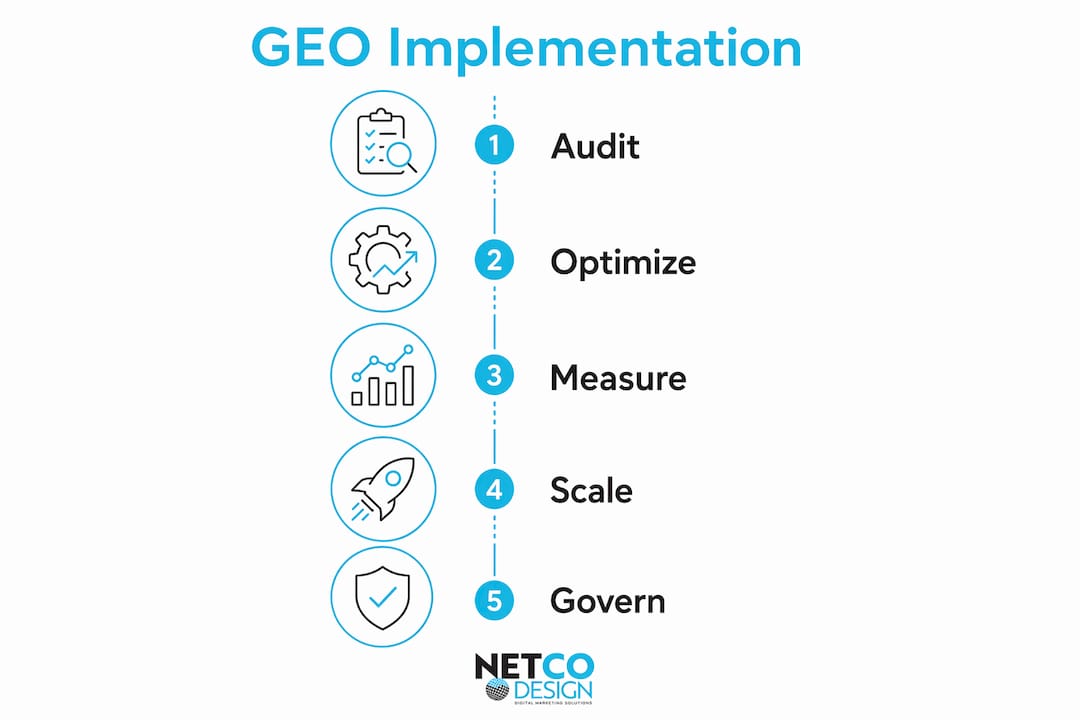
- Audit: Crawl coverage review, AI crawler permission check, GEO readiness scoring for priority pages, and competitive citation sampling across Google Gemini, ChatGPT, and Perplexity.
- Priority mapping: Rank pages by GEO opportunity (traffic volume, informational intent, current citation gap) and assign implementation sequence.
- Extractable content templates: Deploy answer-block templates, FAQPage schema, and definition-first paragraph structures across priority pages.
- Technical fixes: JSON-LD deployment, rendering corrections for JavaScript-heavy pages, robots.txt updates, and Core Web Vitals review.
- Outreach and monitoring: Identify off-site placement opportunities to build entity signals, then track citation rate monthly.
Deliverables clients receive
- Prioritized page list with GEO readiness scores and recommended actions.
- JSON-LD payloads ready for deployment across Organization, Article, and FAQPage schema.
- Extractable-answer templates customized to the client’s brand voice and topic clusters.
- Outreach plan targeting editorial placements and community platforms relevant to the client’s industry.
- Monthly GEO citation report showing citation rate trends across target engines and queries.
Key Takeaways
GEO and SEO share a large portion of the same best practices, making integrated implementation the most efficient path for marketing teams.
| Point | Details |
|---|---|
| GEO targets AI citations | Optimize for mentions inside AI-generated answers, not just rankings in a link list. |
| 70% overlap with SEO | Approximately 70% of best practices are shared between SEO and GEO, so most quality SEO work already supports GEO; incremental effort focuses on extractability and entity signals. |
| Statistics lift AI visibility | Adding cited statistics improved AI visibility significantly; citing external sources produced the largest gain. |
| Sampling is required to measure | No standard GEO metric exists yet — weekly manual sampling across Gemini, ChatGPT, and Perplexity is the baseline method. |
| Netco Design as your GEO partner | Netco Design audits, implements, and monitors GEO for clients with a structured 30–90 day process and monthly citation reporting. |
Why GEO belongs in every client strategy we build
The marketing teams that will hold ground in AI-driven search are not the ones chasing every new platform feature. They are the ones who recognized early that the underlying discipline — authoritative, well-structured, machine-readable content — was always the point. GEO did not invent that standard. It made it impossible to ignore.
What gets underestimated is how much the citation model changes the competitive dynamic. In traditional SEO, a page-one ranking is a relatively stable asset. In GEO, citation sources shift as engines update their retrieval logic, as new content earns authority, and as off-site mentions accumulate. A brand that is cited today can be displaced next month if a competitor publishes a more extractable, better-sourced answer. That volatility is not a reason to avoid GEO — it is a reason to treat it as an ongoing discipline rather than a one-time project.
The 30–90 day implementation plan described in this guide reflects exactly that thinking: audit, implement, measure, and iterate. Not a single sprint, but a repeatable cycle that compounds over time.
Netco Design’s GEO services: what’s included and how to get started
Netco Design offers a full GEO and AI SEO service stack for marketing teams that want structured implementation without building the capability from scratch. The concrete advantage: you get a done-for-you audit, implementation, and monthly monitoring program — without the overhead of hiring and training a dedicated GEO specialist in-house.

Services included in a GEO engagement:
- GEO and AI SEO audits covering crawlability, citation gaps, and schema readiness.
- Extractable-answer content templates customized to your brand and topic clusters.
- JSON-LD schema implementation for Organization, Article, and FAQPage markup.
- Technical SEO fixes: rendering corrections, robots.txt updates, and Core Web Vitals review.
- Ongoing GEO citation monitoring with monthly reporting across Google Gemini, ChatGPT, and Perplexity.
- Off-site outreach planning to build entity signals on platforms AI engines draw from.
For teams building a broader digital marketing strategy alongside GEO, Netco Design integrates GEO with content strategy, local SEO, and paid media for a unified growth program. To see how your site performs against GEO readiness criteria today, review Netco Design’s AI-friendly website guide or contact the team directly at netcodesign.com to schedule a discovery audit.
Useful sources for further reading
- Google AI optimization guidance: The primary technical reference for crawlability, indexability, and E-E-A-T requirements for AI feature inclusion — consult this before implementing any GEO technical change.
- Salesforce GEO primer: Practical guidance on definition-first structure and topic authority building, written for marketing and small-business teams.
- LoudPixel GEO vs. SEO analysis: The source for the 70% best-practices overlap finding and a clear breakdown of where the two disciplines diverge.
- Semrush GEO practical guide: Covers server-side rendering requirements, measurement sampling methodology, and unlinked brand mention strategy.
- Pathmonk GEO synthesis: Summarizes the Princeton research on citation frequency gains for lower-ranked pages and explains the citation gap GEO is designed to close.
- Search Engine Land GEO overview: A practitioner-level explainer on brand presence, entity clarity, and content extractability as the three structural pillars of GEO.
- Netco Design GEO services: Netco Design’s own GEO explainer and service overview for teams evaluating agency support.
FAQ
What is GEO in digital marketing?
GEO (Generative Engine Optimization) is the practice of optimizing content to be cited or mentioned inside AI-generated answers from platforms like Google AI Overviews, ChatGPT, and Perplexity, rather than simply ranking in a traditional search results list.
Is GEO replacing SEO?
No. GEO and SEO share a large portion of the same best practices and work best when integrated — SEO builds the technical and authority foundation that AI engines rely on when selecting citation sources.
What is the main role of digital marketing today?
Digital marketing connects brands with buyers at every stage of the decision process, across search, social, email, and now AI-generated answers — GEO extends that reach into the AI discovery layer where a growing share of informational queries are resolved.
How does GEO differ from SEO in practice?
SEO optimizes for rankings and click-through traffic; GEO optimizes for citations and brand mentions inside AI responses. The key tactical differences are definition-first content structure, extractable answer blocks, and off-site entity signals — on top of the technical SEO foundations both disciplines share.
Which AI engines matter most for GEO in the U.S.?
Google Gemini and AI Overviews are the highest priority for most U.S. marketers given Google’s search volume; ChatGPT (OpenAI) matters for assistant-based discovery; and Perplexity is particularly valuable for measuring citation rate because it cites sources explicitly in its answers.

