

table of contents
TL;DR:
- SEO is crucial for new websites to establish visibility, relevance, and credibility in search results.
- Pre-launch and post-launch SEO efforts, including keyword research, site architecture, and backlink building, accelerate success.
SEO is the single most important investment a new website can make before its first visitor arrives. Search engine optimization gives your site the visibility, relevance, and credibility it needs to appear when potential customers are actively searching for what you offer. Without it, even a beautifully designed website sits invisible in a crowded digital space.
The role of SEO in new websites breaks down into three core functions:
- Visibility: Getting your pages indexed and ranked so users can find you organically
- Relevance: Matching your content to what your audience is actually searching for
- Credibility: Building the trust signals that tell search engines your site deserves to rank
The most practical framework for new sites is the 3 C’s of SEO: Content, Code, and Credibility. These three pillars are interdependent. Strengthen all three, and your site earns rankings. Neglect one, and the other two underperform. For entrepreneurs launching a new site, this framework is your starting map.
How SEO works for new websites
New websites face a specific challenge: zero history. No backlinks, no ranking data, no established trust with Google. SEO closes that gap by building signals across all three pillars simultaneously.

Content is where relevance lives. Your pages need to target specific search queries, answer user intent clearly, and demonstrate expertise on your topic. For new sites, this means choosing focused keyword clusters rather than trying to rank for broad, competitive terms from day one.
Code is the technical layer that determines whether your content gets found at all. Without solid technical SEO, even excellent content and strong credibility efforts won’t be indexed properly. Crawlability, mobile optimization, page speed, and structured data all fall under this pillar.
Credibility covers the external signals that validate your site to search engines. For new sites, this means earning backlinks, generating brand mentions, and building entity signals that associate your brand with your industry.
Key components that work together for new site SEO:
- Keyword research mapped to specific pages and user intent
- Clean site architecture that search engine crawlers can navigate
- Mobile-first design and fast load times
- Schema markup to help AI engines understand your content
- Outreach for early backlinks and brand mentions
- Google Search Console and Google Analytics set up from day one
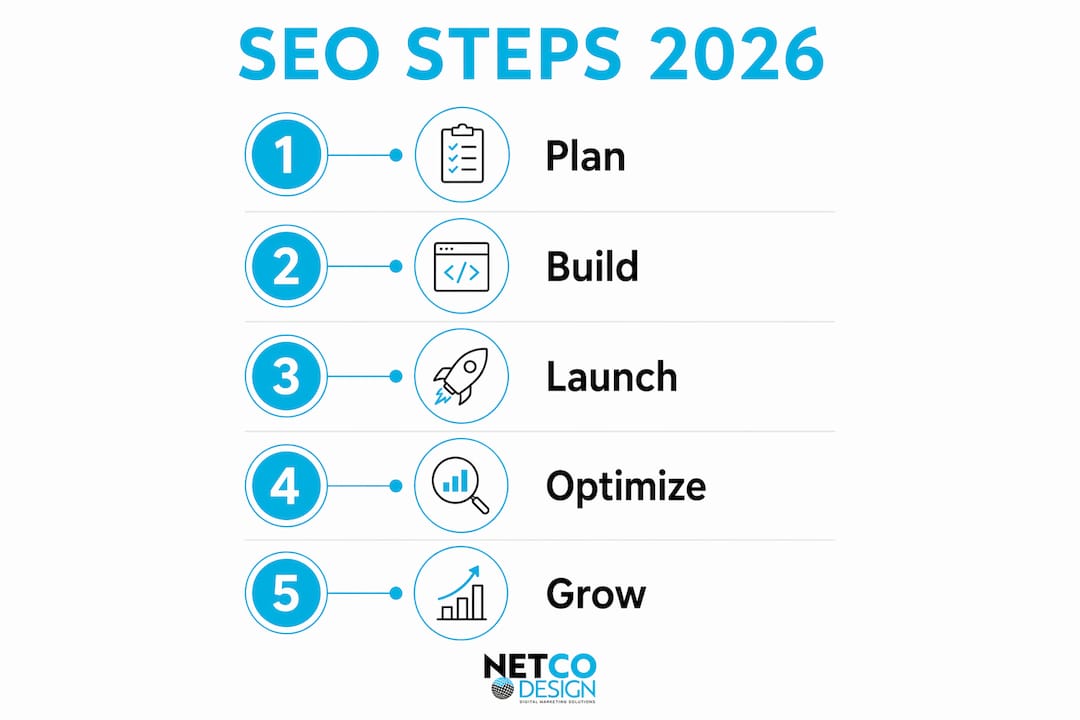
What to do before you launch a new website
Pre-launch SEO is where most entrepreneurs leave the most value on the table. Getting these steps right means your site starts earning visibility from the moment it goes live, rather than spending months recovering from avoidable mistakes.
-
Conduct keyword research and map it to your pages. Identify the specific queries your customers use and assign each keyword cluster to a dedicated page. Tools like Google Keyword Planner and Ahrefs help you find terms with realistic ranking potential for a new site. Focus on longer, more specific phrases where competition is lower.
-
Audit your site architecture before publishing. Your URL structure, internal linking plan, and navigation hierarchy all affect how search engines crawl and understand your site. A flat, logical structure with clear categories outperforms a tangled one every time.
-
Install SSL and verify mobile-friendliness. Google treats HTTPS as a baseline trust signal, and mobile-first indexing means your mobile experience directly affects your rankings. Test every page on a real device, not just a browser preview.
-
Write keyword-targeted content with structured answers. Content that provides a concise direct answer early in the page is much more likely to appear in Google AI Overviews. Structure your pages with clear headings, FAQ sections, and concise answer blocks.
-
Implement Schema markup. Add Organization, Article, and FAQ schema to your key pages before launch. This helps both traditional search engines and AI answer engines understand your content type and authorship.
-
Set up Google Search Console and Google Analytics. These two free tools give you indexing status, keyword impressions, click data, and crawl error alerts from day one. You cannot improve what you cannot measure.
-
Begin initial outreach for backlinks and brand mentions. Reach out to industry directories, local business associations, and relevant publications before launch. Even a handful of early links from credible sources accelerates your site’s trust-building process.
Pro Tip: Build an SEO checklist for new websites and run through it page by page before you hit publish. A single missed canonical tag or blocked robots.txt can delay indexing by weeks.
What to do after your new website goes live
Post-launch SEO is an ongoing process, not a one-time task. The first 90 days after launch are especially critical for establishing your site’s trajectory.
-
Submit your sitemap to Google Search Console. Do this within 24 hours of launch. It signals to Google that your site is ready to be crawled and accelerates the indexing process.
-
Monitor indexing and fix crawl errors immediately. Check Search Console weekly for coverage errors, redirect issues, and pages that failed to index. Address technical problems fast, because technical SEO fixes can boost impressions by 44% on sites with strong Content and Credibility scores within 90 days.
-
Analyze user behavior and refine your content. Once real visitors arrive, their behavior tells you what is working. Pages with high bounce rates and low time-on-page often need clearer answers, better formatting, or stronger internal links to related content.
-
Build backlinks through PR and targeted outreach. Guest posts, podcast appearances, local press coverage, and industry roundups all generate the credibility signals your new site needs. Entity co-occurrence, appearing alongside recognized industry names in third-party content, correlates with AI visibility nearly as strongly as direct backlinks.
-
Update and expand your content based on ranking data. Pages that land on page two of Google often need a content refresh, additional depth, or better internal linking to break through. Review your top 20 ranking pages every 60 days.
-
Optimize for AI-driven answer engines. Generative Engine Optimization (GEO) requires structuring your content so AI models can find, understand, and accurately cite your brand. This means consistent brand descriptions, named authors, and a presence on platforms like Wikipedia, Reddit, and industry publications that AI engines cross-reference.
-
Track performance beyond rankings. Rankings alone no longer tell the full story. Monitor organic traffic, conversion rates, and how often your brand appears in AI-generated answers alongside traditional position tracking.
Benefits of SEO for new businesses and entrepreneurs
SEO delivers compounding returns that paid advertising simply cannot replicate. Every dollar you invest in organic search builds an asset that keeps working long after the initial effort.
- Organic visibility that grows over time. Unlike pay-per-click ads that stop the moment your budget runs out, SEO rankings accumulate. A well-optimized page can generate traffic for years.
- Higher-quality traffic. Organic visitors arrive with intent. They searched for what you offer, which means they convert at higher rates than cold traffic from display ads.
- Brand credibility through search presence. Appearing on page one of Google signals authority to potential customers. SEO delivers sales growth, brand awareness, and credibility for businesses that focus on expert content and brand reputation.
- Cost-effective customer acquisition. The cost per lead from organic search typically drops over time as your authority grows, making it one of the most efficient channels for small businesses with limited budgets.
- Better user experience. The technical and content improvements SEO requires, such as faster load times, clear navigation, and well-structured pages, directly improve the experience for every visitor.
- Competitive advantage in your market. New businesses that invest in SEO early build a moat. By the time competitors notice your rankings, you have months of authority they cannot quickly replicate.
For startups and small businesses, SEO is often the difference between a website that generates leads and one that collects dust. Explore how startup websites grow online with the right foundation in place.
What modern SEO actually looks like for new sites in 2026
SEO has split into three distinct functions, and new websites need to understand all of them. Traditional SEO earns rankings, Answer Engine Optimization (AEO) earns citations inside AI answers, and Generative Engine Optimization (GEO) earns brand recommendations inside tools like ChatGPT and Perplexity. They stack, and the strongest sites pursue all three.

The zero-click reality is the biggest shift for new site owners to absorb. A significant portion of US searches now end without a click, with AI summaries often providing answers before visitors reach a website. That does not make SEO less valuable. It makes brand recognition more valuable, because AI engines cite brands they already trust and rank.
Google now places greater weight on brand signals like reviews, direct traffic, and entity mentions than on keyword volume alone. For new sites, this means building your brand’s presence across multiple platforms, not just optimizing individual pages.
Key strategies for new sites in 2026:
- Build consistent brand descriptions across your website, Google Business Profile, and social profiles
- Add Organization and Person schema with sameAs attributes to connect your entity signals
- Earn mentions in industry publications, forums, and directories that AI engines trust
- Structure content with question-shaped headings and direct answer blocks for AEO eligibility
- Track AI visibility separately from traditional rankings, since ranking first does not guarantee AI citation
Statistic to know: Most SEO leaders plan to increase investment in GEO in 2026, even while acknowledging that measuring its impact remains a challenge. New sites that build GEO habits from launch will have a structural advantage over those that retrofit later.
Netco Design works with businesses across Tampa Bay and beyond to build this kind of integrated SEO foundation, from technical SEO and content strategy to AI visibility and GEO. The goal is always the same: get your brand in front of the right people, whether they are searching on Google, asking ChatGPT, or reading an AI-generated summary. Stay current with the 2026 SEO trends shaping how new sites compete.

Key Takeaways
SEO is the foundation every new website needs to earn visibility, build credibility, and attract customers who are actively searching for what you offer.
| Point | Details |
|---|---|
| Start with the 3 C’s | Content, Code, and Credibility are the three interdependent pillars every new site must build. |
| Technical SEO comes first | Technical SEO fixes can boost impressions by 44% on sites with good Content and Credibility scores within 90 days. |
| Pre-launch prep matters | Keyword mapping, Schema markup, and analytics setup before launch prevent costly delays in indexing. |
| AI visibility is now part of SEO | About 68% of US searches end without a click, making brand signals and GEO strategies critical for new sites. |
| Content structure drives AI citations | Content that provides a concise direct answer early in the page is much more likely to appear in Google AI Overviews. |
FAQ
Why is SEO important for a brand-new website?
A new website has no existing authority or traffic. SEO builds the visibility, relevance, and credibility signals that search engines need to rank your pages and connect you with customers who are actively searching for your product or service.
Is SEO dead or evolving in 2026?
SEO is evolving, not dying. It now covers three functions: traditional ranking SEO, Answer Engine Optimization for AI answer citations, and Generative Engine Optimization for AI recommendations. Strong SEO is the foundation all three run on.
What are the 3 C’s of SEO?
The 3 C’s of SEO are Content, Code, and Credibility. Content covers what your site says, Code covers how it is built technically, and Credibility covers the external signals like backlinks and brand mentions that validate your authority.
What is the 80/20 rule of SEO for new websites?
Most organic traffic comes from a small subset of pages, typically those targeting specific, well-researched keywords with strong technical optimization. New sites should focus their early effort on a small cluster of high-intent pages rather than publishing broadly with thin content.
How long does SEO take to work for a new website?
Technical SEO improvements typically show noticeable indexing gains within a few weeks. New content pages generally take several weeks to rank. Building domain authority through credibility signals requires consistent effort over months.

