

table of contents
Service area pages (SAPs) are dedicated landing pages that target specific cities, suburbs, or neighborhoods where a business provides services without a physical storefront. A plumber serving Naperville, a mobile notary covering Mountain View, an HVAC company working across four Dallas suburbs — each of these businesses needs location-specific pages to show up in local search results. The role of service area pages in SEO is straightforward: they let you rank for “AC repair Plano” or “emergency plumber Boulder” even when you have no office at that address.
Here is what sets service area pages apart from standard location pages:
- Service area pages target the customer’s location, not the business’s physical address.
- Location pages are built for storefronts where customers walk in, like a restaurant or retail shop.
- SAPs are built for businesses that travel to customers, including home services, mobile providers, and delivery-based operations.
- Each SAP targets one service-plus-city combination with unique, locally relevant content.
- They close the visibility gap for service area businesses that Google’s local pack often underserves compared to brick-and-mortar competitors.
Why service area pages are critical for local SEO
A single homepage or one Google Business Profile (GBP) cannot cover an entire service region. Google’s local pack tends to favor businesses with verified physical addresses, which puts service area businesses at a structural disadvantage. SAPs are the most direct way to close that gap.
The benefits stack up quickly when you build them correctly:
- Geographic keyword coverage. Each page targets a distinct service-plus-location query, expanding your organic footprint across multiple cities without duplicating content.
- “Near me” search capture. A homeowner in Boulder searching “AC repair near me” may never see your Denver-based homepage. A dedicated Boulder page changes that.
- Outranking directories. Search results for home services often surface Yelp, Angi, and HomeAdvisor above individual business sites. Well-built SAPs on your own domain can outrank those directories, sending leads directly to you.
- GBP amplification. SAPs complement your Google Business Profile by covering queries outside the 10–15 mile radius where your GBP drives map pack visibility.
- Credibility in new markets. Customers who see a page specifically addressing their city are more likely to trust that you actually serve their area.
Contractors with dedicated city pages per service area generate significantly more local organic traffic than those targeting a region from a single homepage. The gap is not marginal.
How to create and optimize effective service area pages
Building a page that ranks requires more than swapping a city name into a template. Google’s 2026 helpful content classifier actively identifies near-duplicate page sets and treats them as doorway pages, which can result in deindexing. The standard that holds up: roughly 60–70% of each page’s content must be unique and location-specific.
What makes content genuinely unique per city:
- Neighborhood names and local landmarks specific to that city
- Climate or environmental factors relevant to the service (freeze risk in Denver, humidity issues in Tampa)
- Real project examples from that city, with street-level or neighborhood attribution where privacy allows
- Two to three customer testimonials from residents in that specific area
- Response time or pricing data specific to that market
Schema markup is non-negotiable. LocalBusiness and Service schema help Google connect your page to your verified GBP even when you have no physical address in that city. Add FAQPage schema for any Q&A sections, and Review schema when you have city-specific testimonials. Schema directly feeds Google’s AI Overviews, which now appear above the map pack for a meaningful share of local home service queries.
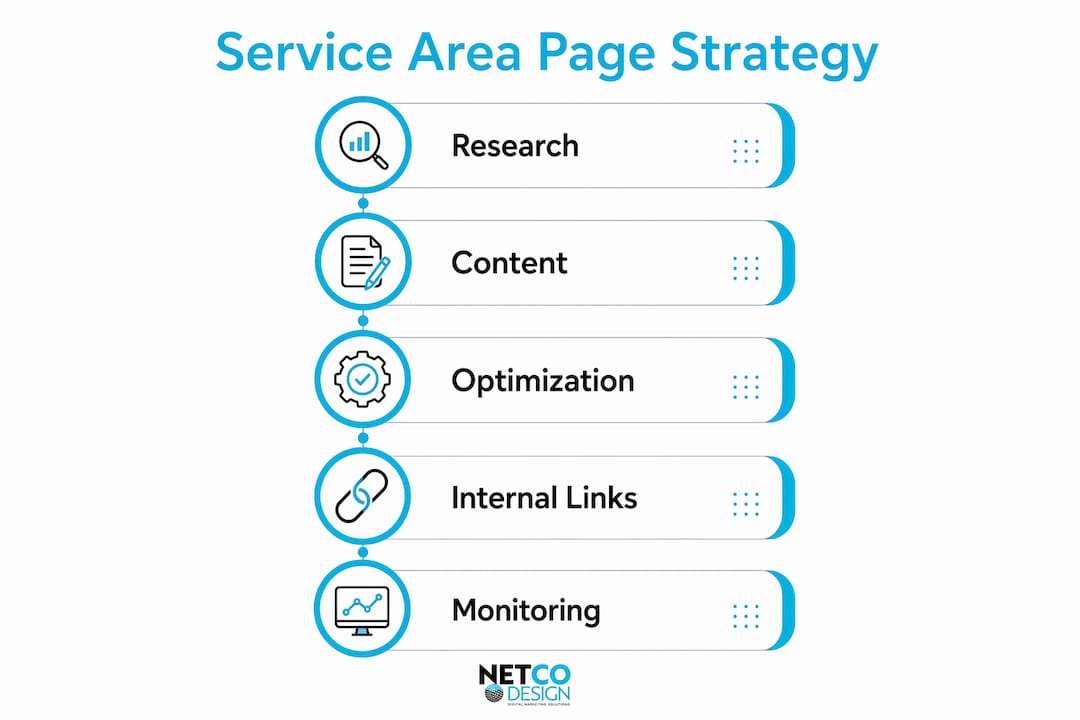
Internal linking structure matters as much as content. A layered link hierarchy signals to Google that your pages form a real content site, not a doorway set. Build it like this:
- Homepage links to main service pages and your top five to eight city pages by revenue or traffic
- A “service areas” hub page in the footer links out to all individual city pages (avoids a flat doorway-style link pattern)
- Each service page links to every city page offering that service (“AC Repair” links to “AC Repair Plano,” “AC Repair Frisco,” and so on)
- Each city page links back to four to six related service pages, two to three neighboring city pages, and the parent service page
Pro Tip: Publish new service area pages in batches of five to ten per week, not all at once. Google’s 2026 helpful content classifier flags large, sudden page sets as a doorway risk. Steady, spaced publishing with genuinely unique content per page is the safer path.
URL structure should include both the city name and the core service: /ac-repair-plano or /emergency-plumber-boulder. Put the city name in the title tag, the H1, and naturally throughout the body text.

Best practices for multi-location businesses
Scaling service area pages across 20 or 30 cities is where most businesses make costly mistakes. The temptation to publish hundreds of thin pages quickly is real, but effective SEO focuses on 15–30 key cities with rich, unique page content rather than a mass of templates.
Practical guidance for managing multiple locations:
- Start with conversion data. Mine your Google Ads history or CRM to identify the 15–30 cities that actually produce paying jobs. Build those pages first, not the ones that just look geographically logical.
- Use a service areas hub page. Link from your footer to a hub page, then from the hub to individual city pages. This avoids listing all 30 cities in the footer, which creates the flat link pattern Google associates with doorway sets.
- Add city-specific photos with geotags. Photos of real jobs in that city, with localized alt text and EXIF data, are among the strongest signals Google reads for content authenticity.
- Include local testimonials. Even two to three city-specific testimonials per page change the content fingerprint enough to escape duplicate detection.
- Track performance with Google Search Console and GA4. Measuring page analytics lets you identify which cities are gaining impressions, which pages have high bounce rates, and where to invest in content improvements.
- Avoid over-extension. Do not create pages for every possible town in a 100-mile radius. Prioritize cities where you have real work history and can write genuinely useful content.
Smaller suburbs and neighborhood-level queries can rank in 60–120 days from publication because competition is thinner. Major metro head terms like “plumber Dallas” typically take 6–12 months from a cold start. The fastest wins come from targeting the smaller cities adjacent to your main metro that competitors have ignored.
For a broader view of how these tactics fit into a full multi-location SEO approach, the structure you build for service area pages feeds directly into your overall local authority.
How service area pages fit into a broader local SEO strategy
Service area pages do not operate in isolation. They work best when integrated with your GBP, your content strategy, and your technical SEO foundation.
Key integration points worth building into your strategy:
- GBP and SAPs cover different ground. Your GBP drives map pack visibility within roughly 10–15 miles of your verified address. SAPs rank for queries outside that radius and for searches where Google cannot confirm the user’s proximity to your location. Together, they cover a service area that neither can handle alone.
- Schema connects the two. The
areaServedproperty in your LocalBusiness schema tells Google which cities your business covers, linking your SAPs to your verified GBP entity. Without it, Google treats each page as untethered content. - User engagement signals matter. Google’s 2026 doorway classifier reads time-on-page, scroll depth, and conversion behavior. Pages with generic content produce poor engagement, which reinforces the doorway classification. Pages with real local detail keep visitors reading and clicking.
- Link from your GBP and directory listings to the relevant SAP, not to your homepage. A searcher who finds you on Google Maps and clicks through to a page built specifically for their city converts at a higher rate than one dropped on a generic homepage.
- Monitor and refine. Use Google Search Console to track impressions and clicks per city page. Use GA4 to watch engagement rates and goal completions. Pages that rank but do not convert need content or call-to-action adjustments, not more keywords.
The 2026 SEO digital marketing trends that matter most for local businesses all point in the same direction: specificity wins. AI Overviews, rich snippets, and local pack results increasingly reward pages that answer a specific local question with real, verifiable detail. Service area pages built on that principle are not just an SEO tactic. They are how a traveling business proves to Google and to customers that it genuinely serves a community.
Key Takeaways
Service area pages are the most direct way for businesses without storefronts to rank in local search, but only when each page carries a majority of unique, location-specific content.
| Point | Details |
|---|---|
| Unique content threshold | Each page needs 60–70% unique, location-specific content to pass Google’s 2026 helpful content classifier. |
| Schema is required | LocalBusiness and Service schema connect your pages to your GBP and feed AI Overviews. |
| Layered internal linking | A hub-page structure prevents the flat link pattern Google associates with doorway pages. |
| Start with conversion data | Build pages for the 15–30 cities that produce paying jobs before expanding further. |
| Track with GSC and GA4 | Measuring traffic, engagement, and conversions lets you refine pages and improve rankings over time. |
FAQ
What are service area pages?
Service area pages are dedicated website pages targeting specific cities or neighborhoods where a business provides services without a physical storefront. Each page focuses on a single service-plus-location combination, like “roof replacement Lakewood,” with unique local content.
Are service area pages important for SEO?
Yes. Service area pages are the primary way traveling businesses rank for location-specific queries beyond their GBP’s proximity radius, helping them appear in organic results that a single homepage cannot capture.
How do you avoid service area pages being treated as doorway pages?
Keep at least 60–70% of each page’s content unique and location-specific, use a layered internal link structure with a hub page, and include real project examples, local testimonials, and city-specific details rather than just swapping city names in a template.
What are the four pillars of SEO?
The four pillars are technical SEO (site speed, crawlability, indexation), on-page SEO (content, keywords, schema), off-page SEO (backlinks, authority), and local SEO (GBP, citations, service area pages). Service area pages sit at the intersection of on-page and local SEO.
Is SEO still effective in 2026?
SEO remains highly effective in 2026, though the bar for quality has risen. Google’s helpful content updates and AI Overviews reward pages with specific, verifiable local detail, making well-built service area pages more valuable than ever for businesses competing in local markets.

