

table of contents
Forget what you might have heard about just “being on Google.” In 2026, a smart search engine marketing (SEM) strategy isn’t just a good idea—it’s your secret weapon. Why? It all comes down to one simple but powerful concept: user intent.
Unlike social media ads that interrupt people while they’re scrolling, SEM puts you in front of them the exact moment they’re actively looking for what you sell. That’s a massive difference. You’re not just shouting into the void; you’re providing the perfect answer to a problem someone has right now.
Why SEM Gives You an Unfair Advantage in 2026
Think about it from a customer’s perspective. It’s the key to understanding why this works so well.
Meet Customers at the Exact Moment They Need You
Imagine you run an HVAC company here in St. Petersburg, Florida. It’s a sweltering July afternoon, and a homeowner’s AC unit just died. They aren’t scrolling through Instagram hoping to see an ad. They’re grabbing their phone and typing “emergency AC repair St. Pete” into Google. A well-run SEM campaign puts your ad at the very top of those results, turning their panic into a high-quality lead for your business in seconds.
The same goes for e-commerce. Let’s say you sell artisanal coffee beans online. When a coffee lover searches for “buy Ethiopian Yirgacheffe beans online,” your targeted Google Shopping ad can pop up instantly with a photo, price, and a direct link to buy. You’ve just closed a sale by being in the right place at the right time.
The real power of SEM is its speed and precision. You can launch a campaign today and start getting targeted traffic, leads, and sales within hours—not months. It’s the fastest way to test new offers, break into new markets, and drive revenue whenever you need it.
SEO and PPC: The Ultimate Growth Partnership
Too many businesses treat paid search (PPC) and organic search (SEO) like they’re in a competition. The reality is, they’re two sides of the same coin. When you make them work together, you completely dominate the search results page.
Think of it this way:
- PPC gives you speed and data. Paid ads get you on page one instantly and provide a firehose of information. You’ll quickly find out which keywords actually convert, what ad copy gets clicks, and how people behave once they land on your site.
- SEO builds long-term authority. Organic rankings create a foundation of trust and credibility with Google and your customers. Ranking high drives a steady stream of “free” traffic and solidifies your brand as an industry leader.
The best part? The data from your PPC campaigns is a goldmine for your SEO strategy. If you discover a keyword in Google Ads has a killer conversion rate, you know exactly what topic to build your next pillar content page around to rank organically. Our guide on Google Ads best practices digs into how you can fine-tune these tactics even further.
With this integrated approach, you’re catching potential customers from every possible angle. And considering Google’s absolute dominance, that’s where you need to be. The latest data shows Google holds about 89.74% of the global search market. For any business trying to compete—especially in a crowded area like Tampa Bay—being invisible on Google simply isn’t an option. You can see more data on search engine market share to understand just how critical it is.
Building Your First High-Impact Campaign
Diving into your first search engine marketing campaign might feel like a huge undertaking, but I’ve seen countless businesses succeed by focusing on just three things: your goals, your keywords, and your message. Getting these fundamentals right from day one is the difference between burning through your ad budget and building a real, revenue-generating machine.
For now, forget about vanity metrics like impressions or clicks. The only question that matters is: What business outcome do you need to achieve? A successful campaign always starts with a sharp, measurable objective tied directly to your bottom line.
Defining Your Business Goals First
Are you a local plumber trying to make the phone ring? That’s a lead generation goal. Or are you an e-commerce shop looking to sell more of a specific product? That’s a sales or conversion goal.
Deciding this upfront will shape every other decision you make. For instance, a campaign focused on generating immediate leads might prioritize call-only ads that run strictly during business hours. On the other hand, a brand awareness campaign might go after broader keywords and use display ads to get in front of as many eyes as possible.
Your campaign goal is your North Star. Without a clear destination, you’re just spending money on traffic. A goal like “Get 15 qualified leads for our kitchen remodeling service this month with a Cost Per Acquisition under $150” is far more powerful than just “get more website clicks.”
Uncovering Keywords That Drive Action
Keyword research is more art than science. It isn’t just about finding terms with high search volume; it’s about decoding the intent behind every search. Someone typing “what is a tankless water heater” is in a completely different stage than someone searching “tankless water heater installation cost Tampa.”
The first search is informational. The second one is transactional—that person is much closer to pulling out their wallet. Your job is to find and target these high-intent, transactional keywords where you can offer an immediate solution.
- Informational Intent: Users are looking for answers. Think “how to fix a leaky faucet” or “best type of grass for Florida.”
- Navigational Intent: Users are trying to get to a specific website, like searching for “Netco Design.”
- Transactional Intent: Users are ready to buy or take action. These are your money keywords, like “buy running shoes online” or “emergency dentist near me.”
A great tactic I always recommend is to put yourself in your customer’s shoes. What problem are they trying to solve right now? Brainstorm the exact phrases they would type into Google when they’re ready to spend money. Tools will give you the data, but your customer knowledge is what uncovers the true intent.
Crafting Ad Copy That Converts
Once you’ve got your keywords, you need an ad that grabs attention and actually earns the click. Bland, generic ad copy is a surefire way to get ignored. Your ad needs to speak directly to the searcher’s pain point and present a clear, compelling solution.
Let’s look at a simple before-and-after for a local pest control company targeting the keyword “ant exterminator St. Pete.”
Before (Generic and Weak):
- Headline: Pest Control Services
- Description: We offer pest control for your home. Call us today for a free quote. We have years of experience.
This is completely forgettable. It doesn’t stand out, and it solves no specific problem.
After (Specific and Compelling):
- Headline: Fast Ant Extermination in St. Pete
- Description: Tired of ants in your kitchen? Get a same-day inspection & eco-friendly treatment. 100% satisfaction guaranteed. Call now!
The “after” version always wins. It perfectly mirrors the user’s search term, taps into their frustration (“Tired of ants”), offers a tangible benefit (same-day inspection), and reduces their risk (the guarantee). For a deeper look at writing ads that work, check out our guide on paid search advertising strategies.
This process flow shows how paid ads (SEM) can create immediate traction and gather data, which in turn fuels your long-term organic growth (SEO) and helps you dominate the search results.
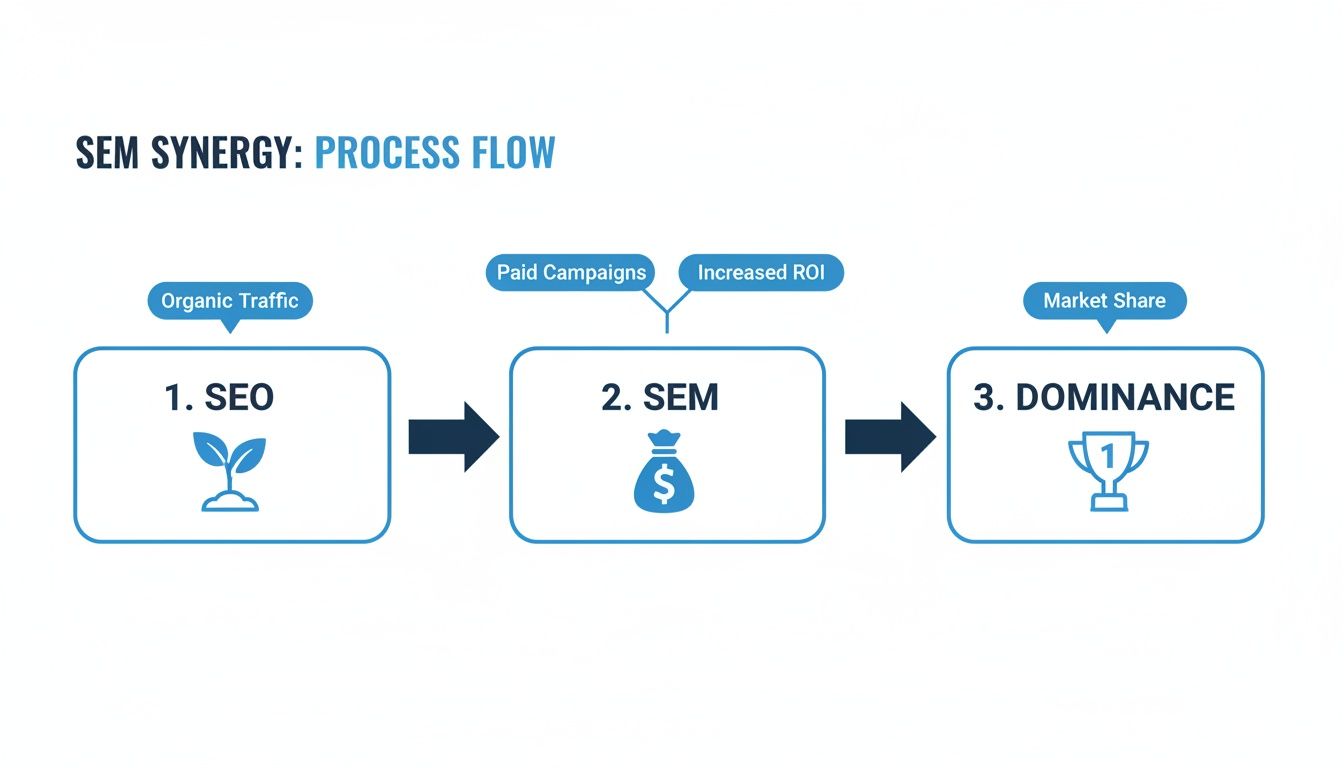
This synergy is powerful. By using paid ads to learn what converts, you’re essentially getting a cheat sheet for your SEO efforts, leading to a much stronger presence over time.
Essential Settings to Stop Wasting Money
Finally, there are a few settings inside Google Ads that I see people overlook all the time—and they can absolutely wreck your budget. Before you hit “launch,” do a quick audit of these critical elements to make your ad spend as efficient as possible.
- Precise Location Targeting: Don’t just target the entire country if you only serve a specific city. Get granular. Use radius targeting or select specific zip codes to ensure only people in your service area see your ads.
- Strategic Ad Scheduling: If you’re a B2B company, running ads at 2 AM on a Sunday is just throwing money away. Look at your data to see when customers are most active and schedule your ads to run only during those peak conversion times.
- A Robust Negative Keyword List: This is non-negotiable. Negative keywords are your defense against irrelevant searches. For example, a high-end cabinet maker should immediately add terms like “cheap,” “free,” and “DIY” to their negative list to stop attracting the wrong kind of clicks.
Mastering Your Budget and Measuring Real ROI
When we talk about search engine marketing, the conversation almost always drifts to cost. But the real question isn’t “How much do I spend?” It’s “What am I getting back for every dollar I put in?” If you can shift your mindset to focus on return, you’ll unlock the key to sustainable growth.
Managing an SEM budget is all about making every dollar work as hard as possible for your business. It’s a game of strategic allocation, not just spending.
Setting a Realistic SEM Budget
Your budget is the fuel for your campaign, and platforms like Google Ads give you a couple of ways to manage it. You can set a daily budget to cap your spend each day or a lifetime budget to spread your total investment over the entire campaign.
Let’s look at how this works in a couple of real-world scenarios.
- Local Service Business: Picture a plumber in Tampa with a starting ad budget of $1,500 a month. That breaks down to roughly $50 per day. The main goal here is getting phone calls for emergency repairs. So, you’d want to pour that budget into high-intent keywords like “emergency plumber near me” and even schedule your ads to run mostly on evenings and weekends when those calls are most likely to come in.
- National E-commerce Brand: Now, think about an online store selling eco-friendly cleaning supplies with a much larger monthly budget of $10,000. With a nationwide audience, you’d split this across different campaigns. A big chunk might fuel Google Shopping ads for specific products, while another portion funds a search campaign targeting broader keywords like “buy non-toxic all-purpose cleaner.”
Whether you’re a small local shop or a national brand, understanding the nuances of Google paid search cost is critical. This knowledge helps you make smarter decisions and get the most out of every dollar.
Focusing on KPIs That Actually Matter
Getting thousands of impressions might feel good, but it doesn’t pay the bills. True success in SEM is measured by Key Performance Indicators (KPIs) that connect directly to your bottom line.
There are two metrics you need to live and breathe: Cost Per Acquisition (CPA) and Return On Ad Spend (ROAS).
CPA tells you exactly how much it costs to land one new customer or lead. ROAS shows you how much revenue you’re generating for every dollar you spend on ads. These are the numbers that prove your campaigns are actually making you money.
Forget the vanity metrics. You need to obsess over these action-oriented KPIs instead:
- Cost Per Acquisition (CPA): If you spent $500 on ads and got 10 new customers, your CPA is $50.
- Return On Ad Spend (ROAS): If you spent $500 and brought in $2,500 in sales, your ROAS is 5x (or 500%).
- Conversion Rate: This is the percentage of people who click your ad and then do what you want them to do, like make a purchase or fill out a contact form.
Tracking these metrics is non-negotiable. If you want to get into the weeds on the calculations, our detailed guide explains how to calculate marketing ROI.
The Financial Case for SEM
The reason SEM is so financially powerful is simple: you’re reaching people with clear buying intent. They are actively searching for a solution you provide. The data backs this up—search leads are known to close at a staggering 14.6% rate, completely dwarfing the 1.7% close rate from outbound methods like cold calling. You can discover more insights about SEO and SEM effectiveness on seoprofy.com.
This incredible effectiveness is why SEM so often outperforms other marketing channels. It’s not about creating demand; it’s about capturing it.
Advanced Strategies for Optimization and Scaling
Getting your campaign live is a great first step, but it’s really just the starting line. The real wins—and the real profit—come from the continuous work of optimizing and scaling what you’ve built. This is where you transform a decent campaign into a high-performance engine for your business.
Once your ads are running and data starts trickling in, it’s time to get your hands dirty. The process of testing, refining, and improving every little piece is what separates a flatlining campaign from one that delivers bigger and better returns over time.
Embrace A/B Testing for Constant Improvement
Guesswork is the fastest way to waste your ad budget. You need real, data-driven answers, and the best way to get them is with A/B testing, also known as split testing. It’s a straightforward concept: you run two slightly different versions of an ad or landing page to see which one actually performs better with your audience.
The trick is to only test one thing at a time. If you change the headline and the description, you’ll never know which change made the difference. By isolating one variable, you can be certain about what works and what doesn’t.
Here are a few high-impact elements we always recommend testing:
- Headlines: Pit a question-based headline against a benefit-driven one. For example, “Need an Emergency Plumber?” versus “Fast & Reliable Plumbing, 24/7.”
- Descriptions: Experiment with different calls to action (CTAs). Does a direct “Call Now for a Free Quote” get more traction than a softer “Get Your Free Quote Online”?
- Landing Pages: Test two versions of your landing page. On one, put the contact form right at the top. On the other, move it below your customer testimonials. The results might just surprise you.
Don’t underestimate the power of small gains. A tiny improvement in your click-through rate (CTR) or conversion rate can have a massive impact on your bottom line. Even a 0.5% bump in conversions can dramatically lower your Cost Per Acquisition (CPA).
Leverage AI-Powered Smart Bidding
Manually tweaking bids for every single keyword is a task from a bygone era. Today, platforms like Google Ads offer powerful AI-driven smart bidding strategies that optimize your bids in real-time for every auction.
Instead of just telling the platform your maximum cost-per-click (CPC), you can give it a business goal and let the algorithm do the heavy lifting to achieve it.
Some of the most common smart bidding strategies include:
- Target CPA (Cost Per Acquisition): You set the maximum amount you’re willing to pay for a conversion, and Google’s AI automatically adjusts bids to hit that average.
- Target ROAS (Return On Ad Spend): You tell the system the return you want for every dollar spent (e.g., $5 in revenue for every $1 in ad spend), and it optimizes to maximize your revenue.
- Maximize Conversions: The algorithm simply works to get you the most conversions possible within your daily budget. This is perfect for lead generation campaigns where volume is key.
Handing the bidding over to AI frees you up to focus on higher-level strategy, like crafting more compelling ad copy or improving your landing page experience. It also helps you get more from your budget by preventing you from overpaying for clicks that are unlikely to convert. Of course, a tight budget also means managing which search terms you don’t want to show up for. For more on that, check out our guide on what negative keywords are and how to use them effectively.
Re-Engage Visitors with Remarketing
Did you know that on average, 97% of people who visit a website for the first time leave without converting? Remarketing is your second chance to bring those valuable prospects back into the fold. It works by showing targeted ads to people who have already visited your site as they browse other websites, watch YouTube, or scroll through social media.
This is easily one of the most effective tactics in your toolkit because you’re no longer talking to a cold audience. You’re reaching people who are already familiar with your brand.
- For an E-commerce Store: You can create an audience of users who added a product to their cart but left before checking out. Then, show them an ad with that exact product, maybe sweetened with a small discount like, “Come back and get 10% off!” to nudge them across the finish line.
- For a Local Service Business: A user visited your “Request a Quote” page but never filled out the form. You can remarket to them with an ad that features a glowing customer testimonial or your latest industry award to build trust and encourage them to come back and finish what they started.
With global SEM spending growing alongside $6 trillion eCommerce projections and 62% of traffic coming from mobile, these campaigns are more critical than ever. As industry data shows, businesses are increasingly relying on paid search for intent-driven traffic. You can explore more of these search engine marketing statistics and trends on fishbat.com. This explosive growth just underscores how vital smart optimization and scaling have become.
Troubleshooting Common Campaign Pitfalls
Sooner or later, every search engine marketing campaign hits a wall. When the numbers aren’t adding up, it’s easy to get frustrated. But don’t panic—the data is telling you a story. Instead of guessing, it’s time to put on your detective hat and diagnose the problem.
This isn’t about some generic checklist. We’re going to solve the specific, real-world issues that drain budgets and kill your ROI. By learning how to spot and fix these common pitfalls, you can get your campaign back on track and stop wasting money.
High Clicks But No Conversions
This is probably the most maddening problem you’ll face. Your ads are getting plenty of clicks, which is great, but that interest vanishes the second people land on your page. This almost always signals a major disconnect between what your ad promised and what your landing page delivered.
Think about it: you run an ad for “50% Off Custom Kitchen Cabinets.” Someone clicks, excited for a great deal, only to be dropped on your generic homepage with zero mention of the sale. They feel tricked, and they’re gone in a flash. That’s a click you paid for, completely wasted.
To fix this, you need to create a seamless experience:
- Message Match: The headline on your landing page must mirror the promise in your ad. No exceptions.
- Offer Visibility: The promotion or specific value from your ad needs to be front and center on the page. Don’t make people hunt for it.
- Clear Call-to-Action (CTA): Your page must tell them exactly what to do next. Use an impossible-to-miss button like “Claim Your 50% Off” or “Schedule a Free Consultation.”
The moment a user clicks your ad, a clock starts ticking. If they can’t find what they were promised within a few seconds, they are gone. Your landing page must instantly validate their click and make the next step obvious and easy.
A Low Quality Score Is Draining Your Budget
Quality Score is how Google grades the overall quality of your ads, keywords, and landing pages. A low score (anything below a 5/10) is a huge red flag. When your score is low, Google penalizes you by making you pay more for each click just to hold your ad position.
Essentially, a low score is Google’s way of telling you that your ads are providing a poor user experience. The usual culprits are a low click-through rate (CTR), weak ad relevance, or a clunky landing page experience.
Here’s how to diagnose and improve it by looking at its three main parts:
- Expected Click-Through Rate: If your CTR is low, your ad copy isn’t hitting the mark. It’s time to rewrite your headlines and descriptions to better align with what users are searching for and include a much stronger CTA.
- Ad Relevance: Are your ads tightly connected to your keywords? Stop using one generic ad for dozens of different keywords. Create smaller, highly focused ad groups where every keyword is directly relevant to the ad copy.
- Landing Page Experience: How fast does your page load, especially on a phone? Is the content on the page a perfect match for the ad they just clicked? Improving page speed and content relevance are two of the quickest ways to boost your score.
For smaller businesses, getting these details right is the key to making a limited budget go further. If you’re feeling overwhelmed, learning more about PPC management for small business can give you a structured path to follow.
Your Budget Disappears Before Noon
There’s no worse feeling than checking your campaign at 10 AM and seeing your entire daily budget is already gone. This usually means your campaign is either targeting an audience that’s way too broad, your bids are too aggressive, or you’re running ads at the wrong times of day.
This often happens when you use broad match keywords that let Google show your ads for all sorts of irrelevant searches. For instance, a local store selling premium “leather briefcases” might find their budget getting eaten up by clicks from people searching for “free briefcase images” or “how to repair leather.”
Here’s how you take back control of your spend:
- Review Your Search Terms Report: This report is your new best friend. It lives inside your Google Ads account and shows you the exact search queries that are triggering your ads and costing you money.
- Build Your Negative Keyword List: As you go through the search terms report, be aggressive. Add every single irrelevant term to your negative keyword list. This one action is the single most effective way to stop wasting money immediately.
- Implement Ad Scheduling: Dig into your conversion data. If you discover that 90% of your leads and sales happen between 9 AM and 5 PM on weekdays, why run ads at 2 AM on a Sunday? Set up an ad schedule to only show your ads during your most profitable hours.
Your SEM Questions Answered
Even with the best plan, you’re bound to have a few nagging questions before you hit ‘launch’ on your first search engine marketing campaign. It’s completely normal.
Here are the most common questions we hear from businesses just like yours, with straight-up answers to give you the confidence to get started.
How Long Does It Take to See Results From SEM?
Unlike SEO, which is a long game, SEM can start delivering results almost immediately. Once your ads are approved and running, you can expect to see traffic and clicks flowing in within a matter of hours. It’s that fast.
But let’s be clear: traffic isn’t the same as profit. Seeing meaningful business results—like qualified leads and actual sales—takes a little more time. The first 2-4 weeks are all about gathering data. This is your testing phase, where you’ll fine-tune bids, experiment with ad copy, and figure out what really connects with your audience.
You should start seeing a clear, consistent return on your investment within the first 1-3 months. That’s when the initial data pays off, and your optimized campaigns really start to perform.
What Is a Good Starting SEM Budget for a Small Business?
There’s no magic number here, but a realistic starting point for most small businesses is somewhere between $500 and $2,000 per month in pure ad spend. This range is usually enough to gather sufficient data to make smart decisions without breaking the bank.
The goal is to start with a budget you’re comfortable experimenting with. Focus on proving the ROI first, and once the campaign turns profitable, you can confidently scale your spending.
Your ideal budget really boils down to two things:
- Your Industry’s Average Cost-Per-Click (CPC): Competitive fields like law or home services have much higher CPCs. You’ll need a bigger budget just to get your foot in the door.
- Your Conversion Goals: How many clicks does it take to get one sale or lead? Knowing this helps you work backward to determine the ad spend needed to hit your targets.
Should I Do SEM or SEO First?
Honestly, the most powerful strategy is to do both at the same time. SEO and SEM work best together—they’re partners, not competitors.
- SEM delivers immediate results. It’s perfect for generating quick leads, testing a new offer, or gathering priceless keyword data from day one.
- SEO builds long-term authority. This is how you drive sustainable, “free” organic traffic and establish your brand as a trusted leader in your space.
Think of it this way: The data from your SEM campaigns—like which keywords convert the best—gives you a treasure map for your SEO strategy. At the same time, a strong SEO presence builds brand trust, which can improve your SEM Quality Score and actually lower your ad costs.
But if you absolutely have to pick one to start, SEM is faster for getting immediate results, while SEO is the smarter investment for long-term, sustainable growth.
What Is Quality Score and Why Does It Matter?
Quality Score is Google’s rating of your ads, keywords, and landing pages on a scale from 1 to 10. It’s a measure of their relevance and quality, and it is incredibly important.
Why? Because a higher Quality Score can land you better ad positions for a lower cost-per-click.
Google’s entire system is built to reward advertisers who create a great user experience. If your ad is a perfect match for the search and your landing page delivers on the ad’s promise, Google rewards you with cheaper clicks. On the flip side, a low Quality Score means you have to bid much higher just to stay visible, which can drain your budget in a hurry.
The best way to boost your score is to make sure your ad copy is highly relevant to your keywords and your landing page experience is seamless. Do that, and you’ll make every dollar in your budget go further.
Ready to stop guessing and start growing with expertly managed search engine marketing campaigns? The team at Netco Design LLC builds revenue-focused strategies that attract qualified customers and deliver measurable results. Let us help you dominate the search results and turn clicks into conversions. Learn more about our services.

