

table of contents
A solid SEO keyword strategy isn’t just about getting more traffic—it’s a battle plan that connects your business goals directly to the search terms real people are typing into Google. It’s the difference between attracting random browsers and getting the right traffic that turns into paying customers.
Aligning Your Keyword Strategy with Business Goals

Chasing keywords with high search volumes but no clear purpose is a classic mistake. I’ve seen it countless times. A powerful strategy always starts with one simple question: What am I trying to achieve?
Whether your goal is to generate qualified leads, drive online sales, or just make the phone ring, your keywords must serve that core objective. This simple step grounds your entire effort in reality, turning a random list of terms into a targeted arsenal of phrases that directly contribute to your bottom line.
Understanding Customer Search Intent
The secret to connecting keywords with your goals is to get inside your customer’s head and understand their search intent. This is just a fancy way of saying you need to know why they’re searching in the first place. Every single query falls into one of three main buckets, and each one needs a totally different game plan.
- Informational Intent: The searcher is just looking for information. They have a problem they’re trying to understand, like “how to spot a roof leak” or “signs of storm damage to roof.” They’re in the research phase.
- Commercial Intent: Now they’re getting warmer. The user is comparing their options and getting closer to making a decision. Think “best roofing companies near me” or “metal roof vs shingle cost.”
- Transactional Intent: This is the money maker. The user is ready to pull the trigger and buy. They’ve decided what they need and are looking for someone to provide it. Searches like “roof repair St. Petersburg” or “get a roof replacement quote” are pure gold.
A common pitfall is getting obsessed with high-volume informational keywords. While they’re great for building awareness, it’s the commercial and transactional keywords that drive revenue. These should always be the priority for your core service and product pages.
Building a Customer-Focused Keyword Foundation
To really nail search intent, you have to know your customer inside and out. Building a detailed customer persona isn’t just a fluffy marketing exercise—it’s non-negotiable. Who are they? What are their biggest headaches? What specific words do they use to describe their problems?
If you haven’t done this yet, our guide on how to perform a target audience analysis is the perfect place to start.
Let’s walk through a real-world scenario. Imagine you run a local roofing company in Tampa, Florida. Your main business goal is to generate 20 qualified leads per month for roof replacements. Simple enough.
Your ideal customer is “Alex,” a 45-year-old homeowner who lives near the coast and is getting nervous about the upcoming hurricane season. Alex isn’t a roofer and doesn’t use technical jargon. They aren’t searching for “asphalt shingle installation.” Instead, Alex is typing things like “hurricane-proof roofing options Tampa” or “cost to replace roof before storm season.”
See the difference? By building your strategy around Alex’s actual language and worries, you attract people who are already pre-qualified. You’re no longer just another roofer; you’re the specific solution to their immediate problem. This customer-first approach turns your keyword list from a boring spreadsheet into a powerful tool for attracting people who are already looking for you, making the journey from search to sale a whole lot shorter.
How to Find High-Impact Keywords for Your Business

Alright, with your business goals locked in and a clear picture of your ideal customer, it’s time to roll up our sleeves. Finding the right keywords is part detective work, part strategic thinking. We’re going to move from broad ideas to the specific, high-value phrases your customers are typing into Google right now.
The whole process starts with what we call “seed keywords.” Think of these as the foundational terms describing your core services or products. They’re usually just one or two words and act as the starting point for uncovering a much bigger world of search queries.
Let’s imagine we’re working with a plumbing company in St. Petersburg, Florida. Their seed keywords would look something like this:
- Plumber St Pete
- Drain cleaning
- Water heater repair
- Emergency plumbing
These terms are a must, but they’re also incredibly competitive. The real magic in an effective SEO keyword strategy happens when you expand on these seeds to find more specific, and often less competitive, variations.
Expanding Your Keyword List with Tools
This is where you bring in the heavy hitters. Professional SEO tools like Ahrefs or SEMrush are game-changers here. While free options like Google Keyword Planner are okay for brainstorming, paid tools give you a crucial look behind the curtain at what your competitors are doing and what your customers are really asking.
Let’s stick with our plumber. If we plug the seed keyword “water heater repair” into a tool like Ahrefs’ Keyword Explorer, we don’t just get a few ideas back—we get hundreds of related terms, common questions, and long-tail variations.
The data reveals much more than just search volume. You get keyword difficulty, traffic potential, and a clear picture of which terms are actually worth your time and effort.
These tools let you slice and dice this massive list to find hidden gems. For instance, you could filter for keywords with a lower difficulty score (meaning they’re easier to rank for) or zero in on phrases that are questions. This is how you unearth highly specific and actionable keywords. We dive deeper into this in our guide on long-tail keyword research.
Uncovering Question-Based Keywords
One of the most powerful moves you can make is to find the questions your audience is asking. People don’t always search in simple transactional phrases; more often than not, they’re looking for answers to a specific problem they’re facing.
Targeting question-based keywords is a fantastic way to build trust and authority. When you create content that directly solves a customer’s problem, you position your business as a helpful expert, not just another service provider.
Using the “Questions” report in your SEO tool, you can find queries people are actively searching for, like:
- “How much does it cost to replace a water heater?”
- “Why is my water heater making a popping noise?”
- “Tankless vs traditional water heater which is better?”
Every single one of these questions is an opportunity for a blog post or an FAQ page. This kind of content attracts people who are in the research phase, nurturing them so they remember your brand when it’s time to buy.
Analyzing Your Competitors’ Keywords
Why start from scratch when your competitors have already done some of the legwork? Ethically “spying” on the keywords driving traffic to their websites is one of the smartest and most efficient tactics in the book.
Most modern SEO tools let you plug in a competitor’s domain and see a list of nearly every keyword they rank for. This can instantly reveal entire categories of keywords you might have completely missed.
Here’s a simple process for a competitive keyword analysis:
- Identify Your Top 3-5 Competitors: Just Google your main seed keywords and see who consistently shows up at the top in your service area.
- Run a Content Gap Analysis: Use a tool to compare your website’s keywords against a competitor’s. This spits out a list of valuable keywords they rank for that you don’t. Goldmine.
- Look for Their Weak Spots: Pay close attention to keywords where your competitors are ranking on the bottom half of page one or on page two. These are prime opportunities for you to create something better and outrank them more easily.
This isn’t about copying what they do. It’s about identifying proven topics that resonate with your shared audience and finding gaps where you can provide more value. By combining seed keyword expansion, question-based research, and competitive analysis, you’ll build a powerful, comprehensive list of keywords that will fuel your entire SEO strategy.
How to Prioritize Keywords for Maximum ROI
So you’ve done the research. Now you’re staring at a massive spreadsheet, packed with hundreds, maybe even thousands, of potential keywords. This is the exact point where most businesses get stuck. An extensive list is just data; the real magic happens when you turn that data into a sharp, actionable plan.
It’s time to move beyond vanity metrics and focus on the keywords that actually drive revenue. Prioritization is all about focus. Instead of spraying your efforts across the board, you’ll strategically pick the terms that offer the best return on your time and content budget. We’ll do this by creating a simple scoring system based on four critical pillars.
The Four Pillars of Keyword Prioritization
To build a strategy that wins, you need to evaluate every keyword against a consistent set of criteria. This framework helps you balance quick wins with long-term growth, making sure every piece of content you create serves a purpose. Think of it as a quality control check for your keyword list.
Here are the four pillars we look at:
- Search Volume: The most straightforward metric. How many people search for this term each month? While bigger numbers look good, they’re not the only thing that matters.
- Keyword Difficulty (KD): This score, which you can find in tools like Ahrefs, estimates how hard it will be to rank on Google’s first page. A lower score means less of a fight.
- Business Relevance: How closely does this keyword connect to what you actually sell? A highly relevant keyword speaks directly to a problem your business solves.
- Commercial Intent: Is the searcher just browsing, or are they ready to pull out their wallet? Keywords containing terms like “buy,” “quote,” or “service” signal that a person is closer to making a purchase.
By scoring each keyword on a scale of 1-5 for each pillar, you can quickly spot your top opportunities. A keyword with high relevance and intent, even with lower volume, is often far more valuable than a high-volume term that’s impossible to rank for and only brings in unqualified traffic.
Finding the Sweet Spot Between Traffic and Revenue
Too many businesses fall into the trap of chasing high-volume keywords, thinking that more traffic automatically equals more sales. But the data tells a much different story.
Believe it or not, a staggering 94.74% of all keywords get just 10 or fewer searches per month. You can find more nuggets like this in these SEO statistics from AIOSEO. The real opportunity is often in targeting those specific, low-competition phrases known as long-tail keywords.
This means your prioritization model should aim for a healthy balance. You’ll want a mix of keywords that serve different strategic goals.
- Quick Wins (High Priority): This is your low-hanging fruit. Look for keywords with low Keyword Difficulty (under 20), high business relevance, and clear commercial intent. The search volume might be lower, but they’ll drive qualified, ready-to-buy traffic and help you build momentum fast.
- Long-Term Goals (Medium Priority): These are the high-volume, “trophy” keywords in your industry. They usually have higher KD scores and take serious effort to rank for. They shouldn’t be your first target, but they’re essential for establishing market leadership down the road.
- Topical Authority Builders (Supporting Priority): These are often informational, question-based keywords. While they might not lead directly to a sale, they build trust and establish your brand as the go-to expert in your field.
Grouping Keywords into Thematic Clusters
The final step in prioritization is to stop thinking about individual keywords and start thinking in terms of topics. This concept, known as topic clustering, is a game-changer. Instead of creating one page for “roof repair” and a separate one for “roof leak fix,” you group them together under a single, comprehensive theme.
Google’s algorithm has gotten incredibly smart at understanding the relationships between words. It rewards websites that demonstrate deep expertise on a particular subject.
To get started, just scan your prioritized list and group related keywords into logical themes. For instance, all keywords related to “emergency plumbing,” “24/7 plumber,” and “after-hours plumbing service” would form a single cluster. This cluster would then become the foundation for a powerful service page that covers the topic from every possible angle.
This approach not only helps you rank for a wider array of searches with a single piece of content but also signals to search engines that you are an authority on that topic. It’s a powerful method that directly impacts your ability to rank for more competitive terms over time. Understanding this connection is a key part of learning how to calculate marketing ROI from your SEO efforts.
Keyword Mapping: Aligning Keywords to the Buyer’s Journey
Okay, you’ve got a prioritized list of keywords. Think of those as your raw materials. Now, we need to turn that list into a cohesive blueprint for your website.
This process is called keyword mapping. It’s all about assigning the right keyword to the right page to meet people exactly where they are in their buying journey.
Think of it like this: You wouldn’t show a first-time visitor to a museum the gift shop before they’ve even seen the main attraction. In the same way, you don’t want to send someone looking for general info straight to a sales page. Keyword mapping makes sure every visitor lands on a page that perfectly matches what they need at that moment.
Aligning Keywords with the Marketing Funnel
The most effective way I’ve found to structure a keyword map is to align it with the classic customer journey, which is typically broken down into three stages: Awareness, Consideration, and Decision.
Each stage lines up with a different kind of user intent, and that intent tells you exactly what kind of content they’re looking for. When you get this right, you create a logical and satisfying user experience. You answer their questions at just the right time, build trust, and gently guide them from being curious to becoming a customer.
A well-executed keyword map transforms your website from a simple collection of pages into a powerful conversion funnel. It ensures that your content architecture is built for both search engines and your ideal customers, maximizing the value of every visitor.
Mapping Keywords to Specific Page Types
Once you get your head around the funnel, putting it into practice is pretty straightforward. You’re essentially matching a keyword’s intent to the right content format on your website. This is a huge signal to Google that your page’s purpose is perfectly aligned with what the searcher expects to find.
Here’s a practical breakdown of how it works for each stage.
1. The Awareness Stage (Informational Keywords)
At the top of the funnel, people are just starting to identify a problem or are looking for answers. They use broad, often question-based keywords. They aren’t ready to buy; they’re in learning mode.
- Keyword Examples: “how to fix a leaky faucet,” “signs of a bad water heater,” “what is the best type of roof for Florida.”
- Content Match: These informational keywords are a perfect fit for blog posts, how-to guides, and resource articles. This type of content establishes your expertise and introduces your brand as a helpful authority, all without a hard sell.
2. The Consideration Stage (Commercial Keywords)
Now, people are actively comparing different solutions and providers. They know what they need and are busy evaluating their options. Their searches get more specific and often include comparison terms or words that signal they’re weighing their choices.
- Keyword Examples: “plumber reviews St. Petersburg,” “shingle vs metal roof cost,” “best local SEO company.”
- Content Match: These keywords belong on pages like comparison guides, detailed service pages, case studies, and pages that highlight what makes you different. This content helps users make an informed decision and positions your business as the best choice.
3. The Decision Stage (Transactional Keywords)
This is the bottom of the funnel. The user is ready to pull the trigger—to buy, hire, or get a quote. Their keywords are highly specific and show clear intent to make a purchase.
- Keyword Examples: “emergency plumber near me,” “get a quote for web design,” “buy tankless water heater Tampa.”
- Content Match: Transactional keywords absolutely must be mapped directly to your money pages: your core product pages, service pages, and contact pages. The content here needs to be direct, persuasive, and make it incredibly easy for the user to convert.
When you systematically map your keywords this way, you create a logical site structure that Google can easily understand and reward. But more importantly, you build a journey that meets your customers’ needs at every single step. It makes them feel understood and confident in their decision to choose you.
This whole process is deeply tied to knowing your audience. If you need a refresher on that, check out our guide on how to create buyer personas for some more insight.
Executing and Measuring Your SEO Keyword Strategy
A brilliant keyword strategy is just a plan on paper until you put it into action. Once you’ve mapped your keywords, the real work begins: weaving those terms into the very fabric of your website. This isn’t about just sprinkling words onto a page; it’s about creating content that is genuinely compelling for your audience and crystal clear to search engines.
But the job isn’t done once your content goes live. Far from it. Consistent measurement is what turns a static strategy into a dynamic one that delivers compounding returns over time. You have to know what’s working, what’s falling flat, and where your next big opportunity is hiding.
On-Page SEO Best Practices
Integrating keywords naturally is an art form. Your goal is for their inclusion to feel completely effortless to the reader while sending powerful relevance signals to Google. Keyword stuffing is an old, outdated trick that will only hurt your rankings.
Instead, focus on strategically placing your primary and secondary keywords in these key on-page spots:
- Title Tag: This is arguably the most important real estate on the page. Try to get your primary keyword near the beginning of the title for maximum impact.
- Meta Description: While it’s not a direct ranking factor, a well-written meta description that includes your keyword can seriously boost your click-through rates from the search results.
- Headings (H1, H2, H3): Your main H1 heading should almost always feature your primary keyword. Use variations and related terms in your subheadings (H2s, H3s) to build out the page’s topical depth.
- URL Structure: A clean, descriptive URL that includes your main keyword (like
yoursite.com/service/emergency-plumbing) is both user-friendly and great for SEO. - Body Content: Your primary keyword should pop up naturally within the first 100 words or so. From there, weave it in, along with your LSI keywords, throughout the rest of the text.
Once you’ve developed your keyword strategy, knowing how to effectively optimize content for SEO is what turns all that research into actual rankings.
Defining and Tracking Your KPIs
You can’t improve what you don’t measure. To really understand if your keyword strategy is paying off, you need to lock in on a specific set of Key Performance Indicators (KPIs). These metrics give you a clear, honest picture of your progress and help justify the investment in your SEO efforts.
The flowchart below shows how different types of keywords align with the stages of the buyer’s journey—a crucial concept for both mapping and execution.
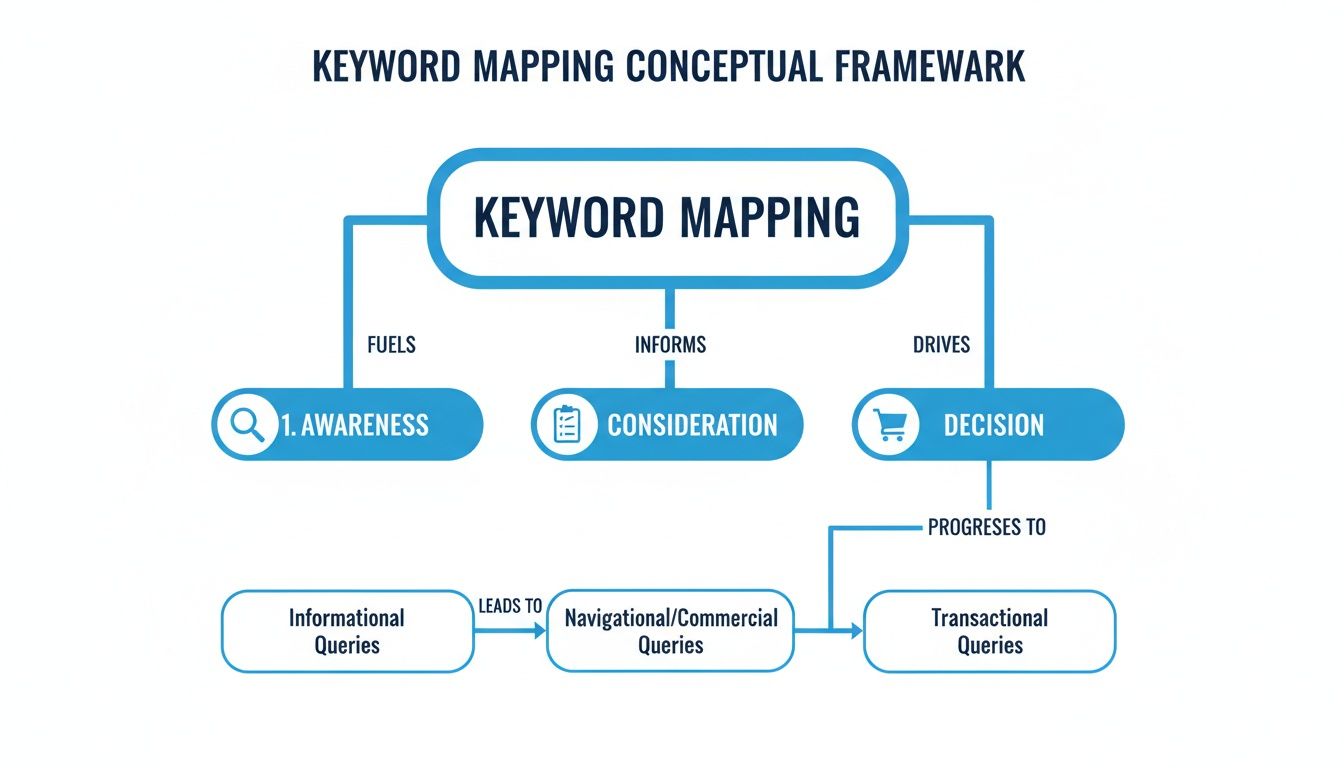
As you can see, broader informational keywords attract people in the Awareness stage, while more specific, commercial terms are perfect for engaging those in the Consideration and Decision phases.
Here are the most critical KPIs you should be watching like a hawk:
- Keyword Rankings: This is the most direct report card for your strategy. Are your target keywords climbing the search results? Tools like Google Search Console and Ahrefs are non-negotiable for tracking this.
- Organic Traffic: An uptick in visitors from search engines is a huge sign that your strategy is hitting the mark. In Google Analytics, you can see exactly which pages are bringing in the most organic traffic.
- Click-Through Rate (CTR): This metric, found right in Google Search Console, shows the percentage of people who see your page in the search results and actually click on it. A low CTR could mean your title tag or meta description needs a rewrite.
- Conversions from Search: This is the ultimate goal, right? Are your organic visitors actually filling out contact forms, making purchases, or calling your business? Setting up conversion tracking in Google Analytics is an absolute must.
Leveraging Google’s Powerhouse Tools
Google gives you two free, incredibly powerful tools that are essential for measuring your SEO success: Google Search Console and Google Analytics.
Think of Google Search Console as your direct line to Google. It tells you which keywords you’re ranking for, your average position, and your CTR. It’s also where you’ll find red flags about technical issues that might be holding your site back.
A pro tip: Make it a weekly habit to check the “Performance” report in Google Search Console. It often uncovers “striking distance” keywords—terms where you’re ranking on page two. A little content optimization can often be enough to push these onto page one for a quick traffic win.
Google Analytics, on the other hand, tells you what happens after someone clicks through to your site. It reveals how much organic traffic you’re getting, which pages are the most popular, and most importantly, how many of those visitors are turning into leads or customers.
By regularly analyzing the data in both tools, you can refine your approach, double down on what’s working, and continuously improve your strategy for long-term, sustainable growth. For more detailed instructions on monitoring your progress, check out our guide on https://netcodesign.com/how-to-check-keyword-ranking/.
Common Questions About SEO Keyword Strategy
Even with the best-laid plans, questions always come up once you’re in the trenches with your SEO keyword strategy. That’s completely normal. The difference between a strategy that fizzles out and one that drives real growth is getting clear, straightforward answers to these common hurdles.
How Often Should I Update My SEO Keyword Strategy?
Your keyword strategy should never be a “set it and forget it” document. The best way to think about it is as a living part of your marketing that needs regular attention to stay sharp.
A major review and overhaul every 6 to 12 months is a great baseline. But you absolutely should be keeping an eye on performance at least once a month. Markets shift, new competitors pop up, and customer search habits change—all of which create new chances for you to grab traffic.
For example, a new product launch or service offering demands immediate keyword research to give it the support it needs. A fantastic proactive habit is to pop into your Google Search Console and look for keywords where you’re already ranking on page two. These are your “striking distance” terms that often just need a small content refresh to jump onto page one.
Think of your strategy as a garden. You plant the seeds (your initial keywords), but you still have to water, weed, and prune to see the best growth. A little monthly maintenance makes all the difference.
High Search Volume or High Relevance: Which Is More Important?
For nearly every small and mid-sized business, relevance wins every single time. If you take one thing away from this guide, let it be this.
A keyword with 10,000 monthly searches is completely worthless if the person searching has zero interest in what you sell. Chasing that kind of traffic is just a vanity metric that will burn through your time and money without bringing in a single lead or sale.
On the other hand, a highly specific, long-tail keyword with just 50 monthly searches can be pure gold if every one of those searchers is a qualified customer ready to buy.
A smart strategy finds a balance:
- Start with high-relevance, low-competition keywords. These are your quick wins. They build your site’s authority and start driving qualified traffic right away.
- Expand to more competitive terms over time. As your website gains authority from those early wins, you can start going after the broader, higher-volume keywords.
Can I Target the Same Keyword on Multiple Pages?
It’s best to avoid this whenever you can. When you have multiple pages on your own site competing for the exact same primary keyword, you create an SEO problem known as “keyword cannibalization.”
This basically just confuses search engines. Google isn’t sure which page is the most important one for that search, which can cause it to split the authority between them or, even worse, rank a less important page higher. The end result is that all of your competing pages can end up with weaker rankings.
Every page on your website should have one distinct, unique primary keyword it’s targeting. You can—and should—use keyword variations and related secondary terms across different pages. But the core topic and primary intent for each URL has to be unique. Your keyword map is your best defense against this common mistake.
How Long Until I See Results From a New Strategy?
SEO is a marathon, not a sprint. While you might see some positive movement with very specific, low-competition keywords in as little as 3 to 4 months, it generally takes a good 6 to 12 months to see significant, lasting results from a comprehensive strategy.
The exact timeline really depends on a few things: your website’s current authority, how competitive your industry is, and how consistently you’re putting out high-quality, optimized content. Patience and steady, consistent effort are the absolute keys to long-term SEO success.
Ready to turn your keyword research into a revenue-generating machine? The expert team at Netco Design LLC builds custom SEO strategies that attract qualified customers and drive measurable growth for businesses in Tampa Bay and beyond. Get a proposal today and start ranking for the keywords that matter.

