

table of contents
A solid SEO strategy for small businesses does one thing really well: it connects you with people who are already online, actively searching for what you sell. It’s the difference between just having a website and turning that website into a machine that brings in leads, phone calls, and sales, day in and day out.
The goal is simple: show up at the exact moment a potential customer needs you.
Why SEO Is Your Most Powerful Growth Engine
When you’re running a small business, every dollar and every minute has to count. Marketing can often feel like a shot in the dark—you spend a ton on ads and just hope they work. Search Engine Optimization (SEO) completely flips that around. Instead of you shouting into the void, you’re just there with the answer when someone asks a question.
Think about it. You’re a plumber in Tampa. A homeowner’s pipe bursts, and the first thing they do is grab their phone and search “emergency plumber near me.” If your website is right there on the first page, you get that call. That’s the raw power of a smart SEO strategy. It’s not about tricking Google. It’s about being the most helpful, relevant result for a real person with a real problem.
From Local Shops to Global Reach
This isn’t just for service businesses, either. A small handmade jewelry shop in St. Petersburg can use SEO to find customers across the globe searching for “unique artisan necklaces.” A local café can totally own searches for “best coffee for remote work,” bringing in a steady stream of weekday customers who might have otherwise gone to Starbucks.
SEO is the process of earning trust with search engines so they recommend your website to their users. When Google trusts you, potential customers are far more likely to trust you, too.
This infographic breaks down how that process creates real value, drawing a straight line from a customer’s search query to your business’s growth.
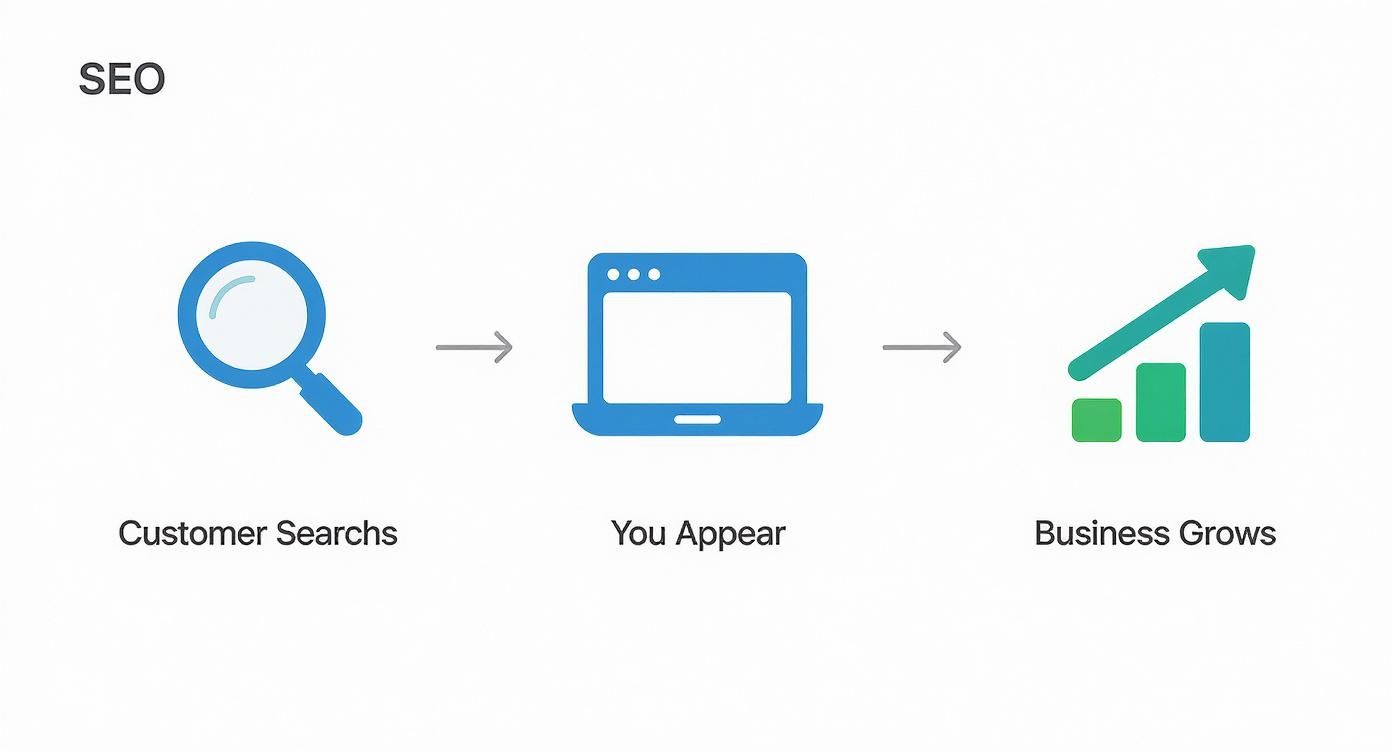
The key takeaway here is that online visibility directly creates opportunity. That makes SEO a non-negotiable tool for any small business that wants to survive and grow.
More Than Just Traffic
A good SEO plan brings in more than just random website visitors—it delivers qualified leads. These aren’t people just browsing. They are people with a specific need, and your business is the solution. That’s why the return on investment from SEO often blows traditional marketing out of the water.
Ultimately, investing in SEO is investing in a sustainable growth engine for your business. The work you put in today to improve your rankings will continue to pay off for months, and even years, down the line. It’s your digital storefront, open 24/7, ready to welcome your next best customer.
Building Your Digital Foundation with Technical SEO
Think of your website as your digital storefront. Before you start worrying about eye-catching window displays (your content) or clever advertising (your links), you have to make sure the building itself is solid. Do the doors open easily? Can customers find their way around without getting lost?
That’s the heart of technical SEO. It’s the foundation your entire online presence is built on, the silent workhorse of a successful seo strategy for small businesses.
If search engines like Google can’t easily crawl, understand, and index your site, even the most brilliant content will remain invisible.

Making Your Website Accessible to Everyone
A huge piece of your technical foundation is making sure your site works perfectly for every single visitor, no matter what device they’re using. This isn’t just a “nice-to-have” anymore; it’s a core requirement for modern SEO.
- Mobile-Friendliness: Well over half of all web traffic now comes from mobile devices. If a potential customer has to pinch and zoom just to read your text, they’re gone. You can use Google’s free Mobile-Friendly Test to see how you’re doing.
- Site Speed: In our impatient world, speed is everything. A slow-loading site doesn’t just frustrate users—it signals poor quality to search engines. In fact, a one-second delay in page load time can cause a 7% reduction in conversions.
Your website’s user experience is a direct reflection of your customer service. A fast, accessible site tells customers you value their time and attention.
Optimizing for speed might sound intimidating, but it often starts with simple fixes like compressing image sizes or upgrading to a better hosting provider. For a deeper dive, you can learn more about Core Web Vitals performance tips that every designer should know to get ahead. This kind of health check ensures you’re not losing customers before they even see what you offer.
Building Trust with Search Engines and Users
Beyond just the user experience, technical SEO is about sending clear trust signals to both people and search engine crawlers. Two of the most important signals are your site’s security and its overall structure.
First up, your website must use HTTPS. See that little padlock icon next to your URL in the browser? That’s a powerful symbol of security. It encrypts the data shared between your site and your visitors, protecting their information. Google has confirmed that HTTPS is a ranking signal, making it non-negotiable.
Second, an XML sitemap acts as a roadmap for search engines. It’s simply a file that lists all the important pages on your website, helping crawlers find and index your content much more efficiently. For a small business, this ensures that your new blog posts, service pages, or product updates get discovered quickly. You don’t need to be a developer for this; most website platforms and SEO plugins can generate a sitemap for you automatically.
The Impact of a Strong Technical Base
Getting these technical fundamentals right is more than just a box-ticking exercise. It’s a strategic move for growth.
The numbers don’t lie. A modern, optimized website is critical for survival. Today, approximately 73% of small businesses in the U.S. have a website, a significant jump from just 64% in 2020.
Better yet, businesses with optimized websites are seeing real rewards, with some reporting revenue increases between 15-50%. A positive web experience can generate up to twice as many leads as an outdated one. Getting your technical SEO right from the start ensures your digital storefront is ready to welcome that growth.
Winning the Neighborhood with Local SEO
For most small businesses, your best customers aren’t halfway across the world; they’re right down the street. This is where a sharp local SEO strategy becomes your most powerful tool, turning your online presence into a magnet for nearby customers.
The entire game is about capturing high-intent “near me” searches—queries from people who are ready to buy right now. When someone searches for “best tacos near me” or “emergency roof repair,” they aren’t just browsing. They have an immediate need, and winning that moment is what local SEO is all about.
Mastering Your Google Business Profile
Think of your Google Business Profile (GBP) as your digital storefront on Google Search and Maps. It’s often the very first interaction a potential customer has with your business, so making a strong first impression is non-negotiable. It’s not just a listing; it’s the centerpiece of your local search presence.
An incomplete profile is a huge missed opportunity. A fully optimized one, on the other hand, can dramatically boost your visibility.
Properly optimized Google Business Profiles get seven times more clicks than incomplete listings. That’s not a minor tweak; it’s a fundamental step toward dominating your local market.
Start by filling out every single section with care and precision. This means:
- Choosing the perfect business category. Be specific. Don’t just pick “Restaurant”; choose “Italian Restaurant” or “Vegan Restaurant” if that’s your niche. This helps Google match you with more relevant searches.
- Writing a compelling business description. Don’t just list what you do. Tell your story. What makes you special? Weave in keywords that your ideal customers would actually search for, like “family-owned bakery” or “eco-friendly cleaning services.”
- Uploading high-quality photos. Show off your space, your products, and your team. Pictures of your storefront, interior, and popular items help customers know what to expect and build trust before they even walk in the door.
The Power of Local Search Intent
The data behind local search is staggering, and it screams “pay attention to this.” A remarkable 46% of all Google searches have local intent. Even more telling, searches that include “near me” have exploded by over 900% in recent years.
What’s really important, though, is that this traffic converts. Nearly 28% of local searches result in an immediate purchase, and an incredible 76% of people who search locally on their phone visit or call a business within 24 hours. These aren’t just statistics; they represent a direct line to your bottom line. You can explore more compelling local SEO statistics and their impact on businesses to see the full picture.
This immediate action is what separates local SEO from broader organic SEO efforts. While both are crucial, local SEO targets customers at the very end of their buying journey. To learn more about this distinction, check out our guide on the key differences between organic and local SEO.
Building Neighborhood Authority
Beyond your GBP, Google looks for other signals to confirm that you’re a legitimate and respected business in your community. Two of the most effective ways to build this authority are through dedicated location pages and clean, consistent local citations.
Create Location-Specific Pages
If you have multiple locations or serve several distinct neighborhoods, you need a unique page on your website for each one. For instance, a plumber serving both Tampa and St. Petersburg should have separate pages like:
yourwebsite.com/plumber-tampayourwebsite.com/plumber-st-petersburg
Each page needs to feel local. Include the specific address, phone number, hours, customer testimonials from that area, and content tailored to that neighborhood. This tells Google you have a real, established presence there.
Build Consistent Local Citations
A local citation is any online mention of your business’s name, address, and phone number (NAP). These pop up on online directories like Yelp, Angie’s List, and industry-specific sites.
Consistency is everything. Your NAP information must be identical across every single platform. Inconsistencies, like using “St.” on one site and “Street” on another, can confuse search engines and water down your authority. Use a tool to audit your existing citations and methodically clean up any errors. This diligent effort proves to Google that you’re a well-established local entity, making you the go-to choice for customers in your neighborhood.
Creating Content Your Customers Actually Want
Effective SEO isn’t about stuffing keywords onto a page anymore. Those days are long gone. Today, a winning seo strategy for small businesses boils down to a much simpler idea: answering your customers’ most pressing questions.
It’s all about creating content that genuinely helps, informs, and solves real problems for the people you want to reach.
When you shift your mindset from “how do I rank?” to “how can I actually help someone?” the entire process becomes clearer. Your goal is to become the go-to resource in your niche, building trust with every helpful article, guide, or FAQ you publish. This trust is what turns a casual searcher into a loyal customer.

Uncovering What Your Audience Is Searching For
Before you write a single word, you need to get inside your customer’s head. What are they actually looking for? This process, known as keyword research, doesn’t have to be complicated or expensive. The best place to start is by stepping into your customer’s shoes.
What problems are they trying to solve? What questions do they have that your business is uniquely positioned to answer?
Think beyond just your product or service name. A person looking for a roofer isn’t just searching “roofer near me.” They’re typing things like “how to fix a leaking shingle” or “cost to replace roof in Florida.” These are the real-world queries you want to capture.
A fantastic, completely free technique is to use Google’s own search bar. Start typing a phrase related to your business and just watch what pops up in the “autocomplete” suggestions. These are real searches from real people, giving you a direct line into their thought process.
For instance, a boutique coffee shop owner might type “best coffee for…” and see suggestions like:
- best coffee for remote work
- best coffee for studying near me
- best coffee for a first date
These aren’t just keywords; they’re content ideas handed to you on a silver platter. Each one represents a specific need you can immediately address.
Understanding the Intent Behind the Search
Finding the keywords is only half the battle. The next—and far more crucial—step is to figure out the user intent. You have to understand the “why” behind every search. What does a person searching for “best coffee shop for remote work” really want to know?
They aren’t just looking for any old coffee shop. They’re looking for a place with specific features:
- Reliable Wi-Fi: Fast, free internet is absolutely non-negotiable.
- Ample Outlets: Nothing is more frustrating than a dying laptop with nowhere to plug in.
- Good Seating: They need a comfortable spot where they can settle in for a few hours.
- A Quieter Atmosphere: It has to be a place where they can actually focus.
Understanding this intent allows you to create content that perfectly matches their needs. Instead of a generic page about your coffee blends, you could write a blog post titled, “Why [Your City] Remote Workers Love Our Coffee Shop.” In it, you’d detail all the amenities that make your location the perfect mobile office. This directly answers the user’s unasked questions and solves their problem on the spot.
From Keywords to a Powerful Content Plan
Once you have a list of keywords and a solid grasp of user intent, you can start building out a content plan. This doesn’t need to be some complex, color-coded spreadsheet. It can be a simple document that maps out your ideas.
The goal is to create different types of content that serve different needs along the customer journey.
- Blog Posts: These are ideal for answering specific questions and sharing your expertise. A plumber could write posts like, “5 Signs You Need to Call an Emergency Plumber” or “DIY vs. Pro: When to Unclog a Drain Yourself.”
- Guides: Perfect for more in-depth topics that establish you as a true authority. An accountant could create “The Small Business Owner’s Ultimate Guide to Quarterly Taxes.”
- FAQs: A dedicated frequently asked questions page is a goldmine. It can capture a huge range of long-tail keywords while providing immense value to your visitors.
By organizing your ideas, you ensure you’re consistently producing valuable content that actually supports your business goals. For a practical look at how this all comes together, you can explore a complete content strategy example to see these principles in action. This approach ensures your efforts are strategic, not just random acts of content.
Ultimately, your content is the engine of your SEO strategy. Creating genuinely useful information that solves real problems is the most sustainable way to attract traffic, build trust, and grow your small business online.
How to Build Authority and Earn Trust Online
In SEO, links from other websites are powerful votes of confidence. When another site links to yours, it’s basically telling Google, “Hey, this business is the real deal.” This is what we call link building, but for a small business, it’s much more useful to think of it as digital PR.
The goal isn’t to chase spammy, outdated tactics. It’s about building real relationships and telling your story so that other local businesses, bloggers, and news outlets want to talk about you. This is a cornerstone of any good SEO strategy for small businesses because it builds authority that both search engines and actual customers trust.

Building Links Through Community Engagement
Your best link-building opportunities are often hiding in plain sight, right in your own backyard. These strategies feel natural because they grow out of real-world interactions, not some complicated digital scheme. You build goodwill, and the valuable links follow.
Here are a few practical, community-focused ideas:
- Sponsor a local youth sports team. Their website will almost certainly have a “Sponsors” page where they’ll happily link back to your site. It’s a simple, high-authority local link.
- Host a charity drive or a community event. Team up with a local non-profit and promote it. Local news outlets and community calendars are always looking for positive stories to share, and they’ll link to your event page.
- Offer a discount to local university students or faculty. Getting your business listed in a university’s resource guide can land you a highly valuable
.edubacklink, which Google loves.
These actions do more than just boost your SEO; they cement your reputation as a valued member of the community.
Creating Link-Worthy Content
Another powerful approach is to create something so genuinely useful that other people can’t help but share it. This is where your content plan connects directly with your authority-building efforts. You create the resource, then you let the right people know it exists.
Imagine a local brewery creating “The Ultimate Guide to Tampa Bay’s Craft Beer Scene.” This guide wouldn’t just hype their own beer. It would feature other breweries, mention complementary restaurants, and highlight local bottle shops.
By creating a resource that serves the entire community, you position yourself as a central authority. Other breweries, food bloggers, and tourism sites will naturally link to your guide because it provides genuine value to their own audiences.
This approach turns competitors into collaborators and generates links you could never get just by asking. What unique resource could you create for your industry or city?
Partnering with Complementary Businesses
Strategic partnerships are a goldmine for small businesses. All you need to do is find another local company that serves a similar audience but doesn’t compete with you directly. This opens the door for cross-promotion that helps everyone involved.
- A wedding photographer could partner with a local florist and a venue. They could feature each other’s work in blog posts, creating content like “Our Favorite Floral Arrangements for a Beach Wedding,” with a link back to the florist’s portfolio.
- A home inspector could team up with a real estate agent. The agent could link to the inspector’s helpful article on “10 Common Issues to Look for During a Home Tour.”
These partnerships create a referral network that works both online and offline. If you want a closer look at the mechanics of earning these connections, our guide on how to build links the right way offers more actionable steps.
At the end of the day, earning links is about being an active, valuable, and connected member of your industry and community. Those genuine connections are what build a durable SEO strategy and lasting trust online.
Measuring What Works and Budgeting for Growth
An SEO strategy is just a document until it starts producing results. To make sure your hard work is actually paying off, you have to cut through the noise and track the metrics that directly impact your bottom line. This isn’t about chasing vanity numbers; it’s about connecting SEO efforts to real-world business growth.
Thankfully, you don’t need a massive software budget to get started. The two most powerful (and free) tools for this are Google Analytics and Google Search Console. They give you a clear window into your website’s performance, helping you monitor the most important indicators without spending a dime.
Focusing on Actionable SEO Metrics
To build a smart SEO strategy for small businesses, you need to track the right data. Forget the fluff. Start by focusing on these core metrics to see what’s truly moving the needle.
- Organic Traffic Growth: Is your overall search visibility trending up? A steady increase in visitors from search engines is the clearest sign that your SEO is working.
- Keyword Rankings: Are you showing up for the searches that matter most to your customers? Keeping an eye on your position for high-value keywords tells you exactly where you’re gaining ground. We have a detailed guide on how to check keyword ranking if you need a walkthrough.
- Conversions: This is the big one. How many visitors are taking a valuable action, like filling out a contact form, buying a product, or calling your business? Tracking conversions is how you prove your SEO is generating tangible leads and sales.
Measuring SEO isn’t just about seeing more traffic. It’s about seeing more of the right traffic—the visitors who are actually likely to become paying customers.
Allocating Your SEO Budget Wisely
Once you know what to measure, the next question is how to invest your resources. For most small businesses, your budget will likely fall into one of three buckets, each with its own set of trade-offs.
- DIY Approach: This is perfect for brand-new businesses with more time than money. While it saves on direct costs, it demands a serious time commitment to learn the ropes and execute properly.
- Hiring a Freelancer: A fantastic middle ground. You get specialized expertise for specific projects, like a technical audit or content creation, without the overhead of a full agency.
- Partnering with an Agency: This is the most comprehensive option. An agency brings a full team of experts to the table to manage your entire strategy, from technical SEO to link building and beyond.
As search engines get smarter, professional expertise has become more valuable than ever. The global SEO market was valued at $82.3 billion in 2023 and is projected to climb to $143.9 billion by 2030. That growth is fueled by proven results—a fact backed by the 79% of marketers who view local SEO as a highly effective strategy. You can find more stats on SEO industry growth at Exploding Topics.
Choosing the right investment path is about making sure every dollar you spend delivers a measurable return.
Your Small Business SEO Questions Answered
https://www.youtube.com/embed/ax9f1l7BH2s
Getting started with SEO can feel a bit like learning a new language. It’s completely normal to have questions, especially about how long it will take to see results and what kind of budget you should plan for. Let’s tackle some of the most common ones.
One of the first things business owners always want to know is, “How long until I see real results?” The honest answer is that SEO is a long-term investment, not an overnight fix. While you might notice some early movement in a few months, it typically takes six months to a year to achieve significant, lasting results.
That timeline gives search engines enough time to recognize and reward the consistent effort you’re putting into building quality and authority. Patience really is the name of the game here—the payoff compounds over time.
What Is A Realistic SEO Budget?
The next big question is always about the cost. The investment for a solid SEO strategy for small businesses can vary quite a bit, depending on your goals, how competitive your industry is, and whether you handle it in-house or hire an expert.
- DIY SEO: This route costs you more in time than money. It’s a great option for new businesses or anyone on a shoestring budget, but be prepared to put in the hours.
- Hiring a Freelancer: If you need help with specific tasks like a technical audit or content writing, you can expect to pay an experienced specialist around $75-$100 per hour.
- Working with an Agency: For a comprehensive, hands-off strategy, agency retainers often start around $3,500 per month. This gets you a full team managing every aspect of your SEO.
Remember, SEO isn’t just another expense; it’s an investment in a permanent asset. Unlike paid ads that vanish the moment you stop paying, the authority and rankings you build through SEO continue to bring in value for years to come.
Ultimately, the most important factor is consistency. Whether you’re investing your own time or bringing in professional help, a steady, strategic effort is what drives growth and delivers a powerful return.
Ready to turn search engine visibility into real business growth? The team at Netco Design LLC specializes in creating and executing a powerful SEO strategy for small businesses that drives qualified leads and sales. Discover how we can elevate your digital presence by visiting us at https://netcodesign.com.

