

table of contents
TL;DR:
- Effective e-commerce SEO depends on designing a flat, logical site architecture that prioritizes user experience and crawl efficiency. Structuring pages within three clicks, using descriptive URLs, and implementing internal links improve rankings and conversions. Adapting to AI-driven search requires organizing content around customer problems and maintaining a mobile-first approach.
Site architecture is the structural foundation of an e-commerce website that directly determines how well search engines crawl your pages and how easily shoppers find products. The role of site architecture in e-commerce SEO goes far beyond aesthetics. It controls crawl budget, distributes PageRank, and shapes the path every visitor takes from landing page to checkout. A SEMrush 2026 study of 50,000 e-commerce domains found that sites with flat architecture averaging 2.5 clicks to product pages rank 47% higher than those with deep architectures exceeding 5 clicks. That single finding captures the entire argument for getting your structure right before you spend another dollar on ads or content.
What is e-commerce site architecture and why does it matter for SEO?

Site architecture, also called information architecture in UX circles, is the system of categories, subcategories, URLs, and internal links that organizes every page on your store. Search engines and shoppers both rely on it to understand what you sell and where to find it. When the structure is clear, Google indexes your most important pages faster and ranks them higher. When it is tangled, your best product pages may never surface at all.
The core elements of a well-built e-commerce site structure include:
- Category hierarchy. Pages flow from homepage to category to subcategory to product. Each level adds specificity without adding unnecessary depth.
- Click depth. Every product page should sit within three clicks of the homepage. Deeper pages receive less crawl attention and weaker PageRank flow.
- URL structure. Clean, descriptive URLs like
/running-shoes/mens/trailsignal relevance to both crawlers and shoppers. Avoid parameter-heavy URLs that duplicate content. - Internal linking patterns. Links from high-authority pages pass ranking power to lower pages. Contextual links within body content carry more weight than sitewide footer links.
- Core Web Vitals alignment. Poor architecture causes longer redirect chains and bloated menus that hurt page speed scores, which Google uses as a direct ranking factor.
The connection between structure and Google’s Quality Rater Guidelines is direct. Pages that are hard to find signal low expertise and poor organization. Pages that are one or two clicks from the homepage signal importance. Your architecture is a vote you cast for your own content.
How does site architecture affect user experience and crawl behavior?
The dual audience for your site structure is shoppers and search engine bots. Both have limited patience. Failing either one costs you rankings and revenue.
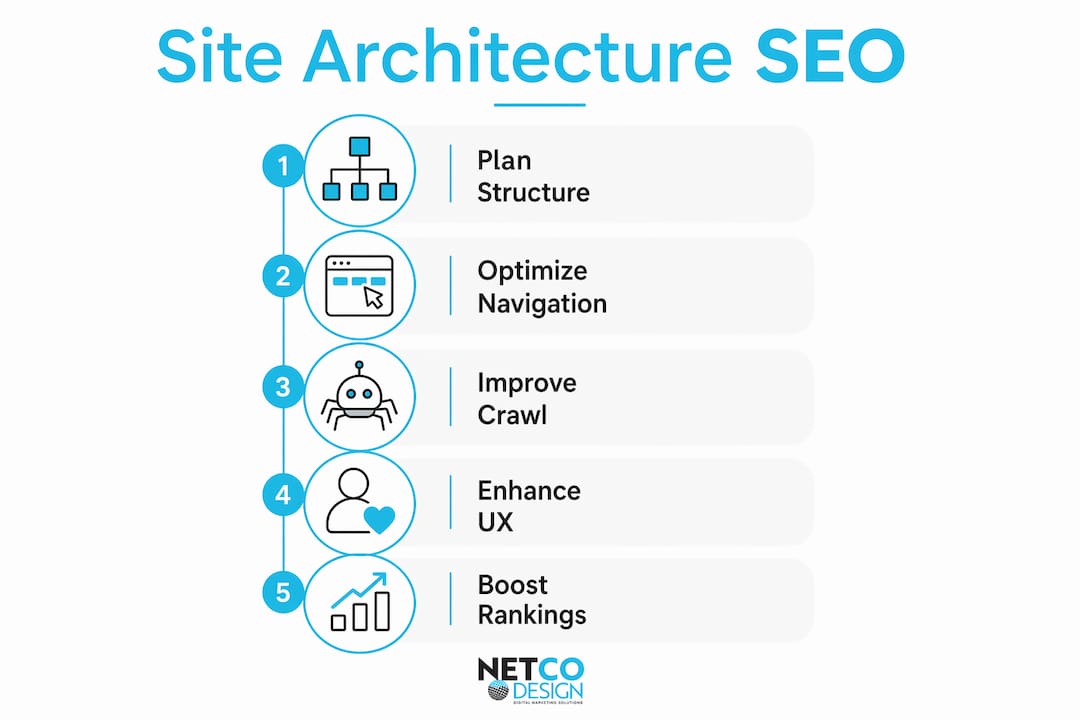
On the shopper side, 62% of online shoppers expect to find products within three clicks. When they cannot, bounce rates climb and pogo-sticking signals to Google that your page did not satisfy the query. The Baymard Institute 2025 research tied to this finding also shows that well-organized sites produce 2.5x higher conversion rates. That is not a marginal gain. It is the difference between a store that grows and one that stagnates.
On the crawler side, Google allocates a crawl budget to every site. Large stores with thousands of product pages can exhaust that budget on low-value URLs before bots ever reach important category pages. The steps below show how architecture shapes crawl behavior:
- Shallow hierarchy. Flat structures put more pages within two or three hops of the homepage, so crawlers reach them on every visit.
- Breadcrumb navigation. Breadcrumbs create secondary internal link paths that reinforce hierarchy and help bots confirm page relationships.
- Faceted navigation control. Filters for size, color, and price generate thousands of URL combinations. Without canonical tags or noindex directives, faceted navigation creates duplicate content and crawl budget waste at scale.
- XML sitemaps. A clean sitemap submitted to Google Search Console tells crawlers exactly which URLs matter, cutting wasted crawl time.
- Internal link authority flow. Pages with many internal links pointing to them receive more crawl attention and stronger ranking signals.
Pro Tip: Run a crawl simulation with a tool like Screaming Frog or Sitebulb before launching any major category restructure. Identify orphaned pages and pages buried beyond four clicks. Fix those first.
Bounce rate and crawl efficiency are not separate problems. They share the same root cause: a structure that does not match how people and bots think about your products.
What are best practices for designing e-commerce site architecture to boost SEO?
The best e-commerce site structures are flat, logical, and built around how buyers think rather than how your warehouse is organized. Apply these practices to close the gap between your current structure and one that performs.
- Keep click depth at three or fewer. Every product page should be reachable from the homepage in three clicks. This is the single most impactful structural change most stores can make, supported by the 47% ranking advantage flat architectures hold over deep ones.
- Build content silos. Group related categories, subcategories, and blog content under a single topical umbrella. Silos concentrate relevance signals and prevent keyword cannibalization across similar pages.
- Use editorial content as a link engine. Hub pages and buying guides that link to product and category pages improve authority flow and capture early-stage buyer queries that product pages alone cannot rank for.
- Apply canonicalization to variants and paginated pages. Product variants like size and color should point canonical tags to the primary product URL. Canonicalization strategies consolidate link equity and prevent crawl budget dilution.
- Implement breadcrumb schema markup. Breadcrumbs with structured data appear in Google search results as navigational paths, improving click-through rates and reinforcing your site hierarchy to crawlers.
- Design mobile architecture first. Mobile-first indexing means Google evaluates your mobile structure as the primary version. Broken or overly complex mobile menus directly harm rankings. Netco Design builds every e-commerce site mobile-first for this reason.
- Audit with real users and crawl tools periodically. Architecture drifts over time as new categories and products are added. Schedule quarterly crawls and user testing sessions to catch structural problems before they compound.
Pro Tip: Check your e-commerce site structure against a three-click rule monthly. Add a new category? Trace the path from homepage to the deepest product in that category and count the clicks.
The most overlooked practice is treating internal linking as a deliberate strategy rather than an afterthought. Internal linking is the primary mechanism for directing PageRank toward high-margin products and key category pages. Every editorial article you publish is an opportunity to send authority exactly where your business needs it most.
How does AI-driven search change e-commerce site architecture?
AI shopping assistants are changing where buyers enter your site. Instead of landing on your homepage and navigating down, AI-referred visitors arrive deep in your structure, often at a product or subcategory page they found through a conversational query. Your architecture must support that entry point without leaving those visitors stranded.
The shift demands what researchers call empathy-based architecture. This means organizing your site around buyer problems rather than product catalog logic. A store that sells outdoor gear should not just mirror its inventory system. It should group pages around problems like “staying warm on winter hikes” and link those hub pages to relevant products, reviews, and guides.
Key structural responses to AI-driven discovery include:
- Hub-and-spoke content models. A central hub page covers a broad topic and links to spoke pages covering specific subtopics and products. This structure improves authority flow and gives AI assistants clear topical clusters to reference.
- Internal search data analysis. Your site’s own search bar reveals what shoppers cannot find through navigation. Zero-result queries expose missing content hubs and category gaps that hurt both SEO and conversion.
- Intent-aligned URL structures. URLs that reflect buyer intent rather than SKU numbers rank better in both traditional and AI-assisted search.
- Avoiding overlapping intent. Two category pages targeting the same buyer problem create algorithmic confusion. Audit for intent overlap and consolidate or differentiate pages before they cannibalize each other.
Buyer-focused architecture consistently outperforms warehouse-logic structures in both usability scores and ranking relevance. The stores winning in AI-assisted search are the ones that built their navigation around customer questions, not product codes.
Key takeaways
A flat, buyer-focused e-commerce site structure is the single most reliable way to improve both search rankings and conversion rates simultaneously.
- Point | Details
- Flatten your architecture | Keep every product page within three clicks of the homepage to gain a measurable ranking advantage.
- Control faceted navigation | Apply canonical tags and noindex directives to filter URLs to prevent crawl budget waste and duplicate content.
- Use internal links deliberately | Direct PageRank toward high-margin products and key categories through contextual links in editorial content.
- Design mobile-first | Google indexes your mobile structure first, so broken mobile navigation directly harms your rankings.
- Audit with real data | Use internal search queries and crawl tools to find structural gaps before they limit organic growth.
Architecture is the foundation most stores build last
I have worked with e-commerce businesses that spent heavily on paid search and content marketing while their site architecture quietly undermined every effort. Rankings plateaued. Crawl reports showed thousands of duplicate URLs from unmanaged facets. Category pages sat five clicks deep and never ranked for anything. The content team was producing great articles that linked nowhere useful.
The uncomfortable truth is that site architecture is a cross-functional project. Marketing, UX, and development all have to agree on the structure before anyone writes a word or builds a page. When those teams work in silos, you get technical debt that takes years to unwind. I have seen a single architecture audit and restructure produce more organic traffic growth than six months of content production, because the structure finally let Google see what the store was actually about.
Small improvements compound fast. Flattening one deep category, adding breadcrumb schema, and building three hub pages with strong internal links can shift rankings within a few months. You do not need a full site rebuild. You need a clear map of where your structure breaks down and a prioritized plan to fix it. Start with your highest-revenue categories and work outward. Iterate based on crawl data and real user behavior, not assumptions.
— Lori Piencykoski
How Netco Design builds e-commerce sites that rank and convert
Netco Design works with e-commerce businesses to align technical SEO and site design from the ground up. The team conducts custom architecture audits that identify crawl budget waste, deep click paths, and internal linking gaps that hold back organic rankings.

Every site Netco Design builds follows a mobile-first structure with clean URL hierarchies, breadcrumb schema, and deliberate internal link strategies. The result is a store that Google can index efficiently and shoppers can navigate without friction. For business owners ready to connect architecture decisions to real revenue outcomes, the SEO trends guide for 2025 and the e-commerce SEO best practices resource on the Netco Design site are strong next steps.
FAQ
What is e-commerce site architecture?
E-commerce site architecture is the system of categories, URLs, and internal links that organizes all pages on an online store. It determines how search engines crawl the site and how shoppers navigate from the homepage to a product.
How does site architecture affect SEO rankings?
Flat architectures that place product pages within 2.5 clicks of the homepage rank 47% higher than deep structures, because search engines crawl and index shallow pages more efficiently.
What is the three-click rule for e-commerce?
The three-click rule states that any product should be reachable from the homepage in three clicks or fewer. Research shows 62% of shoppers expect this, and failing to meet it raises bounce rates and lowers conversions.
How do you handle faceted navigation for SEO?
Apply canonical tags to filter-generated URLs and use noindex directives on low-value combinations. This prevents duplicate URL bloat and preserves crawl budget for pages that actually rank.
How does mobile-first indexing affect site structure?
Google uses your mobile site as the primary version for indexing and ranking. Complicated or broken mobile menus directly harm rankings, so mobile architecture must be as flat and functional as the desktop version.

