

table of contents
In a crowded marketplace, a strong online presence is non-negotiable for growth. Yet, for small businesses, navigating the complex world of digital marketing often feels like an impossible task. With limited resources, every decision and every dollar must count, making it critical to focus on what truly drives results. The challenge isn’t a lack of options, it’s knowing which small business online marketing strategies to prioritize for maximum impact.
This guide eliminates the guesswork. We have compiled a comprehensive playbook featuring 10 essential and actionable online marketing strategies tailored specifically for small and mid-sized businesses. Think of this not as a theoretical overview, but as a practical, step-by-step manual designed to help you attract more customers and increase revenue. We will move beyond generic advice and provide clear, concise instructions for each tactic.
Inside, you will find a detailed breakdown of each strategy, including:
- When to Use It: Pinpoint the ideal scenarios for deploying each tactic.
- Estimated Budgets: Understand the potential financial investment required.
- Key Metrics to Track: Learn how to measure success and justify your marketing spend.
- Quick Implementation Steps: Get started immediately with straightforward, actionable guidance.
From dominating local search results with Local SEO and Google Business Profile management to converting visitors with a high-performance website and targeted paid search campaigns, this article provides the strategic clarity you need. Whether you’re a local service provider in Tampa Bay, a growing e-commerce brand, or an ambitious startup, these proven methods will help you build a robust growth engine for 2026 and beyond.
1. Local SEO Optimization
Local SEO (Search Engine Optimization) is the process of enhancing your online visibility to attract more customers from relevant local searches. This is one of the most powerful small business online marketing strategies for businesses with physical locations or those that serve a specific geographic area, like a dental practice or a home services contractor. When a potential customer searches “plumber near me,” local SEO determines which businesses appear in the coveted Google “Map Pack” and localized organic results.
This strategy works by sending signals to search engines that your business is a legitimate, authoritative entity serving a particular community. It involves meticulously optimizing your online presence, starting with your Google Business Profile (GBP) and extending to consistent business information across the web.
When to Use This Strategy
Local SEO is non-negotiable for any business that relies on local customers. This includes brick-and-mortar stores, restaurants, professional services like law firms and medical clinics, and service-area businesses such as plumbers, electricians, and landscapers. If your target customer is physically located within your city or a specific service radius, this should be your foundational marketing effort.
Key Insight: A well-optimized Google Business Profile is often the first interaction a local customer has with your brand. It functions as a digital storefront, providing hours, services, reviews, and directions all before they even visit your website.
Quick Implementation Steps
- Claim & Optimize Your Google Business Profile: This is your top priority. Fill out every single section completely, including services, products, business hours, photos, and Q&As. Use Google Posts to share updates and offers.
- Ensure NAP Consistency: Your business Name, Address, and Phone number (NAP) must be identical across all online directories and citations (Yelp, BBB, industry-specific sites). Inconsistencies confuse search engines and hurt your rankings.
- Generate Local Reviews: Actively encourage satisfied customers to leave reviews on your GBP and other relevant platforms. Respond professionally to all reviews, both positive and negative, to show you are engaged.
- Build Local Backlinks: Earn links from other local websites, such as community blogs, local event sponsorships, or the Chamber of Commerce. These act as powerful local endorsements.
2. Content Marketing and SEO Strategy
Content marketing is the practice of creating and distributing valuable, relevant, and consistent content to attract and retain a specific audience. When integrated with SEO, it becomes one of the most effective small business online marketing strategies for building long-term authority and driving organic traffic. Instead of directly pitching your products or services, you provide genuinely useful content like blog posts, guides, and videos that solve your audience’s problems.

This strategy works by aligning your content with what potential customers are searching for on Google. By answering their questions and addressing their pain points, you not only rank higher in search results but also establish trust and position your brand as an industry expert. This approach nurtures leads through the entire buying journey, from initial awareness to the final purchase decision.
When to Use This Strategy
Content marketing is ideal for businesses with a longer sales cycle, those in competitive industries, or any brand wanting to build lasting authority. It is essential for professional services (lawyers, consultants), B2B companies, and e-commerce brands that can use buying guides and comparison articles to influence purchasing decisions. If your goal is to generate organic leads and become a go-to resource in your niche, this strategy is a cornerstone of your marketing efforts.
Key Insight: Great content serves two masters: the user and the search engine. It must provide real value and answer a user’s query comprehensively while also being structured and optimized to rank in search results, creating a powerful engine for organic growth.
Quick Implementation Steps
- Conduct Keyword Research: Use tools like Ahrefs or SEMrush to find the specific questions and terms your target audience is searching for. Focus on topics with clear user intent, whether informational (“how to…”) or commercial (“best…”).
- Create Pillar and Cluster Content: Develop a “pillar page” on a broad core topic and create multiple “cluster” articles on related sub-topics that link back to the main pillar. This structure signals topical authority to search engines.
- Optimize Every Piece of Content: Write for people first, but ensure your content includes a primary keyword, related secondary keywords, and answers user questions directly. Use clear headings, short paragraphs, and compelling meta descriptions. Staying organized is key; learn how to create a content calendar on netcodesign.com.
- Promote and Repurpose Content: Don’t just publish and forget. Share your content across social media, in email newsletters, and with industry partners. Repurpose a successful blog post into a video, an infographic, or a series of social media updates to maximize its reach.
3. Pay-Per-Click (PPC) Advertising
Pay-Per-Click (PPC) advertising is a model where businesses pay a fee each time one of their ads is clicked. Instead of trying to “earn” visits organically, you can buy visits to your website, making it one of the most immediate small business online marketing strategies. Platforms like Google Ads allow you to place ads at the top of search results for specific keywords, targeting customers at the exact moment they are looking for your products or services.
This strategy works by bidding on keywords relevant to your business, such as “emergency plumber near me” or “women’s running shoes.” When a user’s search query matches your keywords, your ad is eligible to appear. A well-crafted PPC campaign drives highly qualified traffic, as you are reaching users with clear commercial intent.
When to Use This Strategy
PPC is ideal for businesses that need immediate traffic and leads, want to promote a time-sensitive offer, or operate in a highly competitive market where organic rankings are difficult to achieve quickly. It’s perfect for e-commerce stores launching new products, service businesses needing to fill their appointment books, or any company that wants to test marketing messages and landing page effectiveness with real-time data.
Key Insight: PPC offers unparalleled control and speed. You can turn a campaign on or off in minutes, adjust budgets daily, and get immediate feedback on what messaging resonates with your target audience, providing valuable data for all your marketing efforts.
Quick Implementation Steps
- Start with High-Intent Keywords: Focus on “commercial intent” keywords that signal a user is ready to buy (e.g., “buy,” “quote,” “for sale”). For specific guidance on leveraging PPC, especially for smaller scale operations, delve into Pay-Per-Click strategies tailored for small businesses.
- Create Tightly-Knit Ad Groups: Organize your campaigns into focused ad groups, with each group containing a small set of closely related keywords (5-20) and highly relevant ad copy.
- Write Compelling Ad Copy: Your ad must stand out. Highlight your unique selling proposition (USP), include a strong call-to-action (CTA) like “Get a Free Quote Today,” and use ad extensions to add more information.
- Optimize Your Landing Pages: Send traffic to a dedicated landing page that matches the ad’s promise and is designed for one purpose: conversion. The page should be fast, mobile-friendly, and have a clear CTA.
4. Email Marketing and Automation
Email marketing is the strategic practice of sending targeted messages to a list of subscribers to nurture relationships, promote products, and drive conversions. It has evolved far beyond simple newsletters, now incorporating powerful automation that sends triggered messages based on user behavior. This makes it one of the most effective small business online marketing strategies, consistently delivering one of the highest returns on investment in digital marketing.
This strategy works by building a direct communication channel with an audience that has explicitly opted in to hear from you. By segmenting your audience and automating follow-ups, you can deliver highly relevant content at the perfect moment, such as an abandoned cart reminder for an e-commerce store or an educational sequence for a new B2B lead.
When to Use This Strategy
Email marketing is a vital tool for nearly every business model. It is essential for e-commerce brands looking to recover sales and drive repeat purchases, SaaS companies aiming to improve user onboarding and reduce churn, and professional services firms that need to nurture leads over a longer sales cycle. If your goal is to build long-term customer relationships and increase lifetime value, email automation is indispensable.
Key Insight: Unlike social media, you own your email list. It’s a stable, direct-line asset that isn’t subject to algorithm changes, giving you reliable access to your most engaged audience members.
Quick Implementation Steps
- Build Your Email List: Start by adding clear, friction-free signup forms to your website. Offer a valuable incentive, or lead magnet, like a discount or an informative guide, to encourage subscriptions. Learn more about effective techniques for how to build an email list.
- Create a Welcome Sequence: Automate a series of 3-5 emails for every new subscriber. This is your best opportunity to introduce your brand, set expectations, and drive an initial action while engagement is at its peak.
- Segment Your Audience: Group subscribers based on their interests, purchase history, or how they joined your list. This allows you to send more personalized and relevant content, which dramatically boosts open and click-through rates.
- Balance Value and Promotion: Don’t just sell. Send regular, valuable content like tips, industry news, or helpful resources to keep your audience engaged and build trust, making them more receptive to occasional promotional offers.
5. Social Media Marketing
Social media marketing is the practice of creating and sharing content on social media platforms to build brand awareness, engage with an audience, and drive business goals like website traffic and sales. For small businesses, it offers a direct line of communication with customers and a powerful way to build a loyal community around a brand. It encompasses both organic (unpaid) efforts to build an audience and paid advertising to reach highly specific demographics and interest groups.
This strategy works by establishing a relatable brand personality and consistently providing value to your followers. A home services contractor can showcase impressive before-and-after project photos on Instagram, while a local law firm might use LinkedIn to share articles on legal updates, establishing thought leadership. The goal is to become a trusted resource and stay top-of-mind.

When to Use This Strategy
Social media marketing is valuable for nearly every business, but it’s essential for those targeting specific consumer demographics or building a strong brand identity. E-commerce stores, restaurants, B2C service providers, and creative professionals can use platforms like Instagram and Facebook to visually showcase products and build community. B2B companies and professional services can leverage LinkedIn to connect with industry leaders and generate qualified leads.
Key Insight: Don’t try to be on every platform. Focus on mastering the one or two channels where your target audience spends the most time. A consistent presence on one platform is far more effective than a sporadic presence on five.
Quick Implementation Steps
- Choose the Right Platforms: Identify where your ideal customers are. A local boutique will thrive on Instagram and Facebook, while a B2B software company should focus on LinkedIn and Twitter.
- Develop a Simple Content Calendar: Plan your posts for a week or a month in advance. A consistent schedule of even 2-3 high-quality posts per week builds momentum and keeps your audience engaged.
- Engage Authentically: Social media is a two-way street. Respond to comments and messages promptly, ask questions, and share user-generated content to make your followers feel valued and heard.
- Test Paid Social Ads: Start with a small budget (e.g., $5-$10 per day) to run targeted ads on platforms like Facebook or Instagram. This is one of the quickest small business online marketing strategies to test offers and reach new, relevant audiences.
6. Conversion Rate Optimization (CRO)
Conversion Rate Optimization (CRO) is the systematic process of improving your website to increase the percentage of visitors who complete a desired action. This action, or “conversion,” could be anything from making a purchase and filling out a contact form to subscribing to a newsletter. Rather than focusing on attracting more traffic, CRO is about getting more value from the traffic you already have, making it one of the highest-impact small business online marketing strategies available.
This strategy works by using data, user feedback, and A/B testing to identify and remove friction points in the customer journey. For example, an e-commerce store might test different checkout processes to reduce cart abandonment, while a local home services business could simplify its “Request a Quote” form to generate more leads. Small tweaks can yield significant increases in revenue and leads without a single dollar of additional ad spend.
When to Use This Strategy
CRO is essential once you have a consistent stream of traffic to your website. If you are already investing in SEO, paid ads, or social media marketing, CRO is the next logical step to maximize your return on investment. It’s particularly crucial for businesses with clear conversion goals, such as e-commerce stores, SaaS companies, and lead-generation websites for professional services like law firms or contractors.
Key Insight: CRO isn’t about guesswork or blindly copying competitors. It’s a data-driven science that uses real user behavior to make informed improvements, turning your website into a more efficient and profitable sales tool.
Quick Implementation Steps
- Analyze User Behavior: Use tools like Google Analytics to find high-traffic pages with high bounce rates. Install heat mapping and session recording software (like Hotjar or Microsoft Clarity) to see exactly how users interact with your pages.
- Identify Friction Points: Are users dropping off at a specific form field? Is your main call-to-action button not visible on mobile devices? Use the data you gathered to create a prioritized list of potential improvements.
- Run A/B Tests: Test one change at a time to measure its impact accurately. You can test headlines, button colors, form lengths, images, or page layouts. Start with changes that require low effort but have a high potential impact.
- Add Trust Signals: Reinforce credibility by prominently displaying customer testimonials, security badges (for e-commerce), industry awards, and money-back guarantees. Social proof builds confidence and reduces hesitation.
7. Google Business Profile and Review Management
Google Business Profile (GBP) is a free, dynamic tool that allows you to manage how your business appears on Google Search and Maps. Paired with active review management, it becomes one of the most impactful small business online marketing strategies available, directly influencing customer trust and local search rankings. This combination serves as your digital welcome mat, where potential customers form their first impressions.
This strategy works by leveraging social proof and providing essential information at the moment of search. A complete, active GBP with a steady stream of positive reviews signals to Google that your business is legitimate, relevant, and valued by the community. Since a high percentage of consumers trust online reviews as much as personal recommendations, managing this perception is critical for converting searchers into customers.
When to Use This Strategy
This strategy is absolutely essential for any business with a physical location or a defined service area. This includes restaurants, retail stores, home services contractors, medical practices, law firms, and any other business that relies on local clientele. If a potential customer is likely to search for your type of business with a “near me” or “in [city name]” qualifier, a robust GBP and review management plan is non-negotiable.
Key Insight: Responding to all reviews, especially negative ones, is a powerful marketing tool. A thoughtful response to a bad review can resolve a customer issue publicly and demonstrates to potential new customers that you are an engaged, professional, and accountable business.
Quick Implementation Steps
- Claim and Fully Optimize Your Profile: Fill out every single section of your Google Business Profile. This includes services, products, accessibility information, hours, photos, and a detailed business description.
- Implement a Review Generation System: Create a simple, systematic process to ask every satisfied customer for a review. This can be done via email, text message, or even a simple QR code on a receipt or business card.
- Add High-Quality Media Frequently: Regularly upload new, high-resolution photos and videos of your location, team, products, and completed work. This keeps your profile fresh and engaging.
- Utilize Google Posts: Share weekly updates, offers, events, and announcements using the Google Posts feature. These posts appear directly in your profile and can drive immediate action.
8. Video Marketing and YouTube
Video marketing is the strategy of creating and sharing video content to engage audiences, demonstrate value, and drive customer action. As one of the most dynamic small business online marketing strategies, it leverages platforms like YouTube, social media, and your own website to tell your brand’s story. With YouTube being the second-largest search engine in the world, having a presence there is critical for discovery and building authority.
This strategy works because video is inherently more engaging than static text or images. It allows you to showcase products, explain complex services, and build a personal connection with viewers. A home services contractor can share a dramatic before-and-after project video, while a dental practice can create educational content to ease patient anxiety, making their services more approachable and trustworthy.
When to Use This Strategy
Video marketing is highly effective for businesses whose products or services benefit from visual demonstration or explanation. It’s ideal for e-commerce brands showcasing product features, software companies creating tutorials, professional services answering frequently asked questions, and any local business wanting to build community trust with customer testimonials. If you want to increase engagement and explain your value proposition quickly, video is the perfect medium.
Key Insight: YouTube is not just a video platform; it’s a search engine. Optimizing your videos with relevant keywords, compelling titles, and detailed descriptions allows you to capture an audience actively searching for solutions you provide.
Quick Implementation Steps
- Optimize Your YouTube Channel: Create a professional-looking channel with a branded banner, logo, and a keyword-rich “About” section that clearly explains what your business does.
- Create Compelling Thumbnails: Design high-contrast custom thumbnails with clear text overlays and expressive faces. This is the single most important factor for improving click-through rates in search results.
- Write SEO-Driven Titles and Descriptions: Place your primary keyword at the beginning of your video title (under 60 characters). Write detailed descriptions that include keywords, relevant links, and a clear call-to-action.
- Repurpose Long-Form Content: Maximize your video content’s impact by learning how to create YouTube Shorts from existing video, a crucial strategy for reaching new audiences on the platform.
- Engage with Your Community: Respond to comments and questions on your videos. This engagement sends positive signals to the YouTube algorithm and builds a loyal following.
9. Paid Search (Google Ads) and Retargeting
Paid search advertising, primarily through platforms like Google Ads, allows you to place your business directly in front of customers at the exact moment they are searching for your products or services. This strategy involves bidding on specific keywords, and when a user’s search query matches, your ad can appear at the top of the search results page, offering immediate visibility that organic SEO takes months or years to build.
This approach is powerful because it’s based on user intent. Combined with retargeting, which shows targeted ads to people who have already visited your website, it becomes one of the most effective small business online marketing strategies for driving conversions. Retargeting keeps your brand top-of-mind, reminding warm leads of your value proposition and encouraging them to return and complete a purchase or inquiry.
When to Use This Strategy
Paid search is ideal for businesses that need to generate leads or sales quickly and have a clear understanding of their customer acquisition cost. It works exceptionally well for high-intent queries, such as a home services contractor bidding on “emergency plumber near me” or an e-commerce store targeting searches for a specific product model. Retargeting is a must-have for any business with significant website traffic, especially those with longer sales cycles or high cart abandonment rates.
Key Insight: Paid search buys you immediate visibility based on intent, while retargeting nurtures existing interest. Using them together creates a powerful system that captures new leads and converts prospects who are already familiar with your brand, dramatically improving your ROI.
Quick Implementation Steps
- Start with High-Intent Keywords: Focus your initial budget on keywords that signal a strong intent to buy, like “buy,” “quote,” “service,” or specific product names. These terms convert at a higher rate.
- Create Tightly Themed Ad Groups: Organize your campaigns into small, highly relevant ad groups. Each group should contain a handful of closely related keywords, allowing you to write specific, compelling ad copy that speaks directly to the search query.
- Implement Conversion-Optimized Landing Pages: Don’t send paid traffic to your homepage. Create dedicated landing pages that align with your ad copy and have a single, clear call-to-action (CTA) to maximize conversions.
- Set Up Retargeting Audiences: Install the necessary tracking pixels (like the Google Ads tag) on your website. Create segmented audiences based on user behavior, such as “all website visitors,” “abandoned cart users,” or “viewed specific service page.”
10. Web Design for Conversion and User Experience
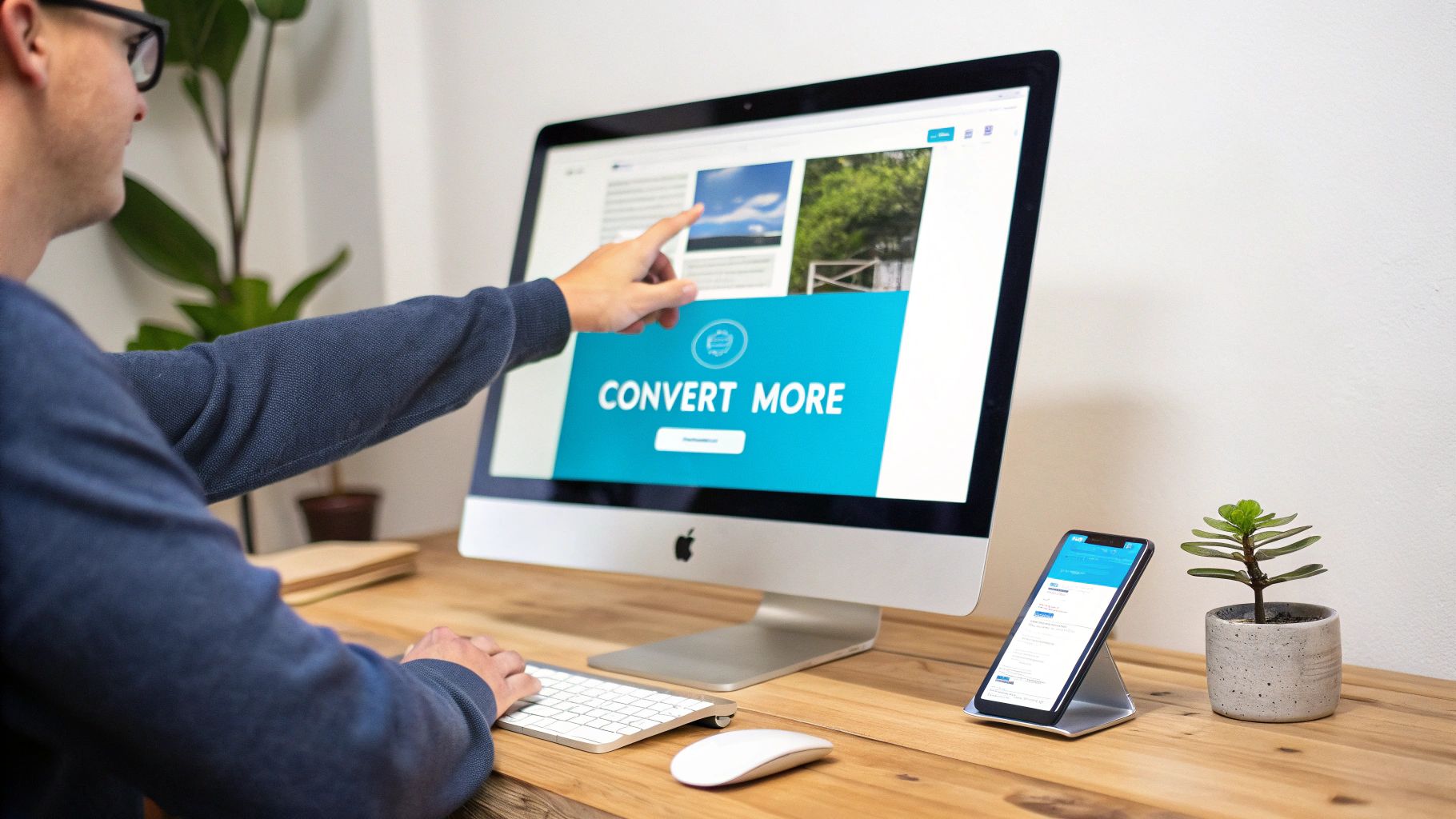
Web design focused on conversion and user experience (UX) is the art of creating a website that is not just visually appealing, but strategically engineered to guide visitors toward taking a specific, desired action. This approach goes beyond aesthetics to focus on site speed, mobile responsiveness, intuitive navigation, and clear calls-to-action (CTAs). It’s one of the most fundamental small business online marketing strategies because your website is often the final destination for all other marketing efforts.
This strategy works by removing friction from the customer journey. For example, a home services website might prioritize a click-to-call button on mobile, while an e-commerce site would streamline its checkout process. The goal is to make it as easy as possible for a visitor to become a lead or a customer.
When to Use This Strategy
A conversion-focused website is essential for every business with an online presence. It is especially critical when you are actively driving traffic to your site through paid ads, SEO, or social media. If your website fails to convert the traffic you’re paying for, your entire marketing budget is wasted. This is a foundational element that should be established before scaling other campaigns.
Key Insight: Your website is not just a digital brochure; it’s your 24/7 salesperson. If it’s slow, confusing, or untrustworthy, it will fail to close deals, no matter how much traffic you send its way.
Quick Implementation Steps
- Prioritize Mobile-First Design: A significant portion of your traffic will come from mobile devices. Design for the smallest screen first to ensure the core experience is seamless, then adapt for larger screens.
- Optimize for Speed: Compress images, use modern formats like WebP, and leverage browser caching. A site that loads in under 3 seconds drastically reduces bounce rates and improves conversion.
- Simplify Navigation & CTAs: Ensure your main value proposition and primary CTA are “above the fold” (visible without scrolling). Keep your main menu simple and make it easy for users to find what they need in as few clicks as possible.
- Build Trust and Credibility: Implement an SSL certificate (HTTPS), display trust badges, showcase customer testimonials, and make your privacy policy easily accessible. This reassures visitors that their information is safe. Explore these and other homepage design best practices on netcodesign.com to further enhance your site’s effectiveness.
Integrating Your Strategies for Maximum Impact
Navigating the world of digital marketing can feel like trying to solve a complex puzzle with constantly changing pieces. You’ve just explored a comprehensive toolkit of powerful small business online marketing strategies, from the foundational necessity of Local SEO and a conversion-focused website to the growth-accelerating power of paid advertising and email automation. Each strategy presented, whether it’s managing your Google Business Profile or launching a targeted video campaign, is a potent tool in its own right. However, the true secret to unlocking exponential growth lies not in mastering a single tactic, but in understanding how they interconnect and amplify one another.
Think of your marketing efforts as an integrated ecosystem rather than a checklist of isolated tasks. Your high-converting web design (Strategy #10) is the central hub, but it generates minimal results without a steady stream of qualified traffic. This is where a robust SEO and content marketing plan (Strategy #2) and precisely targeted PPC campaigns (Strategy #9) become critical. They work in tandem to drive visitors to your site, one organically over time and the other with immediate, paid precision.
From Silos to Synergy: Creating a Compounding Effect
The most successful businesses break down the walls between their marketing channels. A lead captured through a Google Ad is not just a one-time win; it’s an opportunity. That lead should immediately enter an automated email sequence (Strategy #4) that nurtures them with valuable content, builds trust, and guides them toward a purchase. The compelling video content you create for YouTube (Strategy #8) can be repurposed into engaging clips for your social media channels (Strategy #5), driving brand awareness and website traffic from multiple angles.
This synergy creates a powerful compounding effect. For example:
- SEO + CRO: Your SEO efforts bring in organic traffic, but your Conversion Rate Optimization (Strategy #6) ensures that a higher percentage of those visitors take action, effectively multiplying the ROI of your content creation.
- PPC + Review Management: Your paid search ads draw in potential customers who are ready to buy, but your stellar online reputation (Strategy #7) provides the social proof they need to choose you over a competitor. Positive reviews can even increase your ad’s click-through rate.
- Social Media + Email Marketing: You can use targeted social media ads to grow your email list, then use email marketing to build a deeper relationship with that audience, turning casual followers into loyal customers and brand advocates.
Your Actionable Path Forward
The sheer number of available small business online marketing strategies can be overwhelming, but you don’t need to implement everything at once. The key is to start strategically. Begin by identifying the one or two channels that offer the most direct path to your ideal customer. For a local service business, that might be Local SEO and Google Business Profile management. For an e-commerce brand, it might be conversion-focused web design paired with targeted social media ads.
Once you have established a foothold and are generating consistent results from your initial channels, you can begin to layer on complementary strategies. Master one, then add another. The goal is to build a sustainable, data-driven marketing engine that fuels predictable growth for your business. By focusing on integration, consistently executing your plan, and adapting to the ever-changing digital landscape, you will move beyond simply being present online and start actively dominating your market. This integrated approach is what separates fleeting success from long-term, sustainable profitability.
Feeling overwhelmed by the options or unsure where to start? Building a cohesive, revenue-focused digital marketing plan takes expertise and time you may not have. The team at Netco Design LLC specializes in designing and executing integrated small business online marketing strategies that deliver measurable results. Let us build your marketing engine so you can focus on running your business by visiting us at Netco Design LLC.

