

table of contents
In today’s competitive marketplace, online visibility is everything. For small businesses, appearing on the first page of Google isn’t just a vanity metric; it’s a direct line to pre-qualified customers actively searching for your products and services. With countless factors influencing search rankings, the path to the top can seem daunting. It’s easy to feel overwhelmed, but a strategic, step-by-step approach can transform your online presence from invisible to invaluable.
This definitive small business SEO checklist is engineered to cut through the complexity. We’ve distilled the most impactful actions into ten prioritized, manageable steps that address every critical aspect of search engine optimization. From foundational keyword research and technical health to advanced authority-building and local SEO dominance, each point on this list is a crucial lever for sustainable growth.
Think of this article as your comprehensive roadmap. It provides the what, the why, and the how for each essential task. Whether you’re launching a new website in Tampa Bay or aiming to boost lead generation across the country, following this checklist will help you build a powerful SEO foundation. To truly begin your SEO journey, it’s helpful to explore resources that are focused on demystifying Search Engine Optimization (SEO) for marketing agencies, providing a foundational understanding. This guide will equip you with the actionable insights needed to not just compete, but win in the search results. Let’s get started.
1. Keyword Research and Planning
Keyword research is the foundational first step of any successful small business SEO checklist. It is the process of discovering the specific words and phrases potential customers use when searching for your products or services on search engines like Google. This insight allows you to strategically target terms that attract qualified, high-intent traffic to your website. Instead of guessing what people are searching for, you use data to inform your entire content and optimization strategy, ensuring your efforts are focused and effective.
Why It Matters
Without proper keyword research, you risk creating content and optimizing pages that no one is looking for, wasting valuable time and resources. By identifying the right keywords, you align your business with user intent, attract relevant visitors more likely to convert, and gain a competitive edge by uncovering niche opportunities. For example, a local bakery targeting a broad term like “cakes” will face immense competition. Targeting a specific, long-tail keyword like “custom gluten-free birthday cakes in Tampa” attracts a much more qualified, local audience ready to buy.
How to Implement It
Your goal is to find the sweet spot: keywords with reasonable search volume, low competition, and high relevance to your offerings.
- Brainstorm Seed Keywords: Start with broad terms related to your business (e.g., “plumber,” “personal trainer,” “bakery”).
- Use SEO Tools: Input your seed keywords into tools like Google Keyword Planner, Ahrefs, or Semrush. Analyze the suggestions for search volume, keyword difficulty, and related queries. To deep-dive into this crucial step, read this comprehensive guide on conducting keyword research for SEO.
- Focus on Local and Long-Tail Keywords: Emphasize phrases that include local modifiers (“near me,” “in St. Petersburg”) and specific queries (“emergency roof repair for storm damage”). These often have lower competition and higher conversion rates.
- Analyze Competitors: See what keywords your top competitors are ranking for. This can reveal valuable opportunities you may have missed.
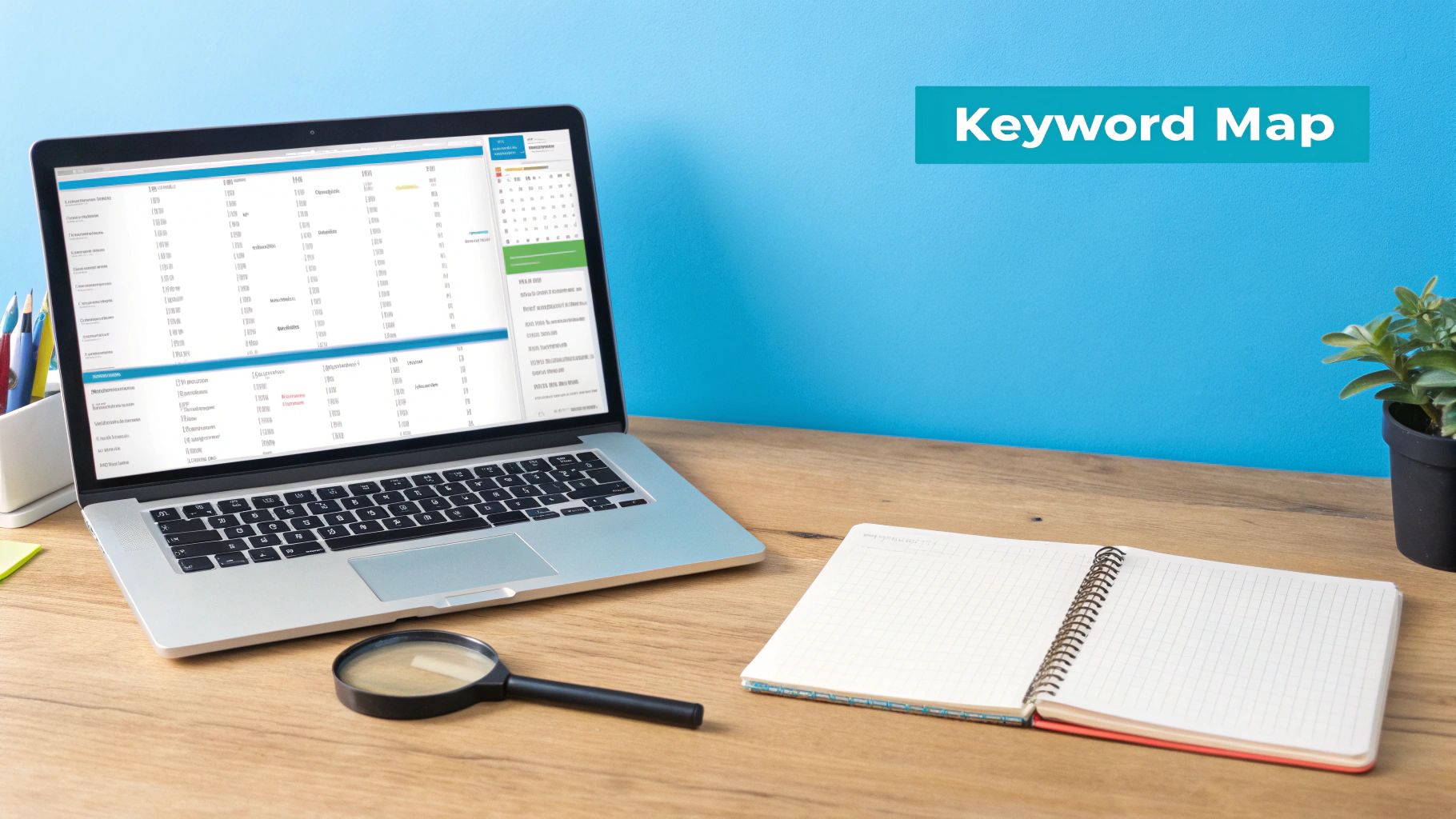
- Create a Keyword Map: Organize your findings in a spreadsheet. Map primary and secondary keywords to specific pages on your website to guide content creation and on-page optimization.
2. Optimize On-Page SEO Elements
On-page SEO is the practice of optimizing individual web pages to rank higher and earn more relevant traffic in search engines. This involves fine-tuning both the visible content and the underlying HTML source code of a page. By aligning elements like title tags, meta descriptions, headers, and body content with your target keywords, you send clear signals to search engines about your page’s topic, making it easier for them to understand and rank your content for relevant searches.
Why It Matters
Proper on-page optimization is crucial because it directly influences how both search engines and users perceive your website. Well-optimized pages are more likely to rank higher, attract more clicks from search results, and provide a better user experience. For a small business, this translates into more qualified leads and sales. For instance, a dental practice that changes a generic page title from “Our Services” to “Family Dentist in Austin, TX | Same-Day Appointments” immediately communicates its core service, location, and a key benefit, attracting a more targeted audience.
How to Implement It
Your goal is to make each page on your site a perfectly optimized resource for its target topic and keyword. This is a critical step in any effective small business SEO checklist.
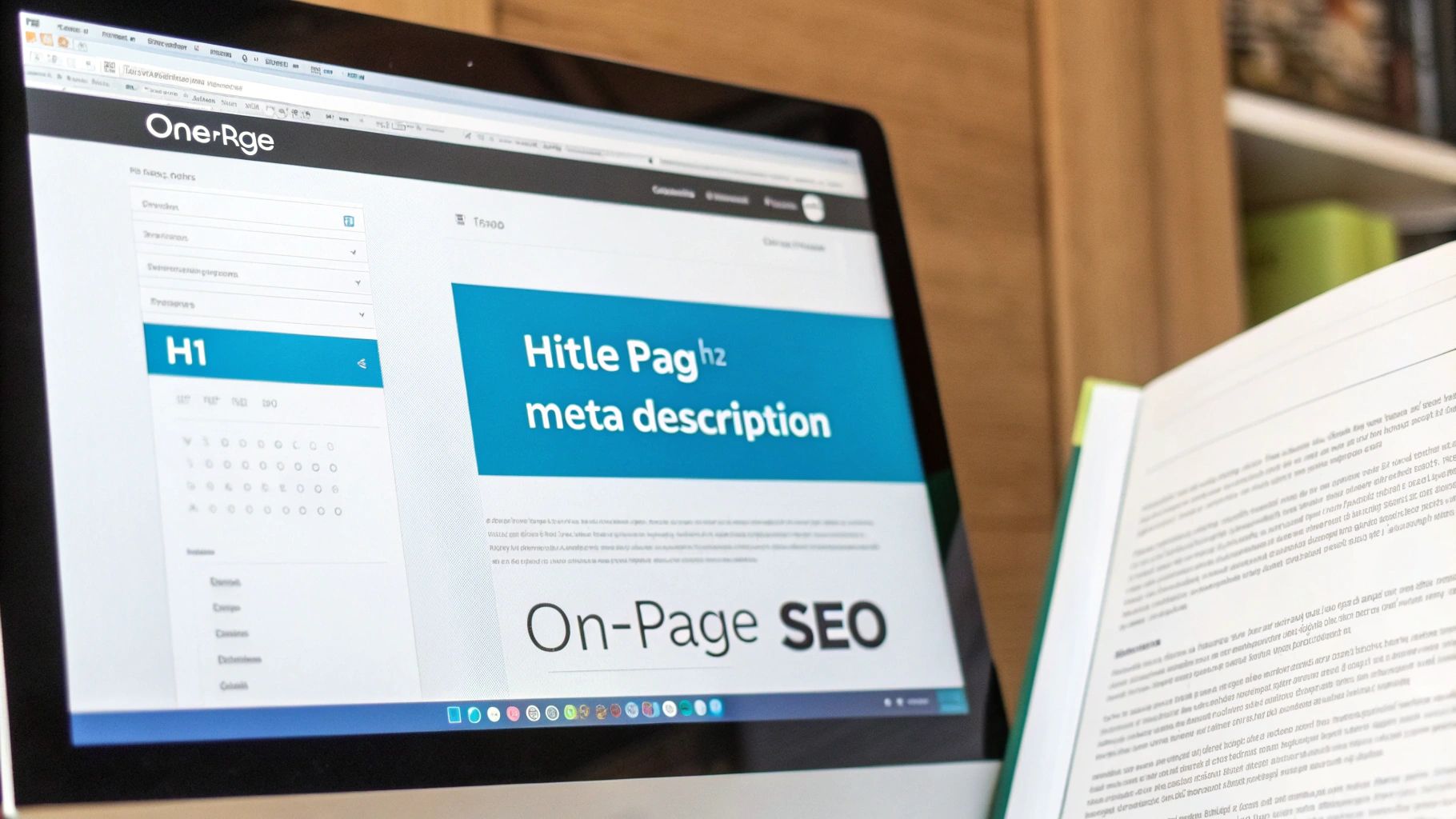
- Refine Title Tags and Meta Descriptions: Your title tag is a major ranking factor. Place your primary keyword near the beginning. Write a compelling meta description that acts like an ad, encouraging users to click. For example, use “Blue Ceramic Coffee Mugs Handmade | Free Shipping” instead of a generic “Coffee Mugs.”
- Structure Content with Headers: Use a single
<h1>tag for your main page title, which should include the primary keyword. Use<h2>and<h3>tags to break up content into logical, scannable sections for subtopics. - Optimize Your Content: Naturally weave your primary keyword into the first 100 words of your page content. Support your topic with secondary keywords and related terms throughout the text.
- Enhance Images with Alt Text: Add descriptive alt text to all images. This helps search engines understand the image content and improves accessibility for visually impaired users.
- Use Internal Linking: Link to 2-3 other relevant pages on your own website within your content. This helps distribute page authority and guides users to more useful information.
3. Create High-Quality, Keyword-Targeted Content
Once you’ve identified your target keywords, the next critical step in any small business SEO checklist is to create content that effectively uses them. This involves developing valuable, comprehensive, and engaging material that directly addresses what your potential customers are searching for. For a small business, this means moving beyond simple service descriptions to create blog posts, in-depth guides, and resource pages that answer questions, solve problems, and establish your authority.

Why It Matters
High-quality content is the engine of SEO. Search engines like Google prioritize showing users the most helpful and relevant results for their queries. By creating content that genuinely helps your audience, you signal to Google that your website is a valuable resource, which can lead to higher rankings, more organic traffic, and increased trust. For example, a home improvement contractor who creates a detailed blog post titled, “How to Prepare Your Home for Painting: A 10-Step Checklist” not only targets the keyword “home painting guide” but also demonstrates expertise, attracting qualified leads.
How to Implement It
Your objective is to produce content that is superior to what is currently ranking for your target keywords while seamlessly incorporating those terms.
- Analyze Search Intent: Before writing, search for your target keyword and analyze the top-ranking pages. Are they blog posts, product pages, or videos? This tells you what type of content Google believes users want to see.
- Aim for the “10% Better” Rule: Create content that is more comprehensive, better written, more up-to-date, or better designed than the current top results. Include unique data, statistics, or original insights.
- Address Related Questions: Use the “People Also Ask” section on Google’s search results page to find common follow-up questions. Answering these within your content makes it more thorough and useful.
- Optimize for Readability: Use short paragraphs, clear H3 headings, bullet points, and bold text to make your content easy to scan and digest.
- Update and Refresh: SEO is not a one-time task. Annually review and update your top-performing content with new information to keep it relevant and maintain its rankings.
4. Build and Earn Quality Backlinks
A crucial part of any small business SEO checklist involves acquiring high-quality backlinks, which are hyperlinks from other reputable websites pointing to your site. Think of these links as votes of confidence or endorsements from other established players in your industry. Google sees these “votes” and interprets your website as more credible and authoritative, which is a powerful ranking signal. The goal is to earn these links naturally through great content and strategically build them through outreach and relationship-building.
Why It Matters
Backlinks are a top-three Google ranking factor, making them essential for competing online. A website with a strong backlink profile from relevant, authoritative sources will almost always outrank a site with few or no quality links, even if their on-page SEO is similar. For a small business, this means earning a link from a respected local chamber of commerce or an industry-leading blog can significantly boost your visibility for target keywords, driving more referral traffic and increasing your domain authority over time.
How to Implement It
Building a strong backlink profile is a long-term strategy that combines creating valuable assets with proactive outreach. The focus should always be on quality and relevance over sheer quantity.
- Create Link-Worthy Content: Develop resources that others will want to link to. This includes original research, comprehensive guides, free tools, or unique industry data.
- Start with Low-Hanging Fruit: Begin by securing links from local business directories (like Yelp), industry associations you belong to, and partner or supplier websites. These are often the easiest to acquire.
- Analyze Competitor Backlinks: Use tools like Ahrefs or Semrush to see who is linking to your top competitors. This can reveal link-building opportunities you can pursue for your own business.
- Guest Post on Relevant Blogs: Offer to write an article for a respected blog in your niche. In return, you can include a contextual link back to a relevant page on your website within the content.
- Build Relationships: Connect with local journalists, bloggers, and industry influencers. Building genuine relationships can lead to natural press coverage and backlinks down the road.
5. Implement Local SEO Optimization
Local SEO is a specialized practice that focuses on optimizing your online presence to attract more business from relevant local searches. For small businesses that serve a specific geographic area, this isn’t just a part of a checklist; it’s a critical component for survival and growth. It involves a set of strategies designed to increase your visibility in local search engine results, such as Google’s “Local Pack” and on Google Maps, ensuring that nearby customers can find you the moment they need your products or services.
Why It Matters
If you’re a plumber, a dentist, or a restaurant, ranking for a national search term is far less valuable than appearing at the top when a potential customer searches “emergency plumber near me” or “best family dentist in [your city].” Local SEO directly connects your business with high-intent customers in your service area who are actively looking to make a purchase. Mastering it means you can dominate the local market, build community trust, and drive consistent foot traffic and phone calls without competing against national brands with massive budgets.
How to Implement It
The goal is to send strong signals to search engines that your business is a relevant, trusted, and prominent authority for a specific geographic location.
- Claim and Optimize Google Business Profile (GBP): This is your most powerful local SEO tool. Complete every single section: add high-quality photos and videos, list all services, write a detailed business description, and utilize features like Google Posts and Q&A.
- Ensure NAP Consistency: Your business Name, Address, and Phone number (NAP) must be identical across your website, GBP, and all online directories. Inconsistencies can confuse search engines and harm your rankings.
- Build Local Citations: Get your business listed in relevant local and industry-specific directories like Yelp, Apple Maps, and the Yellow Pages. Consistency is key.
- Manage Online Reviews: Actively encourage customers to leave reviews on Google and respond to every single one, both positive and negative. A steady stream of positive reviews is a massive local ranking factor.
- Create Localized Website Content: Develop location-specific pages on your website if you serve multiple areas. Write blog posts about local events or news relevant to your industry to signal your community involvement. For a deeper look, check out this guide on getting started with Local SEO.
6. Optimize Site Speed and Mobile Experience
In today’s fast-paced digital world, optimizing your website’s speed and mobile experience is no longer optional; it’s a fundamental requirement. This involves ensuring your site loads almost instantly and functions flawlessly on all devices, from desktops to smartphones. Search engines like Google prioritize sites that offer a superior user experience, making site speed and mobile-friendliness direct and powerful ranking factors that significantly influence your visibility and conversion rates.
Why It Matters
A slow or poorly designed mobile site is a major deterrent for visitors. Studies show that even a one-second delay in page load time can lead to a significant drop in conversions and a higher bounce rate. Since Google now uses a mobile-first indexing approach, it primarily evaluates the mobile version of your site for ranking. A fast, mobile-responsive website not only ranks better but also keeps users engaged, builds trust, and drives more leads and sales. For instance, a local service business that improves its Google PageSpeed Insights score above 90 can see a noticeable increase in mobile traffic and contact form submissions.
How to Implement It
Your goal is to provide a seamless, lightning-fast experience for every visitor, regardless of their device. A key part of any complete small business seo checklist is a technical audit focusing on performance.
- Test Your Performance: Use free tools like Google PageSpeed Insights and GTmetrix to analyze your site’s current speed and get specific recommendations for improvement.
- Optimize Images: Compress images to reduce their file size without sacrificing quality. Use modern, efficient formats like WebP and implement lazy loading so images below the fold load only as the user scrolls down.
- Leverage Caching: Use caching plugins (like WP Super Cache for WordPress) or server-side caching to store static versions of your pages. This dramatically reduces server load and speeds up delivery to repeat visitors.
- Minify Code: Reduce the size of your CSS, JavaScript, and HTML files by removing unnecessary characters, comments, and spaces. Most caching plugins can handle this automatically.
- Upgrade Your Hosting: A cheap, slow web host can undermine all your optimization efforts. Invest in a quality hosting provider known for fast servers and excellent uptime to create a strong foundation.
- Monitor Core Web Vitals: Regularly check the Core Web Vitals report in your Google Search Console. This report tells you exactly how Google perceives your site’s user experience regarding loading, interactivity, and visual stability.
7. Fix Technical SEO Issues
Technical SEO is the practice of optimizing your website’s backend infrastructure to help search engines crawl and index your site more effectively. It forms the foundation upon which all other SEO efforts, like content and link building, are built. Think of it as ensuring your house has a solid foundation and clear pathways before you start decorating the rooms. If Google can’t find, understand, or access your content efficiently, even the best articles and keyword strategies will fail to rank.
Why It Matters
Ignoring technical SEO is like having a beautiful storefront with a permanently locked door. You might have great products inside, but no one can get in to see them. Issues like slow page speed, broken links, or improper indexing instructions can prevent your pages from appearing in search results altogether. For a small business, a technically sound website ensures that every dollar spent on content and marketing has the best possible chance to deliver a return, leading to better rankings, increased organic traffic, and a superior user experience.
How to Implement It
Your goal is to eliminate any technical barriers that hinder search engine bots and create a seamless experience for both bots and human visitors.
- Secure Your Site: Ensure your website uses HTTPS by installing a valid SSL certificate. This is a confirmed ranking signal and builds trust with users.
- Create and Submit a Sitemap: An XML sitemap acts as a roadmap for search engines, listing all your important pages. Create one and submit it via Google Search Console and Bing Webmaster Tools.
- Manage Crawlability: Use a
robots.txtfile to tell search engines which pages to crawl and which to ignore, like admin pages or duplicate content. - Fix Crawl Errors: Regularly check the “Coverage” report in Google Search Console to find and fix errors like 404s (Not Found) or server errors that prevent pages from being indexed.
- Avoid Duplicate Content: Use canonical tags (
rel="canonical") to tell search engines which version of a page is the primary one when similar content exists on multiple URLs. - Implement Structured Data: Add Schema.org markup to your site’s code to help search engines understand your content’s context, which can lead to rich snippets in search results.
8. Optimize for Search Intent and User Experience
Optimizing for search intent and user experience (UX) means aligning your website’s content and design with what a searcher is actually trying to accomplish. It’s about more than just keywords; it’s about understanding the “why” behind a search. By delivering an experience that precisely matches user needs, you not only satisfy visitors but also send powerful positive signals to search engines like Google, which prioritizes results that are genuinely helpful.
Why It Matters
Google’s primary goal is to provide the best possible answer to a user’s query. If your page promises an answer but delivers a confusing, slow, or irrelevant experience, users will quickly leave (a behavior known as “pogo-sticking”). This signals to Google that your page isn’t a good match, hurting your rankings over time. Conversely, a seamless user experience increases dwell time and engagement, which can significantly boost your SEO performance. For instance, an e-commerce site optimized for transactional intent with clear pricing and a simple checkout will convert better and rank higher than a competitor’s confusing product page.
How to Implement It
Your objective is to create a frictionless path from the search results page to the user’s desired action on your site.
- Analyze Search Intent: Before creating content, search your target keyword on Google. Are the top results blog posts (informational intent), product pages (transactional intent), or homepages (navigational intent)? Match your content format to what is already ranking.
- Enhance Readability: Use short paragraphs, clear subheadings (like H2s and H3s), bullet points, and bold text to make your content easy to scan. No one wants to read a wall of text.
- Improve Site Navigation: Ensure your website is easy to navigate with a logical menu structure and clear calls-to-action (CTAs) that guide users to the next step. Make your contact information or purchase buttons impossible to miss.
- Build Trust and Authority: Display trust signals prominently. Include customer testimonials, case studies, security badges, and author bios with credentials. This is crucial for establishing credibility.
- Monitor User Behavior: Use tools like Google Analytics or Microsoft Clarity to track engagement metrics like bounce rate, time on page, and scroll depth. These insights help you identify and fix pages that are underperforming in this crucial part of your small business SEO checklist.
9. Monitor, Measure, and Report SEO Performance
Monitoring, measuring, and reporting is the critical feedback loop in your small business SEO checklist. It is the process of using analytics tools to track the results of your optimization efforts, understand what is working, and identify areas for improvement. This step transforms SEO from a guessing game into a data-driven strategy, allowing you to prove return on investment (ROI) and make intelligent decisions to fuel future growth. Without it, you are essentially flying blind, unable to distinguish effective tactics from wasted effort.
Why It Matters
Consistent tracking is the only way to validate your SEO strategy and justify the resources invested. It provides clear evidence of progress, showing how your efforts translate into tangible business outcomes like increased traffic, leads, and sales. For example, by tracking performance, an e-commerce site might discover that organic search traffic converts 30% better than paid traffic, prompting a shift in marketing budget. Similarly, a local service business can see that organic search generates 40% of its monthly leads, confirming the value of its SEO investment.
How to Implement It
Your goal is to establish a simple yet comprehensive system for tracking key performance indicators (KPIs) that align with your business objectives.
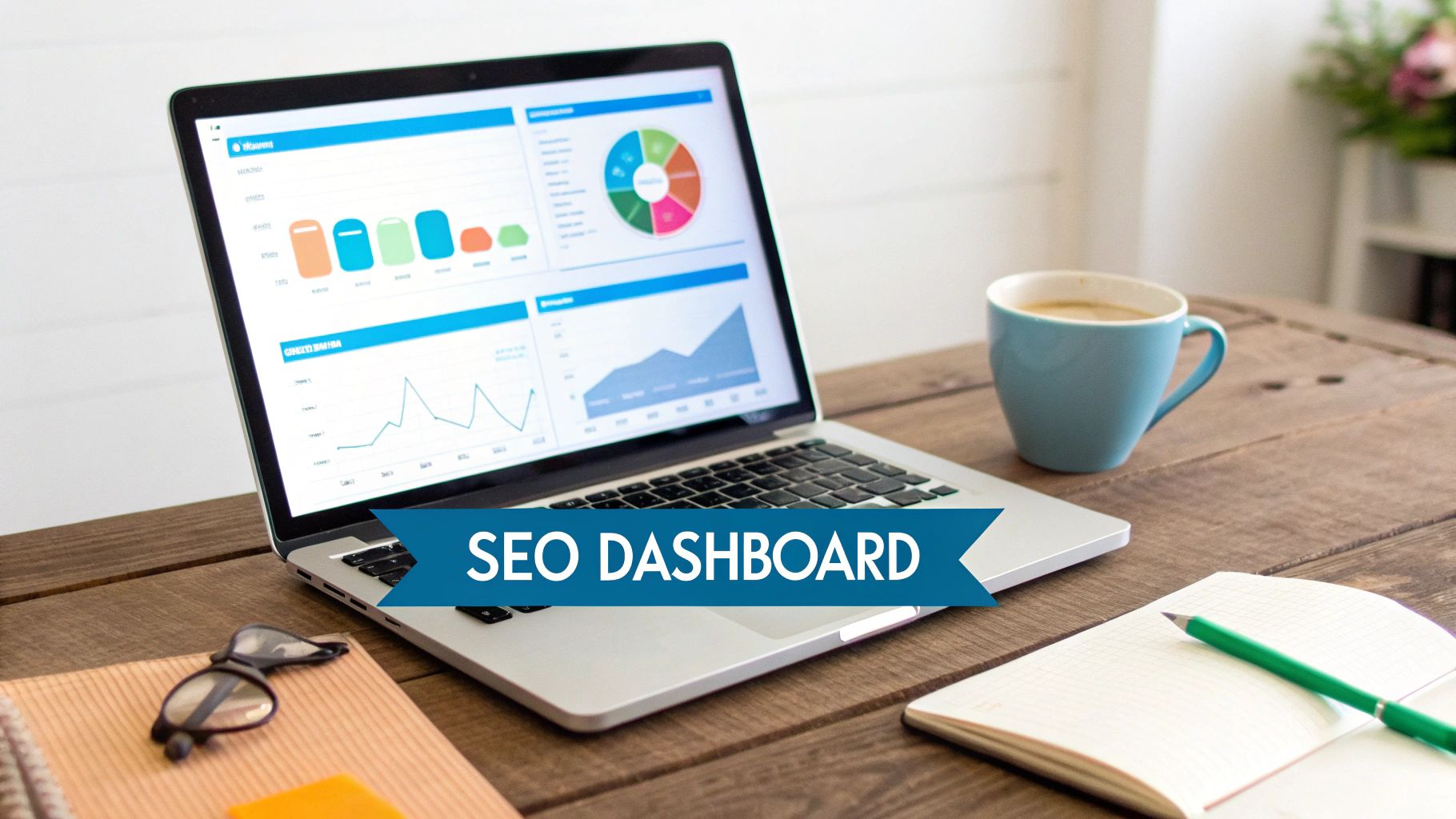
- Set Up Foundational Tools: The first step is to install and configure Google Analytics 4 to track website traffic, user behavior, and conversions (like form submissions or sales). You must also verify your site with Google Search Console to monitor impressions, clicks, keyword positions, and technical health issues.
- Track Keyword Rankings: Use tools like Semrush or SE Ranking to monitor your position in search results for your target keywords. Check this weekly or bi-weekly to spot trends, identify competitors, and measure the impact of your on-page and off-page optimizations.
- Establish a Reporting Cadence: Create a simple monthly report that summarizes key metrics. Focus on organic traffic growth, keyword ranking improvements, and most importantly, the number of leads or sales generated from organic search. This helps connect SEO activities directly to business revenue.
- Analyze and Adapt: Regularly review your data to find opportunities. Look for high-impression, low-click-through-rate keywords in Search Console that could benefit from a title tag update. Identify pages with high traffic but low conversions in Analytics that may need a stronger call-to-action.
10. Build and Maintain Authority Through E-E-A-T Signals
Building authority is a critical component of a modern small business SEO checklist. E-E-A-T, which stands for Experience, Expertise, Authoritativeness, and Trustworthiness, is a framework Google uses to evaluate the quality and credibility of your website. It’s about proving to both search engines and potential customers that you are a legitimate, knowledgeable, and reliable source in your industry. This is especially crucial for businesses in “Your Money or Your Life” (YMYL) sectors like finance, health, and law, where misinformation can have serious consequences.
Why It Matters
Google aims to provide users with the most reliable answers, and it rewards sites that demonstrate strong E-E-A-T signals with higher rankings. Neglecting this means you could be outranked by competitors who do a better job of showcasing their credibility, even if your product or service is superior. For a small business, strong E-E-A-T builds user confidence, which can directly translate into higher conversion rates. For instance, a local clinic showcasing its doctors’ credentials and patient testimonials is more likely to earn a new patient’s trust than a site with no background information.
How to Implement It
Your goal is to weave signals of your credibility throughout your entire online presence, making your authority undeniable to both users and search algorithms.
- Create Detailed ‘About Us’ and Author Pages: Go beyond a simple mission statement. Introduce your team members with professional photos, detailed biographies, and relevant credentials (e.g., certifications, degrees, years of experience). This shows the real people and first-hand experience behind your business.
- Showcase Social Proof and Credentials: Prominently display industry awards, professional certifications, accreditations, and positive customer testimonials. Create detailed case studies that highlight specific problems you solved and the results you achieved for clients.
- Generate Authoritative Content: Publish well-researched blog posts, whitepapers, or guides that demonstrate your deep expertise. Ensure articles, especially on YMYL topics, are written or reviewed by a qualified expert and include an author bio.
- Pursue External Validation: Earn mentions and links from reputable industry publications, partner with other respected businesses, and encourage experts to contribute to your site. Getting your business featured on a local news site or a well-known industry podcast can significantly boost your perceived authority.
- Be Transparent: Make your physical address, phone number, and privacy policy easy to find. Displaying trust badges, such as security seals or Better Business Bureau ratings, reinforces your trustworthiness.
Small Business SEO Checklist — 10-Point Comparison
1. Keyword Research and Planning
- Implementation Complexity: Low–Medium (analysis-focused)
- Resource Requirements: Keyword tools, analyst time
- Expected Outcomes: Targeted keyword map; prioritized opportunities
- Key Advantage: Identifies high-intent, low-competition opportunities
2. Optimize On-Page SEO Elements
- Implementation Complexity: Low (editorial + minor HTML)
- Resource Requirements: Content editor, SEO plugin/tools
- Expected Outcomes: Improved relevance & CTR; quicker ranking gains
- Key Advantage: Fast impact; improves SERP appearance
3. Create High-Quality, Keyword-Targeted Content
- Implementation Complexity: Medium–High (research & creation)
- Resource Requirements: Writers, subject experts, multimedia
- Expected Outcomes: Organic traffic growth; authority; multiple rank entries
- Key Advantage: Builds authority; repurposable assets
4. Build and Earn Quality Backlinks
- Implementation Complexity: High (outreach & PR)
- Resource Requirements: Outreach, PR, link-worthy content, tools
- Expected Outcomes: Higher domain authority; referral traffic; ranking boosts
- Key Advantage: Strong ranking impact; third-party credibility
5. Implement Local SEO Optimization
- Implementation Complexity: Low–Medium (process-driven)
- Resource Requirements: GBP management, citations, review management
- Expected Outcomes: Higher local visibility; more foot/phone leads
- Key Advantage: Dominates local pack; attracts nearby customers
6. Optimize Site Speed and Mobile Experience
- Implementation Complexity: Medium–High (technical)
- Resource Requirements: Developers, hosting, CDN, testing tools
- Expected Outcomes: Better rankings, lower bounce, higher conversions
- Key Advantage: Improves UX and Core Web Vitals; conversion lift
7. Fix Technical SEO Issues
- Implementation Complexity: Medium–High (audits & fixes)
- Resource Requirements: Developer access, auditing tools
- Expected Outcomes: Improved crawlability & indexing; fewer errors
- Key Advantage: Foundational fixes; prevents ranking blockers
8. Optimize for Search Intent and User Experience
- Implementation Complexity: Medium (strategy + design)
- Resource Requirements: Content strategist, UX/design, testing tools
- Expected Outcomes: Higher engagement, CTR, and conversions
- Key Advantage: Aligns content to user needs; improves conversions
9. Monitor, Measure, and Report SEO Performance
- Implementation Complexity: Low–Medium (ongoing)
- Resource Requirements: Analytics tools, reporting templates, analyst
- Expected Outcomes: Data-driven decisions; measurable SEO ROI
- Key Advantage: Reveals opportunities and issues; tracks ROI
10. Build and Maintain Authority Through E-E-A-T Signals
- Implementation Complexity: High (long-term brand work)
- Resource Requirements: PR, credentials, case studies, time
- Expected Outcomes: Stronger trust; improved rankings for sensitive topics
- Key Advantage: Resilience to algorithm changes; higher trust
Turn Your Checklist into Compounding Growth
You have now worked through a comprehensive small business SEO checklist, a roadmap designed to transform your digital presence from a passive brochure into an active, lead-generating machine. Completing these tasks is a significant achievement, but the real power of SEO isn’t found in a single, frenzied push. It’s cultivated through consistent, focused effort where each action builds upon the last, creating a powerful compounding effect.
Think of it this way: your initial keyword research informed your on-page optimizations. Those optimized pages now provide a stronger foundation for your content strategy. That high-quality content, in turn, makes earning backlinks and building E-E-A-T signals more natural and effective. Each item you checked off wasn’t an isolated task; it was a foundational block for the next, more advanced step.
From Checklist to Sustainable Strategy
The true secret to long-term SEO success is transforming this checklist from a one-time project into a recurring strategic framework. SEO is not a “set it and forget it” discipline. Google’s algorithms are constantly evolving, competitor strategies shift, and customer search behavior changes. Your approach must be just as dynamic.
Key Takeaways to Internalize:
- Consistency Over Intensity: A few hours dedicated to SEO each month will yield far greater results than an all-out, 40-hour blitz once a year. Consistency signals to search engines that your website is active, relevant, and a reliable source of information.
- User Experience is Paramount: From site speed and mobile-friendliness to matching search intent, every technical and on-page tweak ultimately serves one master: the user. A happy user who finds what they need quickly is a powerful ranking signal.
- Local SEO is Your Competitive Edge: For many small businesses, dominating the local map pack and localized organic results is more valuable than ranking for broad, national terms. Your Google Business Profile and local citations are non-negotiable assets in your marketing toolkit.
- Data-Driven Decisions Win: Don’t guess what’s working. Use Google Analytics and Google Search Console to track your progress, identify underperforming content, and double down on the strategies that are actually driving traffic and conversions.
Actionable Next Steps: Building Momentum
With the foundation laid, your journey is just beginning. The initial audit and implementation phase is crucial, but maintaining and expanding on that work is what separates stagnant websites from market leaders.
Your 90-Day Action Plan:
- Month 1: Review and Refine. Revisit your keyword list. Are there new opportunities? Check your Google Search Console for “low-hanging fruit” keywords where you rank on page two and create a plan to push them higher with internal links or content updates.
- Month 2: Content and Links. Publish at least two new, high-value blog posts or resource pages targeting specific customer pain points. Begin a modest link-building or digital PR campaign, perhaps by reaching out to a local blogger or sponsoring a community event.
- Month 3: Analyze and Adapt. Dive into your analytics. Which pages are driving the most organic traffic? Which content has the highest engagement? Use these insights to plan your next quarter’s content and promotional activities.
Embracing this small business SEO checklist is more than just a marketing tactic; it’s a commitment to building a resilient, long-term asset for your company. By consistently applying these principles, you are not just chasing rankings. You are methodically constructing a predictable and scalable pipeline of qualified leads, ensuring your business thrives in the digital landscape for years to come.
Feeling overwhelmed by the scope of a comprehensive SEO strategy? You don’t have to do it alone. The experts at Netco Design LLC specialize in implementing every item on this small business SEO checklist, turning complex technical tasks and strategic planning into measurable growth for your business. Let us handle the complexities of SEO so you can focus on what you do best: running your company.

