

table of contents
A solid small business SEO guide isn’t about trying to outsmart Google’s complex algorithms. It’s much simpler than that. It’s about making sure your business shows up when local customers are actively searching for what you sell.
Think of it like this: your website is your digital storefront. Without SEO, it’s like being tucked away on a quiet side street. With a good SEO plan, you move that storefront right onto the bustling main square, directly in the path of people ready to make a purchase.
Why SEO Is Your Most Powerful Marketing Tool
Search Engine Optimization (SEO) is hands-down the most effective way to attract a steady stream of high-quality customers. Unlike paid ads, which vanish the second you stop paying the bill, a smart SEO strategy builds on itself. The results compound over time, delivering long-term, sustainable growth.
But it’s not just about getting more website visitors; it’s about getting the right ones.
For a small business, that means connecting with people in your community who need exactly what you offer, right when they need it. When someone pulls out their phone and searches for “best plumber near me” or “local bakery St. Petersburg,” SEO is what decides if your business appears as the answer. It truly levels the playing field, letting you compete with bigger companies by focusing on your local expertise and customer service.
The infographic below breaks down the three core pillars that hold up any successful SEO strategy.
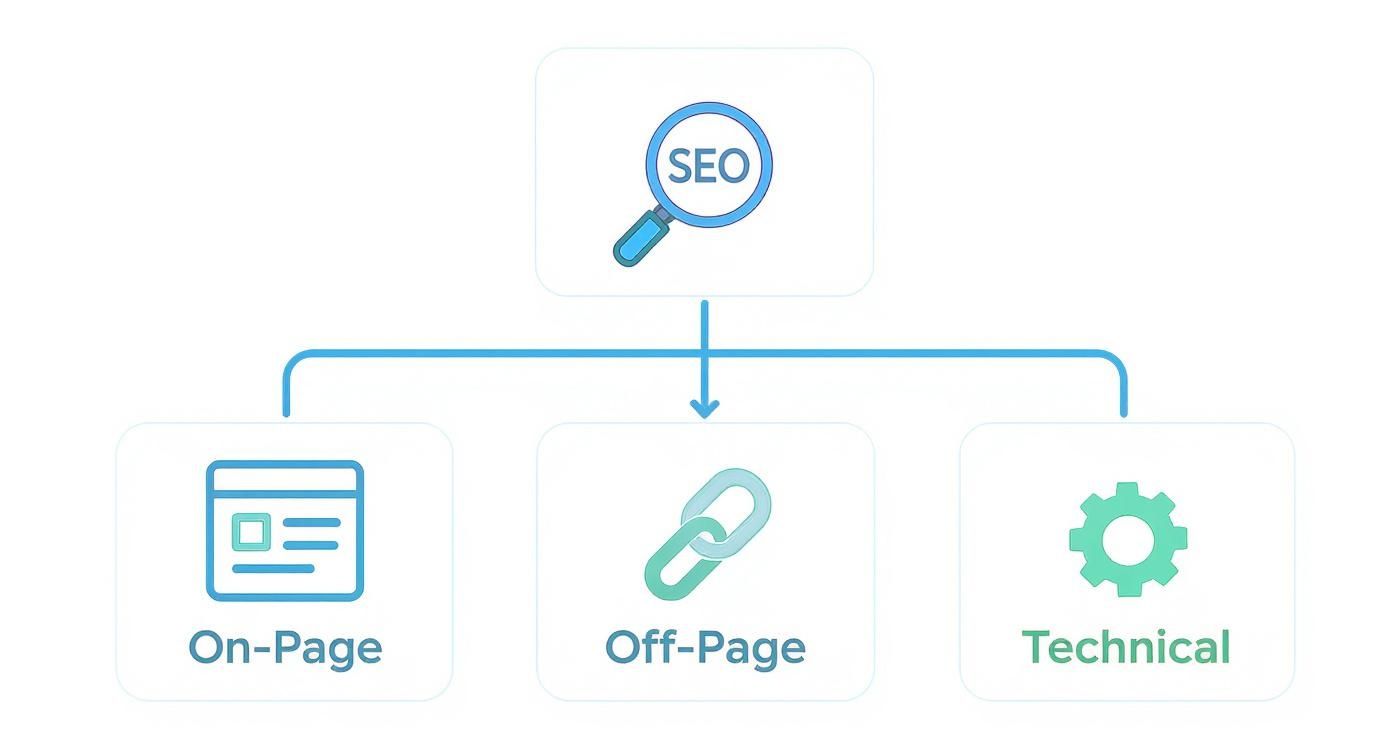
As you can see, a strong foundation is built on On-Page, Off-Page, and Technical elements all working in harmony.
The Three Pillars of Your SEO Foundation
To build a strategy that actually gets results and lasts, you need to understand these three core components. Each one plays a unique but connected role in how search engines see your website’s value and authority. Getting the basics right for each pillar is your first step toward climbing the search rankings.
Before we dive deep, here’s a quick look at how these pillars work together.
The Three Pillars of Small Business SEO
- On-Page SEO is everything happening on your website. This is the stuff you can log in and change right now—the quality of your blog posts and service pages, the keywords you’re targeting, your page titles, and how you use headings to structure your content.
- Off-Page SEO covers all the actions taken off your website to build its reputation. This is mostly about earning backlinks—links from other credible websites pointing to yours. Think of them as votes of confidence from around the internet.
- Technical SEO makes sure your website is built correctly behind the scenes so search engines can easily crawl, understand, and index it. This includes things like your site speed, how well it works on mobile phones, and its overall structure. It’s the functional backbone of your entire online presence.
When you focus on all three pillars, you create a powerful, holistic strategy. A technically sound, mobile-friendly site (Technical SEO) filled with genuinely helpful, keyword-focused content (On-Page SEO) that’s endorsed by other reputable local sites (Off-Page SEO) is the winning formula for long-term visibility.
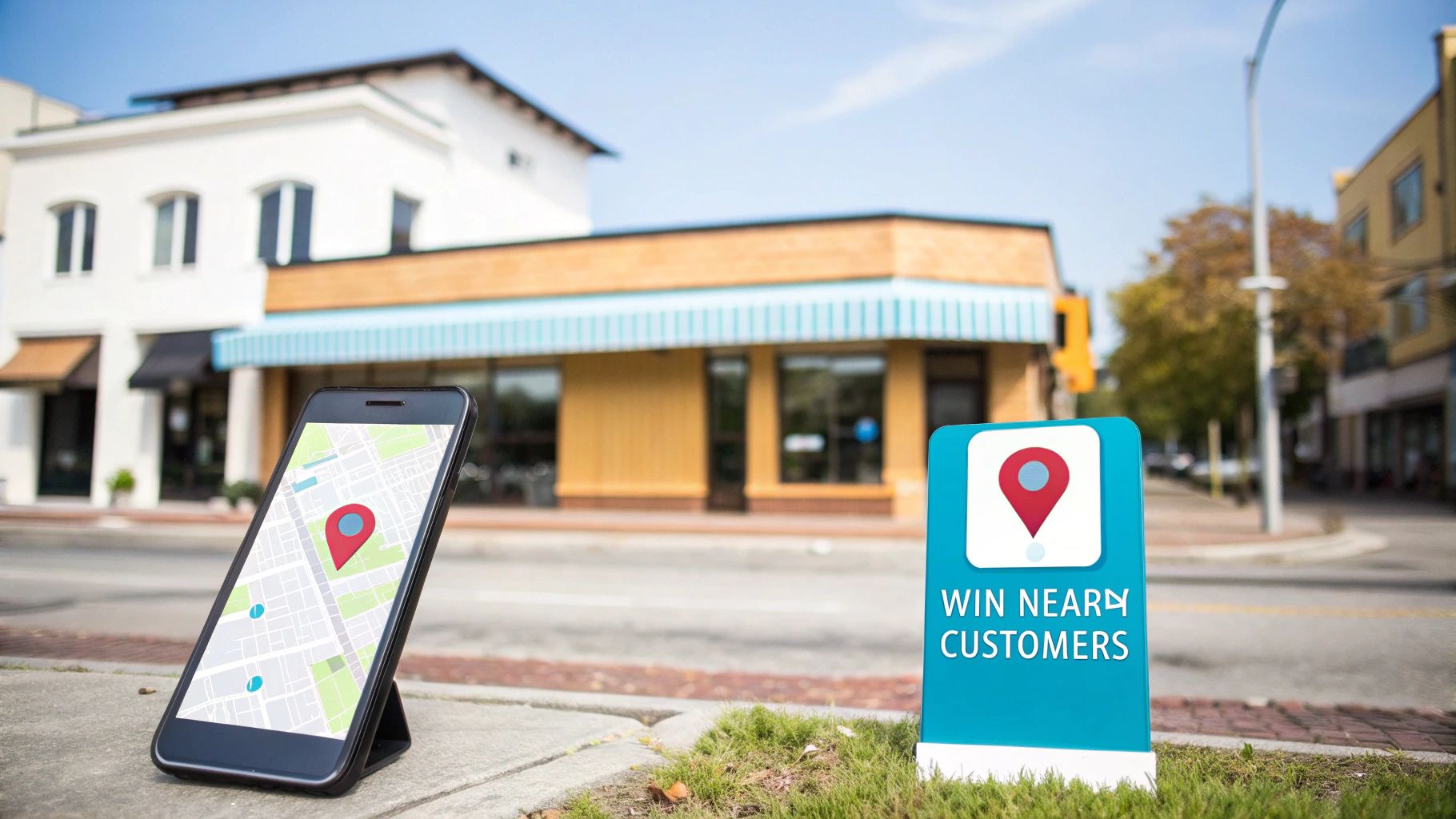
Dominating Local Search to Win Nearby Customers
For a small business, winning the neighborhood isn’t just a goal—it’s the entire game. Dominating local search means you show up at the exact moment a customer down the street needs what you offer. This is how you turn casual online searches into real foot traffic and paying customers.
Local SEO is the engine that drives this success. As of 2025, an incredible 78% of mobile local searches lead to an offline purchase within just 24 hours. Small businesses that land a spot in Google’s coveted Local Pack also see a 40% higher click-through rate than competitors who don’t make the cut. You can find more details in this in-depth analysis of small business SEO statistics.
This section goes beyond the basics and lays out an actionable strategy to make your business the top local choice.
Your Google Business Profile Is Your Digital Front Door
Your Google Business Profile (GBP) is hands-down the most critical tool in your local SEO toolbox. Think of it less like a simple listing and more like your digital storefront. For many, it’s the very first impression they’ll have of your business.
A fully fleshed-out profile doesn’t just list your hours; it actively pulls customers in. It’s your chance to show off what makes you special, build trust with reviews and photos, and make it ridiculously easy for someone to choose you over the competition.
The screenshot below shows the main dashboard where you’ll manage your business’s presence on Google.
This is your command center for everything from business hours and photos to customer reviews and special offers.
Turning Your Profile Into a Customer Magnet
Just having a profile isn’t enough. To really own your local search results, you have to put its features to work. An active, well-managed profile sends powerful signals to Google that your business is relevant, active, and trustworthy.
Here’s how to make your GBP work harder for you:
- Encourage and Respond to Reviews: Don’t be shy—ask your happy customers for reviews. More importantly, respond to every single one, good or bad. It shows you’re engaged and that you value what your customers have to say.
- Use Google Posts for Updates: Treat this feature like a mini-blog for your business. Share special offers, announce new products, highlight an upcoming event, or post a helpful tip. These posts show up right in your profile and tell Google your business is alive and kicking.
- Answer Questions in the Q&A Section: Get ahead of customer questions by answering them before they’re even asked. You can even “seed” this section by asking and answering your own common questions to provide crucial info upfront.
Your Google Business Profile is a living, breathing part of your online presence. Consistent updates, fresh photos, and active engagement with customers aren’t just “best practices”—they are direct ranking factors for local search visibility.
The Power of Consistent Business Information
Imagine giving a friend directions to a party but listing two different addresses. They’d get confused and probably frustrated, right? Search engines feel the same way when your business information is all over the place online.
This consistency is known as NAP (Name, Address, Phone number). Google wants to see the exact same NAP details for your business across various online directories like Yelp, Yellow Pages, and industry-specific sites. If the data is inconsistent, it erodes trust and can seriously tank your local rankings.
Creating Content for Your Neighborhood
To become a true local authority, you need to create content that speaks directly to your community. This proves to both search engines and customers that you’re invested in the area you serve. It’s an incredibly powerful way to build relevance for all those “near me” searches.
Consider these location-specific content ideas:
- Neighborhood-Specific Service Pages: Instead of one generic “Services” page, create pages like “Plumbing Services in Downtown St. Petersburg” or “Landscaping for South Tampa Homes.” Drop in local landmarks and street names to make it feel authentic.
- Community Involvement Blog Posts: Are you sponsoring a local little league team or partnering with another neighborhood business? Write about it! This builds goodwill and generates fantastic local signals.
- Local Case Studies or Testimonials: Feature stories from your local customers. A glowing review from someone down the street is far more compelling to a local searcher than a generic one.
By putting these strategies into action, you’ll be well on your way to climbing the local search rankings. For an even deeper dive, we’ve put together a list of local SEO best practices that provides more advanced techniques to get ahead of the competition.
Turning Your Website Into a Conversion Engine
A well-optimized website is your best employee, working 24/7 to impress both search engines and human visitors. Now that we’ve covered local visibility, it’s time to fine-tune the machine itself—your website. We’ll break down the essentials of on-page SEO and technical performance, simplified for business owners who need results, not jargon.
It all starts with getting inside your customers’ heads and understanding the exact words they type into Google. When you strategically weave those keywords into your site’s structure, you’re creating clear signposts that guide both Google and potential customers right to your doorstep.
Crafting Pages That Google Understands
On-page SEO is really just about organizing individual web pages so they can rank higher and pull in the right kind of traffic. Think of it like organizing the aisles in your digital store. If a customer is looking for “organic dog food,” you need a clear sign pointing them to the right place, not a confusing mess of products.
Your page titles, headings, and descriptions are those signs.
- Page Titles (Title Tags): This is the main headline people see in Google search results and at the top of their browser tab. It’s your most important piece of on-page real estate and should always include your main keyword.
- Meta Descriptions: This is the little blurb of text under your title in the search results. While it doesn’t directly impact rankings, a compelling description is what convinces someone to click on your link instead of your competitor’s.
- Headings (H1, H2, H3): These give your content structure, making it easy for people (and search engines) to scan. Your main heading (H1) should feature your primary keyword, while subheadings (H2s and H3s) can target related terms.
When you organize your content this way, you make it incredibly easy for Google to figure out what each page is about. This massively increases your chances of showing up for the right searches and is a cornerstone of any effective small business SEO guide.
Why Your Website’s Speed Is Non-Negotiable
Have you ever bailed on a website because it took forever to load? Your customers do it, too. A slow website is one of the fastest ways to lose a potential sale and tank your search rankings. Google’s main job is to give its users the best experience possible, which means prioritizing sites that are fast, stable, and easy to navigate.
This focus on user experience is measured by a set of metrics called Core Web Vitals.
These vitals look at three key parts of the user experience: how quickly your page loads (Largest Contentful Paint), how quickly someone can interact with it (First Input Delay), and whether things jump around on the screen as it loads (Cumulative Layout Shift). Passing these checks sends a powerful signal to Google that your site is a quality destination.
Getting these metrics right isn’t just a technical chore; it’s a direct investment in keeping visitors happy and turning them into customers. To get a head start, you can explore some practical Core Web Vitals performance tips to make sure your site is up to snuff.
Making Your Site Mobile-Friendly
I really can’t overstate the importance of a mobile-first mindset. Small business websites have come a long way, with 73% now having an online presence. But here’s the kicker: a massive 84% of visitors prefer mobile-friendly sites. It makes sense when you consider that 60% of all global searches happen on mobile devices. The reward is clear, too—businesses that get mobile right see a 32% higher conversion rate than those that don’t.
A mobile-friendly site isn’t just your desktop version shrunk down. It’s an experience designed specifically for a smaller screen.
- Responsive Design: Your website needs to automatically adjust its layout to look great on any device, from a huge monitor to a small smartphone.
- Readable Text: Fonts should be big enough to read comfortably without pinching and zooming.
- Tap-Friendly Buttons: Links and buttons need to be spaced out so they’re easy to tap with a thumb.
This is no longer a “nice-to-have”—it’s a requirement for modern SEO. Google now primarily uses the mobile version of a site for indexing and ranking (a policy called mobile-first indexing). If your site is clunky on a phone, your rankings will take a hit across the board.
Creating Content That Solves Customer Problems
If there’s one thing to get right in your SEO strategy, it’s your content. It’s the engine that builds trust, proves you know your stuff, and ultimately convinces customers you’re the best choice. This isn’t about churning out random blog posts; it’s about becoming the go-to resource in your area by consistently answering your customers’ most pressing questions.
Think of your website as a library of solutions. Each piece of content is a book helping someone solve a very specific problem. A homeowner doesn’t just search for “landscaper.” They search for things like “how to fix brown spots in my lawn” or “best drought-resistant plants for Florida.” Your job is to write the exact book that answers that question.
When you do this, your marketing stops feeling like a sales pitch and starts feeling like a genuine service. By solving problems for free, you build a foundation of trust that makes people think of you first when they’re finally ready to pull out their wallet.
Finding Your Customers’ Real Questions
The best content ideas don’t come from a brainstorming session—they come from listening. Before you write a single word, you need to uncover the real pain points and questions your audience has. The good news is, your customers are leaving clues everywhere.
You can find a goldmine of content ideas by paying attention to a few key places:
- Your Own Inbox: What are the top five questions you get from customers every single week? Every one of those is a fantastic blog post waiting to be written.
- Customer Reviews: Sift through your reviews (and your competitors’!). What problems do people keep bringing up? What features do they rave about?
- Google Search Suggestions: Start typing a question related to your industry into Google and watch what it auto-suggests. These are real queries from real people.
The goal is to shift your mindset from “What do I want to sell?” to “What does my customer need to know?” When you make that switch, you stop chasing traffic and start attracting loyal followers.
Focusing on real-world problems is a cornerstone of any solid small business SEO guide. Why? Because truly helpful content naturally earns both visitors and links over time, without you having to force it.
Turning Insights Into Authoritative Content
Once you’ve got a list of customer problems, it’s time to create the solutions. Your content should be practical, easy to follow, and get straight to the point. And don’t feel locked into writing standard blog articles; mixing up your formats keeps your audience engaged and coming back for more.
Try building a library of these helpful assets:
- How-To Guides: Create simple, step-by-step instructions. A plumber could write a guide on “How to Fix a Leaky Faucet in 5 Simple Steps.”
- Checklists: These are perfect for breaking down complex processes. A wedding planner might offer a “Printable 12-Month Wedding Planning Checklist.”
- Local Event Highlights: Show your community spirit by writing about local events you’re sponsoring or attending. This builds local relevance and shows you’re a real part of the community.
- Case Studies: Walk through how you helped a local customer solve a tricky problem. This is powerful social proof that shows your expertise in action.
Each piece of content should do more than just solve a problem; it should subtly reinforce that your business is the expert. You can also give Google a helping hand in understanding your content by using structured data. To see how that works, check out our simple guide to Schema markup—it explains how to communicate key business details directly to search engines.
Ultimately, your content strategy should be built around one simple idea: be the most helpful business in your local market. When you consistently provide value, you create a powerful asset that pays you back in customer loyalty and search rankings for years to come.
Building Trust Through Links and Local Partnerships

Think of every link pointing to your website from another respected site as a vote of confidence. In the world of SEO, these links—called backlinks—are digital endorsements. When Google sees other credible local businesses or news outlets linking to you, it’s a powerful signal that you’re a trustworthy player in your field.
This whole process is called link building, but don’t let the term scare you. For a small business, it’s not about technical wizardry; it’s about building genuine relationships in your community. Our small business SEO guide is all about realistic strategies you can actually use, with a focus on quality over quantity. Trust me, one solid link from a respected local source is worth more than a hundred spammy ones from sites nobody’s ever heard of.
Earn Links by Engaging with Your Community
The best backlinks are the ones you earn, not the ones you buy. They happen naturally when you’re an active, valued member of your local scene. So instead of chasing links, focus on creating opportunities for them to come to you. This approach not only boosts your search rankings but also builds your real-world reputation.
You can start earning these powerful endorsements right in your own backyard.
- Sponsor a Local Event: Getting behind a neighborhood festival, a charity 5k, or a little league team usually gets your business name and a link on the event’s website. It’s a fantastic way to get seen and show you care about your community.
- Partner with Other Local Businesses: Find a non-competing business and team up on a joint promotion. A local gym could easily partner with a nearby health food store. You can promote each other on your websites, creating relevant backlinks that make perfect sense to Google.
- Host a Workshop or Free Class: Share what you know! A local accountant could offer a free “Small Business Tax Tips” workshop, which could get picked up by local business groups and community calendars—all of which might link back to your site.
A strong backlink profile is built on real-world connections. Every local partnership, sponsorship, or community engagement is a potential opportunity to earn a digital “vote of confidence” that tells Google you are a legitimate and respected business.
Leverage Local Media and Directories
Local news sites, bloggers, and online directories are always looking for stories and reliable businesses to feature. A mention from one of these sources can send a flood of positive signals to search engines and put your business in front of a whole new audience.
Start by making a quick list of local media outlets. This could be your city’s newspaper, popular neighborhood blogs, or even industry-specific publications in your area.
Once you have your list, try these simple outreach tactics:
- Share Your Expertise: Let local reporters know you’re available to comment on stories related to your industry. A quick quote in an article can land you a powerful backlink.
- Submit to Local Directories: Make sure you’re listed in reputable local directories like your Chamber of Commerce or industry-specific associations. These are often high-authority sites that can give your local credibility a serious boost.
- Announce Something Newsworthy: Did you just win an award, hire a key new employee, or celebrate a big anniversary? Write a brief press release and send it over to local journalists. Your news could easily become their next story.
Tracking Your SEO Results and Planning for Growth
So, how do you know if all this hard work is actually paying off? SEO isn’t a “set it and forget it” game. It’s about making smart, data-backed adjustments over time. This is where you put on your detective hat, cut through the noise, and zero in on the numbers that really move the needle for your business.
Measuring your results is the only way to prove the value of your SEO efforts and make smarter decisions for the future. Without tracking, you’re just guessing. Let’s shine a light on how to do it right.
Your Essential SEO Toolkit
You don’t need a bunch of expensive software to get started. Google gives you two incredibly powerful—and completely free—tools that provide all the data you need. Think of them as the dashboard for your website’s engine.
- Google Search Console (GSC): This is your direct line to Google. It tells you which keywords people are using to find you, how often your site shows up in search, and if any technical gremlins are holding you back.
- Google Analytics (GA4): This tool picks up where GSC leaves off, showing you what happens after someone clicks on your site. You can see how many people are visiting from search engines, which pages they love, and how long they stick around.
These two work together beautifully, giving you the full story from the initial search all the way to their on-site behavior.
Focusing on Metrics That Matter
It’s easy to get lost in a sea of data. To keep things simple and effective, you need to focus on a few key performance indicators (KPIs) that tie directly back to your business goals. These are the numbers that tell you if you’re attracting more of the right customers.
The game has definitely gotten more competitive for small businesses. But those who invest in SEO are still seeing huge returns—many achieve over a 400% ROI within two years. Why? Because organic search drives more than half of all website traffic, and 75% of searchers never click past the first page. People trust organic results. You can dig into more data on the best SEO company services for small businesses on firstpagesage.com.
Key Performance Indicators to Track
To get a clear picture of your progress, you should be monitoring these core metrics every single month. This simple checklist is the heart of any effective small business SEO guide when it comes to measurement.
- Organic Traffic: This is simply the number of visitors who find your site through a search engine like Google, not from paid ads. A steady climb here is the clearest signal that your SEO is on the right track.
- Keyword Rankings: Keep an eye on the search positions for your most important keywords. Are you moving up from page three to page one for “local plumber St. Petersburg”? This shows your content and optimization work are hitting the mark.
- Click-Through Rate (CTR): You’ll find this in Google Search Console. It shows the percentage of people who saw your website in the search results and actually clicked it. A higher CTR means your page titles and meta descriptions are grabbing attention and doing their job.
- Conversions: This is the big one—the ultimate goal. A conversion is any valuable action you want a visitor to take, like making a phone call, submitting a contact form, or completing an online sale. Tracking conversions from your organic traffic is how you prove that SEO is directly generating leads and revenue.
Common Questions About Small Business SEO
Diving into the world of SEO can feel a little overwhelming, especially when you’re already juggling the demands of running a business. Let’s clear up some of the most common questions we hear from small business owners. My goal here is to cut through the jargon and give you the confidence to get started.
A question I get all the time is, “Can I really compete with the big guys?” The answer is a definite yes. SEO is the great equalizer, especially when it comes to local search. For a local customer, your relevance and proximity often matter way more than a big national brand name. This is a core idea in any effective small business SEO guide.
How Long Does It Take to See SEO Results?
This is probably the number one question on every business owner’s mind. The honest answer? It depends. SEO is a marathon, not a sprint. While you might see some small wins early on, you should plan on seeing truly meaningful results within four to six months of consistent work.
A few things can speed up or slow down that timeline:
- How Competitive Your Market Is: A local plumber in a small town will probably see results faster than a boutique hotel in a city swarming with tourists.
- Your Website’s History: A brand-new site is starting from scratch and will take longer to build authority than an older site with a good track record.
- How Consistent You Are: SEO loves consistency. Publishing content regularly and earning new links will make a huge difference in how quickly you see progress.
Think of SEO like planting a garden. You don’t get a harvest the day after you plant the seeds. It takes consistent watering (content), good soil (technical SEO), and plenty of sunshine (backlinks) for it to grow strong and eventually produce a crop.
Can I Do SEO Myself?
Absolutely. Many small business owners handle their own SEO with great success, particularly at the local level. The key is to start with the fundamentals we’ve covered in this guide. Focus on optimizing your Google Business Profile and creating genuinely helpful content for your local community.
But it’s also important to be realistic about your time and expertise.
When Should I Consider Hiring an Expert?
While DIY SEO is totally doable, there often comes a point where bringing in a professional can seriously accelerate your growth. It might be time to call in an expert if:
- You Just Don’t Have the Time: Your main job is running your business. If SEO keeps getting pushed to the bottom of your to-do list, it’s a sign to delegate it to someone who can give it the focus it needs.
- You’ve Hit a Wall: Maybe you saw some good results early on, but now things have stalled. If you’re not sure what to do next to keep growing, an expert can bring a fresh perspective and a new strategy.
- You’re Dealing with Tricky Technical Problems: Issues like a slow-loading site, penalty warnings, or pages not showing up in Google can be complex. These often need specialized knowledge to diagnose and fix properly.
At the end of the day, investing in SEO is investing in a long-term, sustainable way to bring new customers through your door.
Ready to stop guessing and start growing? The team at Netco Design LLC specializes in creating custom SEO strategies that drive real-world results for small businesses. We handle the technical details so you can focus on what you do best. Get in touch with us today for a free consultation!

